










Dhaniya


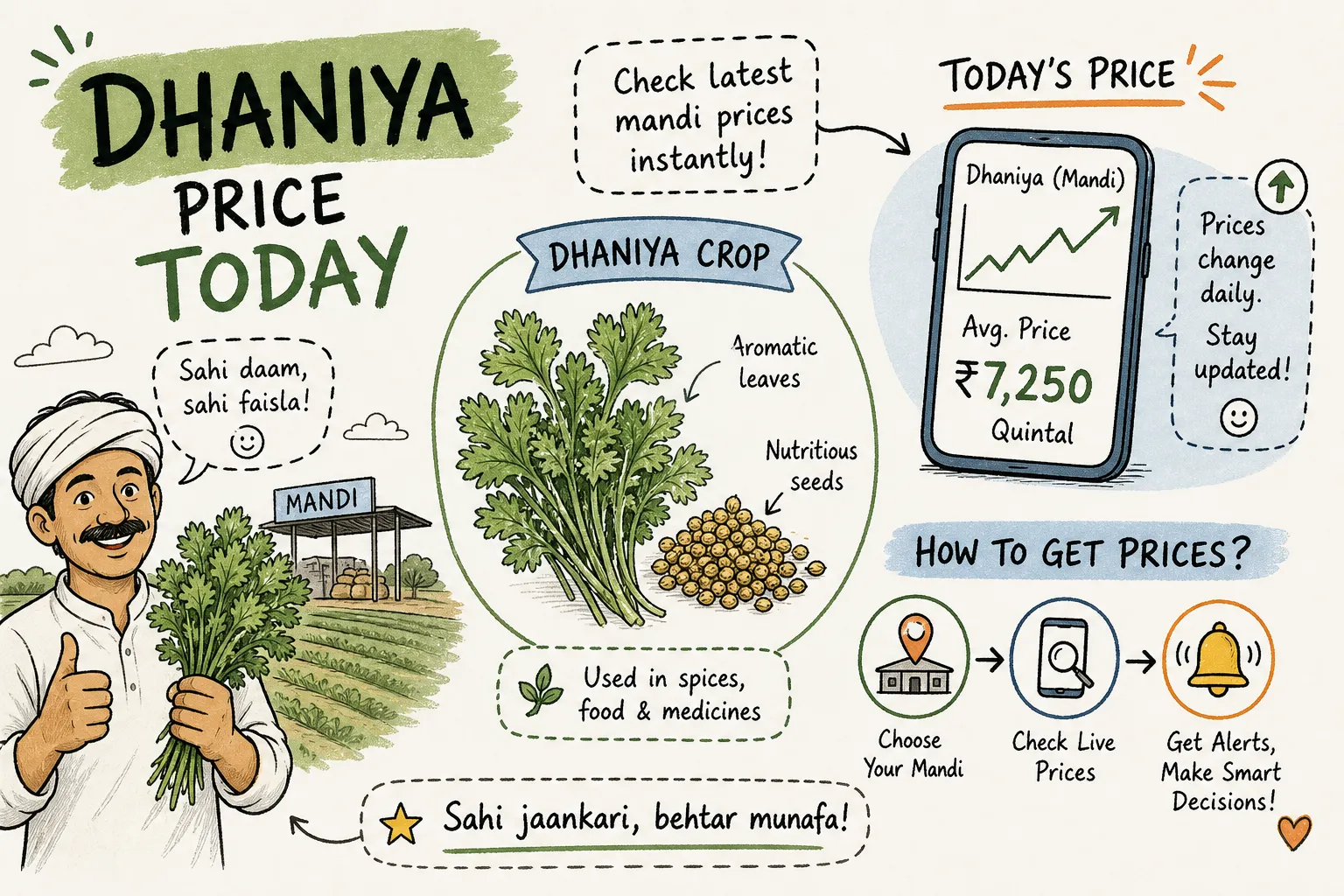
Dhaniya: All Prices Are in Quintal
Description
Dhaniya bhav (coriander price) is holding firm across major Rajasthan mandis right now, and the reasons are worth understanding before you decide to sell your stock. This article gives you the current coriander rates picture for Ramganj, Kota, and Jodhpur, explains what is driving prices up, and helps you decide whether to hold or sell your sabut dhaniya. Before you load your trolley and drive to the mandi, check live dhaniya mandi rates on KhetiKisaan from your phone. Knowing the rate before you arrive saves fuel, avoids bad-timing losses, and gives you negotiating power at the gate.
What dhaniya is and why dhaniya bhav moves so sharply
Sabut dhaniya vs hara dhaniya: two very different markets
There are two distinct dhaniya markets in India, and they behave very differently. Sabut dhaniya (dried coriander seeds) is the commodity traded in bulk at APMC mandis and on NCDEX futures; this is what most farmers in Rajasthan, Madhya Pradesh, and Gujarat produce for commercial sale. Hara dhaniya (fresh green coriander leaves) is a perishable sold at local vegetable markets and reacts to entirely different demand cycles, hara dhaniya rates are driven by seasonal kitchen demand, not by export buying or futures spreads. This article is about sabut dhaniya, the crop that earns you the big mandi income.
The main producing districts for sabut dhaniya are Kota, Baran, and Jhalawar in Rajasthan; Guna and Vidisha in MP; and Unjha in Gujarat, which is one of the country's largest wholesale hubs for coriander. When Unjha sneezes, every mandi in Rajasthan catches a cold; that is how central it is to national price discovery.
Why coriander price reacts faster than most other spice crops
Coriander seeds price reacts sharply to three factors that often move together: rabi acreage, monsoon-season carry-over demand, and spice exporter buying cycles. India is one of the world's largest producers and exporters of coriander seeds, so any domestic supply tightness quickly prompts international buyers to accelerate their orders. Because the crop is grown across a relatively compact rabi window and storage outside cold facilities degrades quality, even a modest acreage shortfall can translate into a disproportionately large price swing at the mandi within a single season. That is precisely the pattern visible in the market right now.
Today's dhaniya bhav in Rajasthan mandis
Ramganj Mandi is one of Rajasthan's largest and most influential coriander markets. What clears at Ramganj by 10 AM sets the tone for district-level trades across the state. The rates below are indicative of the current session; verify live auction prices on KhetiKisaan before travelling.
Note: Kota and Jodhpur APMC rates are updated session to session. Check live dhania aaj ka bhav on KhetiKisaan 's mandi pages for the most current figures before you travel. Mandi rates can move ₹200, ₹500/quintal in a single session, so timing matters. Grade quality also matters significantly: Eagle-grade dhaniya can command a sizeable premium over common grade at the same mandi on the same day, sometimes well above ₹1,000/quintal, so always declare your grade accurately at the auction.
What NCDEX dhaniya futures are telling you
When the futures price sits significantly above your local spot mandi rate, it signals that the market expects prices to stay firm or rise further. A spread of ₹500/quintal or more between the NCDEX rate and your local mandi rate is a practical signal that holding stock in proper storage may be worth considering.
What's pushing dhaniya bhav up right now
Tighter supply: lower sowing and weather damage
Rabi 2025-26 coriander acreage in Rajasthan and MP fell by approximately 10, 12% compared to the previous season, directly reducing the harvestable crop volume. (State agriculture department estimates, Rabi 2025-26) On top of this, heatwave conditions during the maturation phase lowered seed quality and weight in parts of Rajasthan, while heavy rainfall disrupted supply chains out of Nashik, a secondary growing zone. The combined effect is that daily arrivals at Ramganj and major Kota mandis are running below seasonal norms, keeping warehouse and cold storage stocks tight across the board.
Export pull from Middle East and Southeast Asia
Indian coriander seeds are in active demand from Malaysia, UAE, Saudi Arabia, and Nepal. India exported 52,006 tonnes worth USD 67.33 million in the first ten months of 2025-26 (April 2025, January 2026), with April, September 2025 (H1 2025-26) volumes up 11% year-on-year. (Source: APEDA export data, 2025-26) When export orders are strong, large spice processors and exporters enter the mandi competitively, bidding up coriander wholesale price and absorbing stock that would otherwise cap rates. This external demand functions as a price floor: even when domestic consumption softens slightly, export buyers step in and keep dhaniya bhav supported.
Hold or sell your dhaniya stock: reading the signals correctly
Clear signals that now is the right time to sell
Consider selling your stock if you see any of these conditions. Spot mandi rates are near or above the NCDEX futures level, meaning the forward premium has collapsed. Fresh arrivals are building up rapidly at Unjha (Gujarat), signalling new crop is entering the system. Your storage is non-climate-controlled and quality erosion is becoming a real cost, quality loss in uncontrolled storage rarely shows up in farmer calculations until it is too late and the buyer knocks off ₹500, ₹800/quintal at weighment.
When holding makes financial sense
If the NCDEX futures price trades meaningfully above your local spot rate, a spread of ₹500/quintal or more, holding for 30, 45 days in proper cold storage is financially justified. The current supply tightness driven by lower acreage will not reverse quickly: new crop is months away. Export buying cycles also tend to intensify in October, November ahead of festive demand in key international markets, which historically lifts sabut dhaniya rates further. Set your price target before you store, not after. Farmers who wait for the absolute peak usually miss it.
Final take: dhaniya bhav is strong, but act on a plan
Dhaniya bhav is elevated and fundamentally supported right now, but the window for premium prices depends on when new arrivals build momentum and whether export demand holds through October. Farmers with reliable cold storage and comfortable holding margins should consider waiting till October; those with storage constraints should take advantage of current coriander rates rather than gambling on a further rise. Use the NCDEX spread and daily arrival data on KhetiKisaan to make that call with numbers, not guesswork.
Prices can move ₹200, ₹500/quintal in a single session, and one well-timed decision can add thousands of rupees to your final income from the fasal. Checking dhania aaj ka bhav on KhetiKisaan before you reach the mandi gate is the simplest, most accessible advantage available to every kisaan today, use it every time.
| Mandi | Price | Date |
|---|---|---|
| Neemuch MP | 13,050.00/- | 02 Oct, 2026 |
| Mandsaur MP | 14,040.00/- | 02 Oct, 2026 |
| Indore MP | 13,000.00/- | 01 Oct, 2026 |
| Ujjain MP | 13,050.00/- | 01 Oct, 2026 |
| Ratlam MP | 14,020.00/- | 01 Oct, 2026 |
| Kota | 14,075.00/- | 02 Oct, 2026 |
| Ramganjmandi | 14,000.00/- | 01 Oct, 2026 |
| Baran | 14,000.00/- | 01 Oct, 2026 |
| Bundi | 13,000.00/- | 01 Oct, 2026 |
| Kawai | 14,020.00/- | 01 Oct, 2026 |
| Kalapipal MP | 14,020.00/- | 01 Oct, 2026 |
| Shamgarh MP | 14,901.00/- | 01 Oct, 2026 |
| GanjBasoda MP | 14,000.00/- | 01 Oct, 2026 |
| Nimbahera | 13,900.00/- | 01 Oct, 2026 |
| Guna | 13,500.00/- | 01 Oct, 2026 |
| Osian | 14,553.00/- | 01 Oct, 2026 |
| Kekadi | 14,020.00/- | 01 Oct, 2026 |
| Rajkot GJ | 13,500.00/- | 01 Oct, 2026 |
| Bari MP | 14,020.00/- | 01 Oct, 2026 |
| Jaora MP | 14,000.00/- | 01 Oct, 2026 |
| Sheopur MP | 13,560.00/- | 30 Sep, 2026 |
| Kawai Salpura | 13,058.00/- | 01 Oct, 2026 |
| Atru | 14,020.00/- | 01 Oct, 2026 |
| Chhabra | 12,380.00/- | 01 Oct, 2026 |
| NaharGarh | 13,800.00/- | 01 Oct, 2026 |
| Samraniyan | 14,000.00/- | 01 Oct, 2026 |
| Bhawani Mandi | 14,023.00/- | 02 Oct, 2026 |
| Jhalarapatan | 11,000.00/- | 01 Oct, 2026 |
| Khanpur | 12,900.00/- | 01 Oct, 2026 |
| iklera | 14,000.00/- | 01 Oct, 2026 |
| itawa | 13,050.00/- | 01 Oct, 2026 |
| Jodhpur | 15,000.00/- | 02 Oct, 2026 |
| Pratapgarh | 13,058.00/- | 02 Oct, 2026 |
| Chhotisadri | 11,905.00/- | 02 Oct, 2026 |
| Viramgam GJ | 8,080.00/- | 01 Oct, 2026 |
| Gondal GJ | 14,901.00/- | 01 Oct, 2026 |
| Upleta GJ | 14,020.00/- | 01 Oct, 2026 |
| Mahuva GJ | 16,000.00/- | 01 Oct, 2026 |
| Taleja GJ | 15,030.00/- | 01 Oct, 2026 |