








1509 Dhaan

1509 Dhaan: All Prices in Quintal
Description
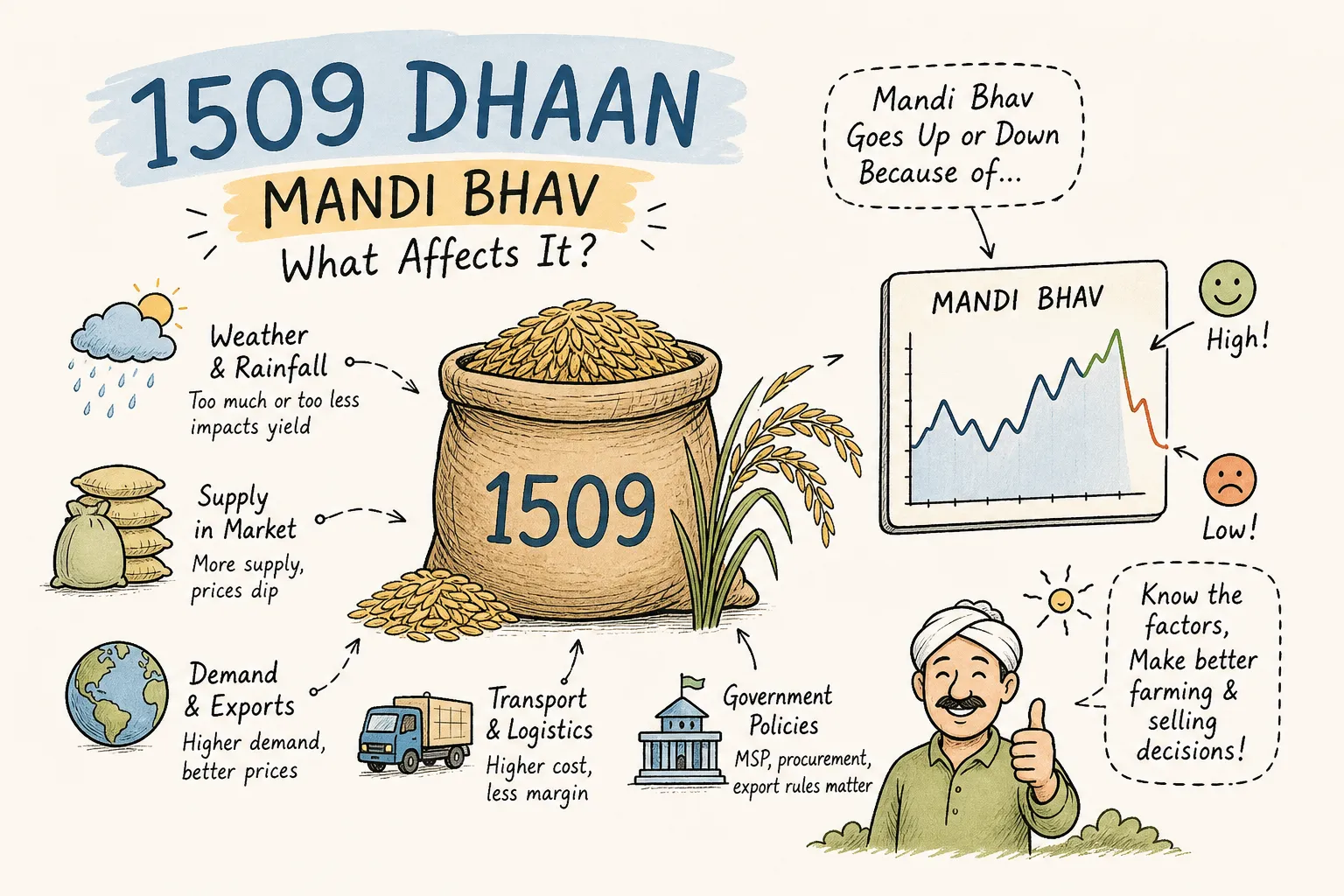
This 1509 dhaan crop description and what affects its mandi bhav covers everything a serious seller needs: agronomy, grain quality benchmarks, and the market forces that push prices up or down each season. 1509 Dhaan is a widely cultivated and traded basmati paddy variety across North India's APMC mandis, yet most farmers selling it have only a rough idea of why the rate posted at one mandi on a Tuesday morning differs from what their neighbour received at a different yard the same week. Understanding 1509 as a variety, its agronomic strengths, its grain quality benchmarks, and what market forces move its mandi bhav (market price) are two separate things. Both matter equally when you are deciding whether to sell today, store for a few weeks, or drive to a different mandi entirely.
This guide covers both. First, a clear crop profile so you know exactly what you are growing and why buyers value it. Second, a practical breakdown of the six main factors that push 1509 Dhaan mandi bhav up or down from one season to the next. Before you load your fasal (harvest) onto a trolley, check today's live 1509 Dhaan rates across multiple APMC yards on KhetiKisaan . It takes two minutes, and checking multiple mandis can help you find better rates on the day you sell.
| Parameter | Detail |
|---|---|
| Variety name | Pusa Basmati 1509 (PB 1509) |
| Maturity duration | 115, 120 days |
| Average yield | 4.25, 5.0 t/ha (up to 6.5 t/ha under optimal conditions) |
| Grain type | Extra-long slender basmati |
| Primary growing states | Punjab, Haryana, western Uttar Pradesh |
| Key export markets | Saudi Arabia, Iraq, Iran, UAE, Yemen |
1509 Dhaan crop description: what makes it stand out among basmati varieties
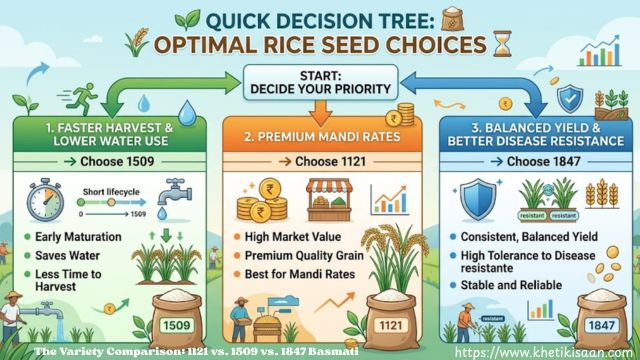
1509 Dhaan is an early-maturing, semi-dwarf basmati developed to address two problems that older basmati varieties carried: long growing duration and high water consumption. Its early-maturity and lower water requirement have made it attractive in areas where groundwater is stressed, and it has since become a dominant kharif crop across Punjab, Haryana, and western Uttar Pradesh for very practical reasons.
Plant characteristics and maturity window
The plant stands at roughly 95, 100 cm, shorter than traditional basmati varieties, with a sturdy stem that resists lodging even in wind and rain. The non-shattering habit means grain loss at harvest is minimal. The critical commercial advantage is its 115-day maturity cycle, which makes it approximately 30 days earlier than Pusa Basmati 1121. That one month of difference is not a minor detail. It frees the field for the rabi wheat sowing window, which directly protects a farmer's annual income from two separate crops rather than one.
Water and input efficiency
Early harvest allows farmers to save 3, 6 irrigations per crop cycle. In states like Punjab and Haryana where groundwater depletion is a serious long-term concern, this reduction in water use is financially significant. Fewer irrigations mean lower electricity or diesel costs, less wear on pump sets, and a smaller per-acre input bill. For small and marginal kisaans (farmers) managing 2, 5 acres, these savings accumulate meaningfully across a season.
Yield potential under field conditions
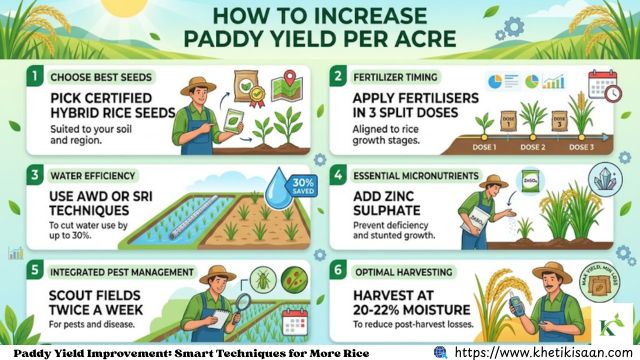
Under typical field conditions, expect 4.25, 5.0 t/ha. With proper water management, timely transplanting, and balanced nutrition, yields of 5.0, 6.0 t/ha are achievable. Demonstration plots have shown up to 6.5 t/ha, but that figure reflects controlled conditions. Plan your input budget around the 4.5, 5.0 t/ha range as a realistic working benchmark, and treat anything above that as a bonus.
Grain quality traits that matter at the mandi
Grain quality is the most variable factor between two 1509 lots offered on the same day in the same mandi. Two farmers can grow the same variety on adjacent fields and fetch prices that differ by ₹100, ₹200/quintal purely because of quality differences visible to the buyer during bidding, and larger differentials are possible in competitive markets where aroma or moisture problems are evident. Knowing what buyers actually look for gives you control over a significant part of your price realisation.
Grain dimensions and cooking characteristics
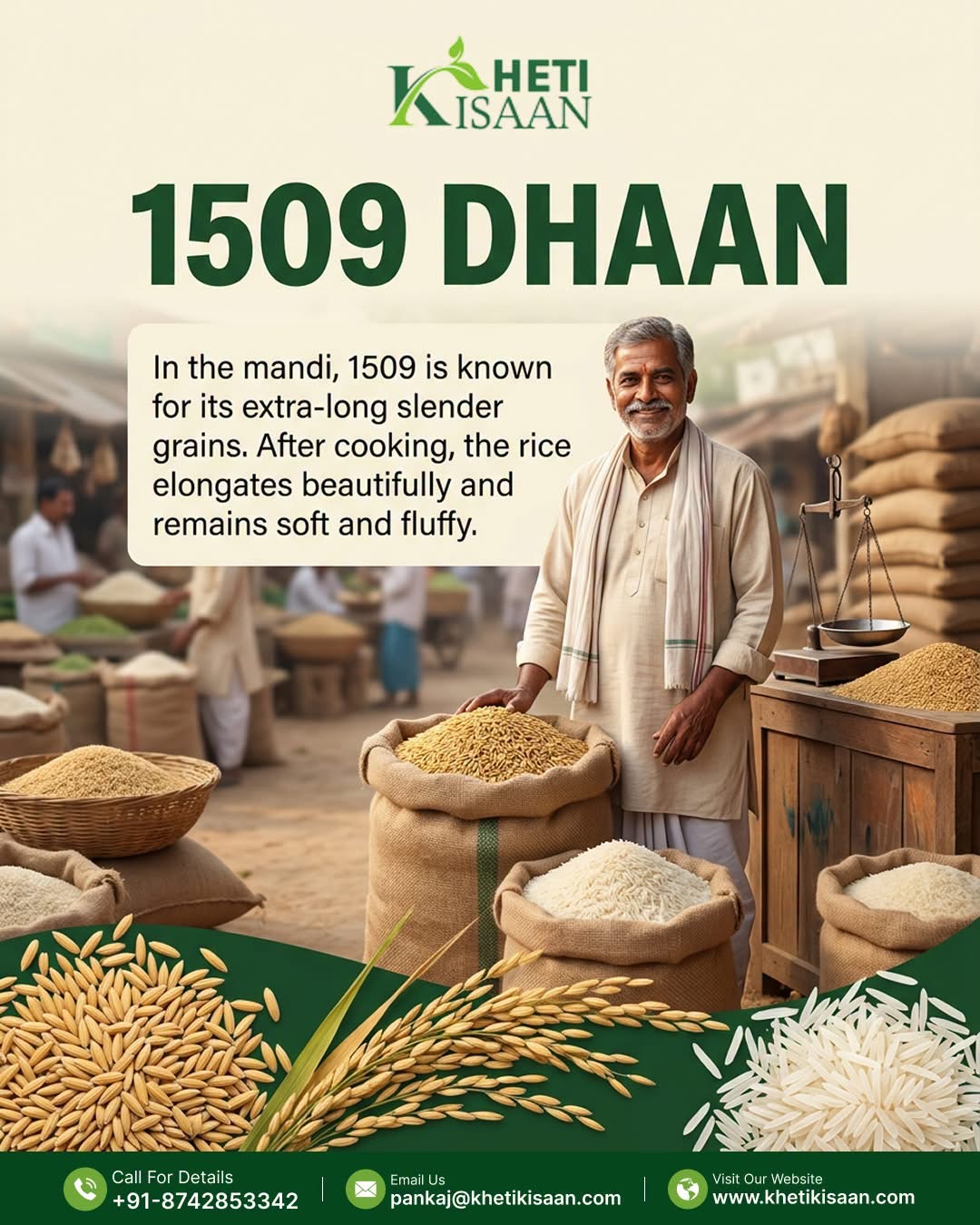
1509 Dhaan produces an extra-long slender grain with a raw kernel length of approximately 8.0, 8.4 mm. After cooking, the grain elongates to around 18, 19 mm, nearly doubling in length. This roughly 2× elongation ratio is the trait that basmati exporters specifically verify before placing an order. Buyers from Saudi Arabia, Iraq, and the UAE are paying for this characteristic appearance and texture; if your lot does not deliver it consistently, the price offered will reflect that.
Aroma and amylose content
1509 Dhaan carries the classic basmati aroma that is non-negotiable for export buyers. Intermediate amylose content of around 21% produces non-sticky, soft, separate grains after cooking, precisely the texture that Middle East consumers pay a premium for. Aroma is not just a marketing term; it is a verifiable quality attribute that millers and exporters assess at the time of purchase, and lots that have lost aroma through poor harvesting or post-harvest handling trade at a clear discount.
Where quality can deteriorate in the field
Harvesting 1509 Dhaan late, particularly when temperatures are still high, degrades aroma and increases the tendency of grains to break during milling. Both outcomes directly reduce the price a farmer will see at auction. The quality that leaves your field is essentially the ceiling on what a buyer will offer; you cannot recover at the mandi what was lost in the field or during transport.
Where 1509 Basmati is grown and why it dominates North India
The core cultivation belt for 1509 Dhaan spans Punjab, Haryana, and western Uttar Pradesh. These states combine basmati-growing tradition, favourable agro-climatic conditions, specifically hot days and cool nights during the grain-filling stage, and a mature APMC mandi infrastructure capable of handling large paddy volumes in a compressed harvest window.
The primary cultivation belt
Mandis in Taraori, Gohana, Karnal, Amritsar, and Sri Ganganagar handle significant 1509 Dhaan volumes each season. The price signals that emerge from major Punjab and Haryana APMC yards during peak arrival weeks tend to anchor the rate expectations at smaller mandis across the region. A strong or weak week at Amritsar or Taraori ripples outward quickly.
Why farmers in this belt prefer 1509 Dhaan over older varieties
The shift from PB 1121 to 1509 Dhaan on many farms in the region was driven by clear, practical advantages: earlier harvest protecting the rabi wheat window, lower per-crop water use, and competitive yield. These are not marginal benefits. The earlier harvest alone can determine whether a farmer completes wheat sowing on time, which affects the next season's income. This is also why 1509 Dhaan arrivals at mandis are highly concentrated into a short October, November window, a factor that has direct consequences for mandi bhav as explained in the next section.
How mandi arrivals and harvest timing shape 1509 Dhaan mandi bhav
When large volumes of 1509 Dhaan arrive in a short window, supply outpaces buyer capacity and rates fall. When arrivals thin out, prices tend to recover. This is not a theory; it is a pattern that repeats with predictable regularity every kharif season, and farmers who understand it can make more deliberate decisions about when to sell.
The harvest window problem
Because 1509 Dhaan matures in 115 days and most farmers in a region sow around the same time, arrivals at APMC mandis peak sharply in October and remain heavy through early November before dropping substantially in December and falling to very low levels by January. This concentrated supply is a predictable annual price pressure point. Buyers at the mandi know it is coming; informed farmers should plan for it too.
How storage timing changes realisation
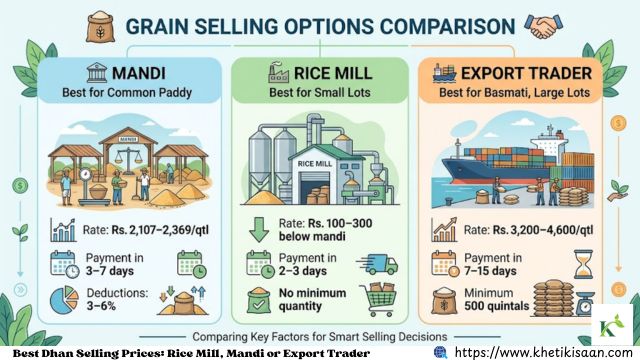
Farmers who can store dry, clean 1509 Dhaan paddy for 4, 8 weeks past peak arrival often see meaningfully higher rates as mandi supply eases. Well-stored, low-moisture lots can earn a premium of ₹100, ₹200/quintal over combine-harvested lots sold immediately at harvest. However, incorrect storage, high moisture content, poor ventilation, damp godowns, leads to quality loss that wipes out any price gain from waiting. Storage only works as a price strategy if the paddy you are storing is already in good condition when it goes in.
Export demand and international rice prices: what affects 1509 Dhaan mandi bhav most
Export demand is the strongest driver of 1509 Dhaan mandi bhav. Because basmati is not a government-procured crop, private exporters and traders set prices based on what overseas buyers are willing to pay. This is a fundamental difference from wheat or common paddy, where MSP procurement creates a price floor. For 1509 Dhaan, the floor is set by the market, not the government.
How the export chain connects to your mandi rate
The price chain works like this: buyers in Saudi Arabia, UAE, Iraq, Iran, and Yemen place orders with Indian exporters. Those exporters buy processed rice from millers. Millers buy raw paddy from traders. Traders bid at the APMC mandi. When export orders strengthen, the bids at your local mandi go up because millers need to procure. When export demand weakens or shipments face delays, surplus stock reaches the mandi and rates soften. Your mandi rate on any given morning is, in part, a reflection of what a buyer in Riyadh or Baghdad was willing to pay last week.
The export policy factor
Government decisions on rice export restrictions and changes to the MEP (Minimum Export Price) create sharp, sudden moves in 1509 Dhaan mandi bhav, sometimes within days of a policy announcement. The price history of recent seasons illustrates this clearly. The government removed the MEP on basmati rice exports, which provided support to prices by making Indian basmati more competitive globally. Tracking these policy changes is not optional for a serious 1509 Dhaan seller; they are among the most powerful paddy price drivers available.
Grain quality at auction: how moisture, breakage, and aroma affect your 1509 Dhaan rate
Two lots of 1509 Dhaan arriving at the same mandi on the same day can fetch a difference of ₹100, ₹200/quintal, with larger gaps possible in strong-quality markets, purely because of quality factors that are visible and measurable at the time of bidding. The buyer at the auction is making rapid assessments on moisture, grain integrity, and aroma. Your preparation before reaching the mandi determines which quality band your lot falls into.
Moisture content: the baseline test every buyer runs
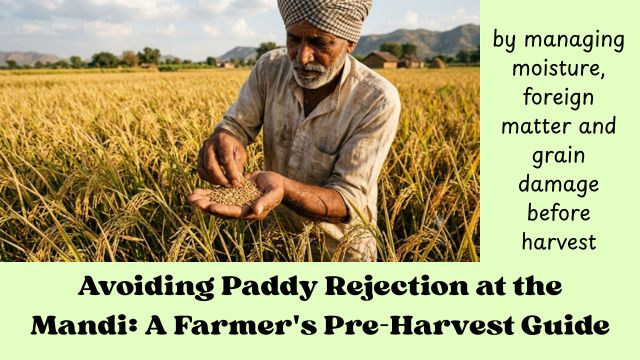
The standard acceptable moisture limit for paddy at APMC auctions in Punjab and Haryana is 17% maximum for procurement acceptance. Lots above this threshold face direct discounts or outright rejection because millers factor in drying costs before they can process the paddy. Use a moisture metre before transport and resist the temptation to rush paddy to the mandi immediately after combine harvesting, when moisture levels are often still elevated. A few days of proper field drying or sun drying can meaningfully improve your price band.
Broken grain percentage and aroma retention
Combine harvesting increases broken content compared to manual harvesting, and a high broken percentage directly reduces milling recovery, which is what a miller is ultimately paying for. Lots harvested and handled carefully, with lower breakage, can fetch ₹100, ₹200/quintal more than typical combine-harvested lots. Aroma loss from delayed or heat-stressed harvesting pulls prices down further. The quality-band framework at the mandi is straightforward: best-priced lots have low moisture, low breakage, and strong aroma; discounted lots have the opposite combination. Knowing this before harvest lets you make better decisions about harvest timing and post-harvest handling.
How to compare APMC mandi rates before selling your 1509 Dhaan
A farmer in Haryana or Punjab often sells at the nearest mandi by default, even when a more distant yard is offering higher rates on the same morning. The barrier is not the distance, it is the information gap. Without knowing what other yards are paying, the default is always the familiar option, even when it costs money.
Why mandi rate today for 1509 Dhaan varies across APMC yards on the same day
Several factors cause price differences between mandis on the same morning. Arrival volume at each yard varies. Active exporter presence differs, some mandis have more exporter-linked commission agents on a given day than others. Local competition among arhatiyas (commission agents) affects bidding intensity. The quality composition of that day's aggregate lot also plays a role. The result is that ₹100, ₹200/quintal differences between nearby APMC yards are not unusual during peak arrival weeks.
Using KhetiKisaan to check live 1509 Dhaan rates before loading
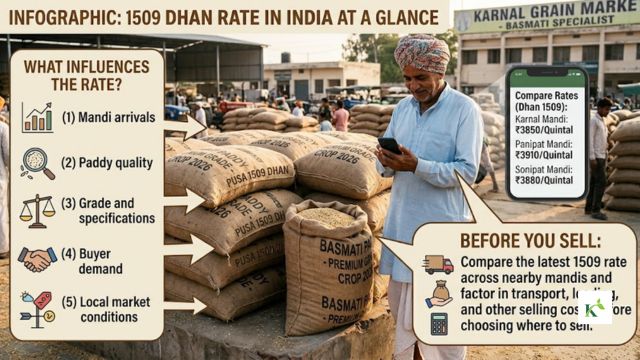
KhetiKisaan publishes live 1509 Dhaan mandi rates to help farmers compare what multiple APMC yards are paying before making a selling decision. Before loading your trolley, check the rates across multiple mandis on KhetiKisaan, identify which APMC yard is paying the highest price for 1509 Dhaan that day, and make your decision with real information rather than guesswork. That one step, done consistently, is one of the simplest ways to improve annual income from 1509 Dhaan cultivation without changing anything about how you grow the crop.
Make 1509 Dhaan work harder for your income
This 1509 dhaan crop description and what affects its mandi bhav comes down to one practical point: growing a strong variety is only half the equation. 1509 Dhaan is early maturing, water-efficient, and capable of producing top-grade basmati grain that commands export premiums. But the mandi bhav you receive on any given day is shaped by factors outside your field, export demand from the Middle East, basmati 1509 arrivals and rates at your APMC yard that week, policy changes in Delhi, and the quality your lot presents at the time of bidding. Understanding these paddy price drivers gives a real commercial edge. Knowing when not to sell is as valuable as knowing when to sell.
Before loading your 1509 Dhaan onto a trolley, check today's live mandi rate today for 1509 on KhetiKisaan , compare what multiple APMC yards are paying that morning, and sell where the rate justifies the effort. The information is available; using it consistently is what separates informed selling from guesswork.
| Mandi | Price | Date |
|---|---|---|
| Bundi | 4,201.00/- | 01 Oct, 2026 |
| Sirsa | 4,578.00/- | 02 Oct, 2026 |
| Ellenabad | 4,451.00/- | 02 Oct, 2026 |
| Hanumangarh | 4,370.00/- | 02 Oct, 2026 |
| Guna | 4,200.00/- | 01 Oct, 2026 |
| Khair UP | 4,200.00/- | 01 Oct, 2026 |
| Udaypura | 4,234.00/- | 01 Oct, 2026 |
| Bari MP | 4,185.00/- | 01 Oct, 2026 |
| Sheopur MP | 4,150.00/- | 30 Sep, 2026 |
| Kota | 4,259.00/- | 02 Oct, 2026 |
| GanjBasoda MP | 4,259.00/- | 01 Oct, 2026 |
| Rawla | 4,450.00/- | 02 Oct, 2026 |
| itawa | 4,150.00/- | 01 Oct, 2026 |
FAQ's
Related Blogs
 Jun 22, 2026
 by Pankaj Sihag