








Chana

Chana: All prices are in Quintal
Description
| Quick Facts: Chana at a Glance | |
|---|---|
| Crop type | Rabi pulse (winter season) |
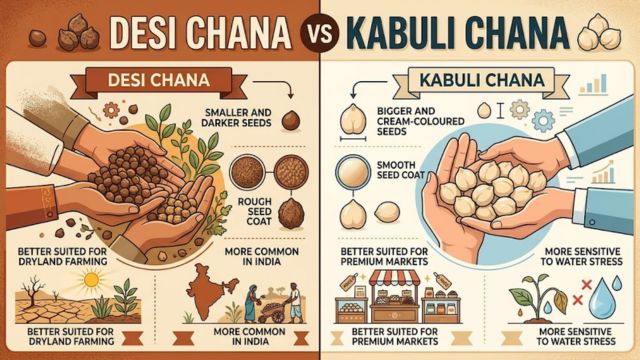
| Botanical types | Desi (small, dark, rough coat) and Kabuli (large, beige, smooth coat) |
| Major producing states | Madhya Pradesh, Maharashtra, Rajasthan, Gujarat, Karnataka |
| Sowing window | October (second half) to mid-November |
| Harvest window | February to March |
| Average yield | 15, 20 quintals per hectare under good management |
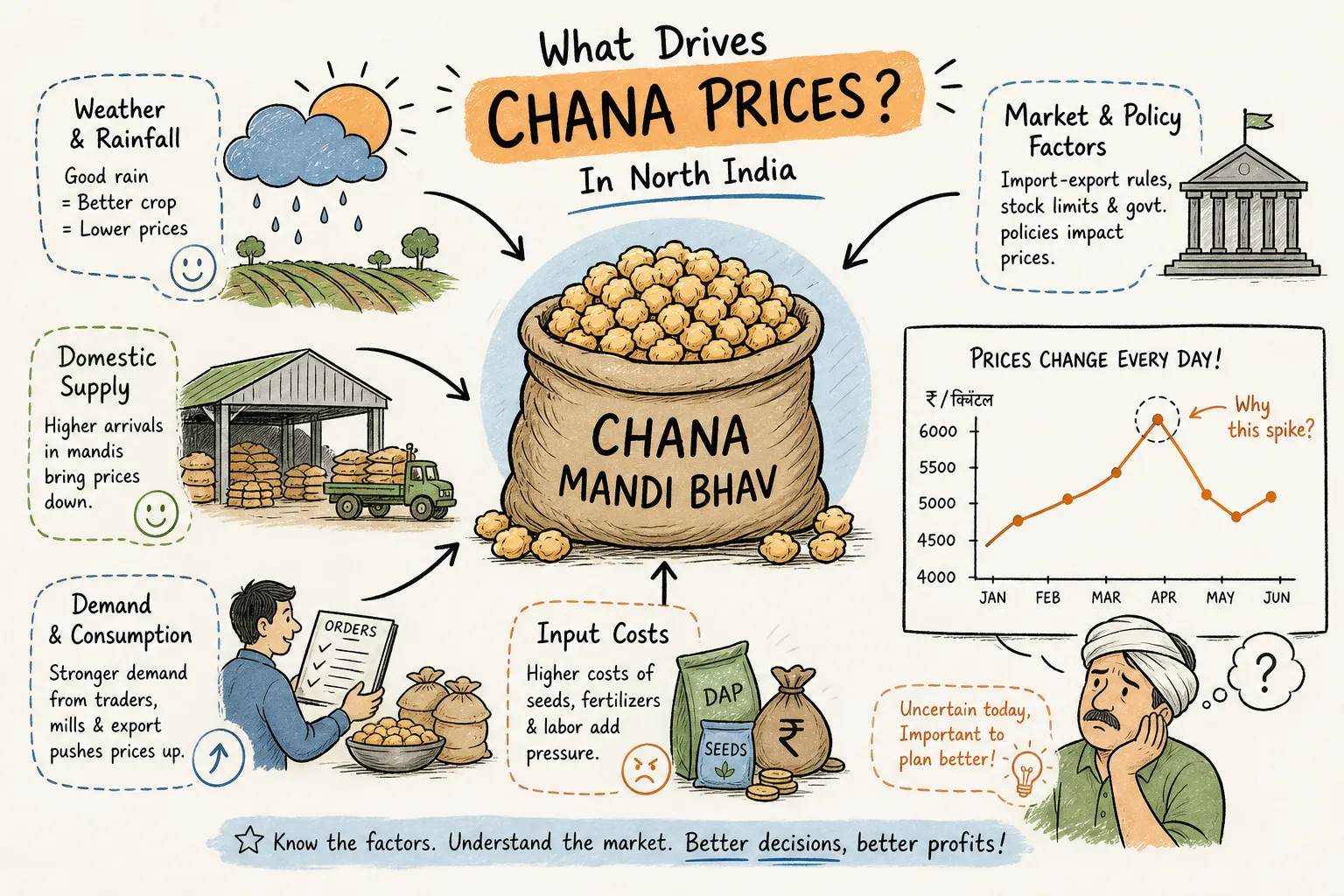
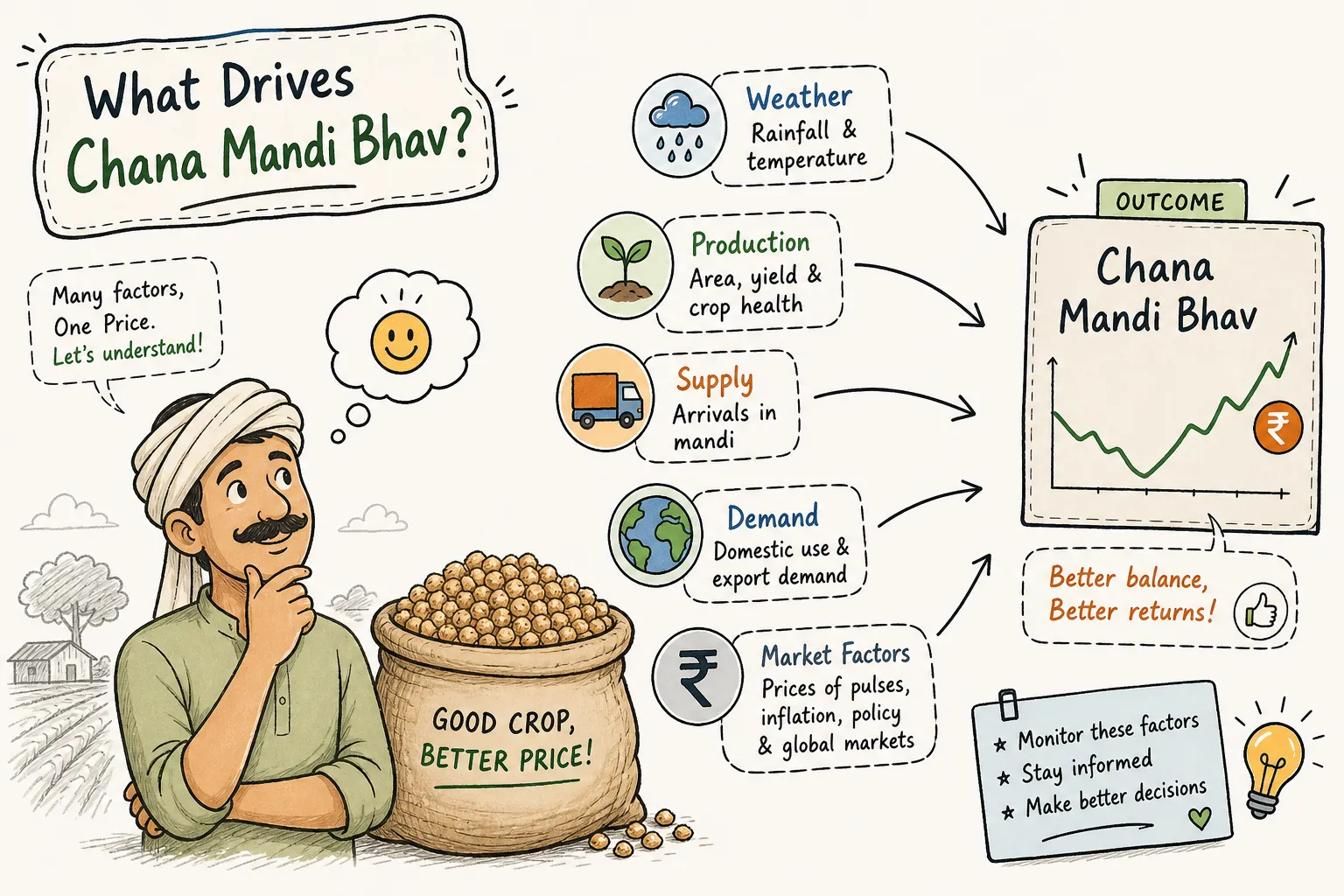
This chana crop description explains what affects chana mandi bhav, and why that knowledge matters more than simply knowing today's rate. Chana (chickpea) is India's single most important pulse crop, yet chana mandi bhav can move by several hundred rupees per quintal within the same season with no obvious trigger for the farmer standing at the auction floor. That movement is not random. It follows a logic built from arrivals, carryover stocks, dal-mill procurement cycles, import duty decisions, and the quality grade your lot receives the moment a trader inspects it.
Many farmers sell at the wrong time because they track the price but not the reasons behind it. Knowing that chana bhav is low in March is useful; knowing why it is low in March, and what conditions would push it higher by June, is what turns a routine sale into a profitable one.
KhetiKisaan monitors chana mandi bhav from APMC yards across Rajasthan and Haryana, with data sourced from ground contacts who attend live bol-chaal (bidding) sessions. This article uses that market intelligence as its backbone to walk you through both sides of the chana price equation: the crop itself and the market forces that value it.
Chana's place in India's pulse economy
Why chickpea is India's most important pulse crop
Chana accounts for roughly 40, 45% of India's total pulse production by area and volume (per Ministry of Agriculture estimates), making it the dominant pulse by a wide margin. It is the primary protein source for hundreds of millions of vegetarian households, the main raw material for dal mills producing chana dal and besan (gram flour), and a meaningful export commodity. Any significant shift in chana production ripples through food prices, dal-mill margins, and rural incomes simultaneously.
Major producing states and their regional weight
Madhya Pradesh leads national production with approximately 26, 30% of output, followed by Maharashtra (20, 25%), Rajasthan (18, 20%), Gujarat (5, 11%), and Karnataka (5, 8%). Together, the top five states account for over 80% of national production. Within Rajasthan, districts such as Barmer, Jodhpur, Nagaur, and Bikaner are significant contributors, and their harvest timing and quality directly influence mandi rates in Sri Ganganagar, Nohar, Kota, and Jaipur, the mandis that North Indian dal mills and traders watch closely during the rabi arrival season.
Rabi cycle and its connection to the pulse market outlook
Chana is an exclusively rabi crop. Its entire annual supply arrives in one harvest window, unlike crops such as moong or urad that have both kharif and zaid cycles. This single-harvest reality is what makes arrival timing so powerful as a chana mandi bhav driver. When all of the season's supply hits mandis in a six-to-eight-week window, the price pressure is concentrated and sharp. Farmers who understand this seasonal pattern can plan their selling strategy well in advance rather than reacting to the rate board on the day they arrive at the mandi.
Desi chana vs kabuli chana: varieties, traits, and market preference
Desi chana: the dominant type in Indian mandis
Desi chana has small to medium seeds, a brown to dark colour, angular shape, and a rough seed coat. It is the type found in the overwhelming majority of mandi arrivals across India. Widely grown varieties include JG 11, which offers wilt resistance and early maturity; DCP 92-3, known for high yield and disease resistance; and Atal (IPC 2007-28), which carries strong resistance to wilt, dry root rot, and collar rot with medium brown seeds. Desi chana is the primary raw material for chana dal splitting and besan milling, so dal-mill demand is almost always for the desi type.
Kabuli chana: premium positioning and export demand
Kabuli chana has large, round, beige or cream-coloured seeds with a smooth seed coat. Varieties like IPCK 2013-163 (Madhav) and JKG-1 are grown where better moisture management and higher input levels are feasible. Kabuli commands a higher price per quintal in most mandis because of export demand, snack processing (chole, hummus), and table use. It is also slightly more demanding in terms of soil preparation and moisture management than desi, so the price premium must be weighed against the higher production risk for kabuli before choosing which type to grow.
How variety choice affects the price you get at the mandi
Buyers and dal mills quote different rates for desi and kabuli on the same day in the same APMC yard. The grade assigned to your lot depends on seed size, colour uniformity, moisture content, and variety purity. A farmer who arrives with a uniform, clean, bold lot of a known variety gets a meaningfully better bid than one with a mixed, high-moisture lot of the same type. Knowing which variety the dominant buyers in your local mandi prefer is one of the simplest and most actionable steps a farmer can take before even sowing the crop.
The chana crop calendar: from sowing window to mandi arrival
Optimal sowing dates and soil requirements
Sow desi chana in the second half of October for rainfed areas. Under irrigation, sowing can extend into the first half of November. Kabuli follows the same general window. Sowing after mid-November is risky because the crop misses the optimal cool temperatures during flowering, which directly reduces pod set and seed weight. Chana performs best on well-drained sandy loam or loam soils. Waterlogged, saline, heavy clay, or alkaline soils reduce both yield and seed quality, and no amount of good agronomy can fully compensate for a fundamentally unsuitable soil.
Crop duration and key growth stages to watch
Desi chana matures in 95, 105 days; kabuli takes 100, 110 days. The stages that matter most for quality are flowering and pod filling. Heat stress or moisture stress during these stages reduces seed weight and causes shrivelling, which directly lowers the mandi grade the lot receives. A farmer who monitors the crop during January and February, when these stages typically occur in North India, can take timely protective measures to safeguard the final grade.
Harvest timing and what it means for chana mandi bhav
Harvest falls in February and March across major producing states. This is when bulk arrivals from Rajasthan, Madhya Pradesh, and Maharashtra hit mandis like Jaipur, Indore, and Akola simultaneously. The concentrated supply is the primary reason chana mandi bhav drops sharply in the March, April window every year. Average yields under good management are 15, 20 quintals per hectare for both desi and kabuli types. Under rainfed, lower-input conditions, yields can fall to 5, 8 quintals per hectare, which affects both farm income and the total supply the market receives that season.
Agronomic and climatic factors that affect chana yield and quality
Soil drainage and residual moisture: the most critical variables
Poor drainage is the single biggest yield killer for chana. Waterlogged roots cannot fix nitrogen effectively, and wet soil conditions accelerate root rot and collar rot, leading to plant death before the crop reaches pod-filling stage. Residual soil moisture from the kharif season should be moderate, enough to support germination and early establishment, but not so high that the root zone stays saturated. Heavy black cotton soils hold too much water and are generally unsuitable for chana unless raised beds or ridges are used to improve drainage.
How unseasonal rain and late frost damage the crop
Unexpected rain after December damages the chana crop in two ways. First, it promotes excessive vegetative growth at the expense of pod development. Second, higher humidity creates ideal conditions for Ascochyta blight, a fungal disease that can spread rapidly through a standing crop and damage seeds visibly, reducing their mandi grade. Late frost during pod filling in January and February, a real risk in North Indian districts, can shrivel seeds and reduce both weight and appearance. A frost-affected lot may still meet MSP norms but will get a lower trader bid at the mandi.
Pest and disease pressure and its effect on mandi price
Pod borer (Helicoverpa armigera) is the most economically damaging pest for chana. It attacks pods directly, reducing seed count and causing visible damage that traders discount heavily at the time of grading. Fusarium wilt is the most important soil-borne disease, capable of wiping out large portions of a field in affected areas. Damaged, shrivelled, or bored seeds receive lower grades, fetch lower rates per quintal, and take longer to move in the mandi. Wilt-resistant varieties like JG 11 significantly reduce this risk, but they must be sown on time to express their advantage fully.
How chana arrivals and carryover stocks push mandi bhav up or down
The seasonal arrival pattern and its effect on chana mandi bhav
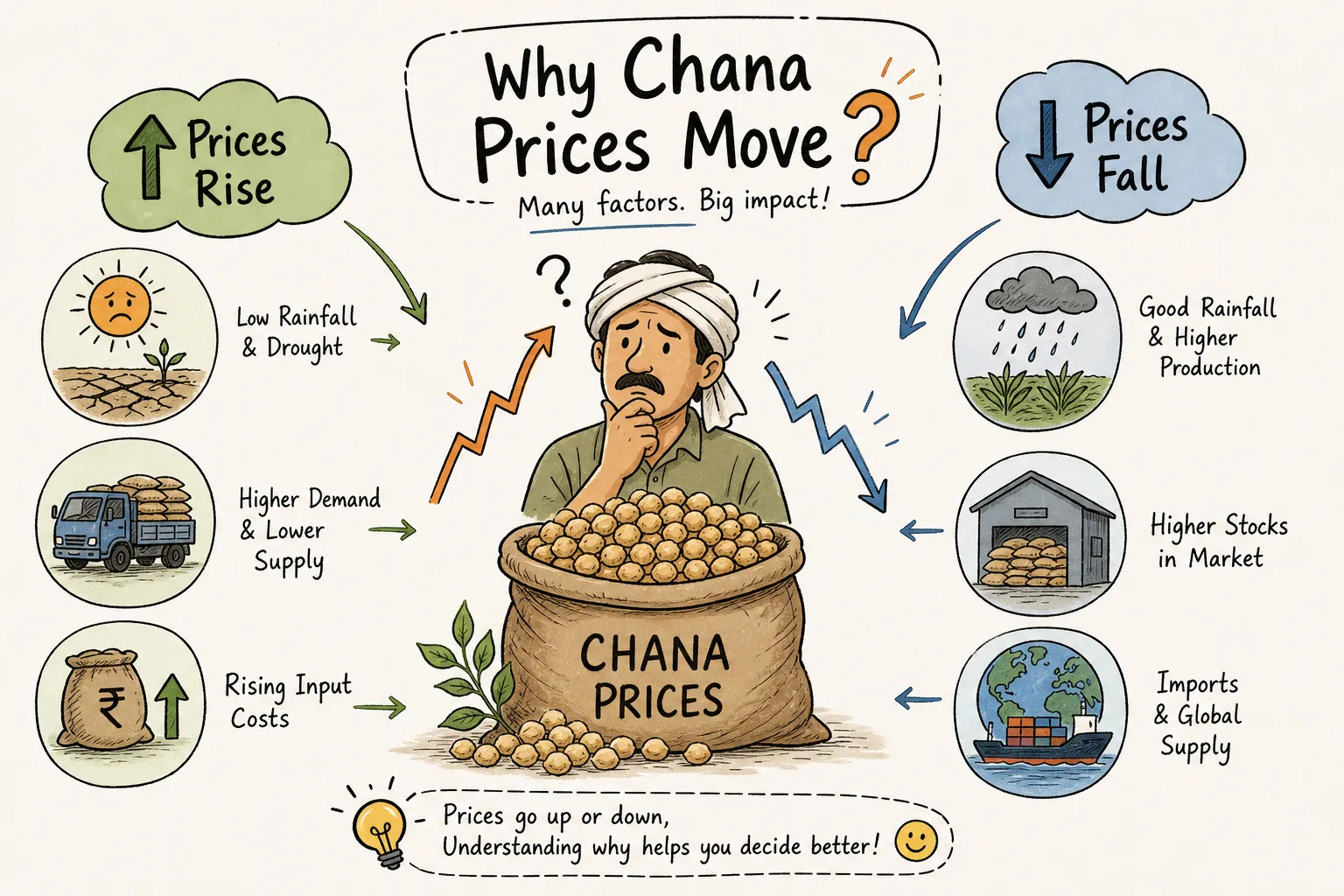
Chana follows a predictable supply curve each year. From June to October, arrivals are very low because the new crop is still months away and only old-season stocks held by traders or dal mills are available. In March and April, arrivals surge as the new rabi harvest floods mandis across multiple states simultaneously, and chana mandi bhav typically bottoms out. As arrivals taper off in May and June, prices begin to recover. Farmers who can store clean, dry chana for 60, 90 days after harvest often capture a better chana mandi price than those who sell at the mandi gate immediately after threshing, though this advantage can be reduced if a large NAFED buffer release or a duty-free import window is announced during the storage period.
Carryover stocks and stockist activity
When traders, dal mills, or government agencies hold large carryover stocks from the previous season, fresh arrivals face extra competition in the market. Stockists in major trading centres like Indore often release old kabuli or desi lots precisely when new-crop prices show a sharp upward move, capping any strong rally.
On the other side, when carryover is thin and the new crop arrives late due to sowing delays or weather disruptions, chana mandi bhav can rise significantly even before harvest is complete. Watching stockist activity, chana arrivals and stocks across key yards, is as important as watching arrival volumes alone.
Using arrival data to make smarter selling decisions
Tracking arrival direction across multiple mandis is more useful than tracking a single mandi's price. KhetiKisaan aggregates daily chana mandi bhav from APMC yards across Rajasthan and Haryana, including Sri Ganganagar, Nohar, Kota, Bikaner, and others, with ground contacts attending live bol-chaal sessions. Before loading a tractor and heading to the nearest mandi, comparing rates across two or three yards can help you avoid underselling losses on a large consignment.
Dal-mill demand and quality grades as chana mandi bhav drivers
How dal-mill procurement cycles create demand surges
Dal mills are the largest buyers of desi chana in Indian mandis. They do not buy steadily throughout the year; they buy in concentrated batches when their raw material stocks run low, creating demand surges that push chana mandi price up in a short window. Festival months like Navratri and Ramzan, the wedding season from November to February, and government nutritional procurement for mid-day meal schemes all typically increase chana dal offtake. A farmer who times a sale to coincide with a mill procurement window generally gets a better rate than one selling in a slack period. Watching when mandis report heavier buyer presence is a practical signal of procurement activity.
Quality grades in APMC mandis and how they are assessed
Traders and mill buyers grade chana on the spot using a set of parameters: moisture content, seed size and uniformity, foreign matter, broken and damaged seeds, and colour or skin integrity. The grading thresholds used by mandis and e-NAM platforms are broadly consistent: moisture up to 10% qualifies for the top range, 10, 12% for the mid range, and 12, 16% for the lower range. Foreign matter tolerance drops sharply as grade rises. Dal-mill procurement specifications are typically stricter, capping moisture at 12%, foreign matter at 0.5%, and weevilled grains at 1%.
Bold, clean, uniform lots typically attract a premium over average lots even on the same day in the same mandi. Post-harvest cleaning, thorough drying to below 12% moisture, and storage in jute bags in well-ventilated godowns are not optional steps, they are the most direct route to the top price band and generally recover more than they cost in better bids.
Government policy, MSP revisions, and import controls: the biggest chana mandi bhav movers
MSP as a price floor and how procurement works
The government announces the MSP for chana before the sowing season so farmers have a reference point when deciding whether to plant. When mandi prices fall at or near MSP, agencies like NAFED and NCCF are mandated to procure from farmers, removing physical supply from the market and preventing a price collapse.
However, MSP only functions as a real floor when procurement is operationally active, not merely announced. In some states and seasons, procurement operations are slow to start or have limited reach, and price bulletins from past rabi seasons have documented open-market rates falling to or below MSP levels during peak arrivals. Do not assume the mandi rate will automatically protect you at MSP; check whether active procurement is running in your district before making a selling decision.
Import duty and duty-free import decisions
India periodically allows duty-free or low-duty chana imports when domestic prices rise sharply. The primary suppliers are Australia and Tanzania. When cheaper imported chana enters the market, dal mills shift to the import and domestic chana mandi bhav faces direct downward pressure. India reimposed a 10% import duty on desi chana effective 1 April 2026, ending the duty-free regime that had been in place since May 2025. Before that reversal, the duty-free window had kept a lid on local prices for nearly a year. A change in import duty can move chana mandi price by hundreds of rupees per quintal within days of an announcement, which is why tracking policy news is as important as tracking mandi arrival data.
Buffer stock releases and stock-holding limits
NAFED maintains a buffer stock of chana procured during MSP operations. When mandi prices rise sharply above MSP, NAFED releases buffer stock into the market, increasing supply and cooling prices. This mechanism prevents runaway price spikes but also caps the upside for farmers holding stocks in anticipation of a price rally. Stock-holding limits imposed on traders and stockists serve a similar function: they reduce speculative hoarding and help stabilise mandi rates during periods of tight supply.
For a farmer trying to plan when to sell stored chana, the key takeaway is simple: track government policy announcements as carefully as you track mandi arrivals. An import duty decision or a NAFED stock release can invalidate a price forecast built on arrivals data alone.
Two things that decide your chana income
Every rupee you earn from chana comes down to two things: the quality of the lot you bring to the mandi and the timing of when you sell it. Quality is built in the field, from variety selection and sowing date to drainage management, pest control, and post-harvest drying and cleaning. Timing is built on market intelligence: chana arrivals and stocks, carryover, dal-mill procurement cycles, MSP procurement status, and import policy. The two are inseparable. A clean, bold lot of well-dried desi chana will still fetch a poor price if you sell it at peak arrival in March into a market flooded with new-season supply and cheap imports.
The farmers who consistently do better at the mandi are the ones who treat market information as seriously as they treat agronomic information. They know their variety's strengths. They clean and dry their fasal (crop) before transport. They compare chana mandi bhav across yards before committing to a buyer. KhetiKisaan exists to make that last step easier, with daily chana mandi bhav from Rajasthan and Haryana APMC yards sourced from the auction floor itself. Check the platform before your next sale and use the price direction, not just the day's rate, to make your decision.
| Mandi | Price | Date |
|---|---|---|
| Nohar | 7,100.00/- | 03 Oct, 2026 |
| Kota | 6,200.00/- | 03 Oct, 2026 |
| Rawastar | 6,681.00/- | 03 Oct, 2026 |
| Sri Ganganagar | 6,500.00/- | 03 Oct, 2026 |
| Goluwala | 6,200.00/- | 03 Oct, 2026 |
| Pillibanga | 6,205.00/- | 03 Oct, 2026 |
| Sirsa | 6,406.00/- | 03 Oct, 2026 |
| Ellenabad | 7,000.00/- | 03 Oct, 2026 |
| Bikaner | 7,040.00/- | 03 Oct, 2026 |
| Rawla | 6,200.00/- | 03 Oct, 2026 |
| Aadampur | 6,600.00/- | 03 Oct, 2026 |
| Bhattu | 6,450.00/- | 03 Oct, 2026 |
| Ghadsana | 5,850.00/- | 03 Oct, 2026 |
| Hanumangarh | 5,703.00/- | 03 Oct, 2026 |
| Sangaria | 6,671.00/- | 03 Oct, 2026 |
| Siwani | 7,200.00/- | 03 Oct, 2026 |
| Medta City | 6,225.00/- | 03 Oct, 2026 |
| Nokha | 6,300.00/- | 03 Oct, 2026 |
| Jaitsar | 6,205.00/- | 03 Oct, 2026 |
| Rajgarh (Sadulpur) | 7,000.00/- | 03 Oct, 2026 |
| Nagaur | 5,703.00/- | 03 Oct, 2026 |
| Deoli | 5,850.00/- | 03 Oct, 2026 |
| RaisinghNagar | 6,581.00/- | 03 Oct, 2026 |
| Abohar | 5,755.00/- | 03 Oct, 2026 |
| Neemuch MP | 6,220.00/- | 03 Oct, 2026 |
| Mandsaur MP | 6,150.00/- | 03 Oct, 2026 |
| Indore MP | 6,200.00/- | 03 Oct, 2026 |
| Ujjain MP | 5,850.00/- | 03 Oct, 2026 |
| Ratlam MP | 5,900.00/- | 03 Oct, 2026 |
| Sardarshahar | 6,504.00/- | 03 Oct, 2026 |
| Padampur | 5,845.00/- | 03 Oct, 2026 |
| Arjunsar | 6,015.00/- | 03 Oct, 2026 |
| Pipariya MP | 6,901.00/- | 03 Oct, 2026 |
| Kareli MP | 8,051.00/- | 03 Oct, 2026 |
| Ramganjmandi | 5,850.00/- | 03 Oct, 2026 |
| Baran | 6,015.00/- | 03 Oct, 2026 |
| Bundi | 6,406.00/- | 03 Oct, 2026 |
| Sadulsahar | 6,000.00/- | 03 Oct, 2026 |
| Phalodi | 6,406.00/- | 03 Oct, 2026 |
| Narsinghpur MP | 6,406.00/- | 03 Oct, 2026 |
| Khandwa MP | 5,900.00/- | 03 Oct, 2026 |
| Niwai | 5,906.00/- | 03 Oct, 2026 |
| Kawai | 5,951.00/- | 03 Oct, 2026 |
| Kalapipal MP | 5,800.00/- | 03 Oct, 2026 |
| Shamgarh MP | 6,250.00/- | 03 Oct, 2026 |
| Sikanagaon MP | 5,800.00/- | 03 Oct, 2026 |
| GanjBasoda MP | 6,400.00/- | 03 Oct, 2026 |
| Khargone MP | 5,840.00/- | 03 Oct, 2026 |
| Anoopgarh | 6,000.00/- | 03 Oct, 2026 |
| Degana | 6,205.00/- | 03 Oct, 2026 |
| Betul MP | 5,951.00/- | 03 Oct, 2026 |
| Dhamnod MP | 6,205.00/- | 03 Oct, 2026 |
| Chaksu | 5,850.00/- | 03 Oct, 2026 |
| Nimbahera | 6,210.00/- | 03 Oct, 2026 |
| Timarni MP | 6,000.00/- | 03 Oct, 2026 |
| Harda MP | 7,400.00/- | 03 Oct, 2026 |
| Charkhi Dadri | 6,150.00/- | 03 Oct, 2026 |
| Udaypura | 7,370.00/- | 03 Oct, 2026 |
| Guna | 5,841.00/- | 03 Oct, 2026 |
| Kekadi | 5,850.00/- | 03 Oct, 2026 |
| Malpura | 5,985.00/- | 03 Oct, 2026 |
| Rajkot GJ | 5,900.00/- | 03 Oct, 2026 |
| Dahod GJ | 5,850.00/- | 03 Oct, 2026 |
| Bari MP | 5,800.00/- | 03 Oct, 2026 |
| Sironj MP | 5,800.00/- | 03 Oct, 2026 |
| Sheopur MP | 5,800.00/- | 03 Oct, 2026 |
| Jaora MP | 5,900.00/- | 03 Oct, 2026 |
| Daloda MP | 5,906.00/- | 03 Oct, 2026 |
| Khanpur | 5,923.00/- | 03 Oct, 2026 |
| Sri Vijaynagar | 5,906.00/- | 03 Oct, 2026 |
| Banapura MP | 5,850.00/- | 03 Oct, 2026 |
| Gajsinghpur | 5,840.00/- | 03 Oct, 2026 |
| Mohangarh | 6,205.00/- | 03 Oct, 2026 |
| Kesarisinghpur | 5,365.00/- | 03 Oct, 2026 |
| Suratgarh | 5,550.00/- | 03 Oct, 2026 |
| Sri Karanpur | 5,300.00/- | 03 Oct, 2026 |
| Bhadra | 5,900.00/- | 03 Oct, 2026 |
| Kawai Salpura | 5,800.00/- | 03 Oct, 2026 |
| Atru | 5,906.00/- | 03 Oct, 2026 |
| Chhabra | 6,103.00/- | 03 Oct, 2026 |
| NaharGarh | 5,950.00/- | 03 Oct, 2026 |
| Anta | 5,580.00/- | 03 Oct, 2026 |
| Samraniyan | 5,750.00/- | 01 Oct, 2026 |
| Khajuwala | 5,785.00/- | 03 Oct, 2026 |
| Lunkaransar | 5,790.00/- | 03 Oct, 2026 |
| Sri Dungargarh | 6,450.00/- | 03 Oct, 2026 |
| Pugal Road | 5,805.00/- | 03 Oct, 2026 |
| Tonk | 5,550.00/- | 03 Oct, 2026 |
| Uniyara | 56.00/- | 03 Oct, 2026 |
| Dooni | 6,200.00/- | 03 Oct, 2026 |
| Todaraisingh | 6,203.00/- | 03 Oct, 2026 |
| Alwar | 6,203.00/- | 03 Oct, 2026 |
| Laxmangarh | 5,700.00/- | 03 Oct, 2026 |
| Chomu | 6,030.00/- | 03 Oct, 2026 |
| Bagru | 5,600.00/- | 03 Oct, 2026 |
| Kishangarh | 6,200.00/- | 03 Oct, 2026 |
| Bassi | 6,200.00/- | 03 Oct, 2026 |
| Dausa | 6,200.00/- | 03 Oct, 2026 |
| Lalsot | 6,150.00/- | 03 Oct, 2026 |
| Bandikui | 6,382.00/- | 03 Oct, 2026 |
| Mandawar | 6,035.00/- | 03 Oct, 2026 |
| Bhawani Mandi | 6,100.00/- | 03 Oct, 2026 |
| Jhalarapatan | 5,800.00/- | 03 Oct, 2026 |
| iklera | 5,950.00/- | 03 Oct, 2026 |
| itawa | 6,200.00/- | 03 Oct, 2026 |
| Bhilwara | 6,255.00/- | 03 Oct, 2026 |
| Barisadri | 6,255.00/- | 03 Oct, 2026 |
| Sujangarh | 6,031.00/- | 03 Oct, 2026 |
| Jhunjhunu | 5,600.00/- | 03 Oct, 2026 |
| Bharatpur | 5,500.00/- | 03 Oct, 2026 |
| Dei | 6,500.00/- | 03 Oct, 2026 |
| Madanganj | 5,852.00/- | 03 Oct, 2026 |
| Bhagat ki Kothi | 6,160.00/- | 03 Oct, 2026 |
| Khairthal | 6,015.00/- | 03 Oct, 2026 |
| Pratapgarh | 6,650.00/- | 03 Oct, 2026 |
| Chhotisadri | 6,200.00/- | 03 Oct, 2026 |
| Viramgam GJ | 5,900.00/- | 03 Oct, 2026 |
| Gondal GJ | 6,815.00/- | 03 Oct, 2026 |
| Upleta GJ | 6,051.00/- | 03 Oct, 2026 |
| Mahuva GJ | 6,700.00/- | 03 Oct, 2026 |
| Palitana GJ | 5,852.00/- | 03 Oct, 2026 |
| Taleja GJ | 6,701.00/- | 03 Oct, 2026 |
 Sep 23, 2026
 by
by