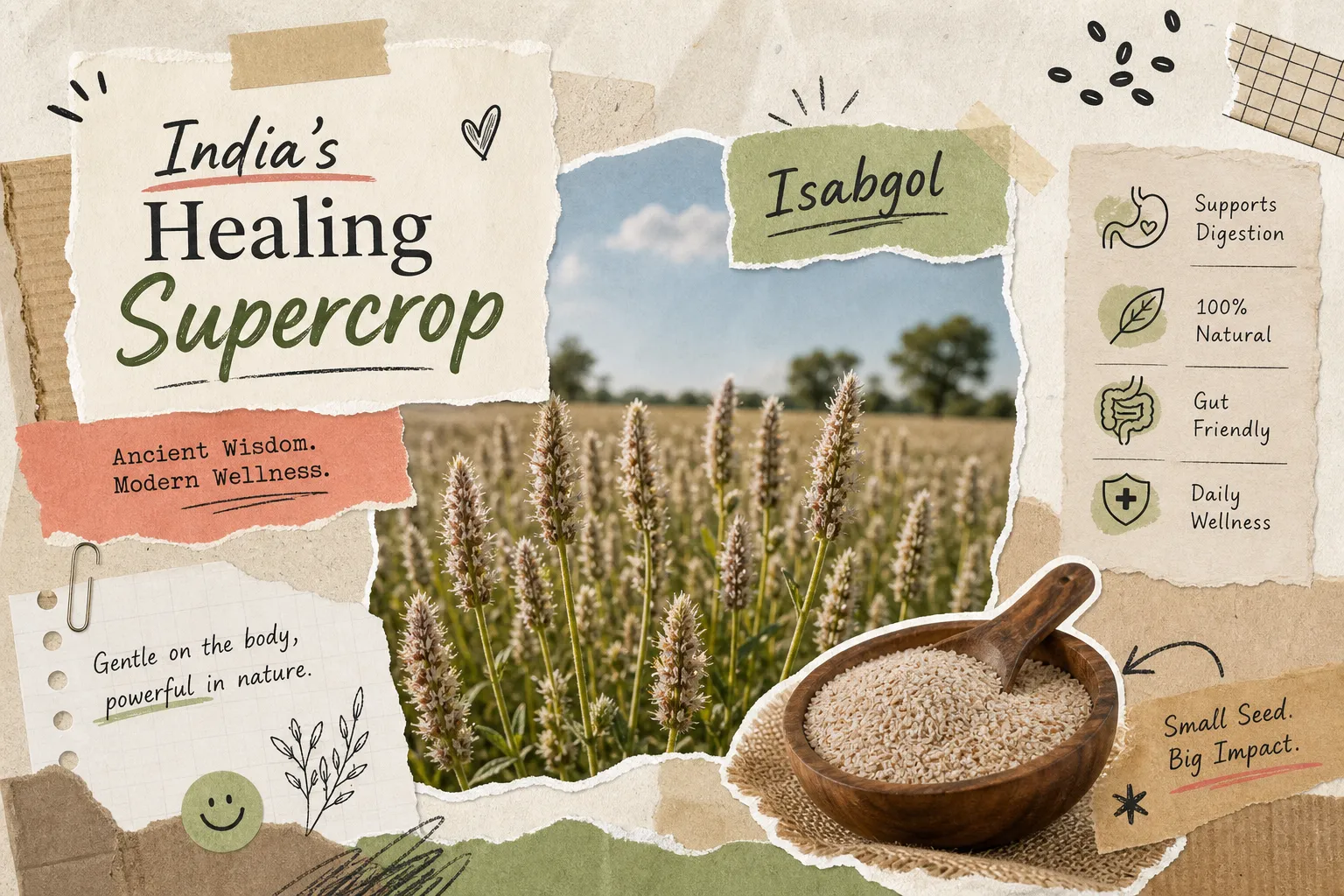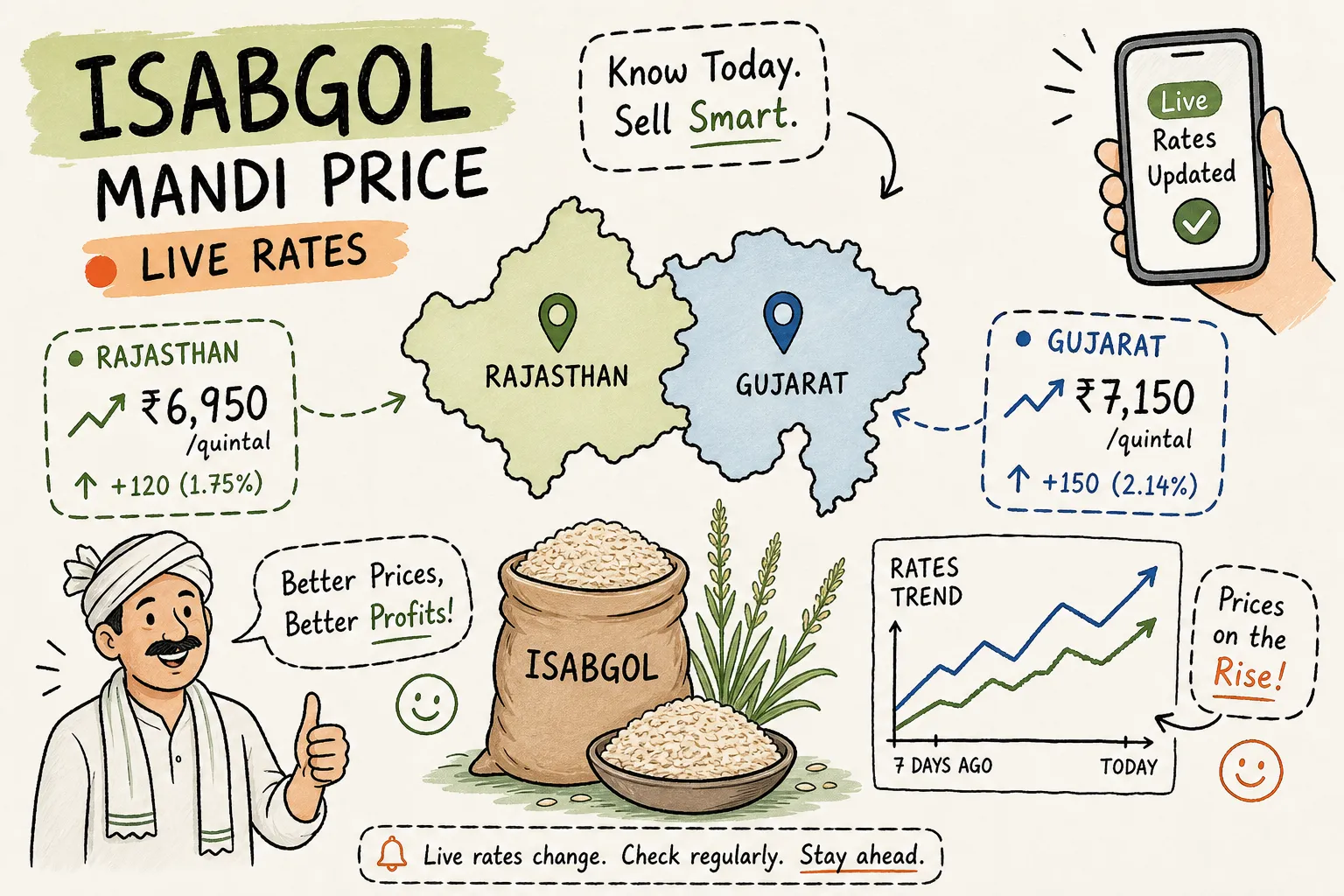









Isabgol
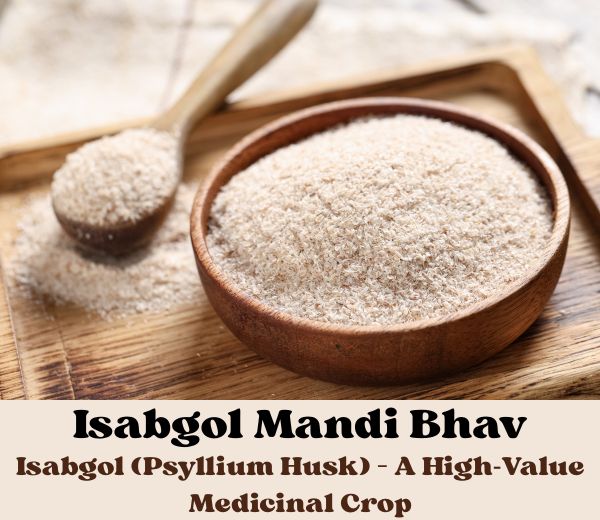
Isabgol: All Prices are in Quintal
Description
| Crop type | Rabi (cool-season annual), Plantago ovata |
| Sowing month | First fortnight of November (optimal) |
| Harvest month | February to March (110, 130 days after sowing) |
| Main producing states | Rajasthan (Barmer, Jalore, Jaisalmer, Bikaner), Gujarat |
| Typical mandi bhav range | ₹9,000, ₹14,500 per quintal (normal supply); up to ₹23,000+ per quintal (tight supply) |
| India's global export share | Over 80% of world psyllium husk supply |
| No MSP | Price is market-determined; no government support price exists for isabgol |
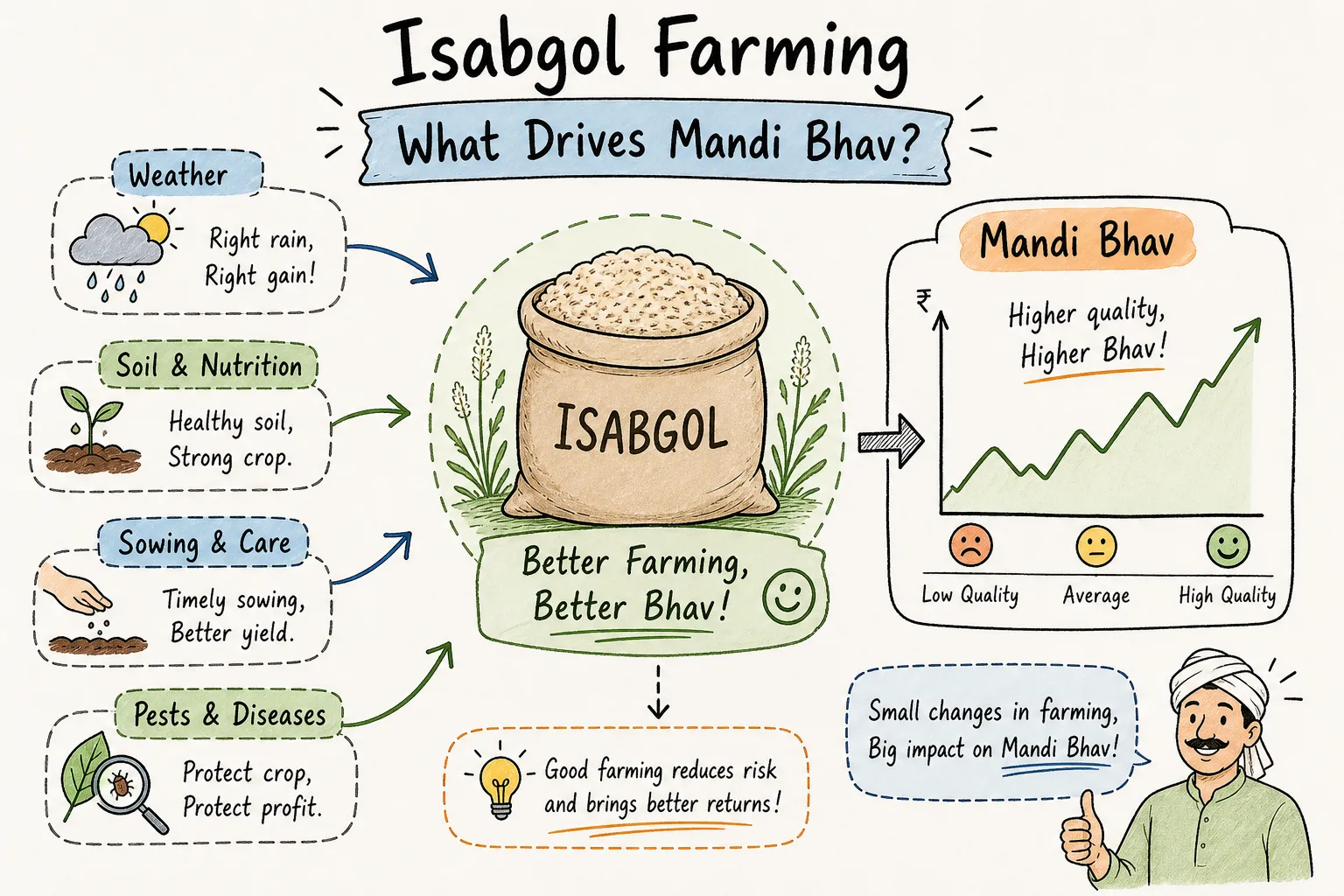
Most kisaans know isabgol (Plantago ovata) as a digestive crop, but that framing undersells it considerably. This guide covers isabgol crop details and how mandi bhav is affected by farming factors such as harvest timing, grade, and export demand. Isabgol is India's most dominant agricultural export in the nutraceutical space, the primary raw material for pharmaceutical psyllium husk sold across the United States, Europe, and the Middle East, and one of the very few rabi crops where a single quality decision at harvest can swing your mandi bhav by ₹1,000 to ₹2,000 per quintal on the same day in the same yard. This is a crop where agronomic discipline translates directly into rupees.
India supplies over 80% of global psyllium husk demand, and Rajasthan is the engine of that dominance. What makes isabgol bhav behaviour so distinct from other rabi crops is the direct pipeline between your field and an international pharma buyer in Germany or a nutraceutical manufacturer in the United States. When their procurement calendars shift, Rajasthan mandi rates respond within weeks. Understanding that chain gives you a genuine advantage over a farmer who simply watches daily prices without knowing why they move.
The full picture works like this: farming decisions from sowing week to harvest moisture shape the grade your crop receives, and supply arrivals, export demand, and processor buying then convert that grade into an actual bhav at the mandi gate. Platforms like KhetiKisaan track live isabgol mandi bhav across APMC yards in Barmer, Jalore, Bhinmal, and Nokha, and we will return to exactly how to use that information before you load your fasal for transport.
Why isabgol is one of India's most strategically important rabi crops
India cultivated approximately 4.5 lakh hectares of isabgol in 2022, 23, producing 4.32 lakh metric tonnes. This makes India the world's largest producer and exporter of psyllium husk by a substantial margin. This is not a regional speciality crop; it is a foreign-exchange earner with documented export revenue of US$330.9 million in FY 2023 alone, with approximately 50,250 tonnes shipped in that year. Industry estimates put India's 2026 export volume on a continued growth trajectory, with 2024 figures already reaching approximately 62 million kg, reflecting sustained global demand.
The reason for such strong demand lies in what Plantago ovata's seed husk actually does. The outer coating of the isabgol seed swells dramatically on contact with water, forming a gel used in pharmaceutical laxatives, dietary fibre supplements, and food products. Pharmaceutical buyers require a swelling index of at minimum 40 mL per gram, while some higher-purity pharma lots demand 45, 50 mL per gram. Food-grade husk typically sits at 30, 40 mL per gram. This grading system is the reason two bags of isabgol from the same village can fetch very different prices in the same mandi on the same morning, a core part of understanding isabgol crop details and how mandi bhav is affected.
Growing regions: where isabgol thrives in India
Rajasthan accounts for the bulk of national production, with Barmer, Jalore, Jaisalmer, and Bikaner as the dominant districts. These arid, sandy-loam belts suit isabgol's agronomic requirements precisely: low humidity, cool winters, and excellent drainage match what the crop needs at every stage. Sandy-loam soils with a pH of 7, 8 and good internal drainage are particularly favoured; waterlogged or heavy clay soils are unsuitable and rarely attempted. Gujarat has also expanded significantly, with cultivated area growing from 13,303 hectares in 2022, 23 to over 31,000 hectares by 2024, driven by similar agro-climatic suitability in its northern districts.
Export significance and its direct link to isabgol mandi bhav
Because India supplies over 80% of global psyllium demand, a shift in export bookings creates an immediate, measurable effect on domestic arrivals. When exporters receive strong forward orders from the US or Europe, they pull stock from mandis faster, which tightens availability and pushes bhav upward. The largest buyers of Indian isabgol are the United States, Germany, and Italy, followed by the UK, Canada, France, Spain, and Japan. A pharmaceutical procurement decision in any of these markets can ripple back to the Bhinmal or Barmer mandi within a matter of weeks.
How isabgol mandi bhav is shaped by sowing decisions and variety choice
The foundation of isabgol mandi bhav is set in the field, not at the auction yard. The cultivar you choose and the week you sow determine yield potential, husk swelling factor, and ultimately which price grade your crop will command at auction. Getting these two decisions right costs nothing extra and has the most direct impact on munafa (profit) of any single farming choice.
Optimal sowing window and the cost of getting it wrong
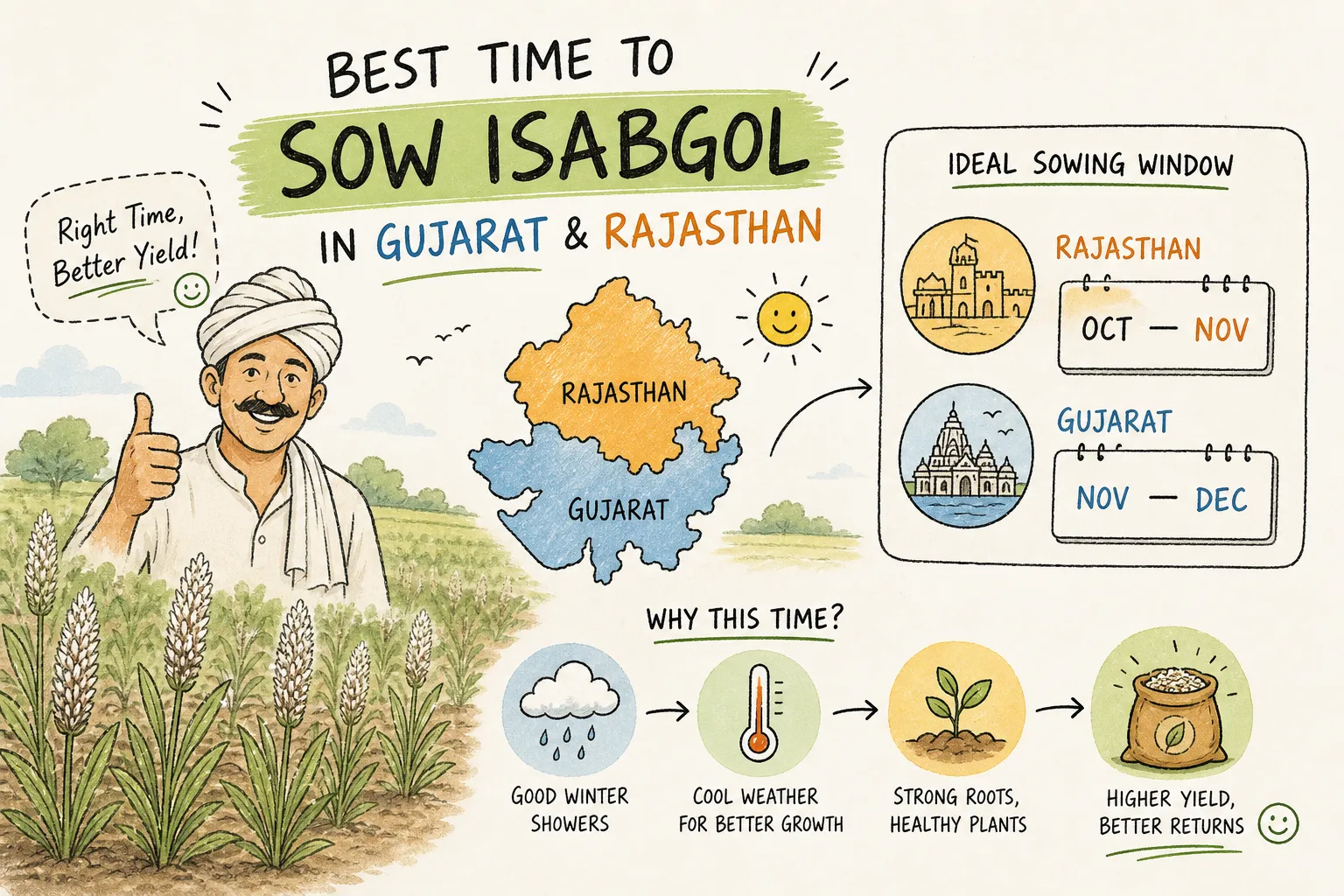
The first fortnight of November is the optimal sowing window for Rajasthan and Gujarat. Sowing before late October risks warm-temperature stress during early growth stages. Sowing after mid-November shortens the vegetative period, which reduces both yield and husk swelling capacity. Even a two-week delay can depress the husk index below the threshold that processors and pharma buyers require for premium-grade classification. In a market with no government MSP, that quality downgrade goes straight to your price.
Popular varieties and what they mean for grade and bhav
Improved varieties such as RI 89, UI-124, Pusa Utkarsh, and Arka Kartik consistently outperform local seed on husk purity, swelling capacity, and disease resistance. UI-124 in particular responds well to balanced NPK application of 45 kg N plus 30 kg P₂O₅ plus 20 kg K₂O per hectare, producing measurably higher-grade output. A higher husk swelling index, which is what buyers are paying for, typically commands a premium of several hundred to over a thousand rupees per quintal in active mandis compared to ordinary-grade lots. The cost of purchasing improved seed is marginal relative to the price gain at auction.
Agronomic practices that separate premium husk from ordinary lots
Quality at the mandi is built during the growing season. Processors and commission agents at APMC yards in Bhinmal, Barmer, and Jalore can distinguish a well-managed lot from a poorly managed one within minutes of visual and physical inspection. Farmers who follow recommended packages consistently receive higher quotes. This is not merely anecdotal, it is the direct result of superior husk index and lower contamination in well-grown crops.
Line sowing, seed rate, and stand establishment
Line sowing at approximately 15 cm row spacing is strongly preferred over broadcasting. It improves air circulation, reduces fungal pressure, and makes weeding manageable. The recommended seed rate for improved varieties is around 5, 8 kg per hectare. Farmers using local seed at excessive rates often end up with overcrowded, disease-prone stands that reduce both yield and husk quality. Overcrowded crops also create humidity pockets that increase post-harvest moisture problems, which translates directly into mandi discounts.
Fertilisation, FYM, and irrigation management
The most productive package in Rajasthan trials combines 10 tonnes of well-decomposed FYM per hectare with 30 kg N and 25, 30 kg P₂O₅, supplemented with PSB and Azotobacter biofertilisers. Irrigation timing is equally critical. Isabgol requires light irrigation at sowing, then again around 30 days and 70 days after sowing. Waterlogging, even briefly, stunts growth and increases susceptibility to root diseases that destroy husk quality. Damaged or diseased husk is automatically downgraded at the mandi, sometimes by an entire price tier.
How isabgol mandi bhav is affected by harvest timing, moisture, and shattering
Once the crop reaches maturity, typically 110, 130 days after sowing in February or March, every additional day in the field increases shattering risk and moisture variability. These post-field variables are among the most direct and immediate drivers of the price your crop receives at auction. Many farmers who manage agronomy well lose margin at this final stage.
How harvest timing connects to mandi price
Isabgol spikes should be harvested when they turn uniformly brown and dry. Harvesting in the early morning, when dew slightly reduces shattering loss, is the widely recommended practice across Rajasthan. Unseasonal rain events in late February to early March, in Barmer, Jalore, and Bikaner, caused standing crops to develop excess moisture and harvested lots to turn black in the field. Both outcomes reduce husk grade and carry direct mandi penalties.
Moisture content and grade classification
Most processors and exporters require isabgol seed with moisture content below 8, 10%. Lots arriving above this threshold are discounted immediately because damp husk is prone to aflatoxin and bacterial degradation during storage and transit. Even a 1, 2% moisture difference can shift a lot from Grade A to Grade B. In active markets, that grade difference is worth ₹1,000, ₹2,000 per quintal at the farm gate. Post-harvest drying under shade before transport to the mandi is not optional; it is a price protection measure.
Shattering losses and their indirect effect on isabgol mandi bhav
When a significant share of the Barmer or Jalore crop shatters due to delayed harvest or adverse weather, total arrivals at mandis fall. Lower arrivals alongside steady buyer demand create a supply-shock that can trigger sharp mandi rate increases in a short period. Shattering is therefore not just a yield loss for an individual farmer; it influences the market for everyone selling in that season.
How arrivals and export activity drive isabgol bhav at the mandi
Supply-side dynamics are the most immediate driver of isabgol mandi bhav on any given day. The price at Bhinmal, Phalodi, or Nokha is essentially a live signal of how much stock is arriving versus how aggressively processors and exporters are purchasing. Understanding this relationship helps you read the market rather than simply react to it.
Seasonal arrival patterns and isabgol price behaviour
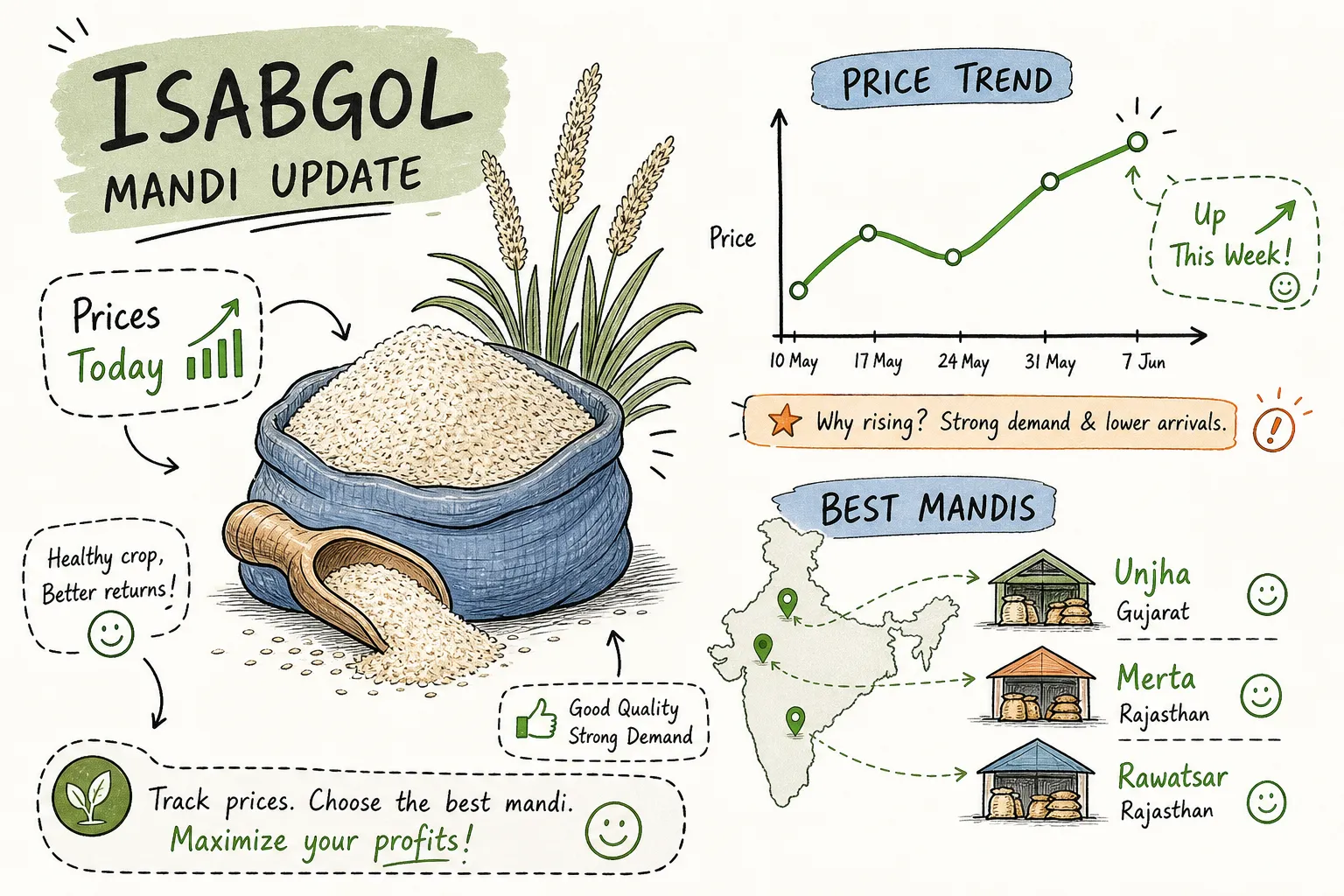
When fresh-crop arrivals peak in March and April, prices typically soften as market supply rises. By contrast, in tighter supply periods, bhav firms quickly. In one period at Bhinmal, monthly average prices reflected reduced stock from the previous season combined with active export buying (discussed in detail in the shattering section above). Later, major Rajasthan mandis including Phalodi, Bhinmal, Bajju and Rani traded within a range reflecting normalised supply conditions. The typical cost of production for a small farmer in Rajasthan leaves a meaningful margin. However, even modest price differences on a 50-quintal lot can amount to a significant sum.
Export bookings and processor inventory as price levers
Strong export bookings pull stock out of domestic mandis faster. When processors simultaneously hold low inventories, they compete with export buyers for the same lots and bid prices up quickly. When processors are already stocked and export demand is quiet, buying slows and bhav weakens. Rival producing countries such as Iran and Afghanistan influence sentiment in global markets but rarely disrupt Indian domestic pricing significantly, because India's share of global supply is so dominant that a poor Iranian crop mainly reinforces Indian export demand rather than creating domestic price volatility on its own.
Global psyllium husk demand: the external force that sets your price ceiling
The pharma and nutraceutical sectors in the United States, Europe, and the Middle East are the ultimate buyers for Indian isabgol. Their procurement calendars and ingredient sourcing decisions set the demand ceiling that filters back through exporters and processors all the way to Rajasthan mandis. Farmers who understand this link can interpret isabgol mandi bhav signals more accurately than those who only watch local arrival volumes.
Pharma demand and its preference for premium grades
Pharmaceutical-grade psyllium husk requires a swelling index of at least 40 mL per gram, plus tight purity and moisture certification. When pharma demand strengthens, it creates a two-tier market: premium lots are bid up sharply, while ordinary-grade stock remains subdued. Farmers with well-managed crops, certified improved varieties, and careful post-harvest moisture control are best positioned to capture this premium. The difference between selling into pharma-grade demand versus food-grade demand can be several hundred to over a thousand rupees per quintal for the same quantity.
How global supply sentiment reaches local mandis
If a major importing country tightens food safety standards, or a competing Iranian crop fails, Indian exporters receive stronger forward orders. Those orders translate into earlier and more aggressive buying at APMC yards in Barmer, Jalore, and Nokha. The chain is straightforward: international demand shifts, exporter behaviour changes, processor procurement accelerates, and isabgol mandi bhav responds within days to weeks. This is the reason keeping track of export market news is as relevant to your selling decision as watching local arrival volumes at the nearest mandi.
How to check live isabgol mandi bhav and sell at the right time
Knowing the agronomic and market factors that influence isabgol crop details and how mandi bhav is affected is only half the equation. The other half is having access to live, verified mandi rates across multiple APMC yards so you can decide exactly when and where to sell your fasal. Without current price data across mandis, you are negotiating blind.
Why comparing multiple mandis before selling matters
Isabgol prices vary meaningfully between mandis on the same day. Bhinmal in Jalore district, Bajju in Bikaner, and Rani in Rajasthan can quote different rates based on local arrival volumes, buyer presence, and quality mix. A farmer who accepts the first quote at the first mandi without comparing can leave a significant amount per quintal on the table. The transport cost of going to a second mandi is often far less than the per-quintal price difference between yards.
Using KhetiKisaan to cross-check live APMC rates
KhetiKisaan provides live isabgol mandi bhav data sourced from on-ground contacts who are physically present at APMC auctions during active bol-chaal (bidding). This means the rates reflect actual transaction prices rather than delayed government feeds or estimated averages. Before loading your isabgol for transport, checking KhetiKisaan's mandi-wise listings for Barmer, Jalore, Nokha, and Bhinmal takes minutes and gives you a clear picture of which yard is quoting the strongest price on that day. Commercial traders and arhatiyas (commission agents) already use this kind of real-time cross-mandi intelligence routinely; there is no reason small and marginal kisaans should be without it.
Storage versus immediate selling: a quick framework
If arrivals are heavy and bhav is soft relative to your production cost of approximately ₹5,100, ₹5,200 per quintal, short-term storage in dry, cool conditions with moisture kept below 10% is a viable option. Isabgol stores reasonably well under proper conditions, and waiting out a temporary supply glut can recover meaningful margin. However, if export demand signals are strong and processor buying is active in mandis, waiting can cost you the price window. The live rate data on KhetiKisaan helps you make this call based on current market information rather than mandi rumour.
Final takeaway: your isabgol crop decisions determine your mandi bhav
Isabgol mandi bhav is not random. It is the outcome of a chain of decisions that starts with sowing week and variety selection, runs through fertilisation, irrigation, and pest management, and ends at the mandi gate with moisture level and arrival timing. Every link in that chain either adds to or subtracts from the price you receive. A farmer who sows on time with improved seed, manages irrigation carefully, harvests at the right moment, and dries the crop properly before transport has done everything possible to claim a premium-grade price at auction.
The part of the equation you cannot control, export demand, processor inventory levels, and seasonal arrival volumes, can still be monitored. Tracking live isabgol mandi bhav across multiple APMC yards before you sell is the single most practical step a kisaan can take to protect margin on the market-facing side. Before you decide where and when to sell your next isabgol lot, visit KhetiKisaan to check verified, real-time rates from the mandis closest to you. That one cross-check, done consistently, is how experienced growers and traders stay ahead of the market.
| Mandi | Price | Date |
|---|---|---|
| Medta City | 13,000.00/- | 02 Oct, 2026 |
| Nohar | 11,700.00/- | 02 Oct, 2026 |
| Bikaner | 14,000.00/- | 02 Oct, 2026 |
| Nokha | 12,200.00/- | 02 Oct, 2026 |
| Nagaur | 13,050.00/- | 02 Oct, 2026 |
| Neemuch MP | 12,000.00/- | 02 Oct, 2026 |
| Mandsaur MP | 12,000.00/- | 02 Oct, 2026 |
| Sardarshahar | 12,004.00/- | 01 Oct, 2026 |
| Arjunsar | 12,530.00/- | 01 Oct, 2026 |
| Phalodi | 14,500.00/- | 02 Oct, 2026 |
| Nimbahera | 12,000.00/- | 01 Oct, 2026 |
| Osian | 15,200.00/- | 02 Oct, 2026 |
| Mohangarh | 12,800.00/- | 01 Oct, 2026 |
| Pugal Road | 11,500.00/- | 01 Oct, 2026 |
| Barisadri | 11,000.00/- | 01 Oct, 2026 |
| Jayal | 10,200.00/- | 01 Oct, 2026 |
| Madanganj | 10,200.00/- | 01 Oct, 2026 |
| Jodhpur | 15,000.00/- | 02 Oct, 2026 |
| Bhagat ki Kothi | 13,500.00/- | 01 Oct, 2026 |
| Viramgam GJ | 8,655.00/- | 01 Oct, 2026 |
| Gondal GJ | 11,417.00/- | 01 Oct, 2026 |
| Sri Dungargarh | 12,204.00/- | 02 Oct, 2026 |
FAQ's
Related Blogs
 Sep 23, 2026
 by Pankaj Sihag
Sep 19, 2026
by Pankaj Sihag

Sep 09, 2026
by Pankaj Sihag
Sep 08, 2026
by Pankaj Sihag