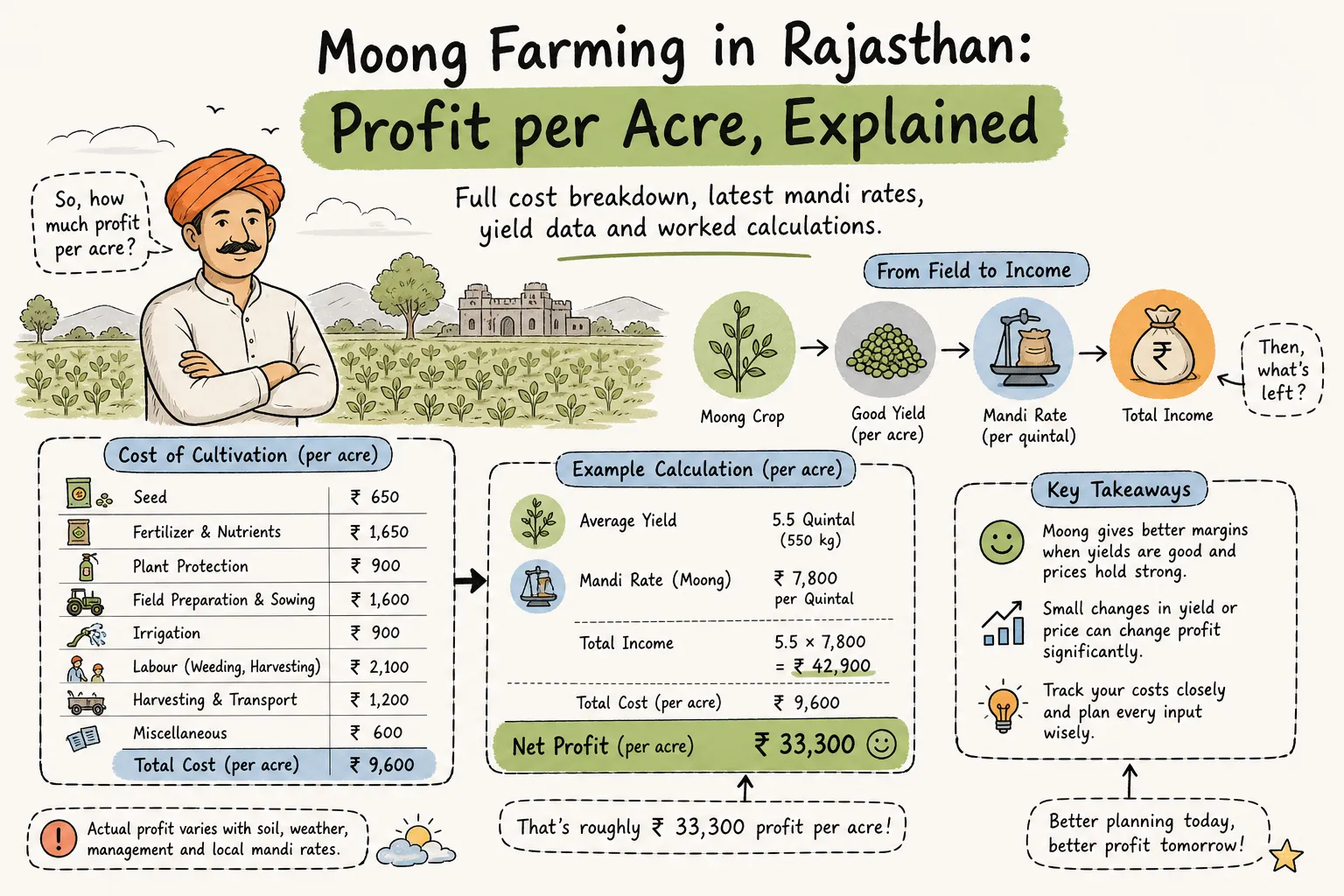









Moong
Moong: All Prices are in Quintal
Description
| Parameter | Detail |
|---|---|
| Crop type | Short-duration warm-season pulse (Vigna radiata) |
| Seasons | Kharif (June, July sowing), Zaid/Summer (February, March sowing) |
| Maturity | 60, 75 days for most commercial varieties |
| Average yield (rainfed kharif) | 6, 10 quintals per hectare |
| Average yield (irrigated zaid) | 12, 15 quintals per hectare |
| Main producing states | Rajasthan (~40, 46%), Madhya Pradesh (~14, 25%), Maharashtra, Karnataka, Bihar, Gujarat |
| Key price drivers | Monsoon arrival volumes, MSP enforcement, export demand, quality grade, NCDEX futures signals |
| Major Rajasthan mandi centres | Nohar, Sri Ganganagar, Hanumangarh |
Moong (green gram) is one of the few pulse crops in India that gives a kisaan two genuine chances to earn in a single year. Its short 60, 75-day cycle slots neatly into both the kharif rotation after monsoon onset and the zaid (summer) window before the heat sets in. Understanding moong crop characteristics and what affects moong mandi bhav, the price you actually receive at the auction yard, is valuable whether you grow it, trade it, or advise farmers on when to sell.
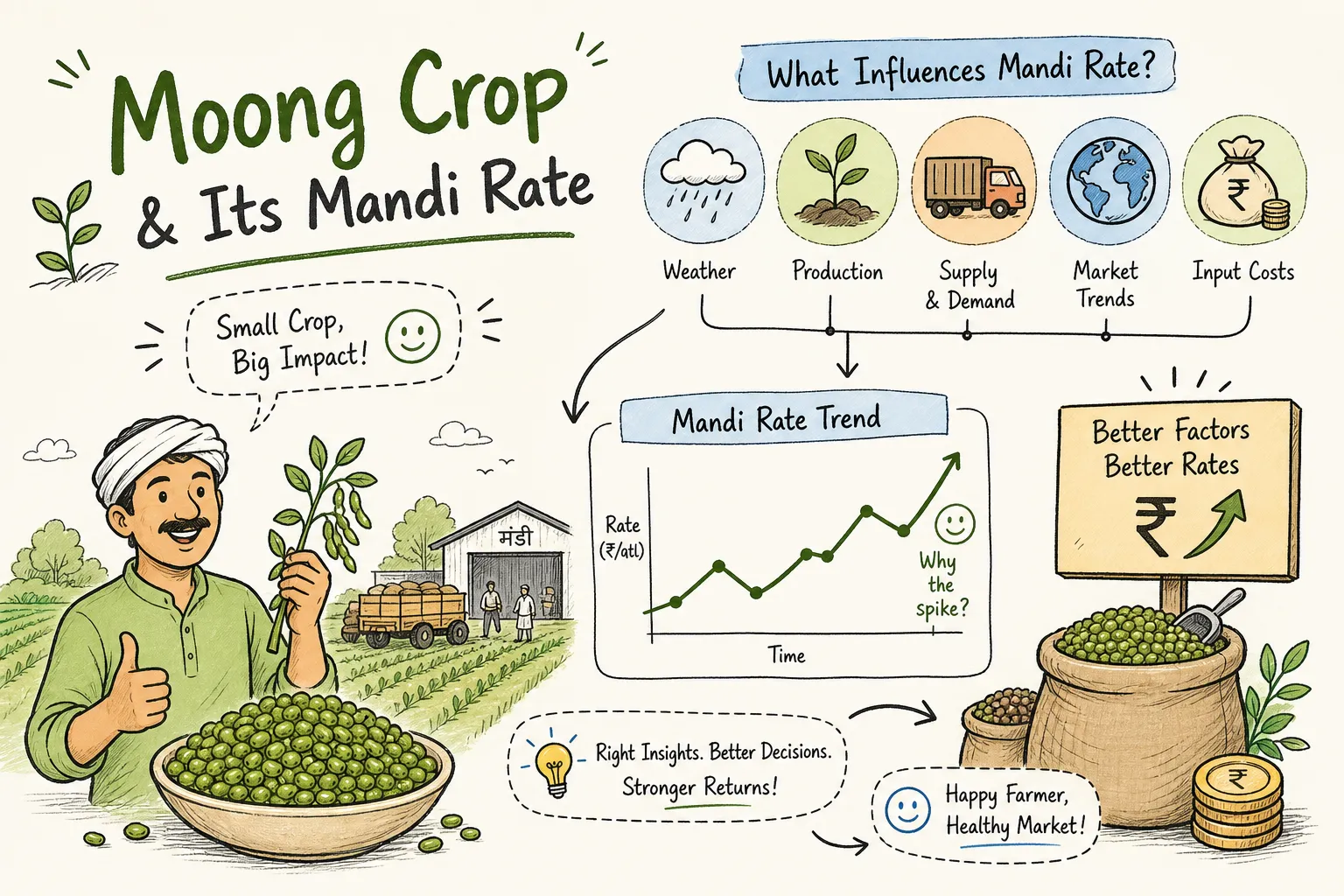
Moong mandi bhav is not simply a function of how much you grew. It responds to monsoon timing, government procurement activity, export demand, and quality at harvest. These factors interact with national arrival patterns across half a dozen producing states simultaneously. A farmer in Nohar who understands the key drivers behind moong mandi bhav is in a fundamentally different position than one who simply loads his trolley and hopes for a good rate on the day.
This article covers the crop's agronomic characteristics, the two sowing calendars, quality parameters that split premium from commodity-grade lots, and the institutional factors that move moong prices up or down independent of what happens in your own field. Read this once carefully and you will have a working framework you can apply every season.
What kind of crop is moong, and why do farmers depend on it
Moong is a warm-season dal crop that performs in both rainfed and lightly irrigated conditions. It fixes atmospheric nitrogen into the soil for the next fasal and matures fast enough to fit between two main crops without competing with them. For a kisaan in Rajasthan or Haryana managing sandy-loam to loamy soils, those three traits together make moong a workable choice that other pulses simply cannot match on duration alone.
The crop's sensitivity to waterlogging is worth flagging right away. Moong does not tolerate standing water, and heavy continuous rain during flowering and podding causes serious pod damage that shows up later as discoloured, shrivelled grain at the mandi. Understanding this vulnerability is not just agronomy, it is directly connected to the price you will receive. Damaged grain fetches a meaningfully lower rate per quintal, so the field decision to harvest quickly after rain exposure has a direct rupee value attached to it.
Agronomic traits that suit North India's conditions
Moong grows best at temperatures between 25°C and 32°C, which is exactly the range that kharif and summer seasons in Rajasthan and Haryana provide. Kharif sowing should be completed by 15 July at the latest; sowing beyond this window reduces the growing period before temperatures drop, compresses yield potential, and shifts your harvest later into a period when arrivals from other states are already flooding the mandi. For zaid, sowing by end of February or early March is non-negotiable because the crop needs to mature before peak summer heat and pre-monsoon humidity arrive.
Why moong fits multiple cropping systems
Because moong matures in roughly 65 days, it can be inserted as a catch crop between wheat (rabi) and the next kharif sowing without leaving the zameen (land) idle for more than a few weeks. The nitrogen it fixes reduces fertiliser cost for the following fasal, a concrete economic benefit that a moong-wheat rotation delivers even in a year when moong prices are average. The fact that moong arrives from two different seasons, zaid harvest in May, June and kharif harvest in September, October, is itself a price factor that traders track closely, because two separate supply pulses hit the mandi at different times of the year.
Major varieties and the sowing calendar farmers should know
The variety you choose affects both your yield and your selling window. In North India, the widely grown commercial varieties are Pusa Vishal, PDM 139, Pant Moong-5, Virat, and HUM 16. According to ICAR and state agricultural university extension literature, Pusa Vishal and PDM 139 are popular in Rajasthan and Haryana for their 60, 65-day duration and reasonable tolerance of kharif conditions. HUM 16 and Virat are commonly preferred for their seed size and bright grain colour, which matters at the mandi because larger, uniform green grain fetches better rates from dal millers and export buyers.
On variety duration: a shorter-duration variety harvests earlier, which means you can potentially reach the mandi before the main arrival pressure from neighbouring states builds up. In seasons where competing state arrivals compress into a tight window, that timing advantage is worth more than a marginal yield difference between varieties, as seen in years when Madhya Pradesh arrivals flood Rajasthan mandis in the third week of October.
Kharif vs zaid: which season delivers better market timing
Zaid moong, harvested in May, June, reaches the mandi before the main kharif flush from Rajasthan, Madhya Pradesh, and Maharashtra arrives in September, October. When domestic stocks are low in the lean months before the kharif crop, zaid moong often commands firmer prices simply because supply is limited and mill demand is consistent. The trade-off is clear: zaid requires confirmed irrigation access, and yield targets of 12, 15 quintals per hectare are only achievable with proper water management. Kharif moong, while lower in irrigation cost, arrives during the highest supply period of the year when multiple states harvest simultaneously, which typically softens mandi rates unless procurement or export demand absorbs the surplus.
Key producing states and mandi centres to watch
Rajasthan contributes roughly 40, 46% of India's total moong production (as reported in Directorate of Pulses Development data across recent seasons), making it the dominant state by a large margin. Madhya Pradesh follows at 14, 25%, with Maharashtra and Karnataka adding meaningful volumes. For a farmer in Nohar or Sri Ganganagar, the mandi bhav in your local market is not determined only by what your neighbours are bringing in. It responds to what is arriving in Bhind, Morena, and Neemuch in Madhya Pradesh at the same time. Tracking arrivals across these competing zones matters as much as watching local weather.
Nutritional value and why processors and exporters want moong
Moong carries roughly 24, 26% protein content, is highly digestible, and is embedded in Indian diets across every region as dal, sprouts, and processed food ingredients. That consistent year-round demand from households, dal mills, and sprout producers creates a price floor that prevents the kind of seasonal collapse that some other kharif crops experience after harvest. Mill demand does not disappear in October just because arrivals rise sharply; it continues steadily, which cushions the price impact of heavy arrival periods.
The export market adds another demand layer. India is among the top global exporters of green gram (mung bean), shipping to the UAE, Singapore, Canada, Malaysia, Bangladesh, Sri Lanka, and Nepal. When export enquiries are strong, surplus domestic arrivals find an exit route and prices hold up better than the domestic supply picture alone would suggest. Conversely, if the government restricts exports or global buyers shift to other origins, that external absorber closes and domestic mandi prices feel the pressure.
Why quality moong fetches a premium over commodity-grade lots
Processors and export agents do not buy on arrival volume alone; they buy on specification. Large, uniform, bright green grain with moisture below 10, 12% and minimal broken or foreign matter is what they need for dal milling recovery and export grading. Lots that fall short of these standards are discounted sharply because the buyer absorbs the cost of cleaning, drying, or re-grading. Based on mandi price-differential patterns for premium versus commodity-grade lots, the gap can run to several hundred rupees per quintal, enough to make post-harvest handling effort financially worthwhile on even a modest holding.
Export demand as a sustained price support mechanism
When export demand is running strong and the government has not imposed minimum export price restrictions or duty barriers, domestic mandi bhav benefits because a share of every state's production moves out of the country instead of competing for mill buyers domestically. Policy signals around export promotion or restriction move market sentiment quickly, often within days of announcement, which is why monitoring agricultural trade news matters as much as watching daily arrival figures.
How monsoon timing and arrival volumes affect moong mandi bhav
Moong mandi bhav is, at its core, a supply-demand number. In any kharif season, monsoon timing is the single largest variable that determines how much moong reaches the mandi, when it arrives, and what condition it is in. A late or uneven monsoon delays sowing beyond the ideal mid-July window, compresses yield potential, and often shifts harvest from multiple states into a shorter, concentrated window, creating downward price pressure when all that grain reaches the mandi at once.
The relationship between sowing acreage and price is direct. When erratic monsoon conditions in Rajasthan, Karnataka, and Maharashtra reduce sowing acreage by around 10, 11%, total kharif arrivals fall proportionately. Lower arrivals mean tighter supply at the mandi, which firms up prices. Farmers who understand this pattern can watch June, July sowing progress reports as a forward indicator of what September, October mandi rates are likely to do.
The sowing-to-arrival chain: why delayed rains shift your selling window
Moong varieties used in North India take roughly 60, 75 days from sowing to harvest. A monsoon that arrives two to three weeks late does not just reduce yield; it pushes every farmer's harvest into the same compressed window, concentrating arrivals in a shorter period and amplifying price volatility. Instead of a gradual build-up of supply over four to five weeks, the mandi sees a sharp surge for two to three weeks, which drives rates down temporarily before supply normalises. If arrivals will be compressed in a particular season, selling earlier in the arrival window rather than at mid-peak makes a concrete difference to your rate per quintal.
Excess rain at flowering and podding: a hidden yield and quality risk
Even when monsoon timing is satisfactory, continuous heavy rain during the flowering and podding stage damages pods and increases the proportion of discoloured, immature, and damaged grain in the harvest. This is a less-discussed risk that directly affects the price category your lot falls into at the mandi. Farmers who recognise this risk during the season can move faster after harvest: quick sun-drying to reduce moisture, prompt threshing before grain quality degrades further, and early mandi entry before damaged grain develops the visible discolouration that buyers penalise.
MSP, government procurement and import-export policy: the biggest institutional price movers
The announced MSP for moong in Kharif Marketing Season 2026, 27 is ₹8,780 per quintal, as notified by the Government of India. That number matters as a benchmark, but it functions as a real price floor only when state agencies or NAFED are actively procuring in your area without caps on quantity. The distinction between the announced MSP and effective procurement is one that many kisaans learn the hard way.
In seasons where procurement is capped, at 25% of a farmer's production in some reported Madhya Pradesh operations, the remaining crop reaches the open mandi regardless. When multiple states' surplus hits the mandi simultaneously without a procurement safety valve, prices can fall well below the MSP figure on paper. The announced price and the price you actually receive are two different numbers unless the procurement infrastructure around you is operational and uncapped.
When MSP protects you and when it doesn't
MSP protects you when there is an active procurement camp within a reasonable distance, when the procuring agency has sufficient purchase authorisation, and when you can get your lot graded and verified quickly. When procurement is absent, announced late, or capped at low quantities, the MSP offers no real protection against open-market price declines. Before harvest, the actionable question to ask is not "what is the MSP?" but "which agency is procuring in my district this season, and when do camps open?"
Buffer stock releases work in the opposite direction. When NAFED offloads stored moong into the market at subsidised rates, it adds effective supply without adding fresh production, which caps the price upside even when mandi arrivals are moderate. Import liberalisation has a similar dampening effect: cheaper imports of yellow pea or moong from other origins erode domestic prices within weeks of a duty relaxation announcement. When both mechanisms operate together, even a moderate arrival season can see prices stall well below what the supply picture alone would predict.
Export demand and import restriction: the policy levers that move moong mandi bhav fast
Government decisions on export promotion, minimum export price, and import duty move moong mandi rates faster than almost any other factor. Removing export duties or relaxing minimum export prices can tighten domestic supply and push rates up within days, as buyers anticipate reduced domestic availability. Conversely, an import duty cut or a duty-free import window suppresses local prices within weeks of announcement. Policy signals of this kind can shift your selling decision by several hundred rupees per quintal with very little warning, making agricultural trade news a daily priority alongside arrival figures.
Quality at harvest: the grading factors that make or break your rate per quintal
At the mandi, two lots of moong from the same field can receive meaningfully different prices depending entirely on post-harvest handling. The grading parameters that buyers apply consistently are moisture content, foreign matter, broken and damaged grains, and grain colour. Getting these right before you load your trolley is one of the highest-return investments of time a farmer can make after harvest.
Moisture is the strongest single price-deduction driver. High-moisture moong above 12% moves into a lower quality band and is discounted sharply because the buyer absorbs the drying cost and spoilage risk. Foreign matter, soil, stones, weed seeds, is penalised because it reduces the usable quantity the buyer actually receives per quintal. Broken and shrivelled grains lower the recovery rate for the dal miller, which directly reduces what they will pay for your lot.
Moisture, foreign matter and broken grains: the three parameters to get right
Achievable targets for a market-ready lot, consistent with NCDEX contract specifications and common trade grade norms, are: moisture below 10, 12%, foreign matter under 1%, and broken or damaged grains below 3% for premium-grade pricing. These are achievable with proper threshing, winnowing, sieving, and two to three days of sun-drying after harvest. The effort required to reduce moisture from 14, 15% down to below 12% is relatively small; the price gain per quintal for that effort is not.
How colour and grain size affect your moong mandi bhav
Bright, uniform green colour and large, consistent grain size attract processor and export premiums above the standard mandi rate. Discolouration from excess rain at harvest, poor drying, or delayed threshing can drop an otherwise good lot into commodity-grade pricing despite adequate protein content. Timely harvest at roughly 80% pod maturity protects both yield quantity and grain quality simultaneously. Harvesting too late, after pods have begun to shatter, increases losses; harvesting before pods have dried adequately raises drying cost and increases the risk of discolouration during storage.
NCDEX futures and what national price signals tell the market
NCDEX moong futures contracts are traded in 5-metric-tonne lots, quoted per 100 kg, with a tick size of ₹1 per 100 kg. The last trading day is the 20th of the contract expiry month, and the delivery basis location is Ex-Merta City. These are details that matter for traders who hedge on the exchange, but even for a farmer or commission agent (arhatiya) who never trades a futures contract, the NCDEX futures price is a useful forward signal worth checking regularly.
When futures prices are running at a significant premium to current spot mandi rates, the market is signalling an expectation that supply will tighten ahead. That signal often reflects anticipated export orders, procurement news, or below-normal arrival projections that professional traders are pricing in before the effect reaches ground-level mandis. For example, if the near-month futures contract is trading ₹400, 500 above the Nohar spot rate, it suggests the market foresees tighter availability, the kind of signal worth cross-referencing with sowing area data before you decide whether to hold or sell. When futures trade at or below current spot, the market is pricing in rising arrivals or softening demand.
How to read bullish and bearish futures signals as a non-trader
A straightforward rule for the farmer or trader who watches futures without trading them: if NCDEX moong futures are trading at a meaningful premium to your local mandi bhav, holding stock in proper dry storage may be worth considering, provided your holding cost is low and grain quality is well within moisture limits. If futures are flat or declining while local arrivals are rising, selling early in the arrival window is generally the lower-risk choice. Waiting for a price recovery during a bearish futures period, with mounting holding costs and quality risk, rarely works in the farmer's favour.
When futures and mandi prices diverge: what that tells you
Divergence between NCDEX futures and local mandi spot rates is a signal to investigate, not to ignore. If futures are elevated while local prices lag, the market may be pricing in an expected export order, a procurement announcement, or a policy change that has not yet affected ground-level mandis. If local prices are elevated while futures are subdued, it may reflect a temporary local supply disruption rather than a genuine national tightening. Both cases point to the same response: check recent news on MSP procurement announcements, export policy, and buffer stock releases before making your selling decision.
Concrete steps to protect your moong income and act on price signals in real time
All the market intelligence in this article only has value if you can translate it into a selling decision on a specific day at a specific mandi. Three decisions do most of the work: timing your sale around arrival patterns, maintaining quality through proper post-harvest handling, and tracking live moong mandi bhav to compare markets before you commit.
On timing: zaid moong sold in May, June typically faces less arrival competition than kharif moong sold in September, October. For kharif, holding your lot for four to six weeks after peak arrivals, if storage is dry and grain quality is within moisture limits, frequently yields a better rate as seasonal supply pressure eases and stocks in dal mills start to thin out. Selling at the exact peak of arrivals simply because the crop is ready and the trolley is available is the most common timing mistake that costs farmers real money per quintal.
Timing, storage and grading: three decisions that move your rate
On timing: sell before the arrival peak or well after it, not during it. A two-week wait after the heaviest arrival days can recover ₹150, 300 per quintal in a normal season. On storage: basic dry, covered storage with proper ventilation costs very little for a four-to-six week hold period. The question to ask is whether the expected price gain exceeds the holding cost and quality risk. On grading: winnow, sieve, and sun-dry your lot to target moisture below 12% and foreign matter below 1% before mandi entry. A single day of proper cleaning effort can shift your lot from commodity pricing into the premium bracket that dal millers and exporters actively compete for.
Tracking live moong mandi bhav on KhetiKisaan
All the price-signal awareness in this article depends on one thing: accurate, timely rate information from the mandis that matter to you. KhetiKisaan publishes real-time moong mandi bhav across key Rajasthan mandis, including Nohar and Sri Ganganagar, with rates sourced from on-ground contacts who are physically present at live APMC auctions during the bol-chaal (bidding). These rates reflect what buyers are actually paying on that day's auction floor, not delayed government feeds or estimated averages. If moong arrivals are rising in Nohar and the rate is softening faster than in Sri Ganganagar, that live comparison alone tells you something about where to take your lot and whether to wait another day. Check live moong mandi bhav on KhetiKisaan before you load your trolley.
Moong crop description and moong mandi bhav: key takeaways for farmers and traders
Moong's short duration, dual-season flexibility, and consistent processor demand give it a structural advantage among kharif pulses, but the price you receive is shaped by factors well beyond your field boundary. Monsoon timing, arrival volumes from competing states, MSP procurement reach, export policy, and your lot's quality at grading collectively determine whether you sell at the top or the bottom of the day's rate range. Understanding the moong crop description and what affects moong mandi bhav is not an academic exercise; it is the difference between a reactive sell and a timed, informed decision. Use KhetiKisaan's live mandi rates, monitor sowing progress reports from June onwards, and invest one day of post-harvest effort in quality preparation, these on-the-ground steps consistently move the needle on what you receive per quintal.
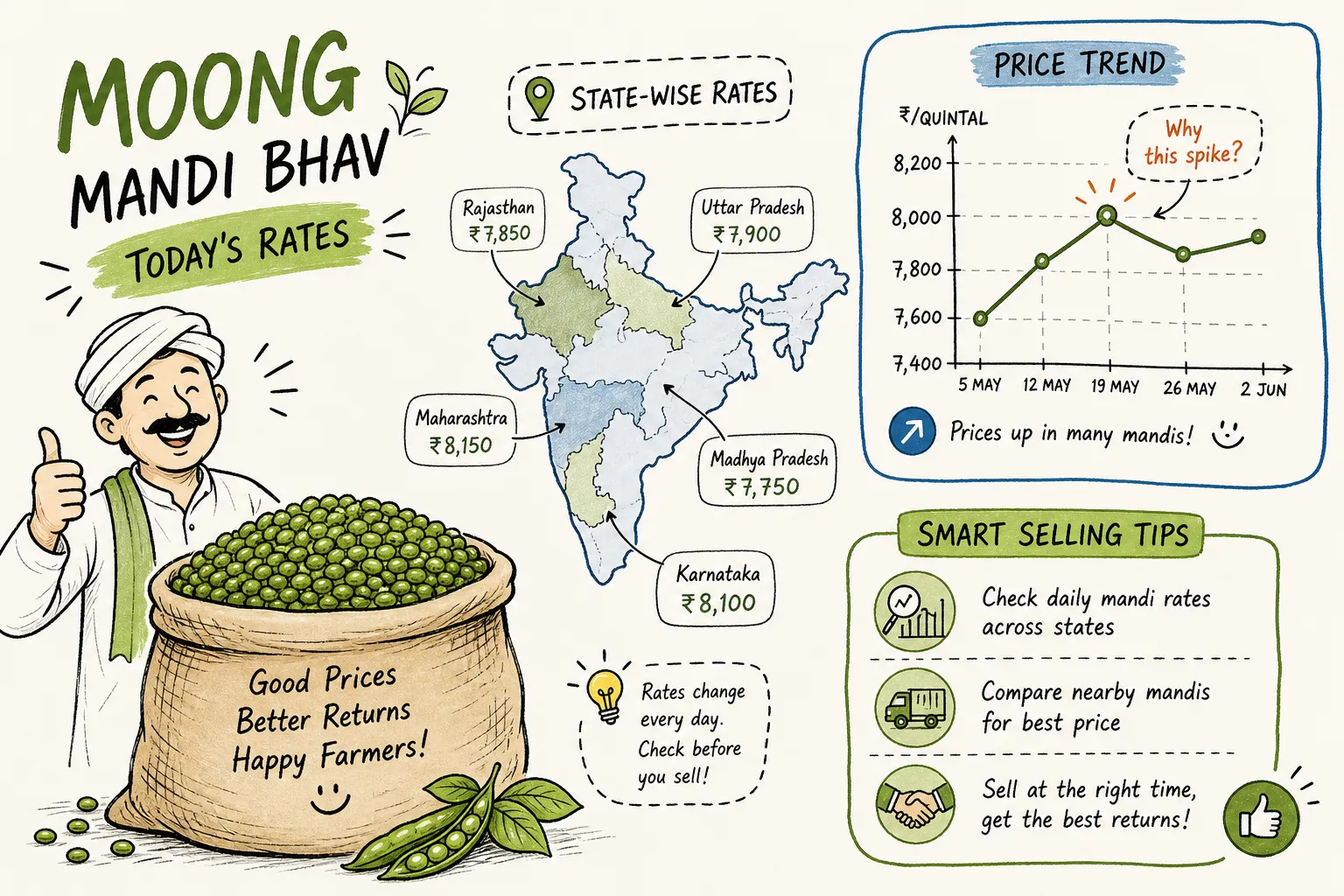
Green Gram Mandi Price
Green Gram Mandi Price helps farmers see the latest moong rates in mandis. Moong, also called green gram, is a short-term crop. It is grown in many parts of India and has good demand in the market.
Moong can be grown in two seasons. It is sown from June to July in Kharif and from March to April in summer. It grows well in warm climatic conditions. It requires less water and thrives more in sandy soils or loamy soils.
Moong is good for the soil. It enhances the strength of the land and aids the growth of the preceding crop to enhance more. It is also grown alongside other crops such as maize and millet by farmers. The plant may be utilized as fodder after harvest.
Moong is used in daily food. It is eaten as dal, sprouts, and flour. It is in demand in local and export markets, so farmers get good selling options.
Key Factors Affecting Green Gram Mandi Price
- Clean grains get a better price
- Low moisture is better
- Demand in mandi changes rates
- Short crop time gives fast return
- Good quality gives a higher price
Green Gram Mandi price changes based on quality and demand. Farmers check the Green Gram Mandi price daily to choose the right time to sell and get better value.
| Mandi | Price | Date |
|---|---|---|
| Medta City | 8,400.00/- | 02 Oct, 2026 |
| Nohar | 8,877.00/- | 02 Oct, 2026 |
| Sri Ganganagar | 8,315.00/- | 02 Oct, 2026 |
| Bikaner | 8,600.00/- | 02 Oct, 2026 |
| Siwani | 8,350.00/- | 02 Oct, 2026 |
| Rajgarh (Sadulpur) | 7,901.00/- | 02 Oct, 2026 |
| Nagaur | 8,600.00/- | 02 Oct, 2026 |
| Neemuch MP | 7,400.00/- | 02 Oct, 2026 |
| Indore MP | 7,252.00/- | 01 Oct, 2026 |
| Kota | 7,400.00/- | 02 Oct, 2026 |
| Sardarshahar | 8,400.00/- | 01 Oct, 2026 |
| Pipariya MP | 8,320.00/- | 01 Oct, 2026 |
| Kareli MP | 7,353.00/- | 01 Oct, 2026 |
| Ramganjmandi | 6,900.00/- | 01 Oct, 2026 |
| Bundi | 7,306.00/- | 01 Oct, 2026 |
| Phalodi | 7,451.00/- | 01 Oct, 2026 |
| Narsinghpur MP | 7,552.00/- | 01 Oct, 2026 |
| Khandwa MP | 7,500.00/- | 01 Oct, 2026 |
| Goluwala | 7,800.00/- | 02 Oct, 2026 |
| Sikanagaon MP | 7,505.00/- | 01 Oct, 2026 |
| GanjBasoda MP | 7,306.00/- | 01 Oct, 2026 |
| Khargone MP | 7,205.00/- | 01 Oct, 2026 |
| Degana | 7,450.00/- | 01 Oct, 2026 |
| Betul MP | 7,500.00/- | 01 Oct, 2026 |
| Dhamnod MP | 7,450.00/- | 01 Oct, 2026 |
| Sirsa | 8,603.00/- | 02 Oct, 2026 |
| Hanumangarh | 8,200.00/- | 02 Oct, 2026 |
| Sangaria | 8,551.00/- | 02 Oct, 2026 |
| Nimbahera | 7,252.00/- | 01 Oct, 2026 |
| Timarni MP | 7,200.00/- | 01 Oct, 2026 |
| Harda MP | 7,602.00/- | 01 Oct, 2026 |
| Bhattu | 7,901.00/- | 02 Oct, 2026 |
| Rawastar | 8,320.00/- | 02 Oct, 2026 |
| Ellenabad | 8,706.00/- | 02 Oct, 2026 |
| Abohar | 7,982.00/- | 02 Oct, 2026 |
| Udaypura | 7,900.00/- | 01 Oct, 2026 |
| Guna | 7,450.00/- | 01 Oct, 2026 |
| Kekadi | 7,550.00/- | 01 Oct, 2026 |
| Malpura | 7,400.00/- | 01 Oct, 2026 |
| Rajkot GJ | 7,500.00/- | 01 Oct, 2026 |
| Dahod GJ | 7,200.00/- | 01 Oct, 2026 |
| Bari MP | 7,350.00/- | 01 Oct, 2026 |
| Sironj MP | 6,801.00/- | 01 Oct, 2026 |
| Sheopur MP | 7,450.00/- | 30 Sep, 2026 |
| Jaora MP | 7,450.00/- | 01 Oct, 2026 |
| Aadampur | 8,100.00/- | 02 Oct, 2026 |
| Ghadsana | 8,700.00/- | 02 Oct, 2026 |
| RaisinghNagar | 8,700.00/- | 02 Oct, 2026 |
| Anoopgarh | 8,686.00/- | 02 Oct, 2026 |
| Sadulsahar | 7,353.00/- | 01 Oct, 2026 |
| Khanpur | 7,500.00/- | 01 Oct, 2026 |
| Banapura MP | 7,451.00/- | 01 Oct, 2026 |
| Pillibanga | 8,500.00/- | 02 Oct, 2026 |
| Gajsinghpur | 8,145.00/- | 01 Oct, 2026 |
| Jaitsar | 8,901.00/- | 02 Oct, 2026 |
| Mohangarh | 7,755.00/- | 01 Oct, 2026 |
| Sri Vijaynagar | 8,700.00/- | 01 Oct, 2026 |
| Rawla | 8,100.00/- | 02 Oct, 2026 |
| Padampur | 8,400.00/- | 01 Oct, 2026 |
| Kesarisinghpur | 7,440.00/- | 01 Oct, 2026 |
| Suratgarh | 8,400.00/- | 01 Oct, 2026 |
| Sri Karanpur | 7,901.00/- | 01 Oct, 2026 |
| Bhadra | 7,200.00/- | 01 Oct, 2026 |
| Kawai Salpura | 5,840.00/- | 01 Oct, 2026 |
| Atru | 7,200.00/- | 01 Oct, 2026 |
| NaharGarh | 6,451.00/- | 01 Oct, 2026 |
| Samraniyan | 5,700.00/- | 01 Oct, 2026 |
| Khajuwala | 8,000.00/- | 01 Oct, 2026 |
| Pugal Road | 6,655.00/- | 01 Oct, 2026 |
| Tonk | 5,580.00/- | 01 Oct, 2026 |
| Uniyara | 6,601.00/- | 01 Oct, 2026 |
| Dooni | 6,000.00/- | 01 Oct, 2026 |
| Todaraisingh | 5,850.00/- | 01 Oct, 2026 |
| Chaksu | 7,000.00/- | 01 Oct, 2026 |
| Bagru | 6,800.00/- | 01 Oct, 2026 |
| Kishangarh | 7,100.00/- | 02 Oct, 2026 |
| Bhawani Mandi | 6,600.00/- | 02 Oct, 2026 |
| Jhalarapatan | 5,850.00/- | 01 Oct, 2026 |
| Bhilwara | 6,670.00/- | 02 Oct, 2026 |
| Sujangarh | 8,595.00/- | 02 Oct, 2026 |
| Jhunjhunu | 7,551.00/- | 02 Oct, 2026 |
| Dei | 7,008.00/- | 01 Oct, 2026 |
| Jayal | 8,450.00/- | 01 Oct, 2026 |
| Madanganj | 7,980.00/- | 01 Oct, 2026 |
| Jodhpur | 8,595.00/- | 02 Oct, 2026 |
| Bhagat ki Kothi | 8,400.00/- | 01 Oct, 2026 |
| Pratapgarh | 8,703.00/- | 02 Oct, 2026 |
| Gondal GJ | 8,350.00/- | 01 Oct, 2026 |
| Upleta GJ | 7,550.00/- | 01 Oct, 2026 |
| Mahuva GJ | 6,750.00/- | 01 Oct, 2026 |
| Palitana GJ | 8,600.00/- | 01 Oct, 2026 |
| Taleja GJ | 7,950.00/- | 01 Oct, 2026 |
 Sep 22, 2026
 by
by