










Sarso
Sarso: All Prices Are in Quintal
Description
Quick facts (sarso crop mandi bhav): Understanding the sarso crop description and what affects sarso mandi bhav begins with the basics. Sarso (mustard, Brassica juncea ) is India's dominant edible oilseed crop by cultivated area, B. juncea is the principal oilseed type grown commercially across the Hindi-heartland rabi belt. The crop is sown from October to November and harvested between February and March. Major varieties yield between 1,300 and 2,767 kg/ha depending on irrigation and seed type, with oil content typically ranging from 38% to 45% in high-yielding commercial lines.
Sarso is not just another rabi fasal. For kisaans across Rajasthan, Haryana, and adjoining states, it is an important source of seasonal income, for many farm households in these belts, it is the primary cash crop of the year. A difference of ₹400, 600 per quintal, entirely within the range that market timing and quality choices can deliver, materially affects whether a season ends in profit or merely breaks even. Understanding what moves sarso mandi bhav is not an academic exercise; it is a practical tool for protecting your earnings.
Tracking live APMC bol-chaal data from mandis across Rajasthan and Haryana, as KhetiKisaan does through on-ground contacts, reveals just how dramatically prices can shift within a single season. The same variety, sold in February versus April, from the same district, can fetch a per-quintal rate that differs by hundreds of rupees. This guide explains why that happens and what you can do about it.
Sarso crop description: varieties, oil content, and what affects mandi rates
Not all sarso is priced equally at the mandi. The variety you grow, its oil content, and the physical condition of the seed at delivery directly influence the per-quintal bid you receive from crushers and traders. A clear sarso crop description, covering which variety you have and its typical oil recovery, is often the first question a serious buyer asks before quoting a price.
Brown/Indian mustard: the dominant oilseed type
Brown mustard ( Brassica juncea ), locally known as raya or rai, accounts for the vast majority of commercial sarso grown in India. High-yielding varieties like Giriraj (2,246, 2,767 kg/ha, 38.7, 42.5% oil) and NRCDR 601 (1,939, 2,626 kg/ha, 39, 42% oil) are the benchmark against which crushers judge their purchase decisions. GDM-5 (Gujarat Dantiwada Mustard 5) is another consistent performer, yielding 2,081, 2,360 kg/ha at 38, 41.4% oil. Crushers calculate their bid partly on expected oil recovery per quintal, so varieties with consistently higher oil content receive stronger offers at the mandi, all else being equal.
Yellow sarso and Laha: smaller acreage, distinct market
Yellow sarso has lower pungency and earlier maturity, with oil content generally in the mid-30s to mid-40s percent range. Under typical field conditions across Rajasthan and Haryana, most commercial yellow sarso lots fall in the 36, 40% oil band, though this varies with agronomy and seed source. Laha is the local name for Brassica juncea in some regional markets and is generally classified alongside raya/rai at the mandi rather than as a separate premium category. Where yellow-sarso lots arrive with oil content in the lower part of that range, crusher bids tend to be softer compared to bold-seed brown mustard with proven oil recovery above 40%.
Variety traits that directly influence what a trader offers
Beyond oil percentage, three quality parameters separate a standard bid from a premium one at any APMC mandi. Bold seed size signals higher oil-bearing surface area and better crushing recovery. Moisture content at delivery is the single most controllable quality variable: new-crop sarso arriving above approximately 8% moisture attracts a discount because the crusher must account for drying costs and weight loss, in line with APMC quality norms. Erucic acid and glucosinolate levels matter primarily to premium buyers and processors targeting food-grade or export-grade mustard oil, but this is an emerging premium segment rather than the day-to-day mandi norm.
Where sarso grows and when: the regional calendar behind mandi timing
The production calendar is the foundation of price anticipation. Knowing when your state harvests relative to other producing states tells you whether you are selling into a building supply wave or a tapering one.
Rajasthan and Haryana: why they dominate sarso production
Rajasthan is consistently one of the largest mustard-producing states in India, with key producing districts including Alwar, Bharatpur, and Sri Ganganagar. According to Rajasthan Agriculture Department data, Bharatpur division contributes approximately 48% of the state's mustard output. Haryana is the second-largest producer, with its own significant contribution to the national arrival curve. The critical point is that both states harvest within the same narrow February, March window, which creates concentrated arrival pressure at mandis across the region simultaneously.
State-wise sowing and harvest windows
The table below summarises the production calendar across major sarso-growing states. Notice that Rajasthan, Haryana, Gujarat, and Uttar Pradesh all share the February, March harvest window, this simultaneous supply surge is the primary driver of peak-season mandi bhav pressure, and it is a pattern that repeats each year.
| State | Sowing window | Harvest window |
|---|---|---|
| Rajasthan | November | February, March |
| Haryana | Late October, November | February, March |
| Gujarat | October, November | February, March |
| Uttar Pradesh | October, November | February, March |
| Punjab | October, November | April, May |
Knowing this calendar helps you understand your competition in the mandi. When Rajasthan and Haryana harvest simultaneously, they together flood national markets with supply. Gujarat and UP add to that pressure within the same window. Punjab, harvesting slightly later, faces a market where early arrivals have already cleared.
Why the harvest window is your first pricing signal
Peak APMC arrivals for sarso in Rajasthan typically run from March through May, with April often recording the highest monthly volumes. January and February are genuinely low-arrival months in most mandis. A farmer selling in the second week of February, before the main harvest rush, faces meaningfully less competitive supply than one selling in mid-March at the height of arrivals. This seasonal timing is not a secret, but most farmers still sell at peak arrival because of cash-flow pressure rather than deliberate choice.
Seasonal arrivals and sarso mandi bhav: how supply volumes push prices up or down
Arrivals are the most immediate, observable price lever. You don't need a commodity trading background to read this signal; you just need to watch what is happening at your nearest mandi before you load your trolley.
The inverse relationship between arrivals and price
When large volumes of new-crop sarso hit major APMC mandis simultaneously, traders know supply is plentiful and bids soften. This is not speculation; it is documented in mandi-level data. Markets like Sumerpur, recording 3,000 or more bori arrivals on a given day, show consistent downward bid pressure. The pattern holds at a season level too: tight arrivals in a lean month support prices, heavy arrivals in the peak window suppress them. This inverse relationship between arrivals andsarso mandi bhavis the most reliable short-term pricing pattern in sarso markets.
Old crop versus new crop: sarson price dynamics at the mandi
Old-crop sarso stored from the previous season typically commands a ₹100, 200 per quintal premium over freshly harvested new crop at the same mandi during the March, April arrival rush. The reason is straightforward: stored sarso has lower moisture, better oil recovery, and has already proven it can survive storage without spoilage, which signals quality to crushers. New crop arriving directly from the field, especially if not properly dried, sits at the bottom of the day's bid range. This premium for stored sarso is one of the clearest arguments for farmers with storage capacity to hold some of their produce beyond the peak arrival period.
Reading arrival data before you take your fasal to the mandi
Watching arrival volumes reported from major mandis in your region over the previous three to five days gives you a directional signal before you make the trip. A sudden spike in daily receipts across multiple mandis means supply is building and bids are likely to soften. A tapering of arrivals into April, May, once the main harvest rush subsides, often restores better prices for farmers who can wait. Platforms like KhetiKisaan track mandi-level arrival and price data in real time, giving you the same information that commission agents and traders already have before the bol-chaal begins.
MSP as the price floor: what the government's support price really means for sarso farmers
MSP is the most quoted number in sarso markets. Its effect on actual mandi bhav is real but more nuanced than most farmers realise, and knowing the nuance helps you use it properly.
How the MSP announcement shifts market expectations
The government's minimum support price (MSP) declaration establishes a clear price floor for sarso, giving farmers confidence that they will not receive less than the announced rate. This assurance encourages growers to withhold sales when open-market offers fall below MSP, prompting traders and crushers to raise their bids to secure the crop. By signalling production-cost recovery and inter-crop parity, the MSP announcement influences market psychology, underpins mandi rates and helps stabilise price movements throughout the rabi season.
When MSP fails to protect and what to do about it
Despite its role as a support mechanism, MSP may not prevent mandi rates from dipping below the support level during periods of heavy arrivals or surges in edible-oil imports. To secure price support, farmers should register with procurement agencies (such as NAFED or their state procurement board) before the harvest season begins. Only registered farmers can access MSP through designated procurement centres, so early registration is essential. Additionally, exploring collective marketing via farmer producer organisations, direct sales to crushers, or simple value-addition practices can reduce dependency on MSP alone and improve price realisation.
Buffer stock procurement and its open-market effect
When government agencies buy large volumes for buffer stock, open-market supply tightens and spot prices lift. Conversely, when government releases buffer stock to control retail oil prices, it adds supply to the market and can cap mandi bhav. Tracking procurement and release announcements alongside daily mandi data gives you a more complete picture than price data alone. This macro-level intelligence is exactly what traders monitor every day; farmers who do the same narrow the information gap significantly.
Import duties and global edible oil prices: the macro lever most sarso farmers overlook
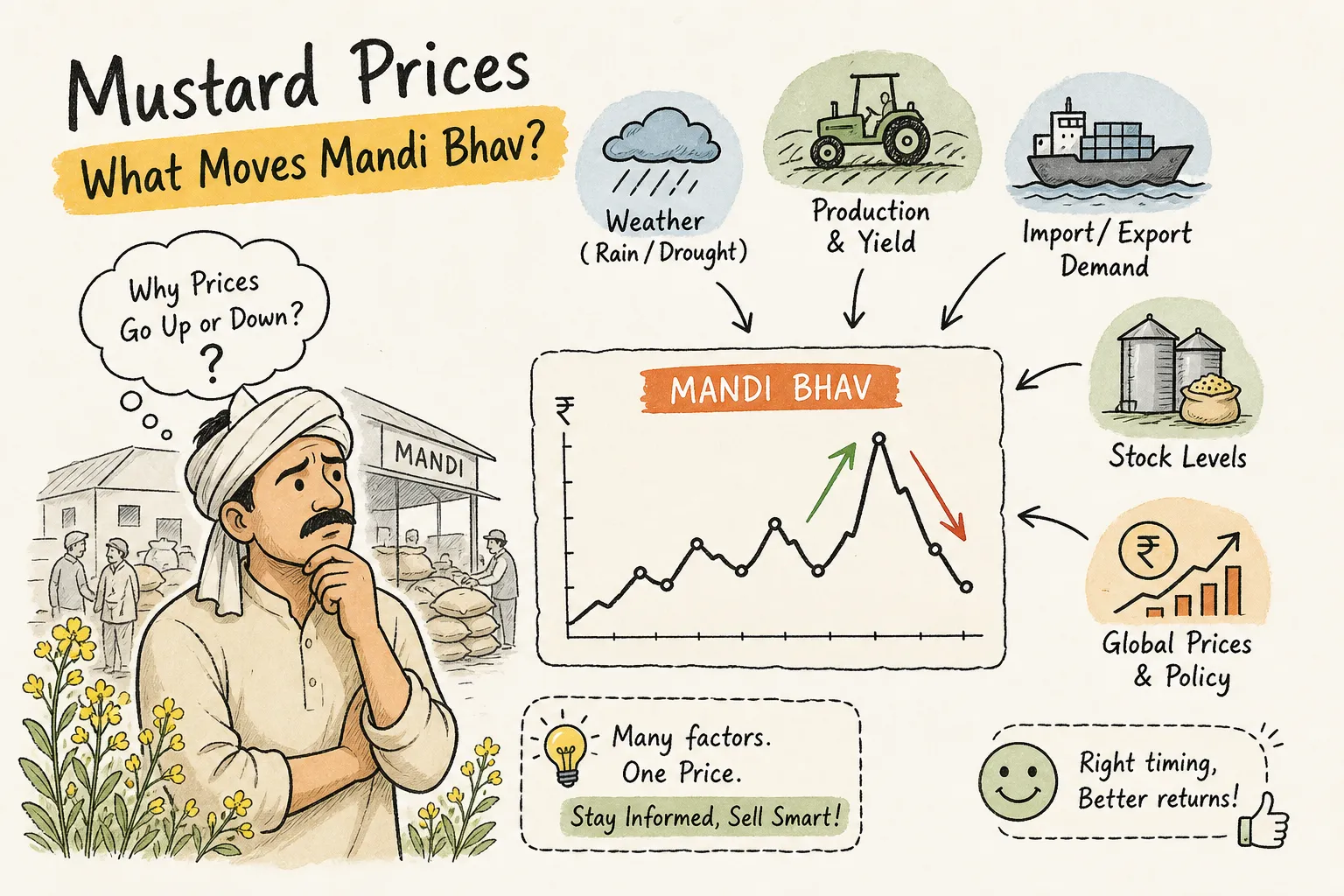
Domestic sarso mandi bhav does not move in isolation. International edible-oil markets transmit directly into what crushers are willing to pay for your crop at the APMC gate. The mechanism is simpler than it sounds.
Why palm oil import duties matter to your sarso bhav
India imports significant quantities of palm oil and soybean oil. When the government reduces import duties on these oils, cheaper foreign edible oil enters the domestic market, reducing the pressure on crushers to source domestic mustard. The result is softer bids for sarso. When duties are raised, imported oil becomes costlier, demand for domestic mustard oil rises, and crushers bid more aggressively at mandi auctions. Duty changes illustrate this clearly. For example, basic customs duty on crude palm oil was raised from 0% to 20%, lifting the effective import duty to 27.5% and supporting domestic oilseed prices. When this duty was later reduced to 10% (effective 16.5%), some of the upward pressure on domestic sarso prices eased. Refined palm oil duty, raised to 32.5% (effective 35.75%), remained unchanged thereafter.
How global edible-oil price cycles affect sarso mandi bhav
Global palm oil prices, driven by Malaysian and Indonesian output, and soybean oil prices, shaped by US and South American harvests, create cycles that ripple directly into Indian sarso mandis. A bull run in global edible oils generally supports domestic sarso bhav because it makes imported alternatives costlier and encourages domestic crushing. A global edible-oil price collapse tends to cap domestic sarso prices even when Indian supply is not particularly large. Traders and crushers monitor these international commodity markets closely, and their bids at your mandi already reflect those global signals in real time.
Crushing demand: the industrial engine behind mustard mandi rates
Mustard oil mills and solvent extraction plants are the primary buyers at APMC mandis. When crushing margins are healthy, when mustard oil retail prices are firm and oilcake (khali) demand from the animal feed sector is strong, crushers bid aggressively and prices stay supported. When crushing margins tighten, their bids soften even if sarso supply has not changed. Khali demand is often driven by the dairy and poultry sectors. A season with strong livestock feed demand can provide an additional floor under sarso prices that purely supply-side analysis would miss.
Weather and crop quality: underrated signals that move mustard prices
Two consecutive seasons of weather stress can sustain a multi-season price rally. One bumper crop can unwind months of bullish market sentiment within weeks of the harvest arriving at mandis. Weather signals are forward-looking price indicators that traders use well before harvest; farmers can use them too.
How monsoon carryover affects rabi sarso output
Sarso is a rabi crop, but its performance depends partly on soil-moisture carryover from the kharif-season monsoon. A weak or spatially uneven monsoon reduces groundwater recharge and depletes the moisture profile that October, November-sown sarso relies on for early establishment and root development. Lower carryover moisture generally translates into lower yields across the belt. Lower expected yields mean lower expected arrivals in February, March, which tends to support mandi prices even before a single grain of new crop arrives at the APMC yard.
Heat stress, frost, and their impact on oil content and yield
Field trial data from ICAR and international climate-agronomy research indicate that warming during the growing season reduces sarso yields, with experimental results showing declines ranging from approximately 0.36% for 0.5°C of warming to 1.4% for 2°C of warming above baseline temperatures. Frost during the flowering stage destroys pod set and directly reduces total marketable output. Beyond yield impact, heat during the seed-filling period lowers oil content, which matters to crushers who calculate their purchase bid on expected oil recovery per quintal. A season with visible quality stress, abnormal heat in January or unseasonable frost at flowering, is often one where prices remain firmer despite adequate-looking arrivals on paper. This is the market adjusting for quality-adjusted supply, not just raw volume.
Moisture content at the mandi: the quality factor you control
New-crop sarso arriving at the mandi with high moisture content attracts a discount at every APMC auction because the crusher must account for drying costs and weight reduction during transport and processing. Properly dried sarso at or below 8% moisture commands a cleaner bid and reduces post-harvest weight loss. This is one quality variable entirely within a farmer's control. Simple sun-drying after threshing, spread over two to three days on a clean surface, can shift your lot from the lower tier of the day's bids to the upper range.
Practical steps to protect your sarso price realisation
Understanding the sarso crop description and what affects sarso mandi bhav is only useful if it leads to action. The following steps are concrete, low-cost, and applicable to any scale of sarso farming.
Time your sale around the arrival peak, not despite it
The February, March peak arrival window is the riskiest time to sell if you have any flexibility. Based on historical mandi time-series data, farmers with 30, 45 days of proper storage capacity have often been able to realise a premium of around ₹100, 200/quintal by holding produce beyond the peak arrival rush and selling as arrivals taper into April, May. The calculation is straightforward: weigh storage cost, including drying, gunny bags, and spoilage risk, against the typical post-peak price recovery in your local mandi. For most farmers with pucca storage space and properly dried produce, the arithmetic favours holding.
Grade, dry, and clean your produce before loading
Bold, clean, and dry sarso consistently fetches higher bids than mixed or moist lots. Proper threshing, winnowing to remove weed seeds and plant debris, and sun-drying to reduce moisture are low-cost improvements that many farmers skip in the rush to get produce to market. These steps take one to two additional days but can shift your lot from the bottom of the day's bid range to the top. Clean, graded produce also signals to the trader that you are a serious seller, which itself affects the opening offer you receive.
Use live sarso mandi bhav data to make informed decisions
Real-time information is a genuine competitive advantage for any kisaan trying to read sarso mandi bhav explanation. KhetiKisaan sources its sarso mandi bhav data directly from on-ground contacts physically present at APMC auctions during live bol-chaal, the actual bidding process, rather than from delayed government feeds or estimated averages. The prices you see reflect what is actually being paid that day in mandis like Nohar, Sri Ganganagar, and other major mustard market centres across Rajasthan and Haryana. Check mustard mandi rates across multiple centres before deciding where to sell, and track the arrival trend over the previous three to five days to judge whether sarson price today is rising or softening.
Combining live mandi bhav data with the macro signals covered in this guide, MSP announcements, import duty changes, global edible oil price movements, gives you an information edge that most traders already have but most farmers historically have not. That gap is closing, and the farmers who close it earliest benefit most. This is precisely where understanding the sarso crop description and what affects sarso mandi bhav translates into real rupees at the point of sale.
Latest Sarso Mandi Bhav in India
Welcome to khetikisaan.com, your trusted online platform for real-time agricultural data. We are dedicated to providing farmers, buyers, and traders with accurate, daily market rates for various winter crops across North and Central regions. Our digital crop information service specializes in delivering the Latest Sarso Mandi Bhav in India straight from active trading hubs. By offering fast and reliable daily price summaries on our website, we ensure that you stay ahead in the market, track daily rate changes smoothly, and maximize your profits.
Market Information
We help you track the Latest Sarso Mandi Bhav in India with simple crop insights. Here are the key details from our platform:
Daily price tracker: We offer exact daily market rates per quintal for major agricultural trading centers like Nohar, Kota, and Neemuch.
Oil content focus: Our platform shows how high oil percentage varieties, usually around 40% to 42%, fetch top premium rates in the market.
Quality parameters: We guide traders on how to properly dry seeds with low moisture to prevent price cuts and maintain elite quality.
Multi-use crop information: Gain comprehensive information about all components of the crop, such as edible mustard oil, animal edible feed, and culinary greens.
Regional coverage: Check-corrected, real-time market information in major agriculture areas in Rajasthan, Haryana, Madhya Pradesh, and Punjab.
| Mandi | Price | Date |
|---|---|---|
| Nohar | 8,080.00/- | 02 Oct, 2026 |
| Kota | 7,800.00/- | 02 Oct, 2026 |
| Rawastar | 8,083.00/- | 02 Oct, 2026 |
| Sri Ganganagar | 7,950.00/- | 02 Oct, 2026 |
| Goluwala | 7,850.00/- | 02 Oct, 2026 |
| Pillibanga | 7,750.00/- | 02 Oct, 2026 |
| Sirsa | 7,900.00/- | 02 Oct, 2026 |
| Ellenabad | 7,980.00/- | 02 Oct, 2026 |
| Bikaner | 7,550.00/- | 02 Oct, 2026 |
| Rawla | 7,800.00/- | 02 Oct, 2026 |
| Aadampur | 7,880.00/- | 02 Oct, 2026 |
| Bhattu | 7,705.00/- | 02 Oct, 2026 |
| Ghadsana | 7,651.00/- | 02 Oct, 2026 |
| Hanumangarh | 7,850.00/- | 02 Oct, 2026 |
| Sangaria | 7,755.00/- | 02 Oct, 2026 |
| Siwani | 8,400.00/- | 02 Oct, 2026 |
| Medta City | 7,900.00/- | 02 Oct, 2026 |
| Nokha | 7,800.00/- | 02 Oct, 2026 |
| Jaitsar | 7,800.00/- | 02 Oct, 2026 |
| Rajgarh (Sadulpur) | 7,350.00/- | 02 Oct, 2026 |
| Nagaur | 7,855.00/- | 02 Oct, 2026 |
| Deoli | 7,755.00/- | 02 Oct, 2026 |
| RaisinghNagar | 7,655.00/- | 02 Oct, 2026 |
| Abohar | 7,800.00/- | 02 Oct, 2026 |
| Neemuch MP | 7,800.00/- | 02 Oct, 2026 |
| Mandsaur MP | 7,851.00/- | 02 Oct, 2026 |
| Indore MP | 7,805.00/- | 01 Oct, 2026 |
| Ratlam MP | 7,505.00/- | 01 Oct, 2026 |
| Sardarshahar | 7,901.00/- | 01 Oct, 2026 |
| Padampur | 7,850.00/- | 01 Oct, 2026 |
| Arjunsar | 7,751.00/- | 01 Oct, 2026 |
| Pipariya MP | 7,500.00/- | 01 Oct, 2026 |
| Ramganjmandi | 7,850.00/- | 01 Oct, 2026 |
| Baran | 7,705.00/- | 01 Oct, 2026 |
| Beawar | 7,850.00/- | 01 Oct, 2026 |
| Bundi | 7,250.00/- | 01 Oct, 2026 |
| Sadulsahar | 7,705.00/- | 01 Oct, 2026 |
| Phalodi | 7,751.00/- | 01 Oct, 2026 |
| Narsinghpur MP | 7,450.00/- | 01 Oct, 2026 |
| Khandwa MP | 7,900.00/- | 01 Oct, 2026 |
| Niwai | 7,900.00/- | 01 Oct, 2026 |
| Kawai | 7,901.00/- | 01 Oct, 2026 |
| Kalapipal MP | 7,900.00/- | 01 Oct, 2026 |
| Shamgarh MP | 7,008.00/- | 01 Oct, 2026 |
| GanjBasoda MP | 7,500.00/- | 01 Oct, 2026 |
| Anoopgarh | 8,090.00/- | 02 Oct, 2026 |
| Degana | 7,800.00/- | 01 Oct, 2026 |
| Betul MP | 7,705.00/- | 01 Oct, 2026 |
| Chaksu | 7,700.00/- | 01 Oct, 2026 |
| Nimbahera | 7,850.00/- | 01 Oct, 2026 |
| Timarni MP | 7,805.00/- | 01 Oct, 2026 |
| Harda MP | 7,405.00/- | 01 Oct, 2026 |
| Charkhi Dadri | 7,901.00/- | 01 Oct, 2026 |
| Guna | 7,700.00/- | 01 Oct, 2026 |
| Osian | 7,700.00/- | 01 Oct, 2026 |
| Kekadi | 7,805.00/- | 01 Oct, 2026 |
| Malpura | 7,870.00/- | 01 Oct, 2026 |
| Bari MP | 7,755.00/- | 01 Oct, 2026 |
| Sironj MP | 7,755.00/- | 01 Oct, 2026 |
| Sheopur MP | 7,805.00/- | 30 Sep, 2026 |
| Jaora MP | 7,812.00/- | 01 Oct, 2026 |
| Daloda MP | 7,703.00/- | 01 Oct, 2026 |
| Khanpur | 76.00/- | 01 Oct, 2026 |
| Sri Vijaynagar | 7,200.00/- | 01 Oct, 2026 |
| Gajsinghpur | 7,651.00/- | 01 Oct, 2026 |
| Mohangarh | 7,800.00/- | 01 Oct, 2026 |
| Kesarisinghpur | 7,800.00/- | 01 Oct, 2026 |
| Suratgarh | 7,802.00/- | 01 Oct, 2026 |
| Sri Karanpur | 7,500.00/- | 01 Oct, 2026 |
| Bhadra | 7,400.00/- | 01 Oct, 2026 |
| DabliRathan | 7,523.00/- | 01 Oct, 2026 |
| Kawai Salpura | 7,320.00/- | 01 Oct, 2026 |
| Atru | 7,205.00/- | 01 Oct, 2026 |
| Chhabra | 7,800.00/- | 01 Oct, 2026 |
| NaharGarh | 7,650.00/- | 01 Oct, 2026 |
| Anta | 7,455.00/- | 01 Oct, 2026 |
| Samraniyan | 7,350.00/- | 01 Oct, 2026 |
| Khajuwala | 7,650.00/- | 01 Oct, 2026 |
| Lunkaransar | 7,705.00/- | 01 Oct, 2026 |
| Sri Dungargarh | 7,150.00/- | 02 Oct, 2026 |
| Pugal Road | 7,008.00/- | 01 Oct, 2026 |
| Tonk | 7,855.00/- | 01 Oct, 2026 |
| Uniyara | 7,505.00/- | 01 Oct, 2026 |
| Dooni | 7,550.00/- | 01 Oct, 2026 |
| Todaraisingh | 8,230.00/- | 01 Oct, 2026 |
| Alwar | 7,700.00/- | 02 Oct, 2026 |
| Laxmangarh | 8,104.00/- | 02 Oct, 2026 |
| Barodamev | 7,871.00/- | 01 Oct, 2026 |
| Chomu | 7,551.00/- | 02 Oct, 2026 |
| Bagru | 7,980.00/- | 01 Oct, 2026 |
| Kishangarh | 7,703.00/- | 02 Oct, 2026 |
| Bassi | 7,901.00/- | 01 Oct, 2026 |
| Dausa | 7,900.00/- | 02 Oct, 2026 |
| Lalsot | 7,901.00/- | 01 Oct, 2026 |
| Bandikui | 8,000.00/- | 01 Oct, 2026 |
| Mandawar | 8,000.00/- | 01 Oct, 2026 |
| Bhawani Mandi | 7,780.00/- | 02 Oct, 2026 |
| Jhalarapatan | 7,550.00/- | 01 Oct, 2026 |
| iklera | 7,400.00/- | 01 Oct, 2026 |
| itawa | 7,890.00/- | 01 Oct, 2026 |
| Bhilwara | 7,200.00/- | 02 Oct, 2026 |
| Barisadri | 6,921.00/- | 01 Oct, 2026 |
| Sujangarh | 6,035.00/- | 02 Oct, 2026 |
| Jhunjhunu | 7,353.00/- | 02 Oct, 2026 |
| Bharatpur | 7,755.00/- | 02 Oct, 2026 |
| Bayana | 8,080.00/- | 01 Oct, 2026 |
| Dei | 7,691.00/- | 01 Oct, 2026 |
| Jayal | 6,905.00/- | 01 Oct, 2026 |
| Madanganj | 7,705.00/- | 01 Oct, 2026 |
| Jodhpur | 7,050.00/- | 02 Oct, 2026 |
| Bhagat ki Kothi | 7,008.00/- | 01 Oct, 2026 |
| Khairthal | 8,100.00/- | 01 Oct, 2026 |
| Pratapgarh | 7,350.00/- | 02 Oct, 2026 |
| Chhotisadri | 7,350.00/- | 02 Oct, 2026 |
| Viramgam GJ | 7,008.00/- | 01 Oct, 2026 |
| Gondal GJ | 7,104.00/- | 01 Oct, 2026 |