










Soyabean
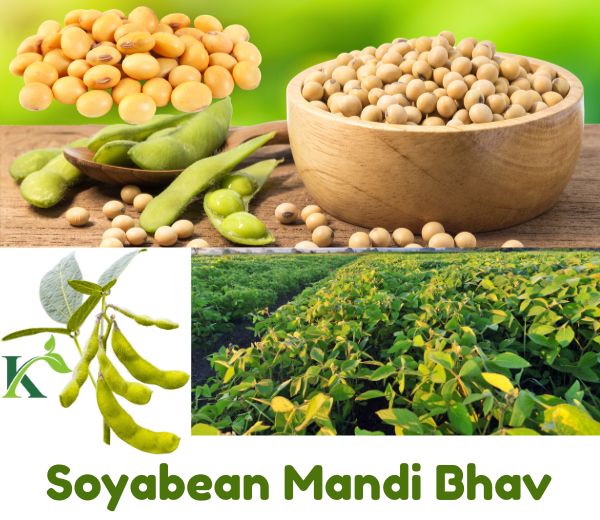
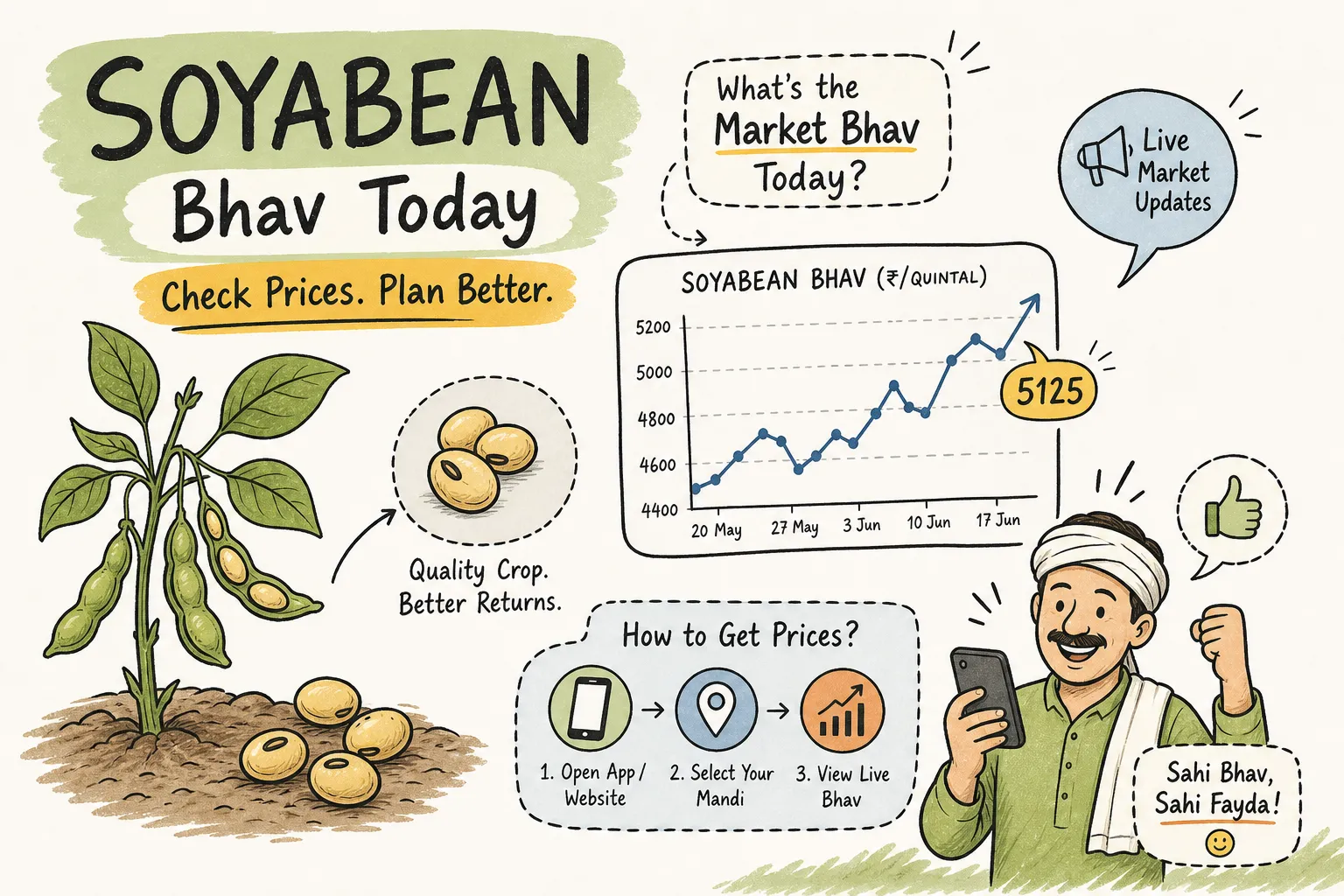
Soyabean: All Prices Are in Quintal
Description
Soyabean bhav is one of the most misleading numbers in Indian agriculture, and the reason is straightforward: two mandis in the same state can quote widely different rates on the exact same day, in some documented cases, several hundred rupees per quintal apart. A farmer who checks a stale average and drives to the wrong mandi can lose that difference before the bol-chaal (auction bidding) even begins. That lost munafa (profit) adds up fast at ten or twenty quintals.
KhetiKisaan reports that its soyabean mandi rates come from on-ground contacts present at APMC auction yards during live bidding, not from delayed government feeds or estimated averages. They reflect what processors and traders actually paid that morning. This article gives you two things: a clear picture of soyabean's market position as a crop, and a practical guide to finding the verified soyabean bhav for your specific mandi before you decide to sell.
Soyabean as a kharif oilseed: why processors keep bidding every season
Soyabean is India's largest domestically produced edible oilseed by volume. Madhya Pradesh is the largest producing state and a major price-setting region, Indore and Dewas mandis function as price-discovery centres for the entire country. Maharashtra's Vidarbha region, through mandis like Latur, Akola, Nagpur, and Karanja, adds significant supply. Rajasthan's Kota and Bundi mandis serve farmers in the Hadauti belt and contribute meaningfully to aggregate arrivals.
What makes soyabean different from a crop like wheat is its crushing chain. Every tonne of soyabean that enters a solvent extraction plant produces two outputs: soya oil for edible use and de-oiled cake (DOC) for poultry and cattle feed. Because both products are in demand year-round, oil mills do not shut down between seasons. According to industry estimates from SOPA, national crushing volumes have been running at approximately 9.5 lakh tonnes per month, which means processor demand is essentially constant. This structural, year-round demand helps support prices and often contributes to a floor above MSP in many seasons.
Why does a farmer in Vidarbha get a different rate than one in Malwa, even on the same day? Three factors drive the gap: local mandi arrival volumes, distance to crushing plants, and mandi infrastructure quality. Each of these pulls in different directions depending on the season. A yard with high processor competition and good road connectivity will tend to quote more per quintal than a smaller, remoter yard, observed mandi comparisons suggest the difference can run to several hundred rupees, though the exact spread varies by day and lot quality.
Today's soyabean mandi bhav: what different mandis are quoting
Today's soyabean rate per quintal ranges widely. Never rely on a state-level average. Check your specific mandi's soyabean bhav on the day you plan to sell. KhetiKisaan's mandi-wise listings provide per-quintal rates for individual APMC yards, sourced from contacts at the live auction. Select your state, pick your mandi, and get the number that reflects what buyers actually paid that morning.
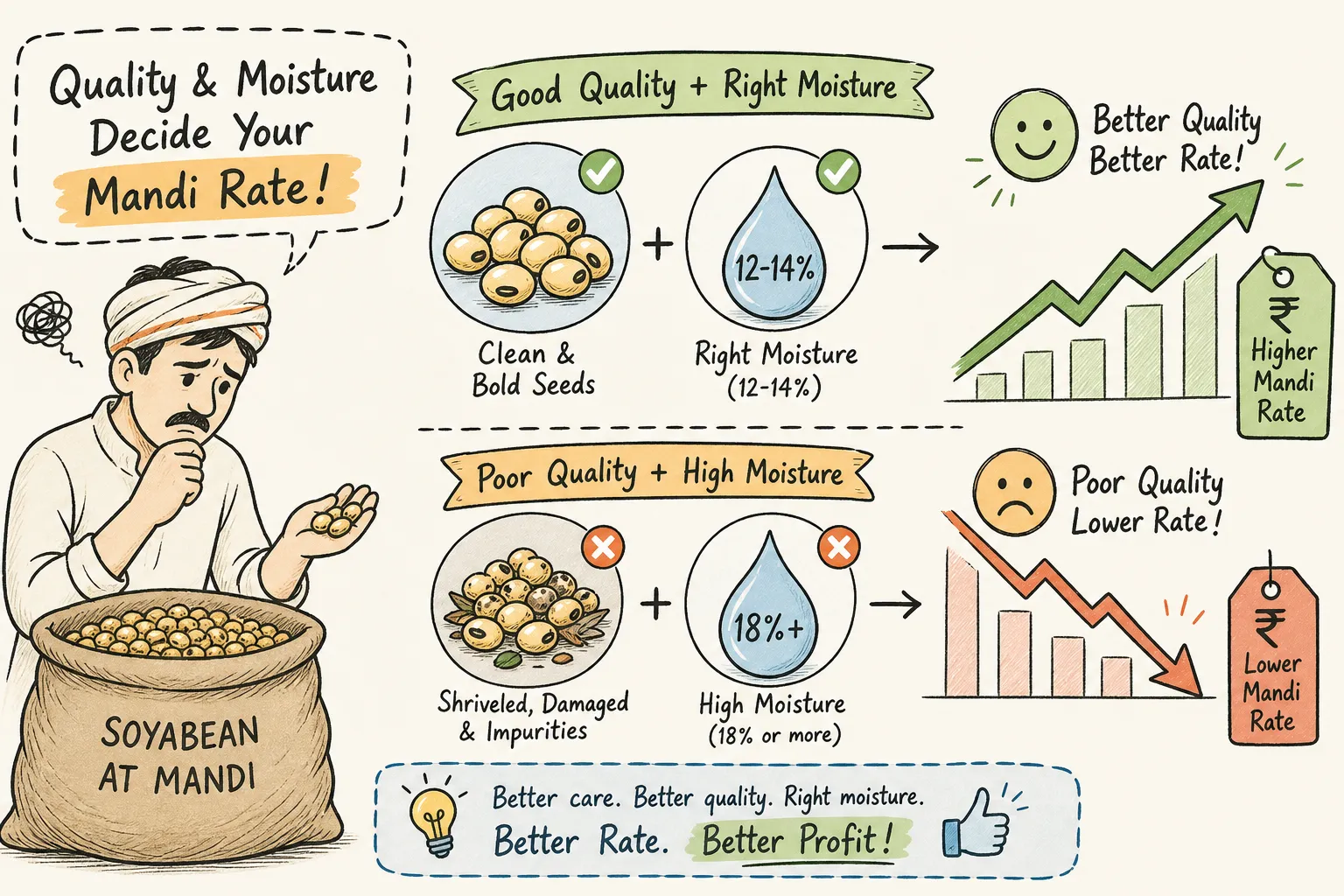
Quality is the other variable that shifts your rate at the bol-chaal. APMC buyers check moisture content, split bean percentage, and colour at the weighment stage. The acceptable moisture standard is typically 12% to 13%. Lots arriving at 14% to 16% moisture face a discount of ₹300 to ₹800 per quintal applied at the auction, a band documented in APMC trade practice. Dry your stock adequately before bringing it to the mandi. Bringing moisture down to 12% or below is the single most controllable quality step before the auction, and it directly protects your per-quintal realisation.
What is driving the soyabean bhav this season
The MSP baseline, the volume of fasal (crop) arrivals at major mandis, and whether processor procurement is active or waiting on the sidelines, these are the three forces shaping soyabean prices right now. Understanding each one helps you time your sale more confidently.
The government-declared MSP for soyabean kharif 2026-27 is ₹5,708 per quintal, up ₹380 from last season. Treat MSP as the safety net, not the target: in active market seasons, competitive mandis trade above it. This season, the government sanctioned 18,700 tonnes of procurement under the Price Support Scheme (PSS) for Maharashtra, and prices in that state firmed up ahead of that intervention, showing that even the announcement of PSS activity can shift sentiment before actual procurement begins.
On the arrivals side, national monthly soyabean arrivals have been in the 3.9 to 5.5 lakh tonne range. When farmers hold back stock in anticipation of better rates, mandi arrivals thin out and prices firm up. When a seasonal post-harvest flush hits in October and November, prices typically soften as supply outpaces crushing demand, a pattern visible in historical mandi arrival data for those months. Watching weekly arrival trends at your nearest major mandi is as important as watching the price itself. A firming soyabean bhav on low arrivals is a signal worth taking seriously.
How global oilseed signals reach your local auction yard
For reference, CME November 2026 soybean futures are currently trading around 1,247 US cents per bushel. When CME futures move up by 2% to 3%, Indore and Latur mandis tend to reflect a firming bias within three to five trading sessions, so this number matters to your sell decision even if you never trade futures yourself. China recorded 13.55 million tonnes of soybean imports in June 2026, tightening global supply sentiment and keeping international benchmark prices elevated.
India is not a major soyabean exporter, but global price cues still influence domestic processor procurement. When international soya oil and DOC prices rise, Indian oil mills can afford to pay more at the APMC gate. Conversely, a sharp fall in CME futures often precedes local mandi softness within a week. The NCDEX soyabean spot market is currently reflecting prices around ₹6,109/quintal, providing another benchmark for tracking domestic processor expectations.
There are periods, however, when global cues become less useful: peak domestic harvest arrivals, rupee depreciation, or sudden changes in government import policy on soya oil. During these phases, local arrival volumes and MSP-based PSS procurement become the dominant price anchors. Checking KhetiKisaan's daily mandi bhav during these periods gives a more grounded read than tracking CME alone.
Conclusion: check live soyabean bhav before you sell
Soyabean bhav varies significantly by mandi, lot quality, and the day's arrival volumes, a state average will rarely tell you what your yard is actually paying. Before you load your stock and head to the mandi, check the current soyabean price today for your specific APMC on KhetiKisaan. Getting the right per-quintal rate on the right day is the most direct lever you have on your seasonal munafa.
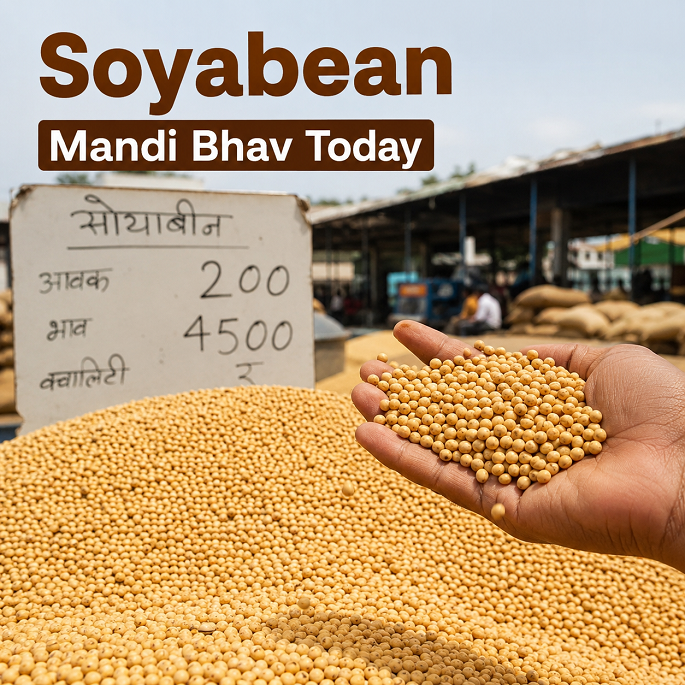
Soyabean Mandi Bhav Today
Soyabean Mandi Bhav today helps farmers to verify the current prices of soyabean in various mandis. Soyabean is a significant crop that is cultivated in states such as Madhya Pradesh, Maharashtra and Rajasthan. It is utilized in oil as well as food; this is why it is a crop of great value to the farmers.
Soyabean is a Kharif crop and starts to be planted in June or July when the monsoon season begins. It thrives in hot and damp climates. During flowering, the crop requires heavy rain and dry weather when the pods are fully developed. Soyabean is also useful in enhancing the soil because it replenishes the land with nutrients.
Soyabean is highly demanded due to the fact that it is used to produce cooking oil. The resulting cake, which has oil removed, is fed to cows and poultry. It is also a material for food preparation, such as soya chunks and milk.
Key Factors Affecting Soyabean Mandi Bhav
- Clean and yellow seeds get a better price
- Low moisture gives a higher rate
- Rain damage can reduce quality
- Demand in the market affects price
- Global market also impacts rates
Soyabean Mandi Bhav today depends on seed quality and demand. Farmers check Soyabean Mandi Bhav today daily to decide the right time to sell. Tracking Soyabean Mandi Bhav Today helps in getting better value in the mandi.
| Mandi | Price | Date |
|---|---|---|
| Neemuch MP | 7,455.00/- | 23 Sep, 2026 |
| Mandsaur MP | 6,250.00/- | 24 Sep, 2026 |
| Indore MP | 7,250.00/- | 24 Sep, 2026 |
| Ujjain MP | 6,200.00/- | 24 Sep, 2026 |
| Ratlam MP | 7,200.00/- | 24 Sep, 2026 |
| Kota | 5,765.00/- | 24 Sep, 2026 |
| Pipariya MP | 4,650.00/- | 23 Sep, 2026 |
| Kareli MP | 5,550.00/- | 24 Sep, 2026 |
| Baran | 6,980.00/- | 24 Sep, 2026 |
| Bundi | 6,865.00/- | 24 Sep, 2026 |
| Narsinghpur MP | 6,801.00/- | 24 Sep, 2026 |
| Khandwa MP | 6,950.00/- | 24 Sep, 2026 |
| Kawai | 6,815.00/- | 24 Sep, 2026 |
| Kalapipal MP | 6,900.00/- | 24 Sep, 2026 |
| Shamgarh MP | 6,100.00/- | 24 Sep, 2026 |
| Sikanagaon MP | 6,700.00/- | 24 Sep, 2026 |
| GanjBasoda MP | 7,050.00/- | 24 Sep, 2026 |
| Khargone MP | 6,951.00/- | 24 Sep, 2026 |
| Betul MP | 6,800.00/- | 24 Sep, 2026 |
| Dhamnod MP | 7,050.00/- | 24 Sep, 2026 |
| Nimbahera | 6,154.00/- | 24 Sep, 2026 |
| Timarni MP | 6,980.00/- | 24 Sep, 2026 |
| Harda MP | 5,590.00/- | 24 Sep, 2026 |
| Udaypura | 5,180.00/- | 24 Sep, 2026 |
| Guna | 5,703.00/- | 24 Sep, 2026 |
| Bari MP | 7,008.00/- | 24 Sep, 2026 |
| Sironj MP | 7,287.00/- | 24 Sep, 2026 |
| Jaora MP | 6,900.00/- | 24 Sep, 2026 |
| Daloda MP | 6,920.00/- | 24 Sep, 2026 |
| Khanpur | 6,500.00/- | 24 Sep, 2026 |
| Dahod GJ | 7,008.00/- | 24 Sep, 2026 |
| Banapura MP | 6,811.00/- | 24 Sep, 2026 |
| Kawai Salpura | 5,430.00/- | 24 Sep, 2026 |
| Atru | 5,525.00/- | 24 Sep, 2026 |
| Chhabra | 5,900.00/- | 24 Sep, 2026 |
| NaharGarh | 5,700.00/- | 24 Sep, 2026 |
| Anta | 5,555.00/- | 24 Sep, 2026 |
| Samraniyan | 5,601.00/- | 24 Sep, 2026 |
| Uniyara | 5,408.00/- | 24 Sep, 2026 |
| Dooni | 5,457.00/- | 24 Sep, 2026 |
| Bhawani Mandi | 5,600.00/- | 24 Sep, 2026 |
| Jhalarapatan | 5,800.00/- | 24 Sep, 2026 |
| iklera | 5,500.00/- | 24 Sep, 2026 |
| itawa | 5,956.00/- | 24 Sep, 2026 |
| Barisadri | 6,200.00/- | 24 Sep, 2026 |
FAQ's
Related Blogs
 Sep 09, 2026
 by Pankaj Sihag
Aug 17, 2026
by Pankaj Sihag