







How Soyabean Quality and Moisture Affect Mandi Rate
 Sep 09, 2026
 by Pankaj Sihag



How Soyabean Quality and Moisture Affect Mandi Rate
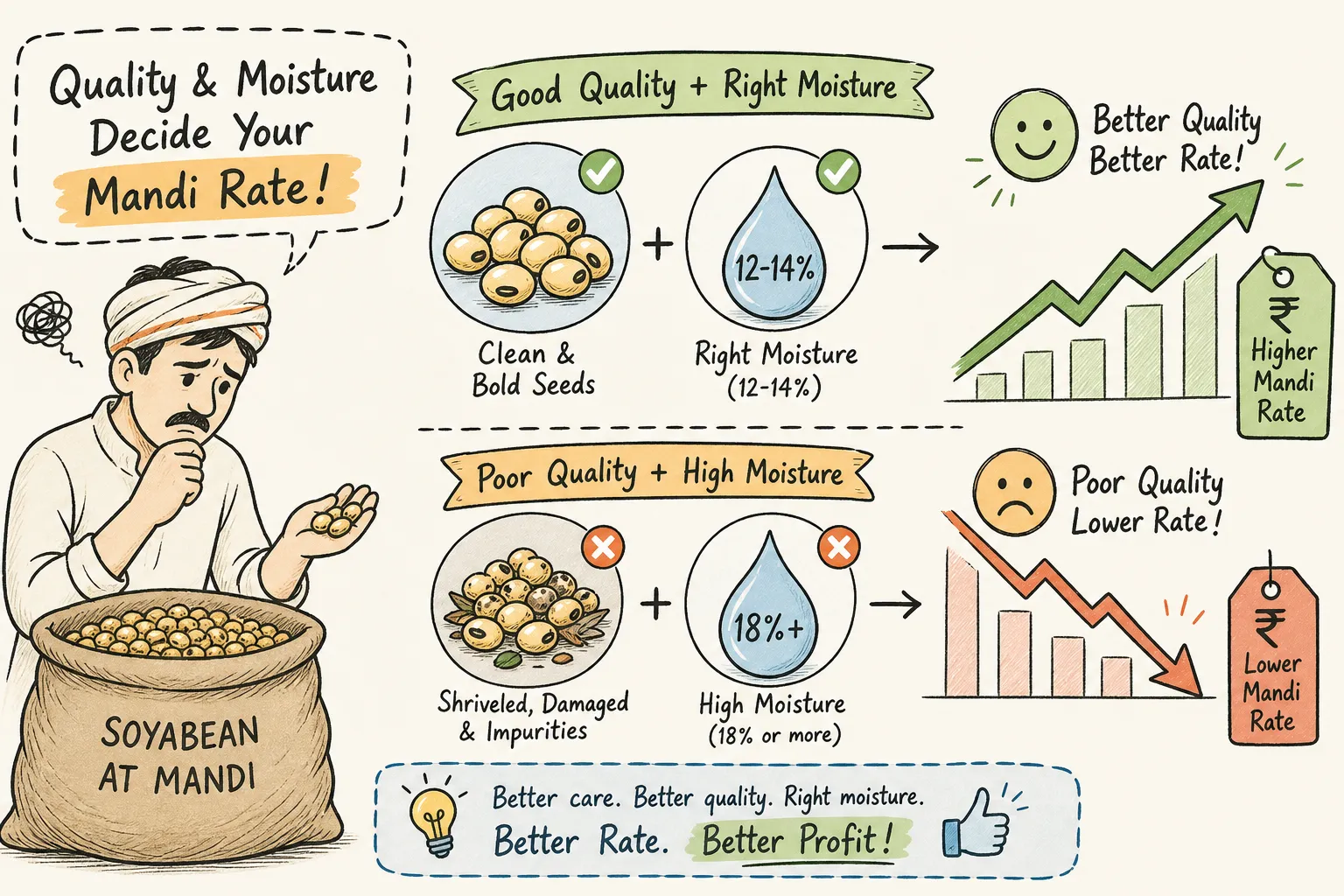
Picture this: you have spent four months growing your soyabean crop, harvested it on time, and loaded your trolley before sunrise to reach the APMC mandi by 8 AM. The arhatiya walks over, takes a handful of grain, rubs it between his fingers, and before the bol-chaal (bidding) even opens, announces a deduction. Moisture too high. Foreign matter above acceptable limit. Your expected price has already dropped before a single bid is placed.
This happens to thousands of soyabean farmers every Kharif season across Madhya Pradesh, Maharashtra, and Rajasthan. The painful part is that most of these deductions are completely avoidable. Understanding how soyabean quality and moisture affect mandi rates is the first step towards protecting what you have worked hard to grow. This article breaks down every parameter buyers check at the mandi, explains the real rupee cost of each shortfall, and gives you a practical plan to act before your fasal leaves the farm.
 Table of Contents
- What you need to know before reading further
- Why quality parameters define your soyabean price at APMC auction
- The 12% moisture limit: India's standard benchmark for soyabean
- How soyabean quality and moisture affect mandi rates: the real rupee impact
- Foreign matter and shrivelled grains: the silent price penalties at mandi
- Oil content and its direct effect on soyabean mandi rates
- Measuring moisture correctly before you load your trolley
- Practical drying, cleaning, and storage steps to protect your crop value
- Protect your munafa before the trolley leaves your farm
- FAQs
What you need to know before reading further
- Standard moisture limit: 12% maximum for FAQ (Fair Average Quality) grade soyabean at APMC and e-NAM mandis
- Foreign matter limit: up to 2% for FAQ grade; excess triggers price deductions
- Moisture penalty: roughly 1 to 1.5% price reduction per 1% moisture above the limit, based on general trade practice; rates vary between mandis and individual traders
- Weight loss from drying: drying from 16% to 11% moisture causes approximately 5.6% weight loss per quintal
- Safe drying temperature: most guidance recommends a maximum of 54 to 60°C air temperature for commercial soyabean dryers; exceeding this risks protein denaturation and oil damage, though seed-grade and storage-drying recommendations may be lower, follow your dryer manufacturer's guidance
- Oil content base grade: approximately 18 to 19% assumed at most mandis for FAQ-grade soyabean; commonly grown varieties in central India average 19.5 to 20%; higher oil can earn a commercial premium
Why quality parameters define your soyabean price at APMC auction
At most APMC mandis, the moment your trolley or bags arrive, the buyer or his appointed checker takes a handful sample and runs a rapid visual and instrument check. They are looking at four things: moisture content, foreign matter percentage, proportion of shrivelled or damaged grains, and oil content via a quick test or declared grade. This initial check takes minutes and shapes the entire price negotiation before the bol-chaal opens.
Moisture, foreign matter, damaged grains, and oil content are not independent variables; they interact with each other. High-moisture soyabean weighs more at the time of sale but processes less usable oil per quintal. Shrivelled grains carry lower oil content and inflate the damaged grain deduction simultaneously. Understanding how these four parameters connect helps you see your lot the way the buyer sees it, not the way you hope he sees it.
The grading check at the mandi is not arbitrary. Buyers purchasing in bulk for crushing plants or for resale need consistency and predictability. A lot that deviates from the FAQ grade increases their processing cost, their storage risk, or their resale discount. Every deduction they apply to your price is tied to a real cost on their side. Knowing this lets you negotiate from a position of knowledge rather than surprise.
The 12% moisture limit: India's standard benchmark for soyabean
The 12% moisture ceiling for soyabean is the FAQ grade standard recognised across Indian APMC markets and e-NAM quality specifications. Below this level, the grain is considered stable for short-term storage and safe for processing without significant oil degradation or mould risk. Above it, processors face additional drying costs, and the risk of spoilage during transport and storage rises sharply. The 12% limit protects the entire supply chain, not just the buyer.
During Kharif 2024-25, the central government allowed a one-time relaxation to 15% moisture for soyabean procurement under the Price Support Scheme (PSS) via NAFED and NCCF. However, that relaxation applied specifically to government procurement agencies and came with a clear condition: the Centre would compensate costs only up to the 12% norm, with any additional cost borne by the state government. Private buyers at APMC mandis were never bound by this relaxation. The benchmark for private trade remains 12%, and farmers bringing wet soyabean to a regular mandi will still face deductions regardless of the government scheme conditions.
Knowing what different moisture levels mean for your stored grain matters just as much as knowing the mandi limit. Soyabean stored at or below 12% is relatively stable; mould activity slows considerably and insect activity drops. Between 12% and 15%, the grain is at elevated risk if stored beyond a few weeks. Above 15%, rapid deterioration begins: dry matter loss accelerates, oil acidity rises, and within months the crop can become unsaleable. Every day your soyabean stays above 12% in a storage bag is a day your potential mandi rate is quietly eroding.
How soyabean quality and moisture affect mandi rates: the real rupee impact
There is no single national rule mandating a fixed discount per percentage point of excess moisture. In practice, however, trader and mandi behaviour follows a broadly similar pattern: for each 1% moisture above the acceptable level, buyers typically apply roughly a 1 to 1.5% deduction to the base price or adjust the net receivable weight downward, though the precise rate varies by mandi and individual contract. On soyabean priced at ₹4,000 to ₹4,500 per quintal, a 2% excess moisture can cost a farmer ₹80 to ₹135 per quintal before any other deductions are applied.
Weight loss from drying is a hidden cost that most farmers do not factor into their income calculation. When you dry soyabean from 16% moisture down to 11%, you lose approximately 5.6% of gross weight. Drying from 20% to 11% can mean a 10% weight loss. If you have 100 quintals at 16% moisture and bring it to 11%, you will actually be selling closer to 94 quintals. That reduction in saleable weight comes directly from not managing moisture at the farm level, and it hits your income just as hard as a price cut does.
Consider a worked example that combines both penalties. A farmer brings 50 quintals of soyabean at 14% moisture and 2% foreign matter to the mandi. The buyer applies a 2% deduction for excess moisture and a 2% deduction for foreign matter, each calculated on a base price of ₹4,200 per quintal. That is a 4% combined cut, reducing the effective rate to roughly ₹4,032 per quintal. On 50 quintals, the total loss from just these two parameters is approximately ₹8,400. That is money that could have been retained with proper drying and cleaning before bringing the fasal to mandi.
Foreign matter and shrivelled grains: the silent price penalties at mandi
Foreign matter includes soil clods, weed seeds, crop stems and pods, stone pieces, and chaff mixed in with the grain. At harvest and threshing, especially with manual or semi-mechanised methods, contamination is common. Most mandis accept foreign matter up to 2% as part of the FAQ grade. Beyond that, buyers apply a deduction, the rate is not fixed nationally, but traders commonly treat excess foreign matter on a roughly 1 to 1.5% of price per 1% excess basis, as every kilogram of foreign matter paid for is a kilogram of usable soyabean the processor did not receive. Actual deduction rates vary by contract and mandi, so it pays to check local trade norms before your sale.
Shrivelled grains are a double penalty: they reduce oil content and increase the damaged grain percentage simultaneously. A lot with visible shrivelling gets downgraded on both counts. Processors know that shrivelled soyabean yields less oil per quintal and generates more waste in the crushing plant. The buyer therefore prices shrivelled lots lower not just because of grade, but because of the actual economic outcome of processing them. Shrivelling usually results from late-season water stress, early frost, or improper harvesting at maturity; it is a field-level problem that has no fix once you are standing at the mandi.
The good news is that foreign matter is largely controllable before you load your bags. Running your harvested soyabean through a basic winnower or cleaning machine before bagging removes most light foreign matter. Visual inspection and hand-sorting of shrivelled grain from the top of your sample gives you a clearer picture of your lot's grade before the arhatiya forms his opinion. Arriving at the mandi with a visually clean, uniform lot signals quality even before the formal check and often influences the opening bid in your favour.
Oil content and its direct effect on soyabean mandi rates
Soyabean is primarily an oilseed crop; the crushing and processing industry buys it for oil yield, with the de-oiled cake as a secondary product. Most mandis assume an FAQ-grade oil content of roughly 18 to 19% for pricing purposes. Commonly grown varieties in Madhya Pradesh and Maharashtra typically deliver 18 to 21% oil content, with observed averages around 19.5 to 20%. When your lot delivers higher oil, the processor gets more output per quintal of input. When it delivers less, the processing economics worsen.
In practice, a soyabean lot testing above the base assumed oil content can earn a commercial premium from buyers at larger mandis, typically in the range of 0.5 to 1% of the base price per additional percentage of oil above grade, though this varies by contract and buyer. Conversely, lots testing below base oil content face a corresponding discount. The same 100 quintals of soyabean can earn meaningfully different rates from the same buyer on the same day, purely based on declared or tested oil content. This holds true across all major mandis: higher oil means a better rate.
What reduces oil content before you reach mandi? Late harvesting causes oil oxidation and quality degradation in the seed. Excessive or high-temperature drying damages the lipids in the grain, reducing effective oil yield at the crushing stage. Prolonged storage at high moisture accelerates oil acidity development, which lowers oil quality even if the quantity appears intact. Variety selection, growing conditions, and timely harvest all influence oil content significantly; drying practices after harvest determine whether that oil content is preserved or damaged before your lot is sold.
Measuring moisture correctly before you load your trolley
A portable grain moisture meter gives you a result in under a minute and costs far less than the financial penalty for arriving at mandi with wet soyabean. These meters work by measuring the electrical properties of the grain, which correlate with moisture content. Accuracy depends heavily on calibration, the specific crop setting (most quality meters include a soyabean setting), and the temperature of the grain sample at the time of testing. For rapid field decisions on whether your lot is ready to sell or needs more drying time, a portable meter is the most practical tool available to a farmer today.
The oven-dry gravimetric method is the most accurate way to measure soyabean moisture content. A weighed sample is dried at a controlled temperature and reweighed; the percentage difference is the moisture content. This method is used by laboratories and serves as the reference against which portable meters are validated. If you receive a mandi deduction that seems excessive and you want to dispute it, an oven-dry test from an accredited laboratory provides the authoritative figure. It takes longer than a field meter, but this result carries more weight commercially and legally.
A moisture reading is only as reliable as the sample it came from. Checking one corner of the top bag in your stack will not reflect the actual average moisture of your full lot. Take small handfuls from multiple bags, different layers, and different positions in your heap. Mix these together thoroughly and then test a sub-sample from this composite. This sampling approach catches moisture variation across your lot and prevents a false low reading from masking high-moisture pockets that will be discovered at the mandi.
Practical drying, cleaning, and storage steps to protect your crop value
Sun drying on clean, raised platforms is the most accessible drying method for most Indian soyabean farmers. Spread the grain no more than 5 to 7 cm deep and turn it every 2 to 3 hours to ensure even drying. In October conditions in central India, drying from 15% to 12% moisture typically takes 2 to 4 days with good sun exposure, though nighttime humidity can slow the process.
For mechanical dryers, most technical guidance recommends a maximum air temperature of around 54 to 60°C for commercial soyabean; exceeding this causes protein denaturation and oil damage that permanently reduces the crop's processing value. Always follow your dryer manufacturer's recommended temperature settings, as seed-grade and storage-drying limits may be lower. Never dry soyabean directly on soil or unclean surfaces, as contamination from mud or weed seeds directly adds to your foreign matter percentage.
After drying, pass your soyabean through a winnower or grain cleaner to remove chaff, broken pods, weed seeds, and dust. If you do not have access to a machine, even a hand-held sieve or wind winnowing method reduces foreign matter meaningfully. Separate visibly shrivelled, discoloured, or damaged grain from the main lot before bagging. Mixing these into the bag lowers your average grade and gives the buyer justification for a blanket deduction on the entire lot, which always costs more than the time taken to sort.
Store cleaned, dry soyabean in woven polypropylene bags (bori) with a moisture-proof liner, placed on wooden pallets or bamboo mats away from direct floor contact. Keep the storage space ventilated, cool, and dry. During the monsoon period, humidity-driven re-absorption of moisture is a real risk; check your stored grain every two weeks with your portable meter. If moisture climbs back above 11%, spread and re-dry before sealing again. Under cool, dry, and ventilated conditions with humidity controlled, soyabean bagged at 11% should remain stable at that moisture level until you are ready to sell.
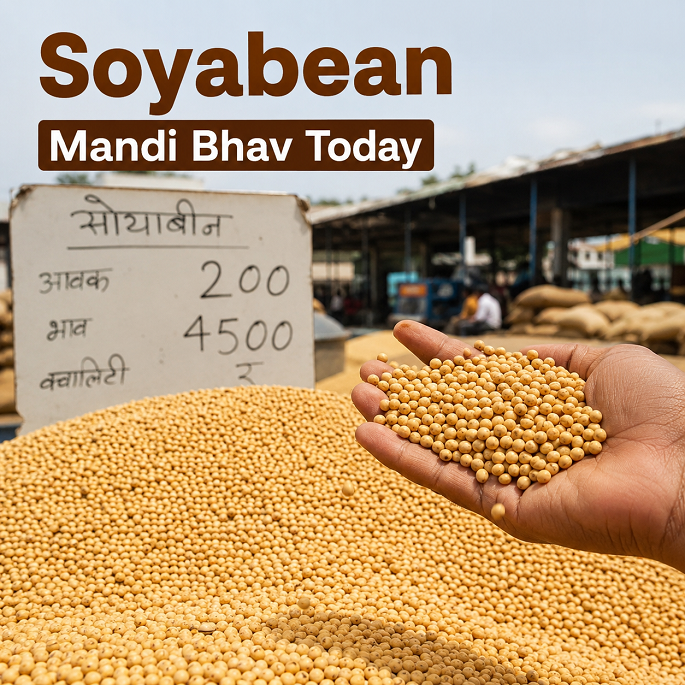
Once your soyabean meets the quality standard, moisture below 12%, foreign matter cleaned out, and lot looking uniform, the next decision is timing your sale. Checking live soyabean mandi bhav (auction prices) on KhetiKisaan gives you today's rates across major APMC centres so you can compare prices before you leave home. Knowing where the rate is strongest on a given day means your quality-prepared lot gets the best price available in the market, not just the first price you are offered at the nearest mandi.
Protect your munafa before the trolley leaves your farm
The way quality and moisture affect your mandi rate is not complicated once you understand what buyers are measuring. The 12% moisture limit, the foreign matter tolerance, the shrivelled grain penalty, and the oil content premium or discount are all quantifiable. Every percentage point of excess moisture or contamination has a rupee value attached to it, and understanding how soyabean quality and moisture affect mandi rates makes clear that this rupee value comes directly out of your earnings at auction.
Practical steps such as drying to below 12%, cleaning your lot properly, sampling moisture correctly, and storing under the right conditions are all achievable with tools and methods available to most farmers. None of them require expensive equipment or specialist knowledge. What they do require is acting before your fasal reaches the mandi, not after the deduction has already been applied.
Prepare your soyabean before it reaches the auction yard, and the mandi rate you receive will reflect the quality you put in. Check KhetiKisaan for today's soyabean mandi bhav across key APMC centres so you can combine your quality preparation with smart timing and sell when the market is working in your favour.
FAQs
Related Blogs
Aug 17, 2026
by Pankaj Sihag