







Online mandi vs local APMC: where do farmers earn more?

 Sep 10, 2026
 by Pankaj Sihag



Online mandi vs local APMC: where do farmers earn more?
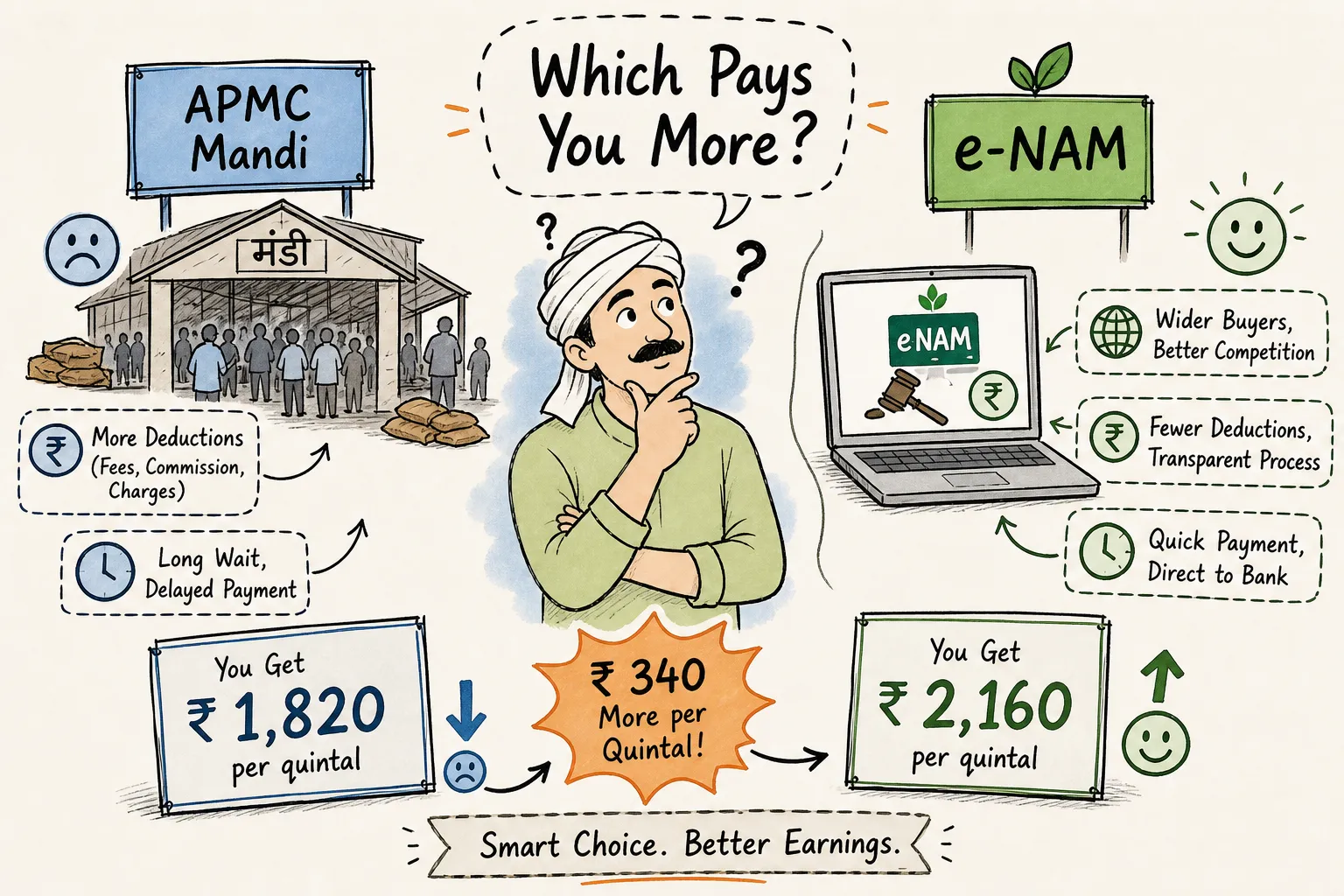
Every harvest season, kisaans (farmers) across Rajasthan, Haryana, and Punjab face the same decision: online mandi vs local APMC, which channel delivers more munafa (profit) per quintal after all deductions? The local APMC mandi is familiar. You know the arthiya (commission agent), you know the weighing shed, and you know roughly what to expect. But e-NAM promises wider competition, more transparent bol-chaal (bidding), electronic payment settlement directly to your bank account within one business day of delivery acceptance, and digital recording of all bids. The real question is which channel actually puts more money in your pocket.
Before making this call, the first step is knowing what the going mandi bhav actually is across multiple markets on that specific day. KhetiKisaan tracks mandi-wise price data sourced from on-ground contacts at APMC auction yards across Rajasthan, including Sri Ganganagar and Nohar, and presents this as the platform's own reporting rather than independently verified research. Once you have a credible price benchmark, the comparison between channels becomes far more concrete.
This article covers everything you need to make that decision: how e-NAM actually works, how fees compare, what the logistics reality looks like for smallholders, how fast payment reaches your account, and which channel suits which crop or situation.
| Factor | Local APMC mandi | e-NAM / e-mandi |
|---|---|---|
| Arthiya commission | Commonly 2%+ in Rajasthan | May still apply if routed through agent |
| Platform charge | None | ~0.1, 0.3% only (varies by state and arrangement) |
| Payment timeline | Days; through arthiya settlement | Within 1 business day after delivery acceptance |
| Buyer reach | Buyers physically present only | Buyers from other mandis and states |
| Produce still goes to a physical mandi | Yes | Yes, e-NAM is not a separate market |
 Table of Contents
- What e-NAM actually is (and what most farmers get wrong about it)
- Online mandi vs local APMC: does e-NAM actually deliver a better mandi bhav?
- e-NAM vs local APMC: fees and deductions compared
- Online mandi vs local APMC: payment timelines and logistics
- Which channel works better for which crop or situation?
- How to compare mandi-wise prices before you choose your route
- The bottom line: online mandi vs local APMC
- FAQs
What e-NAM actually is (and what most farmers get wrong about it)
The most common misconception about e-NAM is that it is a separate digital marketplace sitting somewhere in the cloud, away from the local mandi. It is not. e-NAM (National Agriculture Market) is a digital bidding layer placed directly on top of the existing APMC infrastructure. The physical mandi does not go away; you still need to bring your fasal (crop) there.
The "local mandi + online auction" model explained
When a farmer sells at an e-NAM-enabled mandi, the produce arrives at the physical mandi yard just as it would for a normal APMC sale. The difference begins after arrival: mandi staff assay the crop, measure quality parameters, and upload a digital lot to the e-NAM portal. Once the lot is live, buyers from outside that local market, including traders from other mandis and even other states, can participate in the online bol-chaal. At a regular APMC mandi, only buyers physically present in that yard can bid. That is the fundamental structural difference.
Step-by-step flow of an e-NAM sale
- Farmer registers on e-NAM once (free, one-time process)
- Brings produce to an e-NAM-enabled APMC mandi
- Mandi staff assay the crop and upload quality data to the portal
- Online bol-chaal opens to all registered buyers, including those from other markets
- Farmer reviews bids and accepts or rejects the winning offer
- Payment is credited electronically to the farmer's registered bank account
Which mandis in Rajasthan are e-NAM enabled?
As of 2026, Rajasthan has 173 APMC mandis integrated with the e-NAM platform, according to government data, placing it among the more extensively covered states in the national network of 1,656 mandis. The number has grown significantly over the past few years, with multiple rounds of new mandi additions. For the current status of any specific market, check the official e-NAM portal or contact your local Krishi Upaj Mandi Samiti (KUMS). KhetiKisaan's mandi-wise listings can also help you identify which nearby markets are active and what prices they are reporting on a given day.
Online mandi vs local APMC: does e-NAM actually deliver a better mandi bhav?
This is the question that matters most. A farmer does not care about the architecture of a trading platform; the concern is straightforward: will I get more per quintal by going the e-NAM route?
Why local APMC auctions can suppress prices
The structural problem at a traditional mandi is a limited buyer pool. Only traders physically present in that yard can participate in the auction. When the buyer pool is small, the opportunity for arthiya-buyer coordination increases, and information asymmetry works against the farmer. A farmer standing in one mandi rarely knows that a neighbouring mandi is paying ₹150 more per quintal for the same sarso that same morning. That knowledge gap is what local intermediaries have historically exploited.
How a wider bidder pool changes the price outcome on e-NAM
The entire premise of e-NAM is that inter-mandi and inter-state buyer participation creates genuine competition in the bol-chaal. More buyers competing for the same lot means upward pressure on the final price. When a buyer in Gujarat can bid on a guar lot sitting in a Rajasthan mandi, local buyers can no longer assume they face no competition. The caveat is real, though: this advantage only materialises when the mandi actually has an active pool of registered online traders for that specific commodity. If few buyers have registered for chana or isabgol in your mandi's e-NAM network, wider access on paper does not translate to wider competition in practice.
When local mandi prices beat the online mandi rate
For highly perishable crops, onion, tomato, leafy vegetables, speed of sale matters far more than price discovery. A tomato grower cannot afford to wait through an assaying and online bidding process. Local buyers who know the produce and want it fast can sometimes offer competitive prices precisely because of that urgency. Similarly, for commodities with strong local industrial demand, nearby buyers may already be willing to pay at or above inter-state levels, making the extra steps of e-NAM unnecessary.
e-NAM vs local APMC: fees and deductions compared
This is where the comparison becomes most concrete. Fees are not abstract percentages; on a ₹5,000/quintal crop, a 4% combined deduction is ₹200 per quintal straight out of your pocket. Understand exactly what each channel costs.
The deduction stack at a traditional APMC mandi in Rajasthan
A Rajasthan farmer selling sarso, chana, or guar at a local APMC mandi typically faces several layers of deduction. The mandi fee (market fee) for guar in Rajasthan is reported at around 1.6%, check the relevant APMC notification for your commodity, as rates can vary. The arthiya commission is commonly 2% for foodgrains and oilseeds, including sarso, chana, and guar. On top of these, development cess and other levies add further deductions, and informal charges for weighing, loading, and handling are real costs even if not always formally itemised.
On a ₹5,000/quintal sale of sarso, a combined deduction of 4, 5% amounts to ₹200, ₹250 per quintal. Selling 50 quintals in a season means ₹10,000, ₹12,500 that does not reach your bank account.
What e-NAM actually charges in comparison
| Charge type | Traditional APMC mandi | e-NAM / e-mandi |
|---|---|---|
| Mandi / market fee | Applies (typically 1, 2%) | Usually still applies if settled through mandi books |
| Commission agent (arthiya) | Commonly 2%+ in Rajasthan | May still apply if routed through agent |
| Platform / portal charge | None | Small: ~0.1, 0.3% only (varies by state and arrangement) |
| Direct trade area savings | Not applicable | No mandi fee or commission in some direct trade structures |
Net realisation difference: what the numbers suggest
The Karnataka ReMS model offers a useful benchmark. Under that arrangement, traditional APMC trade carried a 1.5% mandi fee and 2% arthiya commission, while the e-trading platform charged 0.1% as its transaction cost, a potential saving of over 3 percentage points. On a ₹5,000/quintal price, this amounts to roughly ₹150, ₹175 per quintal in the farmer's favour under e-NAM, assuming the arthiya commission is genuinely eliminated in that transaction structure. The critical word is "assuming": e-NAM does not automatically remove the arthiya from the transaction. If the trade is still routed through a commission agent, that 2% charge remains. The platform charge figures also vary by state and specific e-trading arrangement, so verify the applicable rate for your mandi before drawing a direct comparison.
Online mandi vs local APMC: payment timelines and logistics
Knowing the fee structure is one part of the picture. Logistics and payment realities on the ground can completely change whether e-NAM is practical for a given farmer in a given season.
The distance and transport burden at local APMC mandis
Small and marginal farmers bear a disproportionate share of the cost of bringing produce to a mandi, particularly for low-value-per-kg commodities. Road quality, the cost of hiring a vehicle, and time spent waiting at the mandi yard can eat significantly into net realisation. This is a persistent disadvantage of the physical APMC system, especially in areas where the nearest mandi is 40, 60 kilometres away. The farmer pays both the financial and time cost of this journey before a single bid is placed.
Grading, assaying, and lot readiness requirements on e-NAM
e-NAM shifts the challenge rather than eliminates it. For online bidding to work, produce must be assayed and standardised before a digital lot can go live on the portal. Remote buyers bidding from another state cannot physically inspect the crop; they rely entirely on the quality data uploaded by the mandi. Rajasthan's e-NAM infrastructure has expanded considerably: 136 NIR spectrometers for testing oil and moisture content, 136 MATT AI-based grain analysers for detecting defects and damage, and 111 mandis with mobile sorting and grading units are now operational. For crops like sarso, guar, and chana that have relatively standard grading parameters, this infrastructure works reasonably well. For heterogeneous or perishable produce, the assaying process remains a bottleneck.
Why fragmented small lots are a problem on both channels
A smallholder with two or three quintals to sell faces structural disadvantages in both systems, though for different reasons. At the local APMC mandi, a small lot gives the farmer almost no bargaining power; traders know they can hold out for a lower price. On e-NAM, a small or inconsistent lot may not attract enough online bidders to generate meaningful competition. The practical solution that consistently emerges from research and on-ground experience is FPO (Farmer Producer Organisation) aggregation: pooling produce from multiple small farmers into larger, standardised lots before bringing them to either channel. This single step improves price outcomes at both the local APMC and on the e-NAM platform.
How payment works at the local APMC mandi
In the traditional APMC system, payment typically flows through the arthiya rather than directly from buyer to farmer. Settlement can happen in cash or cheque, and timelines are governed by state mandi rules, not by a centralised system. In practice, settlement often takes several days, and cash-based transactions carry their own risks around record-keeping and dispute resolution. The farmer's dependence on the arthiya for payment is also a source of power imbalance in the relationship.
Electronic payment on e-NAM and what the timeline looks like
e-NAM mandates direct electronic payment to the farmer's registered bank account via RTGS, NEFT, or BHIM UPI. The official settlement guideline is within one business day after the buyer accepts delivery. Either way, the payment is faster and fully traceable compared to the traditional arthiya settlement process. For a farmer who needs to pay for the next round of beej (seeds) or khad (fertiliser), receiving payment within 24 hours rather than several days is a tangible operational benefit.
Documents and bank details you need ready before you sell on e-NAM
e-NAM registration is free and a one-time requirement. You need a government-issued ID proof, a bank passbook or cancelled cheque showing your account details, and a registered mobile number. Registration can be completed online through the e-NAM portal, via the mobile app, or at the mandi help desk. Once registered, you do not repeat this process at every sale. The initial setup takes a few hours, and most mandi help desks in Rajasthan can assist farmers who are not comfortable completing the process digitally.
Which channel works better for which crop or situation?
There is no single correct answer that applies to every farmer, every crop, and every season. The right choice depends on your specific situation.
When e-NAM is likely the better route
e-NAM tends to deliver better outcomes for crops with established grading standards, sarso, chana, guar, and gehun (wheat), where remote buyers can bid confidently based on assay data alone. It also works better for farmers with larger, standardised lots, or those who can access FPO aggregation. If your local mandi's arthiya margins are historically high and inter-state demand exists for your commodity, the wider buyer pool that e-NAM provides is more likely to push your price above what local bidders alone would offer.
When sticking with the local APMC mandi makes more sense
The local APMC route often makes more practical sense for highly perishable crops where speed of sale is everything. If the nearest e-NAM-enabled mandi is far away and the transport cost wipes out any price advantage, the local option is clearly better. For mandis not yet equipped with functional grading labs or reliable internet connectivity, the e-NAM process simply does not run smoothly, leaving the farmer with delay and uncertainty rather than a better price. A trusted arthiya relationship that delivers fair rates and fast payment is also a legitimate reason to stay with the familiar channel.
The hybrid approach most experienced farmers use
Experienced kisaans in North India rarely commit permanently to one channel. They check the going mandi bhav across multiple APMC yards before loading the fasal onto a vehicle. They assess their crop quality, lot size, and distance to the nearest e-NAM-enabled mandi on that specific day. If the local mandi is already offering a strong price for sarso, there is no reason to absorb the extra logistics cost of travelling further. If the local mandi price looks suppressed and a nearby e-NAM-enabled mandi is active for that commodity, the switch makes financial sense. This "check first, then decide" approach is not complicated, it just requires reliable price information before you commit to a route.
How to compare mandi-wise prices before you choose your route
Price intelligence is the foundation of the sell decision. Without knowing what multiple mandis are actually paying on a given day, any comparison between channels is guesswork.
Why knowing live mandi bhav across mandis is the first step
Before a Rajasthan farmer loads their guar or chana onto a vehicle, knowing what Sri Ganganagar, Nohar, and other nearby mandis are paying that day is critical. If the local mandi is already offering a price close to or above what a distant e-NAM-enabled mandi is reporting, the logistical cost of travelling further does not justify the switch. Conversely, if there is a ₹200, ₹300/quintal gap between your local mandi and a neighbouring one, that gap is worth investigating before you commit. Every channel decision starts with verified price intelligence, not with assumptions about which route is generally better.
How KhetiKisaan gives you verified rates from live APMC auctions
KhetiKisaan states that it sources its mandi bhav data from on-ground contacts who are physically present at live bol-chaal proceedings at APMC auction yards, not from delayed government feeds or estimated averages. According to the platform, prices reflect actual transaction rates from that day's auction. The platform covers mandi-wise price listings for key Rajasthan crops including sarso, guar, chana, gehun, narma, and isabgol, across mandis such as Sri Ganganagar and Nohar. Checking KhetiKisaan before you load your produce gives you a working benchmark across multiple markets. With that benchmark in hand, you can compare your local mandi's going rate, weigh the logistics cost of alternative mandis, and make the channel decision based on actual numbers rather than habit or guesswork.
The bottom line: online mandi vs local APMC
Neither the online mandi nor the local APMC mandi is universally better for every kisaan, every crop, and every season. In the online mandi vs local APMC comparison, the right answer depends on your crop type, lot size, distance to the nearest e-NAM-enabled mandi, and what the mandi bhav actually looks like across markets on that specific day.
The fee structure clearly favours e-NAM when arthiya margins are high: a 2% commission versus a 0.1, 0.3% platform charge is a real and meaningful difference, especially on high-value crops like sarso or guar across multiple quintals. But logistics costs, grading readiness, crop perishability, and the quality of your local mandi's arthiya relationship can all tip the balance back toward the familiar APMC route in specific situations.
The one habit that separates the kisaan who consistently gets a fair price from the one who does not is straightforward: check today's mandi-wise rates on KhetiKisaan before you load your produce. Know what Sri Ganganagar is paying for chana versus what Nohar is paying for sarso. Then compare those numbers against your logistics costs and crop readiness, and make the channel decision based on verified data. Applied consistently across every harvest, that approach is how you build a farming operation that earns what your fasal is actually worth.
FAQs
Related Blogs
Sep 19, 2026
by Pankaj Sihag

Sep 11, 2026
by Pankaj Sihag