







Desi Chana vs Kabuli Chana: Which Variety Gives Better Yield and Higher Mandi Price?
 Jun 27, 2026
 by Pankaj Sihag



Desi Chana vs Kabuli Chana: Which Variety Gives Better Yield and Higher Mandi Price?
Kabuli chana vs desi chana comes down to this: desi usually gives more stable yield, while kabuli often gets a higher mandi price but has no MSP safety net.
Desi chana MSP for rabi 2026–27 is ₹5,875 per quintal. Kabuli chana has no government MSP.
Kabuli chana mandi prices usually range between ₹6,500 and ₹7,500 per quintal for regular grades. Premium bold kabuli can go up to ₹9,000–₹13,000 per quintal.
Desi chana yields around 7–12 quintals per acre under good irrigated conditions. Kabuli usually gives 6–8 quintals per acre.
Kabuli usually needs a higher seed rate because of its larger grain size and often needs more careful crop management
 Table of Contents
Desi or Kabuli: Which Chana Puts More Money in Your Pocket?
The answer is not the same for every kisaan. When comparing kabuli chana vs desi chana, the right choice depends on your zameen, irrigation, nearby mandi, and how much risk you can handle.
Desi chana is the safer option. It gives stable yield and minimum support price (MSP). Kabuli chana can bring a better market price, but it comes with more risk and higher input cost.
This guide helps you understand which chana is more profitable in India based on your farming conditions.
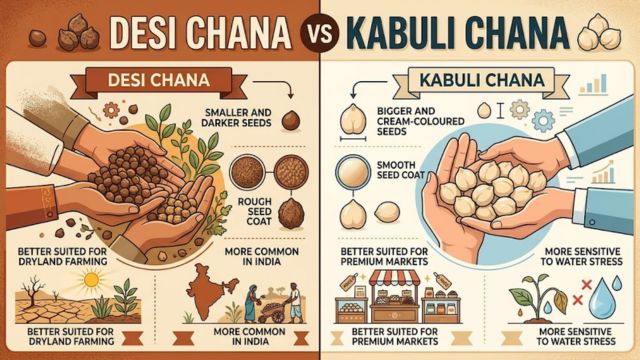
What is the Difference Between Desi and Kabuli Chana?
Both are chickpeas, but they behave differently in the field and in the mandi.
Desi chana:
- Smaller and darker seeds
- Rough seed coat
- Better suited for dryland farming
- More common in India
Kabuli chana:
- Bigger and cream-coloured seeds
- Smooth seed coat
- Better suited for premium markets
- More sensitive to water stress
India grows mostly desi chana. Many desi chana varieties India farmers use are suited for MP, Rajasthan, Uttar Pradesh, and Maharashtra.
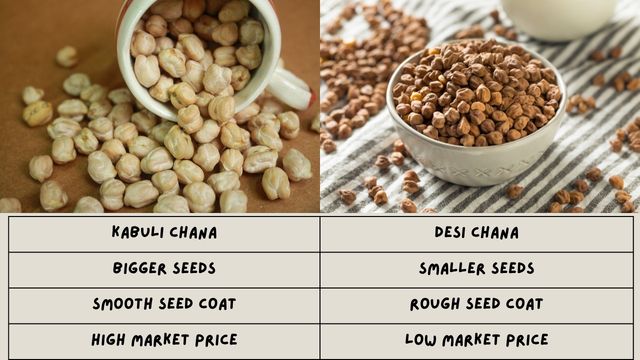
|
Factor |
Desi Chana |
Kabuli Chana |
|
Seed size and look |
Small, dark brown, rough coat |
Large, cream-coloured, smooth coat |
|
Yield per acre |
7–12 quintals |
6–8 quintals |
|
MSP (2026–27) |
₹5,875 per quintal |
No government MSP |
|
Average mandi price |
₹5,500 – ₹6,200 per quintal |
₹6,500 – ₹7,500 per quintal |
|
Premium grade price |
Sells at standard market rate |
₹9,000 – ₹13,000 per quintal |
|
Seed rate (per Acre) |
25–30 kg |
35–40 kg (Needs more seed due to larger grain size) |
|
Water need |
Low to moderate (1–2 irrigations) |
Moderate (3–4 timely irrigations) |
|
Export demand |
Moderate |
Higher international demand |
Remember, all prices are subject to change based on live Agricultural Produce Market Committee (APMC) auction activity.
Desi Chana: Better Yield and MSP Support
For most farmers in rain-fed or semi-irrigated areas, desi chana is often the safer option.
Yield Advantage
Desi chana usually performs better under Indian field conditions.
With popular varieties like JG 11, JG 16, Vijay, and Pusa 362, farmers can expect around 7–12 quintals per acre under good management.
Even under low-water conditions, desi chana often gives more stable output than kabuli.
MSP Support
The desi chana MSP 2026–27 is ₹5,875 per quintal.
This gives farmers a support price if open mandi rates fall.
Lower Input Cost
Desi chana needs:
- Lower seed cost
- Fewer irrigations
- Better drought handling
This helps keep total cultivation cost lower.

Kabuli Chana: Higher Price but More Risk
Kabuli chana can give a better selling price, but only under the right conditions.
Better Mandi Price
The kabuli chana price per quintal usually stays above desi chana.
Current rates in many mandis range between ₹6,500 and ₹7,500 per quintal for regular grades.
Premium bold kabuli, often called dollar chana, can fetch ₹9,000 to ₹13,000 per quintal during strong export demand.
Lower Yield
The kabuli chana yield per acre India farmers usually get is around 6–8 quintals.
This means a higher mandi price does not always guarantee higher profit.
Example:
- Desi: 10 qtl × ₹5,875 = ₹58,750
- Kabuli: 7 qtl × ₹7,000 = ₹49,000
But if bold kabuli gets ₹10,000 per quintal, the same 7 quintals can bring ₹70,000.
Kabuli chana can be more profitable in a strong market, but it also carries higher price risk.
No MSP Support
Kabuli chana has no separate MSP.
Its price depends fully on market demand, export movement, and arrivals.
If supply rises or imports increase, rates can fall.
Which Chana is More Profitable?
This depends on your field conditions.
Choose desi chana if you:
- Have less water
- Want lower investment
- Want MSP support
- Want stable yield
Choose kabuli chana if you:
- Have assured irrigation
- Can spend more on seed
- Have nearby mandi with premium buyers
- Can handle market ups and downs
For most small and medium farmers, desi is usually the safer profit option.
Kabuli works better where conditions and market both support it.
Desi Chana vs Kabuli Chana: Quick Farmer Guide
Before sowing, compare these important points:
Desi Chana
- Yield: 7–12 qtl/acre
- MSP (2026–27): ₹5,875/qtl
- Lower seed cost
- Better in dry areas
- Lower market risk
Kabuli Chana
- Yield: 6–8 qtl/acre
- No MSP support
- Higher market price
- Premium bold grades: up to ₹13,000/qtl
- Higher seed rate
Check your water, field condition, and local mandi demand before choosing.
Final Thoughts
Choosing between desi and kabuli chana starts in the field, but profit is decided at the mandi.
Desi gives better stability through yield and MSP support. Kabuli offers a premium price but needs stronger management and carries more market risk.
Before sowing and before selling, check the latest chana mandi bhav on KhetiKisaan. The price gap between desi and kabuli changes across mandis and can directly affect your final earnings.
FAQs
Related Blogs
Sep 23, 2026
by Pankaj Sihag
Sep 14, 2026
by Pankaj Sihag