







Today's Makka Mandi Rates in India: Latest Prices & Market Trends
 Aug 22, 2026
 by Pankaj Sihag



Today's Makka Mandi Rates in India: Latest Prices & Market Trends
- Today's makka mandi rates in India vary from one market to another based on arrivals, quality, variety, demand, and local trading conditions.
- The maize MSP for the Kharif marketing season 2026-27 is ₹2,410 per quintal, up from ₹2,400 in 2025-26.
- Government mandi data reports minimum, maximum, and modal prices, so farmers should check the rate for their specific mandi rather than rely on one national figure.
- Madhya Pradesh, Karnataka, Bihar, Maharashtra, Telangana, Andhra Pradesh, and several other states are important maize-growing regions in India.
- All prices are subject to change based on live Agricultural Produce Market Committee (APMC) auction activity.
 Table of Contents
What Are Today’s Makka Mandi Rates in India?
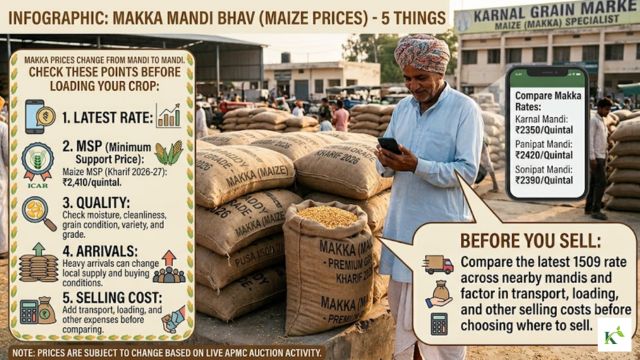
The today makka mandi rates in India do not follow one fixed national price. Mandi records include minimum, maximum, and modal prices for individual markets, and these can differ considerably depending on the crop arriving at the yard, its quality, and local demand.
Agmarknet provides daily mandi price and arrival information, which farmers can use to check the rate in their own market before selling. A rate quoted in one district may not apply to another market, even when both are trading maize.
The maize mandi bhav today should therefore be checked along with the mandi name, variety, grade, and reported price. A higher rate in a distant market may also leave you with less money after transport and loading costs.
Why Does the Makka Price Vary Between Mandis?
The makka price today can change because the supply and buying conditions are different from one market to another.
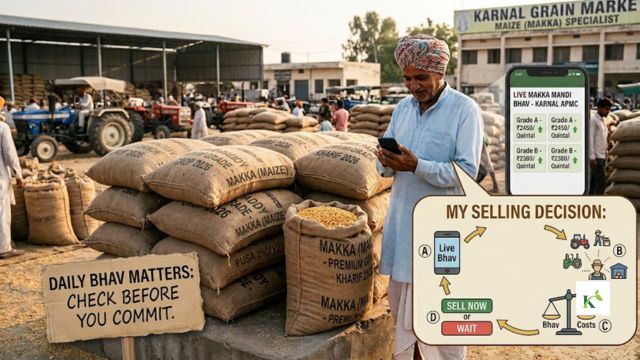
Fresh arrivals are one of the first things to watch. When large quantities reach a mandi at the same time, buyers have more produce to choose from. Prices can move differently when arrivals are lighter.
Quality also matters. Moisture, grain condition, cleanliness, variety, and grade can affect what a buyer is willing to pay. Transport is another consideration, particularly when a nearby mandi is offering a slightly lower rate but costs much less to reach.
Demand from feed, food-processing, starch, and other industrial users also affects the broader maize market. The impact on an individual mandi, however, depends on local buying activity and the availability of maize.
What Is the Maize MSP for 2026-27?
The government has fixed the maize minimum support price (MSP) at ₹2,410 per quintal for the Kharif marketing season 2026-27, compared with ₹2,400 per quintal in 2025-26. The government estimates the cost of production at ₹1,544 per quintal, making the MSP 56% higher than this estimated cost.
MSP and the open mandi rate are not the same thing. MSP is the government-announced price, while the rate quoted in an open market can vary according to demand, supply, quality, procurement activity, and local trading conditions.
For farmers, the useful comparison is between the latest local mandi bhav and the MSP, rather than assuming that every mandi will quote ₹2,410 per quintal.
Which States Are Major Maize-Growing Regions in India?
India grows maize across several states. The Agricultural and Processed Food Products Export Development Authority (APEDA) lists Madhya Pradesh, Karnataka, Bihar, Maharashtra, Telangana, West Bengal, Rajasthan, Tamil Nadu, Andhra Pradesh, and Uttar Pradesh among the country's major maize-growing states. According to APEDA, maize production was estimated at 43.41 million tonnes for 2024-25.
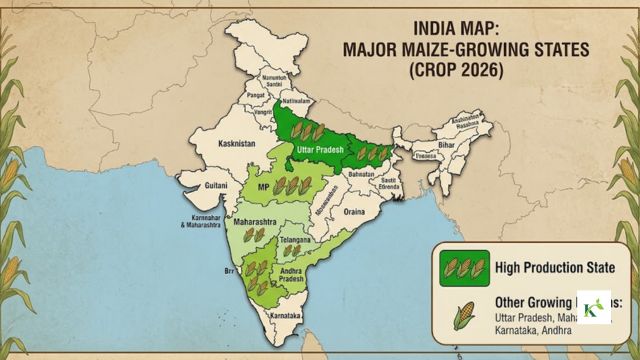
With maize grown across so many regions, mandi rates are not the same everywhere. Harvest timing, daily arrivals, local demand from processing units, and transport costs can all influence what farmers are offered for their maize.
How Can Farmers Track Maize Mandi Bhav Daily?
The maize market rate today is most useful when checked close to the day of sale. Government agricultural-market data provides mandi-level minimum, maximum, and modal prices, while Agmarknet publishes daily price and arrival reports.
The National Agriculture Market (e-NAM) connects participating APMC mandis through a national electronic trading platform. Farmers can use the platform to check market information and access trading opportunities where their mandi is part of e-NAM.
Farmers can also use KhetiKisaan to check available mandi bhav updates and compare market rates before deciding where to sell.
What Should Farmers Check Before Selling Makka?
Before taking your crop to the mandi, check the latest rate for your maize, recent arrivals, and the quality requirements of buyers. If another mandi is offering a higher price, compare the difference with the extra transport and loading costs.
For example, a mandi offering ₹100 more per quintal may not give you a better return if it costs ₹120 more per quintal to take your crop there.
Also check whether the quoted rate is for maize of a similar variety and quality to yours. This makes the comparison more useful.
Conclusion
The maize price today in India can vary from one mandi to another. The MSP for maize is ₹2,410 per quintal for 2026-27, but the price offered in the open market depends on local supply, demand, crop quality, and other market conditions.
Before taking your crop to the mandi, check the latest bhav and work out your expected return after transport, loading, and other costs.
KhetiKisaan can help you check current maize mandi rates before you take your crop to market.