










Tarameera
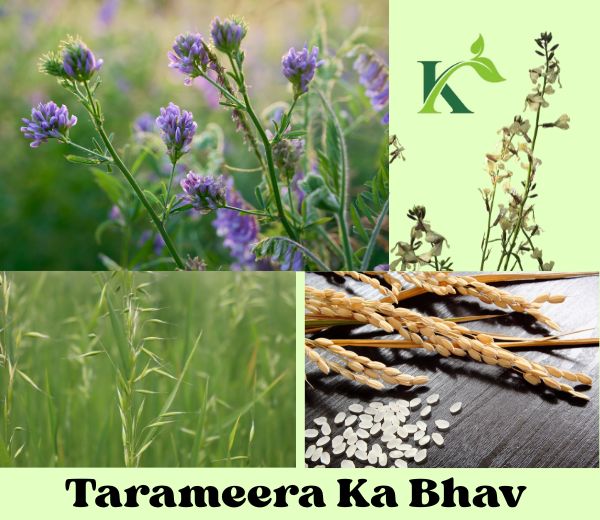
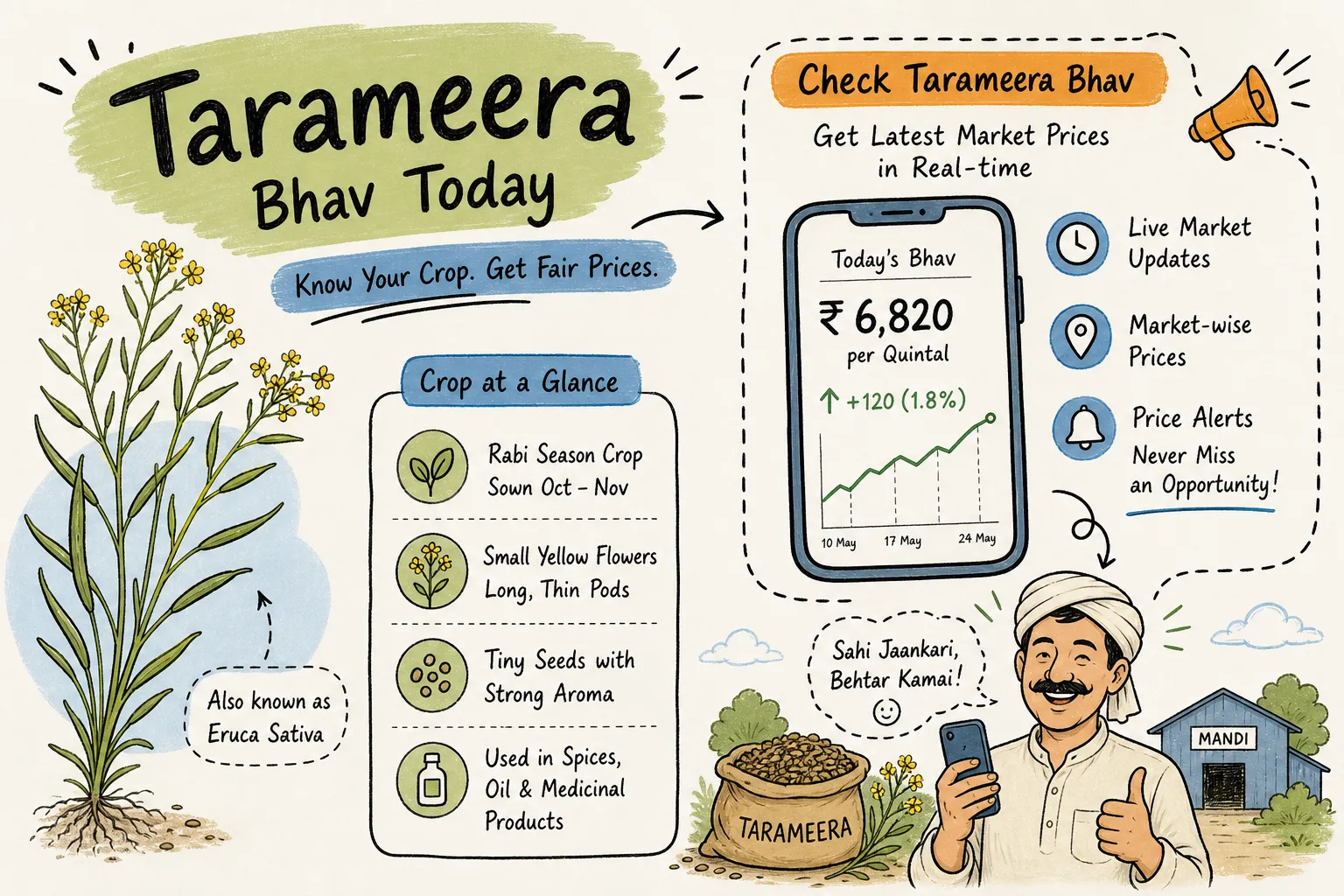
Tarameera: All Prices are in Quintal
Description
| Quick Facts: Tarameera (Taramira) Oilseed | |
|---|---|
| Crop name | Tarameera (Eruca sativa), also known as taramira, rocket seed, or jamba |
| Oil content | Approximately 25, 30% (27.8% typical) |
| Key growing state | Rajasthan (principal state; concentrated in Hanumangarh, Sri Ganganagar, and Nagaur districts) |
| Moisture limit for best grade | Not more than 6% |
| Official MSP | Not covered under current government MSP notifications |
Tarameera bhav (market price) is not listed on every price platform, which is exactly why growers of this niche rabi oilseed often end up selling blind. Unlike sarso, which gets daily coverage across every agri-news channel, price data for this crop is scattered, inconsistent, and hard to verify. During the 2025, 26 rabi season, rates across Rajasthan mandis ranged from ₹4,200 to ₹5,460 per quintal depending on the market, the quality presented at auction, and weekly arrival pressure.
This article gives you a mandi-wise price snapshot from the last rabi season, a six-month trend read, a clear explanation of why tarameera holds its own against sarso, quality grading clarity, and a practical guide on when to sell for maximum returns. For verified, ground-level tarameera bhav before you head to the mandi, check KhetiKisaan's live price listings.
Key Features of Tarameera
Tarameera (Eruca sativa), also known as taramira or rocket seed, is a short-duration rabi oilseed with an average oil content of 22, 30%. It thrives in arid and semi-arid regions, matures in 85, 100 days, and requires minimal irrigation. The seed has a distinctive pungent flavour due to high erucic-acid levels and is rich in essential fatty acids and antioxidants.
Agronomic Benefits
Tarameera is well suited to light soils and contributes to crop rotation by breaking pest and disease cycles in mustard and chickpea systems. Its deep root system improves soil structure and increases water infiltration. Low seed rate (4, 5 kg/ha) and tolerance to frost and drought reduce input costs, while rapid canopy closure suppresses weeds naturally.
Importance of Tarameera
As a niche oilseed, tarameera offers farmers a valuable alternative when mainstream mustards face surplus pressure. Its concentrated cultivation in Rajasthan, Haryana and Uttar Pradesh helps stabilise farm incomes. Nutritionally, its oil is prized for cooking and salad dressings, and its seedcake is a high-protein livestock feed. Moreover, the crop's low water requirement aligns with sustainable agriculture and climate-smart farming practices.
Uses of Tarameera
Oil extracted from tarameera seeds is used in culinary applications, especially in North Indian cuisine, and in the manufacture of margarine and condiments. Industrially, its erucic-acid-rich oil serves as a lubricant and in the production of biopolymers. The crushed cake is employed as organic manure or animal feed. Young leaves of the plant are occasionally harvested for use in salads and traditional herbal remedies.
Why tarameera holds its own against sarso in the mandi
Tarameera commands a competitive price for two reinforcing reasons. First, its seed oil content of roughly 27.8% (with some varieties reaching 30%) is broadly comparable to sarso, and its pungent oil has distinct uses in edible oil markets across North India. Second, total market arrivals remain far smaller than mustard. This supply-side scarcity is what keeps the crop's rates competitive even in years when sarso softens under surplus pressure.
Sarso seed typically carries 30, 35% oil content, giving it a slight technical edge. But sarso is also cultivated across millions of hectares nationally, meaning any good production year pushes national supply sharply higher and drags prices down. Tarameera's cultivation is concentrated mainly in Rajasthan's Hanumangarh, Sri Ganganagar, and Nagaur districts, keeping arrivals at a manageable level. As a result, tarameera rates tend to be more stable during bumper sarso years, a meaningful advantage for farmers who grow both crops.
For a kisan with both sarso and tarameera to sell after rabi harvest, understanding this price-stability differential is commercially useful. In the 2025, 26 season, when sarso prices came under pressure, some tarameera mandis in Rajasthan remained above ₹5,000 per quintal. Knowing which fasal to send first can add thousands of rupees to your total seasonal income.
What decides the actual rate you get at the auction
Three things determine your tarameera mandi rate. The first is the official quality grade your crop falls into. The second is moisture content, it must be under 6% for best grade. The third is the complete absence of Argemone seed contamination: under standard mandi inspection practice, presence of Argemone seeds renders a lot unacceptable and subject to rejection or penalty. Buyers assess these points visually during bol-chaal (bidding), so the grade your lot is assigned effectively determines where in the price range you land.
| Grade | Foreign Matter Max | Dead/Damaged Seeds Max | Unripe Seeds Max | Admixture Max |
|---|---|---|---|---|
| Special | 2.0% | 3.0% | 2.0% | 10.0% |
| Standard | 4.0% | 5.0% | 4.0% | 15.0% |
| General | 6.0% | 8.0% | 8.0% | 20.0% |
Better grades typically fetch a meaningful premium over lower ones, varying by mandi and auction date, the price spread seen across live auction data suggests the difference between General and Standard grade can run to several hundred rupees per quintal. Three practical steps before bringing your crop to the market can make a real difference.
First, dry the grain to under 6% moisture: as a recommended post-harvest practice, spreading the crop on a tarpaulin in direct sun for 2, 3 days before loading works well in most conditions. Second, clean the lot using a basic thresher or sieve to bring foreign matter below 2%, which targets Special grade. Third, store tarameera separately from other oilseeds to prevent admixture that automatically lowers your grade.
The right time to sell your tarameera for maximum returns
Sell in the post-Holi window, mid-March to mid-April, when arrivals begin to thin after the initial harvest rush. Selling in the first two weeks after harvest, when every kisan is bringing crop to the auction yard simultaneously, locks you into the lowest rates of the season.
Farmers who stored their crop for just 3, 5 weeks after harvest and waited for arrival pressure to ease recovered to rates around ₹5,300 per quintal by early March. That is a gain of ₹400, ₹900 per quintal purely from timing, with no change in quality. Combined with proper drying and cleaning to achieve Special grade, the combined impact on your total returns per quintal is substantial.
Because tarameera is a niche oilseed, many generic price aggregators do not publish timely quotes for it, where they do, data is often delayed. Check current tarameera bhav on KhetiKisaan before loading your tractor so you can compare Jaipur against Sumerpur and your local market to pick the best destination. This 10-minute habit before every trip to sell is one of the most straightforward ways to protect your price.
Tarameera bhav: check live rates before you go to the mandi
Tarameera bhav can shift meaningfully from one mandi to the next and from one week to the next, the 2025, 26 season showed a swing of over ₹1,200 per quintal between the February low and the Jaipur peak. Knowing your rate before you leave home is not optional; it is the difference between a good season and a missed opportunity. Check live tarameera bhav on KhetiKisaan before every trip to the auction yard and use the mandi comparison to route your crop where it will earn the most.
| Mandi | Price | Date |
|---|---|---|
| Medta City | 6,200.00/- | 02 Oct, 2026 |
| Nohar | 7,100.00/- | 02 Oct, 2026 |
| Siwani | 6,001.00/- | 02 Oct, 2026 |
| Nagaur | 6,220.00/- | 02 Oct, 2026 |
| Deoli | 5,215.00/- | 02 Oct, 2026 |
| Ellenabad | 6,155.00/- | 02 Oct, 2026 |
| Mandsaur MP | 5,650.00/- | 02 Oct, 2026 |
| Arjunsar | 5,352.00/- | 01 Oct, 2026 |
| Beawar | 5,805.00/- | 01 Oct, 2026 |
| Phalodi | 5,205.00/- | 01 Oct, 2026 |
| Degana | 5,852.00/- | 01 Oct, 2026 |
| Jaitsar | 5,300.00/- | 02 Oct, 2026 |
| Bikaner | 5,703.00/- | 02 Oct, 2026 |
| Charkhi Dadri | 6,504.00/- | 01 Oct, 2026 |
| Jaora MP | 5,800.00/- | 01 Oct, 2026 |
| Sirsa | 6,200.00/- | 02 Oct, 2026 |
| Goluwala | 6,100.00/- | 02 Oct, 2026 |
| Rawastar | 6,152.00/- | 02 Oct, 2026 |
| Mohangarh | 5,630.00/- | 01 Oct, 2026 |
| Kesarisinghpur | 5,925.00/- | 01 Oct, 2026 |
| Suratgarh | 5,300.00/- | 01 Oct, 2026 |
| Khajuwala | 5,185.00/- | 01 Oct, 2026 |
| Dooni | 5,300.00/- | 01 Oct, 2026 |
| Chaksu | 5,005.00/- | 01 Oct, 2026 |
| Chomu | 5,925.00/- | 02 Oct, 2026 |
| Bagru | 5,800.00/- | 01 Oct, 2026 |
| Kishangarh | 5,700.00/- | 02 Oct, 2026 |
| Bassi | 6,303.00/- | 01 Oct, 2026 |
| Dausa | 6,151.00/- | 02 Oct, 2026 |
| Bandikui | 5,550.00/- | 01 Oct, 2026 |
| Mandawar | 5,906.00/- | 01 Oct, 2026 |
| Bhawani Mandi | 5,500.00/- | 02 Oct, 2026 |
| Bundi | 6,205.00/- | 01 Oct, 2026 |
| Jayal | 6,967.00/- | 01 Oct, 2026 |
| Madanganj | 5,703.00/- | 01 Oct, 2026 |
| Bhagat ki Kothi | 5,951.00/- | 01 Oct, 2026 |
FAQ's
Related Blogs
 Sep 28, 2026
 by Pankaj Sihag