





Tarameera Ka Bhav Today: Live Mandi Rates in Rajasthan
 Sep 28, 2026
 by Pankaj Sihag



Tarameera Ka Bhav Today: Live Mandi Rates in Rajasthan
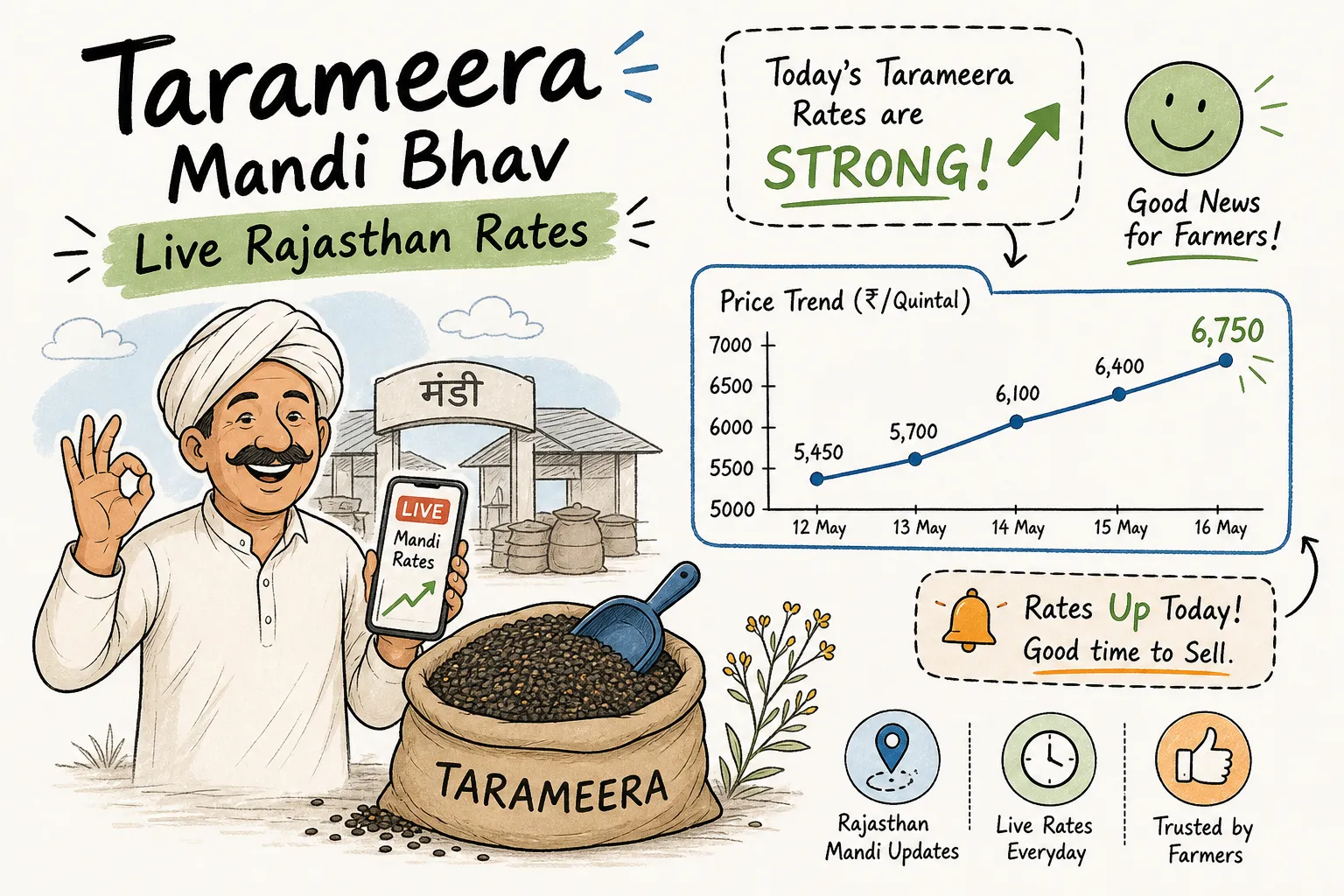
Tarameera ka bhav: Quick facts, tarameera is currently trading at ₹5,800, ₹6,200 per quintal in Nagaur, with a Rajasthan state median of approximately ₹6,190 per quintal as of late September 2026. If you are growing this crop in North Rajasthan and planning your sale this season, those numbers matter before you hitch the trolley to the tractor. Tarameera (also spelled taramira or jamba) is a Rabi oilseed crop that rarely gets the spotlight that sarso does, but it earns its place on marginal zameen where other crops simply do not pay.
KhetiKisaan tracks tarameera ka bhav daily through on-ground contacts present at live APMC auctions across Rajasthan. That means you get the actual bol-chaal (bidding) rate from the morning auction, not a delayed government feed. By the time you finish reading this article, you will know today's rate, how it stacks up against sarso, what forces push the daam up or down through the season, and exactly what steps to take before you bring your fasal to the mandi.
 Table of Contents
- What is tarameera and why Rajasthan farmers still value it
- Today's tarameera ka bhav in major Rajasthan mandis
- How tarameera rates compare to sarso and other oilseeds
- Seasonal factors that move tarameera daam up or down
- What mandi charges actually cost you per quintal
- Grading your tarameera for a better price at the APMC auction
- Where to check live tarameera mandi bhav every day
- Conclusion: Tarameera ka bhav, what to do now
- FAQs
What is tarameera and why Rajasthan farmers still value it
A drought-hardy Rabi oilseed with a steady market
Tarameera (Eruca sativa) is a Rabi oilseed crop tailor-made for the semi-arid belt of North Rajasthan. It matures in roughly 90, 100 days, requires far less water than most competing crops, and can produce a viable yield on marginal, sandy land where sarso or chana would struggle. These qualities make it a logical choice for kisaans in Sri Ganganagar, Hanumangarh, Nagaur, and Barmer districts, where irrigation access is limited and soil fertility is variable.
Rajasthan accounts for the bulk of India's tarameera production, which gives local mandis genuine price-discovery power for this commodity. The crop fits neatly into rotations where the farmer wants to spread risk across oilseeds without committing to the higher input cost of sarso cultivation. Its short duration also frees up the field earlier in the season for the next crop cycle.
Where it goes after harvest: the end-use demand chain
After harvest, tarameera seeds move primarily to small cold-press oil units where they are crushed for a pungent edible oil that is consumed locally and sold in urban markets as a traditional flavour ingredient. The seed meal left after oil extraction, known as khali, is valued as cattle feed, which adds a secondary demand layer independent of the edible oil market. This dual-use structure gives the commodity a more stable price floor than single-use minor oilseeds.
A smaller but growing export market for tarameera seed adds a third layer of demand. When global enquiries pick up, typically in April and May after the new crop is assessed, mandi prices at North Rajasthan APMCs can firm up noticeably. This end-use diversity means tarameera rarely collapses to truly unviable levels, which is a meaningful reassurance for a kisaan who has committed the land and input cost.
Today's tarameera ka bhav in major Rajasthan mandis
Live APMC rates per quintal across key markets
The table below reflects the latest available tarameera mandi bhav across confirmed Rajasthan markets. The price range column shows the low-to-high spread seen in a single day's auction, while the modal rate reflects the most common transaction price. Per kg figures are rounded for quick reference.
| APMC / Mandi | Price range (₹/quintal) | Modal rate (₹/quintal) | Per kg (approx.) |
|---|---|---|---|
| Nagaur | ₹5,800, ₹6,200 | ₹6,000 | ₹60 |
| Rani (AMC) | ₹5,900, ₹5,950 | ₹5,926 | ₹59 |
| Rajasthan state median | Insufficient data | ₹6,190 | ₹62 |
| Sri Ganganagar | ₹4,320, ₹5,063 | Verify via KhetiKisaan live feed | ₹43, ₹51 |
| Nohar | ₹5,150, ₹6,135 | ₹5,800 | ₹61 |
Sri Ganganagar shows a notable variation between sources, with quotes ranging from ₹4,320 to ₹5,063 per quintal depending on the reporting feed and lot quality. This spread underlines why cross-checking the live auction price before you travel to any specific mandi is essential. For Nohar, confirmed tarameera-specific data was not available at time of publication; check KhetiKisaan's daily mandi bhav page for the most current verified figure.
How to read auction price ranges
The low end of any mandi's price range reflects lots that arrived with higher moisture, visible kanka (weed seeds), or more damaged seed. The high end reflects clean, dry, well-graded tarameera that buyers can store or process without additional handling cost. Never compare two mandis' rates without knowing what quality each figure represents. A ₹6,200 rate at Nagaur for Special-grade seed and a ₹5,800 rate there for General-grade seed are not interchangeable data points; they reflect two completely different lots.
Taramira seed rate and price history: what the trend tells you
Understanding tarameera ka bhav in context requires a brief look at where prices have moved. Taramira seed rate has historically tracked within a ₹4,500, ₹7,000 per quintal band in Rajasthan mandis over recent seasons, with the floor set largely by crushing economics at oil mills and the ceiling driven by tight supply years or periodic export interest. Taramira price history shows that the sharpest upward moves have coincided with poor monsoon years that reduced sown area, while the softest rates came during seasons of heavy simultaneous arrivals of sarso and tarameera. Keeping this band in mind helps you judge whether the current tarameera ka bhav represents a fair window to sell or a moment to hold stock a little longer.
How tarameera rates compare to sarso and other oilseeds
The price relationship between tarameera and sarso
Sarso (mustard) consistently commands a higher price per quintal than tarameera, and the gap in the current Rabi marketing season is substantial. Sarso in Rajasthan mandis is trading around ₹7,900, ₹8,100 per quintal, which puts it roughly ₹2,000, ₹3,000 per quintal above tarameera's prevailing range. This premium exists because sarso has a government Minimum Support Price (MSP) as a price backstop, a much larger production base, and broader industrial demand from edible oil refineries.
That said, the gap is not fixed. In years of tight tarameera supply, oil mills bid more aggressively for available seed and the discount to sarso narrows meaningfully. Farmers who track both crops simultaneously can make better decisions about which to sow more of in the coming Rabi season. For this season's sales, the arithmetic is clear: sarso pays more, but tarameera's lower input cost and hardier nature make it viable on acreage where sarso would underperform.
Tarameera vs. arandi and til: where it stands
Arandi (castor) prices are driven by global oleochemical demand and tend to be more volatile than tarameera's relatively stable regional price band. Til (sesame) responds sharply to export orders, which makes it rewarding in boom years but unpredictable in quiet ones. Tarameera occupies a calmer middle ground: it is regionally anchored, its buyers are primarily local oil mills and livestock feed traders, and its price does not swing wildly with global commodity news. For a kisaan who values predictability over speculation, that stability has real value.
Why tarameera does not have an MSP and what that means for you
Unlike sarso, tarameera is not covered under the government's Minimum Support Price programme. There is no procurement backstop from NAFED or state government agencies if prices fall below a viable level. Your net realisation depends entirely on how many buyers show up at the auction and how competitive the bidding is on the day you arrive. This makes two things critical: knowing which mandis have the most active oil mill buyers on any given day, and timing your arrival to avoid peak supply periods when competition among sellers is highest and buyers have the upper hand.
Seasonal factors that move tarameera daam up or down
The Rabi harvest flush and its effect on prices
Tarameera is sown between mid-September and mid-October across most of Rajasthan and harvested from late January through early March, depending on the district. This puts its harvest in direct overlap with sarso arrivals. When large volumes of both crops reach the mandi simultaneously in February and March, supply pressure tends to soften prices for both. The typical seasonal curve runs like this: prices are firmer in October and November when carry-forward stocks are low and the new crop is still in the ground, soften through the February, March harvest flush, then gradually recover from May onwards as mandi arrivals thin out.
Practically, this means that farmers with adequate storage and low debt pressure are better off holding at least a portion of their lot until May or June rather than selling everything at harvest. The price recovery is not dramatic, but even a ₹300, ₹500 per quintal improvement across 50 quintals is a meaningful addition to the season's income.
Rainfall patterns, acreage changes, and carry-forward stock
The area sown in any Rabi season directly shapes the mandi bhav in the following marketing season. A dry October with poor soil moisture at sowing time results in lower germination, reduced crop area, and tighter supply at mandis later in the year, which supports better taramira APMC rates. Conversely, a well-distributed September, October rain encourages wider sowing and larger arrivals. Oil mills and traders also hold carry-forward stocks from the previous season's procurement, and when mills draw down those reserves during a period of heavy fresh arrivals, they reduce their buying urgency, which pulls prices lower.
Export demand and its occasional price spike
A burst of export enquiry for tarameera seed or tarameera oil can lift mandi prices noticeably at North Rajasthan APMCs that are well-connected to port logistics. This does not happen every year, but when it does, the effect can be a ₹400, ₹700 per quintal spike over a period of two to three weeks in April or May. Watching agri-trade news in that window and staying connected to a platform like KhetiKisaan that tracks price movements in real time gives you the early signal to sell when the market is in your favour rather than after the moment has passed.
What mandi charges actually cost you per quintal
Breaking down the deductions between gross mandi bhav and your pocket
The headline tarameera ka bhav you see on a price board or a digital platform is the gross auction price, not your take-home amount. In Rajasthan APMCs, the statutory mandi fee is 1.6% of the transaction value, and the arhatiya (commission agent) charges a further 2.0%. Together, that is 3.6% off the top before any other costs are counted. On a gross price of ₹6,000 per quintal, that statutory deduction alone is ₹216 per quintal.
On top of those percentage-based charges, you pay hamali (loading and weighment labour) at approximately ₹20, ₹50 per quintal, and transport from your farm to the mandi at a cost that varies sharply by distance and vehicle type. A farmer 30 km from the mandi might spend ₹80, ₹120 per quintal on transport; one who is 80 km away can easily spend ₹180, ₹250. Add these together and total deductions on a ₹6,000 gross price can reach ₹400, ₹600 per quintal, leaving a net farm-gate realisation of ₹5,400, ₹5,600 per quintal.
Cleaning and drying costs: the hidden margin killer
Tarameera arriving at the mandi with more than 6% moisture or visible impurities will be bid down sharply or rejected by serious buyers. The cost of cleaning and drying before the trip to the mandi is real, but it is almost always recovered in the price premium. Farmers who arrive with clean, dry, well-graded seed consistently recover ₹200, ₹400 more per quintal than those who do not, based on the grade differential observed at competitive mandis like Nagaur and Dausa. Across 50 quintals, that is ₹10,000, ₹20,000 in additional income for a few hours of post-harvest processing work.
Grading your tarameera for a better price at the APMC auction
The three official grades and their tolerances
Indian mandi standards recognise three grades for tarameera: Special, Standard, and General. The key parameters assessed by buyers at auction are moisture content, foreign matter (kanka, soil, debris), damaged or discoloured seeds, unripe or shrivelled seeds, and admixture of other mustard varieties. Moisture must not exceed 6% for any grade, and no lot should contain any trace of Argemone seeds, which are a statutory adulterant.
| Grade | Foreign matter (max) | Damaged seeds (max) | Unripe / shrivelled (max) | Other mustard admixture (max) |
|---|---|---|---|---|
| Special | 2% | 3% | 2% | 10% |
| Standard | 4% | 5% | 4% | 15% |
| General | 6% | 8% | 8% | 20% |
The price gap between Special and General grade at a competitive mandi can run to several hundred rupees per quintal. At Nagaur and Dausa, where multiple oil mill buyers bid against each other, well-graded Special lots consistently attract the top end of the day's price range. General-grade lots settle at the low end or are passed over entirely by quality-conscious buyers.
Practical steps to achieve Special or Standard grade before the mandi
Four steps taken after harvest can meaningfully lift your lot's grade and your net price. First, spread the seed on a clean threshing floor and sun-dry it for two to three days until moisture drops below 6%; a handful grabbed from the bag should feel dry and the seeds should rattle freely. Second, run the seed through a manual or motorised grain cleaner to remove kanka, soil particles, and chaff. Third, winnow the cleaned seed to remove visibly shrivelled, damaged, or discoloured seeds that would count against your foreign matter tolerance. Fourth, store the finished lot in clean, dry jute bags away from moisture and rodents until transport day.
These steps add perhaps one to two days of labour per 50 quintals. The return on that time, at ₹200, ₹400 per quintal in additional auction price, is among the highest-return activities a kisaan can undertake in the post-harvest period. Arriving at Nagaur mandi with a clean Special-grade lot during a session with five or six active oil mill buyers is the single most effective way to capture the top end of the day's tarameera mandi bhav.
Where to check live tarameera mandi bhav every day
Why a single delayed price feed is not enough for a selling decision
Government portals like Agmarknet carry genuinely useful data, but the prices often carry a 24, 48-hour lag by the time they are compiled, uploaded, and visible to users. For a selling decision that needs to be made before 8 AM when you load the trolley, yesterday's rate is already stale. Commodity aggregator sites compound this problem by averaging prices across both high-volume and low-volume mandis, which can distort the picture significantly. A mandi that traded 10 quintals at ₹5,200 pulls the average down even if the large nearby APMC traded 2,000 quintals at ₹6,100.
A farmer deciding whether to sell today or hold for another week needs the actual bol-chaal rate from that morning's auction at the specific mandi they are considering. Anything less is guesswork dressed up as data.
How KhetiKisaan gives you the actual auction floor price
KhetiKisaan's price advantage comes from its network of field reporters stationed at APMC auction yards during live bidding sessions. At mandis including Nagaur, Sri Ganganagar, and Nohar, these reporters capture actual transaction prices as the auction proceeds, not delayed government feeds or estimated averages. For tarameera, this means you see the genuine price spread from that morning's auction, broken down by mandi, so you can compare two or three nearby APMCs before deciding where to bring your fasal.
Beyond tarameera mandi bhav, KhetiKisaan covers sarso, gwar, arandi, chana, moong, isabgol, and other key Rajasthan crops in the same verified format. If you are holding a mixed lot from this season or planning for the next Rabi sowing, checking KhetiKisaan daily keeps all your price intelligence in one place. Visit the platform every morning before making any sale or storage decision this season.
Conclusion: Tarameera ka bhav, what to do now
Tarameera ka bhav in Rajasthan mandis is currently holding at a reasonable level, but as this article has shown, the rate you see on a price board is only the starting point. Your actual realisation depends on the quality of your lot, your choice of mandi, the timing of your sale relative to peak arrivals, and how closely you track the market in the days leading up to your trip. Check live tarameera ka bhav on KhetiKisaan every morning to make every selling decision on real data, not yesterday's numbers.