







Best Time to Sell Narma Cotton for Maximum Price in India
 Sep 08, 2026
 by Pankaj Sihag



Best Time to Sell Narma Cotton for Maximum Price in India
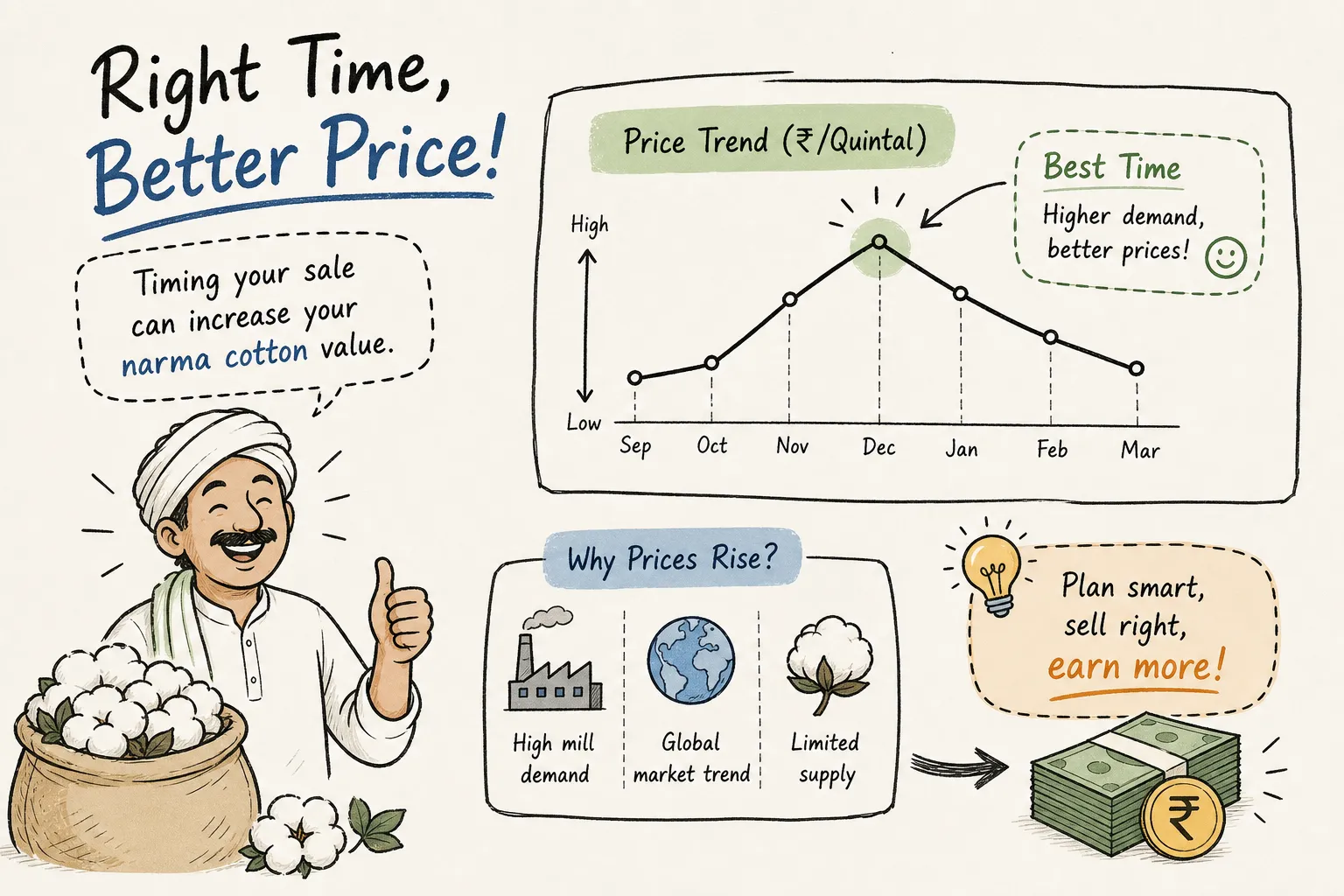
Knowing the best time to sell narma can add thousands of rupees per quintal to your seasonal revenue, yet many narma growers sell at the worst possible time: right after harvest, in October or November, when every other farmer in the region is doing exactly the same thing. Large volumes hit the mandi simultaneously, traders have all the bargaining power, and you end up accepting whatever rate is on offer. The financial pressure of pending input loans makes it even harder to hold back.
This article gives you a practical framework to fix that. You will understand how narma prices move through the year, when the seasonal high window typically arrives, how to calculate whether storing your cotton makes financial sense, and what five specific signals to watch before you make the sell decision. Before any of that, start with one simple habit: check the daily narma bhav at Sri Ganganagar mandi on KhetiKisaan. Rates sourced directly from live auction yards, not delayed government feeds, give you the price intelligence to act with confidence rather than guessing.
| Crop type | Kharif (sown June, July, harvested Oct, Jan) |
|---|---|
| Typical low-price window | October, February (peak arrivals) |
| Typical high-price window | April, July (lean supply) |
| Monthly holding cost (all-in) | 2, 3% of cotton's current value |
| Price differential (low to peak, normal year) | 10, 25% |
 Table of Contents
- How the narma price curve moves through the year
- Why selling immediately after harvest often costs you money
- Best time to sell narma: seasonal windows and signals
- MSP: your price floor and when it actually protects you
- Market signals that tell you when to sell narma cotton
- Storage vs selling now: the real maths of holding your crop
- Three ways to sell narma cotton and which one fits your situation
- A 5-step checklist: deciding the best time to sell narma
- The bottom line on timing your narma sale
- FAQs
How the narma price curve moves through the year
The kharif arrival surge and what it does to your price
Narma is a kharif crop, sown in June, July across Rajasthan, Haryana, and Punjab. First pickings reach the mandi by October, and arrivals build steadily through November and December. The result is predictable: when supply floods in from all directions at once, mandi prices soften. This is not bad luck or a conspiracy by traders. It is basic supply-demand economics playing out every single season.
Historical price data tells a consistent story: October through February is the soft-to-moderate price window for narma. Farmers who sell during this period are selling into the heaviest supply pressure of the year. The only exception is when government procurement through CCI (Cotton Corporation of India) is active and absorbing volumes near MSP, but even that support is uneven across mandis and quality grades.
The lean-supply window: best time to sell narma cotton
Once farm stocks deplete and new-season arrivals dry up after January and February, the situation reverses. Textile mills and traders who need cotton to keep production running now compete for whatever is left in the market. This competition pushes prices upward. Historical data consistently shows April through July as the price-strength zone for Indian cotton. May 2022 recorded a high of ₹10,057 per quintal, a useful benchmark for what the off-peak window can deliver in a strong market year.
The price differential between the October arrival-period lows and the May, June seasonal highs ranges from 10 to 25 percent in a normal crop year. On cotton priced at ₹8,000 per quintal, that difference translates to ₹800 to ₹2,000 per quintal. Multiply that across your full holding and the financial case for waiting becomes very clear.
Why some crop years break the seasonal pattern
The seasonal curve is a probability, not a guarantee. Global cotton prices, India's export policy, a strong monsoon affecting next-season crop estimates, and the scale of CCI procurement can all override the seasonal tendency in certain years. In a year when global cotton is under severe pressure, domestic prices may not recover meaningfully in the April, July window. Treat the seasonal pattern as your base case, and use real-time market signals to confirm or adjust your timing each year.
Why selling immediately after harvest often costs you money
The arrival-pressure effect on mandi prices
When large volumes arrive at the Sri Ganganagar or Nohar mandi simultaneously in November and December, the trader's negotiating position is very strong. They can be selective, wait out the queue, and offer lower bids knowing another seller is right behind you. The farmer who needs to sell today has very little room to push back. This arrival-pressure effect is a primary driver of why post-harvest prices are structurally weak relative to the annual average.
How loan pressure forces early selling
Input loans taken during sowing season for seeds, fertiliser, and pesticides are typically due right at harvest time. This is not a coincidence; it reflects the agricultural finance cycle. The result is that many narma growers are forced to sell at a poor price simply because the loan repayment cannot wait. Recognising this structural trap is the first step to planning around it. If you can arrange a short-term warehouse receipt loan against stored cotton, you can repay the input loan without liquidating your crop at a distress price.
Best time to sell narma: seasonal windows and signals
The April, July price window: what the data shows
By April, the previous kharif's arrivals have largely dried up. Old stocks in farm storage are tight. Mills that delayed procurement during the high-supply months now need cotton urgently. Low supply and sustained demand together create the conditions for price strength. The gap between October lows and May, June highs in a normal year sits in the 10 to 25 percent range, as historical seasonal data consistently shows.
A narma grower who stores from November and sells in May or June is not just hoping for better prices, they are positioning with the seasonal tendency, not against it. Whether the gain covers storage costs depends on your specific holding costs, covered in the storage maths section below.
How global cotton demand and exports shape the domestic peak
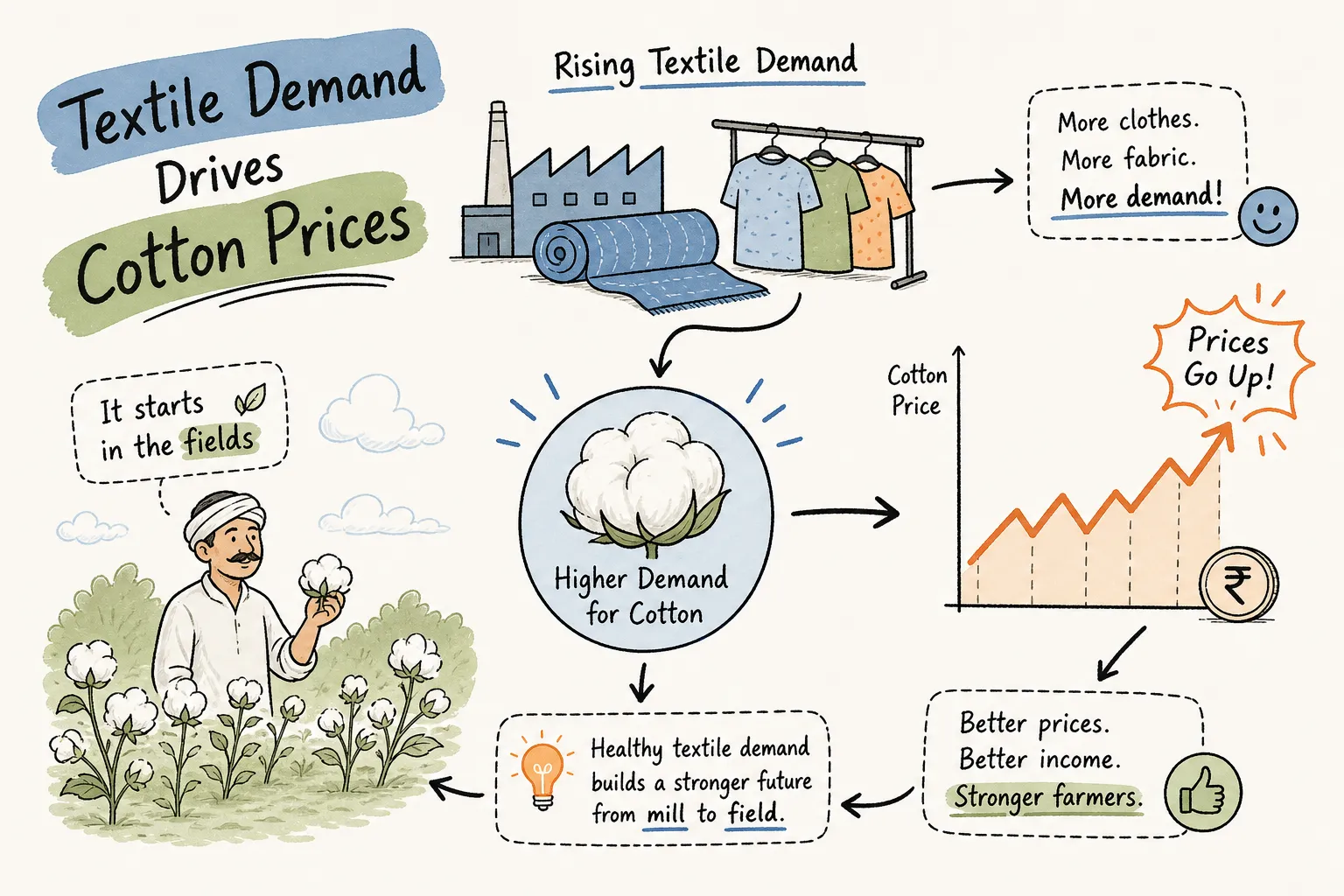
India exports cotton primarily to Bangladesh, Vietnam, and China, with the USA emerging as a growing destination in recent trade reports. These export shipments are concentrated in the February, June window. The Cotton Association of India's estimate for FY2025, 26 exports is 1.50 million bales, with Bangladesh remaining the largest single buyer. When export demand is strong during this period, it pulls domestic prices upward by reducing available supply. Domestic textile mill restocking after the Diwali festival season also adds buying pressure from January onward, at exactly the time when arrivals are declining.
The year-on-year variation to watch for
The seasonal high does not always arrive in the same month. In some years the peak comes in May; in others it arrives in June or July. This is why watching real-time price signals matters more than following a fixed calendar. The seasonal pattern tells you the direction; live mandi data tells you the actual timing. The next two sections give you both the signals to watch and the maths to evaluate your decision.
MSP: your price floor and when it actually protects you
How MSP works as a floor price in the narma mandi
MSP (Minimum Support Price) is the minimum price the government guarantees you will receive for your crop, provided an authorised procurement agency is actively buying in your area. For kharif 2026, the MSP for medium-staple cotton (kapas) is set at ₹8,267 per quintal, and for long-staple cotton at ₹8,667 per quintal. When mandi prices fall near or below MSP, agencies like CCI are expected to step in and procure, preventing a price free-fall during peak arrival season.
When government procurement actually kicks in, and when it doesn't
MSP protection is not automatic. CCI procurement activates only when the government has declared procurement centres open in your area and when your cotton meets quality norms for moisture and staple length. In seasons when market prices stay comfortably above MSP, CCI stays largely out of the market. In weak years, there can be delays of several weeks before procurement centres open and absorb volumes. In Rajasthan during 2024, 25, procurement was limited partly because quality and moisture constraints reduced the volumes CCI could accept, which meant the price floor was weaker in practice than it appeared on paper.
How to use MSP as a decision benchmark
If your local mandi rate is within 5 to 8 percent of MSP, selling now carries significant downside risk. You have very little buffer before you are selling below the government's own floor. Note that this 5, 8 percent threshold is an advisory heuristic: procurement activation depends on declared centres and quality norms, so the buffer is not a regulatory trigger. If mandi prices are 15 to 20 percent above MSP, you have a comfortable margin, and the decision shifts to whether waiting adds more than your storage costs. At the time of writing, Sri Ganganagar narma was trading around ₹8,616 per quintal in early September 2026, approximately 4 percent above MSP, a narrow gap that warrants careful thought before locking in a large sale at current levels.
Market signals that tell you when to sell narma cotton
Arrivals data: the single most useful weekly indicator
When weekly arrivals at major narma mandis start declining sharply after January, it signals that supply is tightening and prices are likely to firm. APMC mandi offices and AGMARKNET publish weekly arrivals data. A consistent drop in daily arrivals over three to four consecutive weeks is a strong early signal that supply pressure is easing and buyers will soon need to compete more aggressively for available stock.
Textile mill demand and export order news
Two demand-side signals are worth tracking closely. First, watch for news of domestic mills increasing procurement or running at higher capacity utilisation rates, this indicates they are absorbing stock faster than supply is coming in. Second, watch for news of India receiving fresh export orders from Bangladesh or China, since these orders represent future demand that has not yet hit the physical market, meaning prices are likely to rise. Both signals are available through commodity trade publications, APMC circulars, and agricultural news platforms.
Tracking live narma bhav on KhetiKisaan before you sell
For narma growers in Rajasthan, particularly around Sri Ganganagar mandi, the difference between a good sell decision and a poor one often comes down to whether you are looking at today's actual auction rates or last week's government-feed data. KhetiKisaan publishes live daily narma mandi prices sourced from ground-level contacts present at the actual bol-chaal (auction bidding). Before any sell decision, checking the day's narma bhav trend on KhetiKisaan takes two minutes and tells you whether prices are rising, steady, or slipping. That single data point tells you whether to hold your cotton for another week or move it immediately.
Storage vs selling now: the real maths of holding your crop
What it actually costs to store narma cotton per month
Holding costs have three components. Warehouse storage in regulated godowns runs approximately ₹35 to ₹56 per 100 kg bale per month (based on published regulated godown tariff schedules). Quality deterioration in ordinary covered storage, from moisture uptake, yellowing, or contamination, costs approximately 0.5 to 1.5 percent of value per month. Financing costs on borrowed capital typically run 0.8 to 1.2 percent of stock value per month at working-capital lending rates of 10 to 14 percent annually.
Combined, the all-in monthly holding cost for narma cotton typically works out to 2 to 3 percent of the cotton's current value. On cotton priced at ₹8,000 per quintal, that is approximately ₹160 to ₹240 per quintal per month. Over three months of storage, you need prices to rise by at least ₹480 to ₹720 per quintal just to cover costs, before you make any additional gain.
How to calculate your personal break-even price for waiting
The formula is straightforward. Storing for three months at a 2.5 percent monthly holding cost means you need prices to rise by 7.5 percent above current levels to break even. If the seasonal pattern historically delivers a 15 to 20 percent price rise in strong years, storage makes clear mathematical sense, you cover costs and still capture 7.5 to 12.5 percent additional profit. If the seasonal gain in a weak year is only 5 to 8 percent, storage barely covers costs and the effort is questionable.
Here is a quick numerical example. Current price: ₹8,000 per quintal. Monthly holding cost: ₹200 per quintal (2.5%). Three-month holding cost: ₹600 per quintal. Break-even price after three months: ₹8,600 per quintal. If seasonal history suggests prices could reach ₹9,200 to ₹9,600 by May, the potential gain of ₹600 to ₹1,000 per quintal above break-even is well worth the wait. If prices are expected to reach only ₹8,400 to ₹8,500, selling now is the better choice.
When storing is not worth it
Immediate sale makes more sense when cotton quality is already below acceptable standards, when local storage is not humidity-controlled and deterioration risk is high, or when the farmer is carrying high-interest debt that compounds faster than any seasonal price gain can offset. In these scenarios, the cost of delay outweighs the benefit. If quality is the concern, selling at a slightly discounted rate now is always better than selling at a heavily discounted rate six months later when the cotton has yellowed or lost staple length.
Three ways to sell narma cotton and which one fits your situation
Spot mandi sale: fast, transparent, no price certainty
The standard route is to bring your cotton to the APMC, have it weighed and graded, and sell at the day's auction rate. This works well for farmers who need immediate liquidity, have lower-quality cotton that will not improve with storage, or simply do not have access to proper storage facilities. The downside is clear: in October and November, you are a price-taker with very little negotiating power. In April and May, the same spot mandi route delivers a much better rate without any additional complexity.
Forward contracts with a ginning mill or trader
Some large ginners in Rajasthan and Haryana offer forward purchase contracts at the start of the season, locking in a price before harvest arrives. The farmer gets price certainty and avoids both storage costs and price risk. The ginner gets supply security. The trade-off is that if mandi prices surge well above the contracted price, the farmer misses the upside. Forward contracts suit farmers who prioritise certainty over maximum potential gain, or those who genuinely cannot manage the storage logistics.
MCX and NCDEX cotton futures: the hedging route
MCX relaunched a revised cotton futures contract in February 2023 with updated quality specifications to improve price discovery for the cotton value chain. NCDEX also offers cotton futures with delivery features, including the 29 mm cotton contract. These instruments allow a seller to lock in a future price while still holding physical cotton in storage, the most sophisticated way to capture seasonal price upside while protecting against a downside move. This route requires a demat account and a working knowledge of futures mechanics, making it better suited to larger commercial growers with substantial volumes than to small or marginal farmers who are well served by the spot or forward contract routes.
A 5-step checklist: deciding the best time to sell narma
Run through these five steps before making any major sell decision. This is your annual decision framework, not a one-time reference.
- Check where the current mandi price sits relative to MSP. If the gap is less than 8 percent, your downside risk from waiting is lower because government procurement support may activate near that level, though keep in mind that procurement is conditional on declared centres and quality norms, so it is not guaranteed. If prices are 15 to 20 percent above MSP, you have room to make a timing decision based on other factors rather than feeling forced to sell defensively.
- Look at weekly arrivals data at your mandi. Declining weekly arrivals signal tightening supply and prices likely to firm. Rising arrivals mean more selling pressure is coming. Check KhetiKisaan for daily narma bhav trends at Sri Ganganagar to see whether prices are moving up, holding steady, or slipping over the past week.
- Calculate your storage break-even. Apply the 2 to 3 percent per month holding cost to your current price and work out how many months of storage your break-even requires. Then ask: is the seasonal price upside historically large enough to cover that cost and leave a meaningful gain in the current market environment?
- Check export and textile mill demand signals. News of fresh export orders from Bangladesh or China, or reports of domestic mills ramping up procurement, are forward indicators of price strength that will show up in mandi rates within weeks. These signals are available through commodity news sources and APMC circulars.
- Assess your own financial position honestly. If you are carrying high-cost debt due for repayment, your effective holding cost is higher than the standard 2 to 3 percent benchmark. In that case, selling in tranches works better than an all-or-nothing approach: sell enough to clear urgent debt in November or December, hold the rest for the February, March period, and consider a final tranche in May or June if storage conditions and price signals justify it.
The bottom line on timing your narma sale
The best time to sell narma is rarely the day after harvest. The seasonal price curve is consistent enough to plan around, and the financial cost of ignoring it is real and recurring. Selling into the October, December arrival surge is the single most common timing mistake narma growers make, and it is entirely avoidable with a little planning and the right price intelligence.
MSP gives you a floor to measure downside risk. Storage maths gives you a break-even target to evaluate whether waiting is financially justified. Tracking live narma bhav at Sri Ganganagar mandi on KhetiKisaan gives you daily price direction to act with confidence instead of guessing. Use the 5-step checklist at the start of every selling season, not just once.
The farmers who consistently get better prices for their fasal (crop) are not luckier than their neighbours. They are simply better informed. Start by checking today's narma bhav on KhetiKisaan before you make your next sell decision.
FAQs
Related Blogs

Oct 02, 2026
by Pankaj Sihag

Sep 12, 2026
by Pankaj Sihag
Sep 02, 2026
by Pankaj Sihag

Aug 27, 2026
by Pankaj Sihag


Apr 11, 2026
by Pankaj Sihag
Apr 08, 2026
by Pankaj Sihag