







Castor Bean Derivatives: Top Industrial Applications Explained
 Oct 10, 2026
 by Pankaj Sihag



Castor Bean Derivatives: Top Industrial Applications Explained
| Parameter | Detail |
|---|---|
| Primary derivative | Ricinoleic acid (up to 90% of castor oil fatty acid content) |
| Key industrial derivatives | Hydrogenated castor oil (HCO), dehydrated castor oil (DCO), sebacic acid, undecylenic acid, ethoxylated castor oil, castor methyl ester (CME) |
| Industries served | Lubricants, cosmetics, paints, plastics, pharmaceuticals, biofuels |
| India's global position | Supplies roughly 85, 90% of the world's castor seed and castor oil |
| Global derivatives market | Approximately US$1.5, 1.7 billion |
| Typical FOB price, refined castor oil | US$1,630, 1,650/MT from Kandla/Mundra |
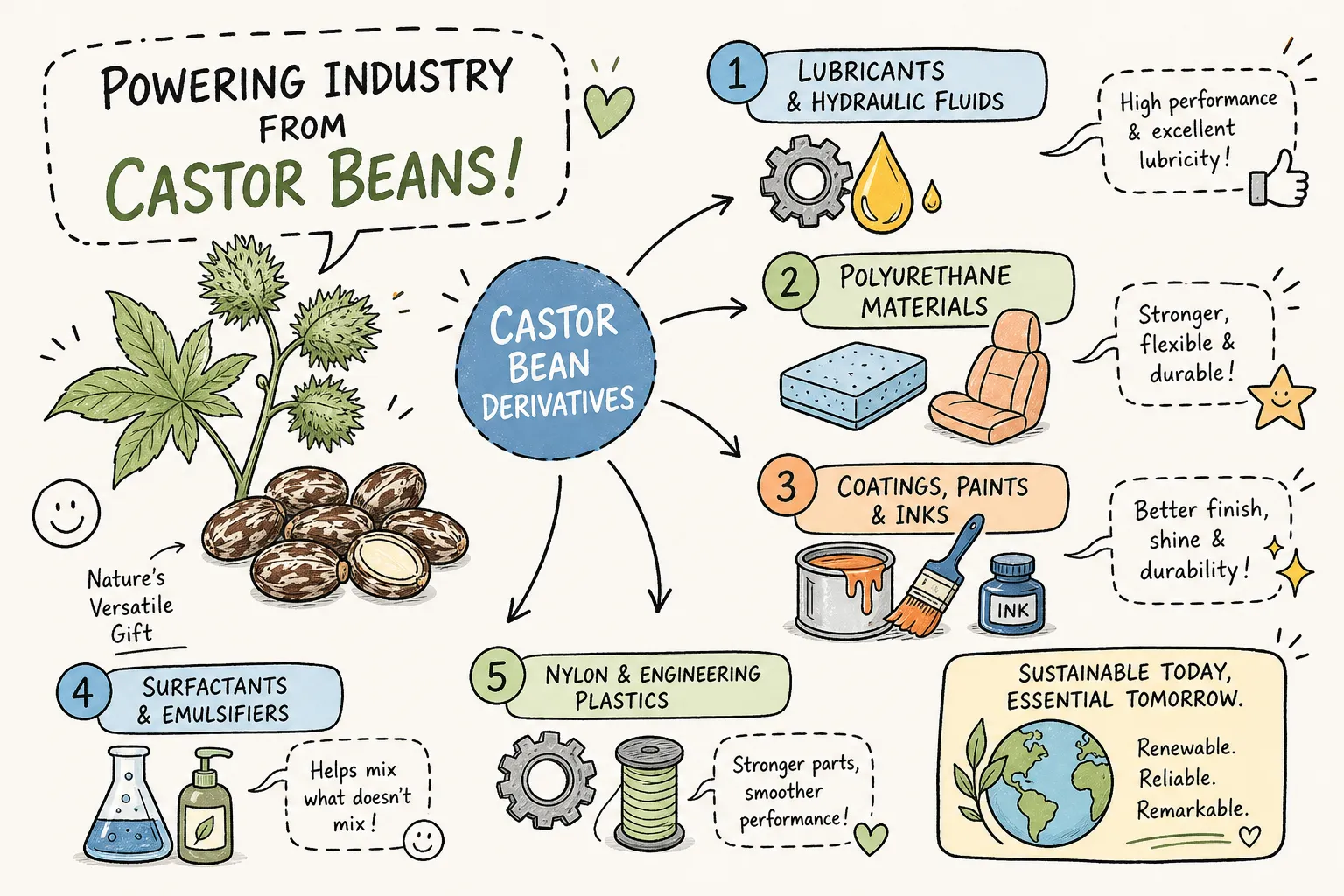
The industrial applications of castor bean derivatives span at least six major sectors: lubricating greases, cosmetic emollients, alkyd paints, polyurethane foams, bio-based nylon, pharmaceutical excipients, and biofuel blends. No other commercially available vegetable oil produces this breadth of downstream chemicals from a single crop, which is why global demand for arandi (castor) keeps growing year after year. That industrial demand eventually shows up as mandi bhav movement at APMC yards across India, making it essential for kisaans to understand what is driving prices from the other end of the supply chain.
For farmers growing arandi in Rajasthan, Gujarat, or Andhra Pradesh, tracking live arandi mandi bhav is the most direct way to catch those demand-driven price windows. KhetiKisaan publishes daily arandi rates sourced from ground contacts at live APMC auctions, giving you the same-day visibility needed to act on market movements rather than react to them a week later.
 Table of Contents
- Why arandi oil is chemically unlike any other crop oil
- Industrial applications of castor bean derivatives, Lubricants and industrial greases
- Paints, varnishes, and surface coatings: dehydrated castor oil at work
- Cosmetics and personal care: ricinoleic acid as the quiet workhorse
- Industrial applications of castor bean derivatives in plastics, polyurethanes, and bio-based nylon
- Pharmaceuticals and biofuels: smaller volumes, strong demand signals
- How global industrial demand moves arandi mandi bhav
- Closing thoughts
- FAQs
Why arandi oil is chemically unlike any other crop oil
The ricinoleic acid advantage
Roughly 85, 90% of arandi oil's fatty acids are ricinoleic acid, a hydroxylated C18 acid that carries three distinct chemical features in a single molecule: a carboxylic acid group, a secondary alcohol (hydroxyl) group, and a carbon-carbon double bond. Think of it as a molecule with three chemical "hooks," each of which lets chemists attach it to a different industry. Neither palm oil nor soya oil contains hydroxyl-functional fatty acids at this concentration, so they simply cannot produce the same range of downstream chemicals regardless of how they are processed.
This unusual structure, not an accident of nature, is the commercial foundation of the entire castor derivatives industry. Every major application discussed in this article traces back to one or more of those three functional groups being exploited in a specific way.
What these functional groups enable
Each functional group opens a separate industrial pathway. The hydroxyl group reacts directly with isocyanates to form polyurethanes, participates in esterification, and is the basis for surfactant chemistry. The double bond enables hydrogenation to produce solid castor wax (hydrogenated castor oil, or HCO), dehydration to produce drying oils used in paints, and pyrolysis to produce sebacic acid and undecylenic acid. The carboxylic acid group enables the synthesis of polyamides (nylon) and polyesters. In practical terms, one agricultural crop feeds at least six distinct industrial sectors simultaneously.
Industrial applications of castor bean derivatives, Lubricants and industrial greases
How hydrogenated castor oil thickens greases
HCO is produced by saturating the double bond in castor oil under hydrogen pressure, yielding a hard, waxy solid with a melting point around 85, 88°C. When HCO is hydrolysed, it releases 12-hydroxystearic acid (12-HSA), which is the actual thickener used in lithium and calcium soap greases. The crystalline network formed by 12-HSA traps base oil and gives grease its semi-solid consistency, outperforming many petrochemical thickeners in high-temperature and water-resistance applications. HCO and 12-HSA together account for roughly 25, 30% of castor derivative market value globally, making this the highest-volume solid derivative from castor oil by a considerable margin.
Castor-derived ester lubricants for engines and aviation
Castor oil esters and ricinoleate esters are used as aviation piston-engine lubricants and specialty machine oils because of two properties: strong metal-surface adhesion from the polar hydroxyl group, and natural biodegradability. Typical viscosity for industrial castor oil sits at 600, 900 cP at 25°C; finished lubricant grades are selected at 32 to 320 cSt at 40°C depending on the machinery type. This segment is a consistent volume buyer of Indian castor oil exports, with China, the Netherlands, and the United States among the largest consuming markets.
Castor esters carry a 15, 40% cost premium over mineral-oil equivalents, but they justify that premium through lower maintenance frequency and regulatory compliance where biodegradability is mandated, particularly in European markets where green procurement rules are tightening.
Paints, varnishes, and surface coatings: dehydrated castor oil at work
What dehydrated castor oil (DCO) does in a paint film
DCO is made by removing water from ricinoleic acid's hydroxyl group, which creates extra conjugated double bonds. These bonds enable oxidative drying: the film hardens when exposed to air, much like linseed oil but with better colour retention and gloss in many formulations. DCO is incorporated into alkyd resins, which form the backbone of most conventional oil-based paints, delivering flexibility, adhesion, and water resistance in protective coatings for industrial and decorative surfaces.
Ethoxylated castor oil as a coatings surfactant
Ethoxylated castor oil, also called PEG-castor, is a nonionic surfactant produced by reacting castor oil with ethylene oxide. It wets pigments, disperses them uniformly, and stabilises emulsions in waterborne paints and printing inks. The long ricinoleate chain provides oil compatibility, while the polyether tail provides water affinity, a balance that synthetic surfactants struggle to replicate at comparable cost to the formulator. This makes it a practical choice for formulators who need reliable pigment dispersion without raising their input costs significantly.
Typical specification parameters for coatings intermediates
Buyers in the coatings industry specify three key parameters when sourcing castor-based intermediates. Iodine value (measured in g I₂/100 g) indicates the degree of unsaturation; higher values support oxidative drying in alkyd systems. Acid value (mg KOH/g) is kept low, typically below 5, 10 mg KOH/g, in polyurethane coatings polyols but is intentionally higher during alkyd synthesis. Brookfield viscosity at 25°C, along with Gardner colour scale and moisture content, rounds out the standard release-test specification for most liquid coatings intermediates.
Cosmetics and personal care: ricinoleic acid as the quiet workhorse
Skin care, lip products, and hair formulations
Ricinoleic acid's long carbon chain makes it an excellent emollient: it spreads evenly on skin and hair, forms a moisture-retaining film, and resists oxidation better than many lighter oils. Castor oil itself has an unusually high viscosity compared with coconut or sunflower oil, which gives lip gloss, mascara, and hair-conditioning treatments that thick, glossy texture consumers associate with premium formulations. This physical characteristic is not easily replicated by lighter plant oils, making castor the preferred base in many high-end personal care products.
Castor wax (HCO) in solid cosmetics
Hydrogenated castor oil functions as a wax base in lipstick, deodorant sticks, and solid perfumes, providing structure, melting-point control, and a non-greasy skin feel at a cost well below carnauba or beeswax. Ethoxylated castor oil (PEG-castor) acts as an emulsifier and solubiliser in creams, lotions, and shampoos, allowing oil-soluble fragrance ingredients to dissolve cleanly in water-based formulas. Together, these two derivatives make castor oil indispensable across both solid and liquid cosmetic formats.
Why cosmetics buyers pay a premium for Indian-origin material
India exports pharmaceutical and cosmetic-grade castor oil with stringent specifications: colour below 3 Gardner, acid value below 2 mg KOH/g, and moisture below 0.1%. This premium export grade commands higher prices in international tender cycles, and that buying pressure feeds directly back into arandi mandi bhav during peak harvest periods in Gujarat and Rajasthan. A farmer who understands this mechanism knows that cosmetics procurement activity is one of the recurring signals worth watching alongside mandi rate data.
Industrial applications of castor bean derivatives in plastics, polyurethanes, and bio-based nylon
Castor oil polyols in polyurethane foams and sealants
Castor oil reacts directly with isocyanates because of its naturally occurring hydroxyl groups (hydroxyl value approximately 160, 168 mg KOH/g), making it a ready-made bio-based polyol for rigid and flexible polyurethane (PU) foams, adhesives, sealants, and elastomers. No additional chemical modification is needed before the isocyanate reaction, which simplifies the manufacturing process compared with petroleum polyols that must be synthesised from scratch. Castor polyols contribute hydrophobicity, low moisture-vapour transmission, and renewable carbon content, properties that are now commercially required in automotive seating, shoe soles, and construction panels.
Sebacic acid and nylon-6,10: the diacid pathway
Alkaline cleavage of ricinoleic acid produces sebacic acid, a ten-carbon diacid, along with 2-octanol as a co-product. Sebacic acid reacts with hexamethylenediamine to form nylon-6,10, used in bristles, monofilaments, and engineering components. It also produces sebacate-ester plasticisers valued for low-temperature flexibility in medical and food-contact applications. India's sebacic acid exports were approximately US$25 million in 2022, 23 (Solvent Extractors' Association / DGCI&S data), with the United States, Netherlands, and Japan among principal buyers.
Undecylenic acid and bio-based polyamide (nylon-11)
Pyrolysis of ricinoleic acid or castor methyl ester (CME) yields undecylenic acid, an 11-carbon terminal-alkene acid, along with heptanal as a co-product. Undecylenic acid is then hydroaminated to 11-aminoundecanoic acid, the sole monomer for nylon-11 (PA11): a high-performance bio-based polyamide used in automotive fuel lines, pneumatic tubing, oil and gas flexible risers, and wire jacketing. Nylon-11 is the best-known example of a fully renewable engineering polymer derived from a single agricultural crop, carrying a 100% bio-based carbon content that no petroleum-derived nylon can match. Specialty polymer intermediates of this type command US$3,000, 7,000+ per tonne, far above raw castor oil prices of US$1,000, 1,600 per tonne, illustrating the enormous value-addition chain that the arandi crop feeds into.
Pharmaceuticals and biofuels: smaller volumes, strong demand signals
Castor oil in pharmaceutical formulations
Food-grade and pharmaceutical-grade castor oil serves three distinct roles in medicine. As a laxative, ricinoleic acid stimulates intestinal contractions through action on gut receptors. As a drug-delivery excipient, it solubilises lipophilic active ingredients that cannot otherwise dissolve adequately in water-based vehicles. As a coating agent, it protects tablets and capsules during manufacturing and storage. Meeting these roles requires pharmaceutical-grade material with tight specification: acid value below 1, 2 mg KOH/g, hydroxyl value approximately 160, 168 mg KOH/g, iodine value 82, 90 g I₂/100 g, colour below 3 Gardner, and moisture below 0.1%, with USP/BP monograph conformance for drug applications.
Ethoxylated castor oil, specifically polyoxyl 35 castor oil (marketed under the name Cremophor EL), is a critical excipient used to solubilise poorly water-soluble drugs. Its most prominent oncology application is conventional intravenous paclitaxel (Taxol), where Cremophor EL incorporates the drug into surfactant micelles and prevents precipitation after dilution into infusion solution. This single pharmaceutical application alone represents a consistent, specification-driven demand stream that keeps premium castor export volumes firm.
Castor methyl ester (CME) as a biofuel and biolubricant feedstock
Castor methyl ester is produced by transesterifying castor oil with methanol and meets many biodiesel standards. Under India's 2026 biofuel framework, biodiesel derived from non-edible oils including castor qualifies as FAME (fatty acid methyl ester), and automotive diesel under IS 1460 permits up to 7% FAME by volume (B7 blend). In practice, CME is currently more valued as a biolubricant feedstock and chemical intermediate than as a commodity fuel: its high viscosity and price premium make it less competitive against soya or rapeseed FAME in straight biodiesel blending. Growing policy interest in bio-based lubricants and green chemistry in Europe and the United States, however, is increasing CME demand as a specialty input and supporting long-run arandi price floors.
How global industrial demand moves arandi mandi bhav
India's supply dominance and the export-price link
India accounts for roughly 85, 90% of global castor seed production, with Gujarat as the dominant state and Rajasthan contributing meaningfully to total output. In 2024, India exported 701,614 tonnes of castor oil valued at approximately US$1.042 billion, with China alone taking nearly 50% of that volume. When demand spikes from any of the six industries covered in this article, whether from a surge in European automotive polyamide orders, a biofuel mandate update, or a cosmetics export tender, Indian exporters and processors increase procurement. That buying pressure travels all the way back to APMC auction yards as higher mandi bhav. The global castor derivatives market stood at approximately US$1.5, 1.7 billion in 2025, 26 and is projected to reach US$2.5, 2.9 billion by 2034 at roughly 5, 7% CAGR.
Why export cycles create predictable price windows for kisaans
Derivative exporters operate on contract cycles tied to European and US procurement calendars; buying activity tends to intensify in specific quarters, driving short-term spikes in arandi mandi rates. A farmer who knows that hydrogenated castor oil demand is rising in Germany for industrial greases is better positioned to decide whether to sell immediately after harvest or store arandi for 4, 8 weeks to catch a procurement-driven price peak. The relationship between global HCO demand and mandi bhav is positive but lagged: a genuine demand spike is most likely to lift arandi bhav when seed inventories are already tight, while heavy harvest arrivals can dampen even strong export buying.
This is where real-time mandi bhav data becomes a practical decision tool. Watching whether arandi rates at Sri Ganganagar, Nohar, or your nearest APMC yard are trending upward simultaneously across multiple mandis is a direct signal of active export procurement. KhetiKisaan's daily arandi mandi bhav updates, sourced from ground contacts present at live APMC auctions during the actual bol-chaal (bidding), give you exactly this visibility so you can act on price movements the same day they happen, not days later when the opportunity may have already closed.
Key demand driver watch-list for arandi farmers
Monitor the following as early indicators of likely mandi bhav movement:
- European automotive production news (polyamide/nylon-11 demand for fuel lines and tubing)
- Global lubricant-grade procurement tenders and HCO spot price changes at Mundra/Kandla
- Cosmetic-grade castor export notifications and specialty pharmaceutical tendering cycles
- Indian biofuel policy updates affecting CME and FAME demand
- China's sebacic acid production activity, as China is both India's largest buyer and a competing processor
Closing thoughts
The industrial applications of castor bean derivatives touch more sectors than most people expect: from the grease inside an industrial motor to the lipstick on a shelf, from nylon-11 tubing running through a car's fuel system to a critical pharmaceutical excipient carrying a cancer medicine into the bloodstream. Each of those use cases creates a layer of demand that ultimately traces back to the arandi crop in your field.
For kisaans growing arandi in Rajasthan, Gujarat, or Andhra Pradesh, understanding this demand chain is not academic. It is the difference between selling at harvest-low and selling when export procurement of hydrogenated castor oil or sebacic acid pushes mandi bhav to a seasonal peak. The additional return from those well-timed sales can be significant.
Keep an eye on global derivative demand signals, check live arandi mandi bhav on KhetiKisaan regularly, and time your sales accordingly. The industrial world's appetite for ricinoleic acid is large, growing, and directly connected to the price you receive at your nearest APMC yard, making an understanding of industrial applications of castor bean derivatives one of the most practical tools in any arandi farmer's planning kit.
FAQs
Related Blogs

Sep 28, 2026
by Pankaj Sihag