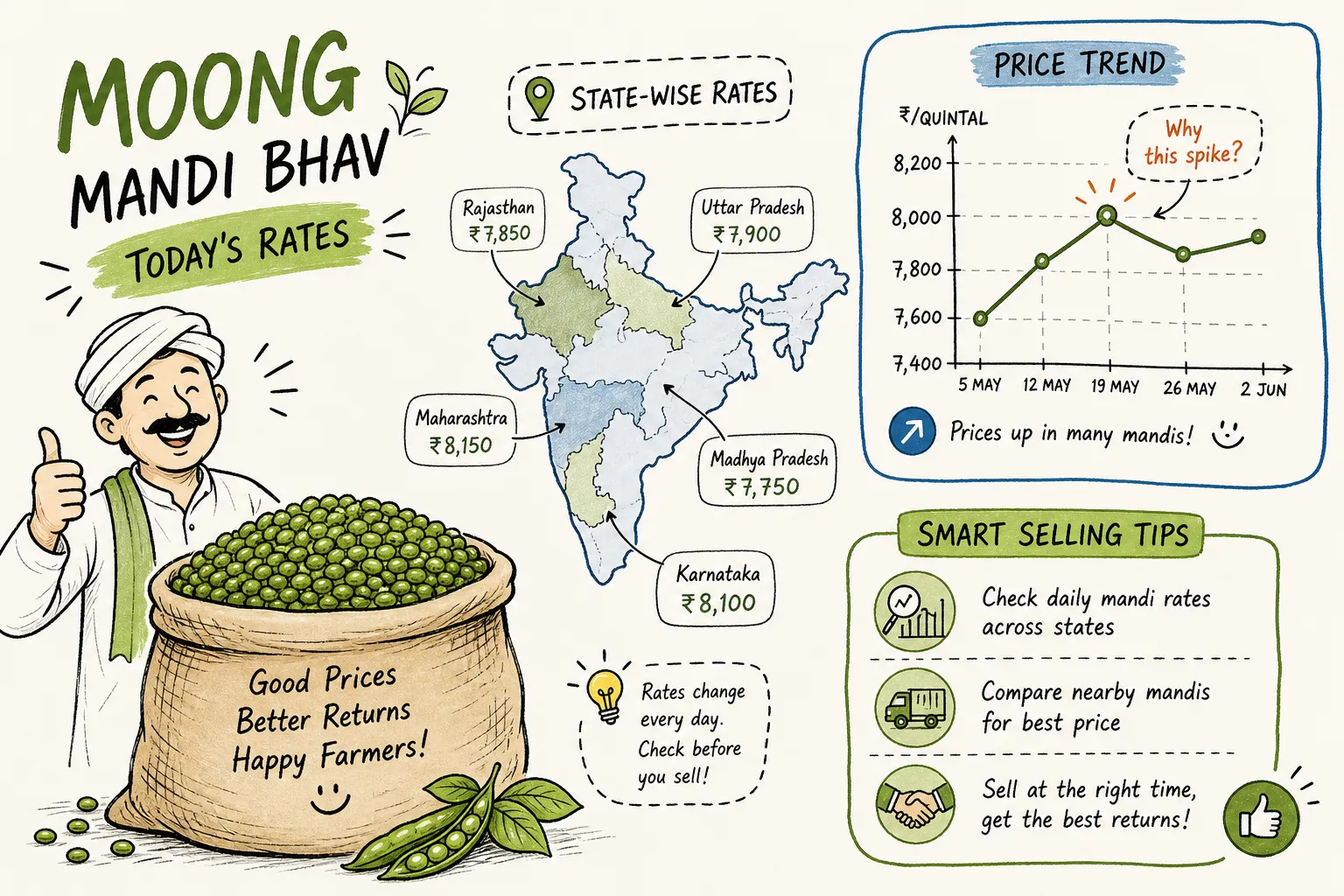






Arandi Ka Bhav Today: Live Castor Mandi Rates India
 Sep 28, 2026
 by Pankaj Sihag



Arandi Ka Bhav Today: Live Castor Mandi Rates India
| Today's arandi price range | ₹7,350, ₹7,630 per quintal (major Gujarat APMCs) |
|---|---|
| Key producing states | Gujarat (dominant, ~80% of national output), Rajasthan |
| Price direction (12 months) | Softer, down approximately 7.4% year-on-year |
| Main price drivers right now | Export availability, crushing demand, reduced kharif acreage |
| Best source for live rates | KhetiKisaan (sourced from live APMC auction floors) |
Arandi ka bhav (castor seed mandi rate) has been moving in a narrow but uncertain range over the past few months, and knowing the exact price before you carry your fasal to the mandi can be the difference between a good return and a missed opportunity. Across major Gujarat APMCs today, castor seed market prices are ranging between ₹7,350 and ₹7,630 per quintal, with Rajasthan mandis typically quoting ₹100, ₹200/quintal lower depending on the yard and lot quality.
Rajasthan also has active castor markets, and rates vary by mandi, grade, and daily arrival volumes. A figure seen on a generic commodity website may already be 24 hours old, which, in a volatile commodity market, is enough to cost you hundreds of rupees per quintal. KhetiKisaan sources these rates directly from live bol-chaal (auction bidding sessions) at APMC yards, so the figures reflect actual transactions, not estimated averages or delayed government feeds.
By the end of this article, you will know today's arandi rates across key mandis, what is moving the castor seed price right now, how grade and moisture affect your final payment, and exactly how to decide whether to sell your stock today or wait for a better return.
 Table of Contents
- Today's arandi mandi rates across Gujarat and Rajasthan APMCs
- Why arandi ka bhav varies from one mandi to the next
- What is pushing arandi ka bhav up or down right now
- How castor seed prices have trended over the past 12 months
- Arandi Ka Bhav: live mandi rates and where to sell
- Sell your arandi now or wait? A practical decision framework
- How do I know if my arandi lot will fetch a premium price?
- FAQs
Today's arandi mandi rates across Gujarat and Rajasthan APMCs
Gujarat APMC rates for castor seed today
Gujarat is the national benchmark for castor seed pricing because it accounts for roughly 80% of India's total castor production. When Gujarat rates move, every other mandi in the country follows. Rates below are sourced from live APMC auction sessions and are updated after each morning's bol-chaal:
| Mandi (APMC Yard) | Price per Quintal (₹) | Price per Kg (₹) |
|---|---|---|
| Viramgam | ₹7,350 | ₹73.50 |
| Vijapur (Kukarvada) | ₹7,500 | ₹75.00 |
| Visnagar | ₹7,527 | ₹75.27 |
| Kadi | ₹7,550 | ₹75.50 |
Arrivals at these yards vary daily, and the final bol-chaal rate can shift by ₹50, ₹150/quintal depending on lot quality and how many buyers are competing for seed on a given morning. The ₹7,630/quintal figure seen on some trackers represents the higher end of Gujarat's transaction range on strong-quality lots.
Rajasthan castor market rates today
Rajasthan is a secondary but steadily growing castor belt, with active trading at mandis in the Bikaner region, Nohar, Sumerpur, Osian, and Rawatsar. Rates at Rajasthan APMCs typically track Gujarat with a discount of ₹100, ₹200/quintal, primarily because crushing plant concentration in Rajasthan is lower and transportation costs to major processors add a margin for buyers.
| Mandi (Rajasthan) | Approx. Range (₹/quintal) |
|---|---|
| Nohar | ₹7,100, ₹7,300 |
| Sumerpur | ₹7,000, ₹7,250 |
| Osian | ₹6,900, ₹7,200 |
| Rawatsar | ₹7,000, ₹7,300 |
These are indicative ranges based on recent auction data. Actual rates on any given day depend on how much arandi arrives at the yard that morning and the number of active buyers. Always verify the current arandi ka bhav from a live source before you load your trolley.
Where today's castor seed price stands without an official MSP
A key point every castor farmer must know: castor seed is absent from the government's kharif MSP (Minimum Support Price) notification, which covers crops like paddy, tur, moong, groundnut, and cotton. This means you have no government procurement safety net to fall back on. The open mandi rate is your actual price, which makes real-time arandi ka bhav intelligence even more critical before you go to sell.
Why arandi ka bhav varies from one mandi to the next
Quality grades that directly change your price
India's commercial grading framework for castor seed uses three categories: Special, Standard, and General. The grade your lot falls into determines the price the buyer offers at auction. The table below compares key specifications across all three grades:
| Parameter | Special | Standard | General |
|---|---|---|---|
| Oil content (min) | 48% | 45% | Below 45% |
| Moisture (max) | 5% | 6% | 7% |
| Extraneous matter (max) | 0.5% | 1.0% | 2.5% |
| Damaged/discoloured seeds | Nil | 0.5% | 1.5% |
| Broken seed (max) | 1% | 3% | 6% |
A Special-grade lot with over 48% oil content and clean seed can command a 20, 35% premium over a General-grade lot at the same mandi on the same day. That gap translates to ₹200, ₹500 more per quintal, which adds up fast when you are selling 50 or 100 quintals at once.
How moisture and oil content affect your final payment
Moisture is the single most common reason a buyer applies a discount at auction. If moisture content is above the base specification (typically 5, 6%), the buyer either rejects the lot or applies a weight-adjusted deduction: for every percentage point above the limit, you effectively receive payment for less weight than what you actually delivered.
The practical check is simple: pick up a handful of arandi seeds. If they feel heavy, slightly sticky, or cool to the touch even in warm weather, they are very likely above 6% moisture. Sun-drying your lot on a clean tarpaulin for two to three days before taking it to the mandi is the cheapest quality upgrade a kisaan (farmer) can make. Properly dried seed consistently fetches ₹200, ₹400/quintal more than a damp lot from the same harvest.
What is pushing arandi ka bhav up or down right now
Export demand and India's role in global castor oil trade
India supplies over 85% of the world's castor oil, which means global export orders pull directly on domestic arandi rates. When international buyers in Europe, China, and the United States increase procurement for lubricants, cosmetics, specialty chemicals, and pharmaceuticals, crushing mills in Gujarat compete harder for raw seed and push mandi prices upward. India's top castor oil export destinations in 2024 were China (347 million kg), the Netherlands (81 million kg), and the United States (67 million kg).
When orders from these markets slow, buying pressure at APMC yards weakens and the castor seed market price softens. The current year-on-year dip of approximately 7.4% in India's castor oil export price reflects this reduced export-demand dynamic: international buying has been moderate rather than strong, easing the urgency for mills to pay up for seed.
Crushing industry offtake and mill procurement behaviour
Castor oil mills, concentrated in Gujarat's Saurashtra and north Gujarat belts, are the biggest buyers at APMC auctions. Their procurement decisions are driven by crushing margins: the gap between what they pay for seed and what they earn from the oil they produce. When oil prices are firm and seed is available at moderate rates, mills step up buying and provide solid price support at the mandi. When oil prices soften or seed costs rise faster than oil prices, mills slow their purchases, arrivals at mandis pile up, and rates drift lower. Right now, compressed crushing margins are a key reason the arandi ka bhav has stayed subdued compared to where it was twelve months ago.
Acreage reduction and monsoon: the supply-side squeeze
Here is the most important forward-looking data point for every castor farmer: kharif 2025 castor acreage was estimated to be 10, 12% lower year-on-year (ICOA data), which tightened seed availability entering 2026. A smaller crop means less arandi coming to market in the post-harvest window, and that supply tightness sets a floor under prices. Castor is also highly sensitive to monsoon distribution: erratic or deficient rainfall during pod-filling stages in Gujarat and Rajasthan's growing regions can further shrink the harvest and trigger sharp price spikes once arrivals begin. With kharif 2026 sowing underway in September, the final acreage number for this season will be a critical price signal to watch over the next two months.
How castor seed prices have trended over the past 12 months
The softening trend in 2026 and what caused it
Castor oilseed prices in India fell approximately 6.2% in Q1 2026, moving from ₹139.73/kg in January to ₹134.24/kg by March. A further 3.72% quarter-on-quarter decline followed in Q2 2026. The cause was straightforward: heavier seed arrivals after the kharif harvest reduced the urgency for mills to bid aggressively, allowing them to procure seed at more comfortable rates. This softening at the oil level translated directly to subdued arandi ka bhav at APMC yards during the same period. Looking at the full 12-month picture, the year-on-year decline in castor oil export prices stands at approximately 7.4%, making this the weakest price environment for arandi in recent years.
Seasonal price patterns and what they mean for you in September
The arandi price calendar follows a predictable rhythm. Rates typically soften between November and February when fresh kharif arrivals are at their peak and buyers have plenty of choice. From March onwards, as arrivals thin out and mills compete for remaining stock ahead of the lean season, prices tend to firm up.
In September, the current pre-arrival window, kharif castor is still standing in the fields across Gujarat and Rajasthan. Arrivals at mandis are low, and the next major arrival flush will come after the November, January harvest. This seasonal thinning of supply is one reason the castor seed market price is relatively stable right now, rather than under the heavy downward pressure seen during peak arrival months. For farmers who stored arandi from the previous harvest, this pre-arrival window is typically when holding stock makes the most sense, provided quality has been maintained.
Arandi Ka Bhav: live mandi rates and where to sell
The problem with delayed price feeds
Most government mandi portals and generic commodity aggregators publish rates with a 24, 48 hour lag, or show only the modal (average) price rather than the actual highest bid achieved at that morning's auction. For a kisaan deciding whether to bring 50 quintals to the mandi on a specific day, a stale rate creates real financial risk. If prices dropped ₹150/quintal since yesterday but you travelled based on yesterday's figure, you either undersell or make the trip for nothing. NCDEX futures contracts are useful for reading the directional trend over weeks, but they do not tell you what Kadi APMC paid per quintal at 9 AM that morning.
How KhetiKisaan sources arandi ka bhav from live auction floors
KhetiKisaan addresses this gap with a direct approach: a network of on-ground contacts physically present at APMC auction yards during live bol-chaal sessions. These contacts report actual transaction rates as they happen, not estimated averages or delayed government-feed prices. The result is a price figure that reflects what buyers actually paid for seed at that yard on that morning.
Before loading your trolley, check KhetiKisaan's arandi mandi bhav page to compare rates across multiple APMCs in both Gujarat and Rajasthan. If Kadi is quoting ₹200/quintal higher than your nearest yard today, that difference covers the transport cost and more. The platform covers multiple castor-trading APMCs with prices updated after each auction session. Beyond price data, KhetiKisaan's market commentary also tracks export order trends and crushing industry news, giving you the context to understand why the castor seed price is moving, not just the number itself.
Sell your arandi now or wait? A practical decision framework
Signals that favour selling today
Do not delay selling if any of the following conditions apply to your situation:
- Today's mandi rate is above your cost of production plus a margin you are comfortable with. A good price today is better than a hoped-for price next month.
- Your storage facility is not properly sealed or ventilated, and local humidity is above 65%. High-moisture arandi in a poorly ventilated space develops mould within weeks, and a mouldy lot fetches far less than the price you waited for.
- You need working capital now to purchase beej (seed), khad (fertiliser), or other inputs for the next crop cycle.
- Arrivals at your nearest mandi are still heavy and daily rates are drifting lower. Selling into a falling market always beats waiting for a recovery that may not arrive before quality deteriorates.
When holding stock makes sense
Holding is rational only under specific conditions. Today's arandi ka bhav should be close to or below your breakeven. Your storage must be confirmed dry, airtight, and properly ventilated, with seed moisture verified below 7%. The seasonal arrival peak for this harvest should be ending, and mill procurement should be expected to pick up over the next 4, 6 weeks as on-hand stocks thin out.
Set a price target and a time limit before you decide to store. If arandi reaches ₹7,800/quintal by a date you have set, you sell. If it does not, you sell anyway rather than holding indefinitely on hope. KhetiKisaan's daily rate updates and market commentary can help you track whether export orders from China or Europe are increasing, the clearest early signal that mill procurement is about to pick up and support mandi rates.
How do I know if my arandi lot will fetch a premium price?
Check two things before you go to the mandi. First, oil content: seed above 48% oil qualifies for Special grade and commands the highest castor seed price per quintal. Second, moisture: seed below 5, 6% moisture is accepted without deduction. Clean, dry, high-oil arandi consistently fetches ₹200, ₹500/quintal more than a mixed or damp lot at the same auction on the same day. If you are unsure, three to four days of proper sun-drying and a simple hand-feel test before loading is the cheapest quality improvement available to you.
Arandi ka bhav today ranges between ₹7,350 and ₹7,630 per quintal across Gujarat APMCs, with Rajasthan mandis tracking ₹100, ₹200 lower. Prices have softened over the past year, but reduced kharif acreage and India's dominant role in global castor oil supply provide a structural floor. Grade quality, moisture content, and the timing of your sale matter as much as the headline mandi rate. A Special-grade, dry lot can earn ₹500/quintal more than a General-grade lot at the same yard on the same day.
The single most valuable habit a kisaan selling arandi can build is checking the live mandi rate from a verified, ground-level source before loading the crop. KhetiKisaan's arandi bhav page, sourced directly from on-ground contacts at live APMC auction sessions, gives you that edge. The rate you see reflects an actual transaction, not a delayed government average. Bookmark the page and check it every morning during peak arrival season, that one consistent habit can add hundreds of rupees per quintal to your annual returns from the same crop, with no extra input cost.
FAQs
Related Blogs
Sep 28, 2026
by Pankaj Sihag
Sep 23, 2026
by Pankaj Sihag