





Best Wheat Varieties in India That Give High Yield and Better Profit
 Jun 26, 2026
 by Pankaj Sihag



Best Wheat Varieties in India That Give High Yield and Better Profit
- Choosing the right wheat variety can improve both yield and final profit.
- Newer high-yield wheat seeds (HVY Seeds) like DBW 327 and DBW 303 can produce around 24–30 quintals per acre under good management.
- Some improved varieties come with resistance to yellow rust and better tolerance to heat stress.
- The right wheat seed should always match your soil type, climate, and irrigation conditions.
- Tracking MSP and mandi demand can help farmers plan better before harvest.
 Table of Contents
- Which Wheat Varieties Give Better Yield in India?
- Top High Yield Wheat Varieties in India
- Which Wheat Variety is Better for Low Water Areas?
- How Much Wheat Production Per Acre Can You Expect?
- Average Yield Comparison
- How Does MSP Affect Wheat Profit?
- How Should Farmers Choose Wheat Seeds?
- How Should Wheat Be Stored After Harvest?
- Final Thoughts
- FAQs
Which Wheat Varieties Give Better Yield in India?
For wheat farmers, choosing the right seed before sowing is one of the most important decisions of the Rabi season.
The seed you select affects yield, grain quality, disease resistance, and final market returns.
Many farmers now prefer improved wheat seeds in India because newer varieties are better suited to changing weather conditions, especially rising temperatures during the grain-filling stage.
The blog talks about wheat varieties that are currently performing well across different wheat-growing regions.
Top High Yield Wheat Varieties in India
Here are some of the wheat varieties many farmers prefer for better yield and stable returns:
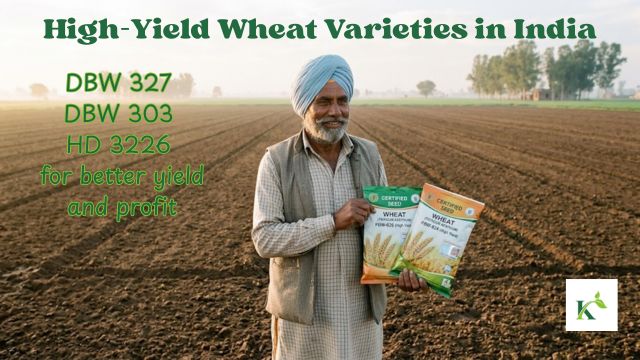
1. DBW 327 (Karan Shivani)
DBW 327 is one of the newer wheat varieties recommended for the North Western Plains Zone.
Average Yield: 28–30 quintals per acre under good management
Maturity: Around 155 days
Best Regions: Punjab, Haryana, Western Uttar Pradesh
Key features:
-
Strong stem helps reduce lodging
-
Better tolerance to terminal heat
-
Resistant to yellow rust
2. DBW 303 (Karan Vaishnavi)
DBW 303 is suitable for timely sowing and irrigated conditions.
Average Yield: 24–30 quintals per acre
Maturity: Around 155–156 days
Best Regions: North Western Plains Zone
Key features:
-
Good grain filling
-
Resistant to leaf rust and yellow rust
-
Suitable for early sowing
3. HD 3226 (Pusa Yashasvi)
HD 3226 is a commonly used wheat variety known for stable yield and good grain quality in irrigated areas.
Average Yield: 22–28 quintals per acre
Maturity: Around 140–145 days
Best Regions: Plains of North India
Key features:
-
Better tolerance against rust diseases
-
Good grain quality
-
Performs better when sown on time
4. DBW 187 (Karan Vandana)
DBW 187 is a reliable wheat variety that adapts well to different conditions, especially in central and eastern wheat-growing regions.
Average Yield: 22–26 quintals per acre
Maturity: Around 120–145 days
Best Regions: Central and Eastern plains
Key features:
-
Good adaptability
-
Better heat tolerance
-
Gives stable performance in different conditions
Which Wheat Variety is Better for Low Water Areas?
Farmers with limited irrigation should look at drought-resistant wheat varieties.
Some commonly preferred options are:
-
DBW 187
-
HI 8759
-
GW 322
These varieties are often preferred in drier regions like parts of Rajasthan and Madhya Pradesh.
How Much Wheat Production Per Acre Can You Expect?
Even the best wheat production per acre varieties need proper management to perform well.
Your final yield will depend on:
-
Timely sowing
-
Balanced fertiliser use
-
Proper irrigation
-
Weed management
-
Disease control
Average Yield Comparison
|
Wheat Variety |
Potential Yield Per Acre |
Best Sowing Time |
Key Highlight |
|---|---|---|---|
|
DBW 327 (Karan Shivani) |
28–30 quintals |
October 25 – November 5 |
Strong stems; stops crop falling over (lodging) |
|
DBW 303 (Karan Vaishnavi) |
24–30 quintals |
October 25 – November 10 |
Uniform, heavy grains; resistant to leaf and yellow rust |
|
HD 3226 (Pusa Yashasvi) |
22–28 quintals |
November 1 – November 15 |
High protein content; top choice for bread/flour mills |
|
DBW 187 (Karan Vandana) |
22–26 quintals |
November 5 – November 25 |
Highly adaptable across changing weather and soils |
How Does MSP Affect Wheat Profit?
For the 2026–27 Rabi marketing season, the government has fixed wheat minimum support price (MSP) at ₹2,585 per quintal, which gives farmers a price floor.
This means if market prices fall, procurement centres will still buy at this rate.
Higher-yield varieties can improve total income because more production per acre means better returns even at MSP.
In some cases, private traders may offer slightly higher prices depending on grain quality and local demand.
How Should Farmers Choose Wheat Seeds?
Before buying wheat seed types in India, check these points:
Soil Type: Some wheat varieties grow better in clay-rich or heavier soil, while others perform well in sandy or lighter soil.
Water Availability: Choose varieties according to the number of irrigation rounds you can manage.
Sowing Time: Some seeds are best for timely sowing, while others are suitable for late sowing.
Disease History: If rust or plant diseases are common in your area, choose resistant varieties.
Local Demand: Grain quality and local mandi demand can affect the final selling rate.
How Should Wheat Be Stored After Harvest?
Good storage helps protect grain quality and selling value.
Farmers should:
-
Dry wheat properly before storage
-
Keep moisture around 12–14% for safe storage
-
Use clean and dry gunny bags
-
Keep grain off the floor to avoid moisture
-
Protect stock from insects and rats
Poor storage can reduce both grain quality and weight.
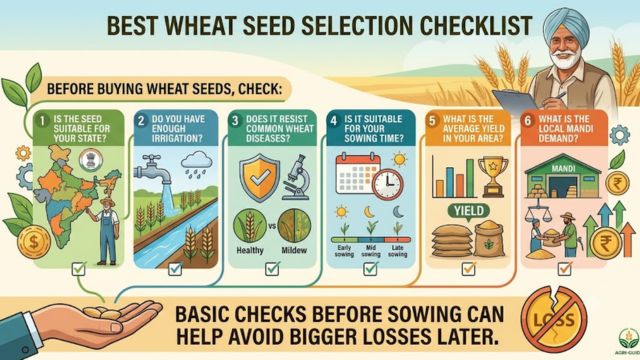
Before buying wheat seeds, check:
-
Is the seed suitable for your state?
-
Do you have enough irrigation?
-
Does it resist common wheat diseases?
-
Is it suitable for your sowing time?
-
What is the average yield in your area?
-
What is the local mandi demand?
Basic checks before sowing can help avoid bigger losses later.
Final Thoughts
There is no single wheat variety that works best for every farmer. The right choice depends on the soil, water availability, weather, and sowing time.
A variety that performs well in Punjab may not give the same result in Madhya Pradesh or Bihar. That is why it is important to understand your local conditions before buying seed.
On KhetiKisaan, farmers can check live mandi bhav, compare nearby market rates, and follow crop updates to make better sowing and selling decisions.
FAQs
Related Blogs

Sep 10, 2026
by Pankaj Sihag
Sep 03, 2026
by Pankaj Sihag
Aug 27, 2026
by Pankaj Sihag
Aug 26, 2026
by Pankaj Sihag