





Post-Harvest & Quality: How to Prevent Paddy Rejection at the Mandi
 Jun 25, 2026
 by Pankaj Sihag



Post-Harvest & Quality: How to Prevent Paddy Rejection at the Mandi
-
Paddy is usually rejected for high moisture, foreign matter, or damaged and discoloured grains.
-
The moisture limit for paddy procurement is 17 percent; anything higher risks rejection or a lower price.
-
Correct drying, cleaning, and harvest timing before the mandi prevent most rejection cases.
-
Mixing grain varieties, or harvesting too early or too late, both raise the chance of rejection.
-
KhetiKisaan lets you check live mandi rates and quality trends before you decide where to sell.
 Table of Contents
- Why Does Paddy Get Rejected at the Mandi?
- What Quality Checks Does Paddy Face at the Mandi?
- Why Does Moisture Content Cause the Most Rejections?
- How Can You Remove Foreign Matter Before Selling Paddy?
- How Do You Avoid Damaged, Discoloured or Immature Grains?
- What Should You Check Before Taking Paddy to the Mandi?
- The Bottom Line
- FAQs
Why Does Paddy Get Rejected at the Mandi?
Paddy is mostly rejected at the mandi for high moisture content, foreign matter, or damaged and discoloured grains, not because the yield is low.
Brokers check every lot against fixed quality norms, and a lot that fails gets rejected on the spot or bought at a much lower rate.
To prevent paddy rejection at mandi, the real work happens before you load the tractor.
A few changes to harvesting, drying and cleaning in the days before you sell can decide the sale price.
What Quality Checks Does Paddy Face at the Mandi?
Every season, the Ministry of Consumer Affairs, Food and Public Distribution notifies fair average quality (FAQ) specifications for paddy.
Government procurement agencies enforce these rules for minimum support price (MSP), while private mandis use them as broad quality benchmarks.
The main parameters checked are:
-
Moisture content
-
Foreign matter (organic and inorganic)
-
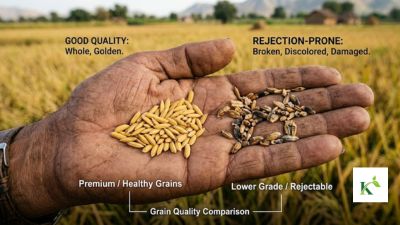
Damaged, discoloured, sprouted or weevilled grains
-
Immature, shrunken or shrivelled grains
-
Admixture of other paddy varieties or lower grades
Crossing the limit on even one count can get a lot turned away.
Checking produce against these points at home is how most farmers prevent paddy rejection at mandi.
Why Does Moisture Content Cause the Most Rejections?
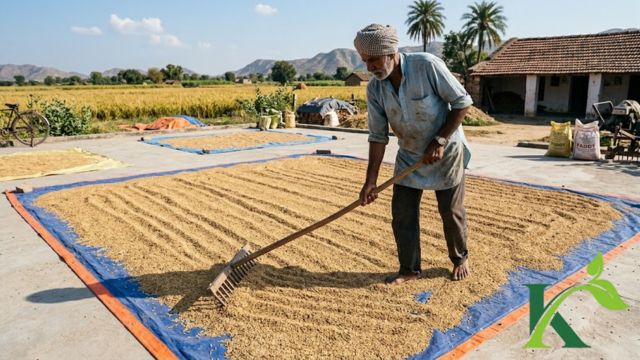
The moisture limit for paddy is fixed at 17 percent, and untimely rain or early harvesting often pushes it past that.
Grain above this limit risks discolouration and fungal growth during storage, so buyers reject it outright rather than take that chance.
A few habits help:
-
Harvest only once the crop has matured and the field has dried, ideally a few days after the last rain.
-
Spread cut paddy on a tarpaulin sheet rather than bare ground, since soil moisture seeps back into the grain.
-
Turn the grain a few times through the day so it dries evenly, not just on the surface.
How Can You Remove Foreign Matter Before Selling Paddy?
Winnowing and sieving the grain at home removes most foreign matter, which includes straw, husk, stones, soil and weed seeds.
The combined limit allowed under FAQ norms is low, and a lot heavy with field debris is one of the easiest reasons for a broker to turn a farmer away.
Run the paddy through a winnower at least twice, and pick out stones or soil by hand if the field was wet during harvest.
Keep different varieties separate at every stage, since mixing two types of paddy in one bag counts as admixture and can pull the whole lot into a lower grade.
How Do You Avoid Damaged, Discoloured or Immature Grains?
Getting the harvest timing right is the biggest factor.
Cutting too early leaves more immature and shrivelled grains, while delaying harvest exposes the crop to rain and shattering in the field, both of which raise the share of damaged and discoloured grains.
Watch the crop closely once 80 to 85 percent of grains in a panicle turn golden yellow; that is usually the right window.
Avoid leaving cut paddy in the field overnight if rain is expected, and handle threshing gently, since rough threshing can crack the grain too.
What Should You Check Before Taking Paddy to the Mandi?
A quick check at home, rather than at the mandi, catches most issues that lead to rejection:
-
Test a handful of grain for moisture; it should feel dry and crack cleanly.
-
Sieve the lot once more to clear any remaining husk, stones or weed seeds.
-
Keep each variety in separate, clearly labelled bags.
-
Use clean, dry gunny bags, since damp or reused bags can add moisture back to dried grain.
-
Skip loading any paddy that got rained on after drying, even if it looks fine.
Run through this before taking your fasal to the mandi:
-
Moisture at or below 17%
-
Foreign matter under the FAQ limit
-
No mixing of paddy varieties in one bag
-
Grain dried on a tarpaulin, not bare ground
-
Clean, dry gunny bags only
-
No grain rained on after drying
Our Tip: A few extra minutes at home can save a wasted trip and a lower price for your fasal.
The Bottom Line
Most paddy rejection comes down to three things: too much moisture, leftover foreign matter, and grains damaged by wrong harvest timing, and none of it is beyond a farmer's control.
A few careful steps at home, from drying on a clean surface to sieving the grain twice, go a long way to prevent paddy rejection at mandi and get a fair price on the first attempt.
Before your next harvest, check current dhan mandi bhav and quality trends for paddy in your district on KhetiKisaan, so you know what buyers expect before you load the tractor.
FAQs
Related Blogs

Jun 22, 2026
by Pankaj Sihag