





When to sell wheat after harvest to maximise price

 Sep 10, 2026
 by Pankaj Sihag



When to sell wheat after harvest to maximise price
| Harvest window (Rajasthan & MP) | Late March to mid-April |
|---|---|
| Harvest window (Punjab) | Mid-April to early May |
| Harvest window (Haryana) | Mid-April to late April |
| Harvest window (UP) | Early April to late April |
| Price bottom | April, when mandi arrivals peak across North India |
| Mild recovery window | June to August, as arrivals thin and trader demand firms |
| MSP 2026-27 | ₹2,585 per quintal (up from ₹2,425 in 2025-26) |
| Typical storage cost | ₹5, 10 per quintal per month (certified warehouse), plus handling and weight loss |
| Daily mandi bhav tool | KhetiKisaan reports daily wheat rates at Sri Ganganagar, Nohar, and other APMC centres |
When is the best time to sell wheat after harvest to get maximum price in India? It is the question every rabi farmer confronts the moment the thresher stops and traders appear at the gate quoting prices that feel painfully low. Sell now and take what the market offers, or hold your gehun (wheat) and wait for prices to recover, a decision that can mean a swing of ₹200, ₹400 per quintal. On 100 quintals, that is ₹20,000, ₹40,000 walking into or out of your pocket.
This guide is built as a decision-support tool. By the time you finish reading, you will know the seasonal price cycle, what MSP means for your options, how to calculate whether storage actually pays, and how to track daily wheat bhav at your local APMC so you can act at the right moment rather than guess.
 Table of Contents
- Why wheat prices fall sharply right after harvest
- When is the best time to sell wheat after harvest to get maximum price in India?
- What MSP means for your sell decision
- Historical wheat rates at Sri Ganganagar and Nohar: what the data shows
- The real cost of storing wheat: calculating whether it pays
- Forward contracts and price hedging: locking in a price before you sell
- Sell now or hold? A practical framework for your decision
- How to track daily wheat bhav and catch the price peak
- When is the best time to sell wheat after harvest in India, summary
- FAQs
Why wheat prices fall sharply right after harvest
Prices dip in April because every farmer across the belt is selling at the same time. Supply floods the mandi and traders have the upper hand. This is not bad luck; it is basic market economics playing out exactly as it always does.
The arrival surge and how it drives mandi bhav down
When arrivals at a mandi jump from a few hundred quintals per day to several thousand within a single week, buyers face zero urgency, they know the next truckload is already on the road. You can see the same pattern with onions in Lasalgaon, where prices dropped from roughly ₹3,700 per quintal to ₹1,500 the moment kharif arrivals increased, and with potatoes in Delhi's Azadpur, where rates fell ₹300 per quintal in days as arrivals climbed. Wheat follows exactly the same structural behaviour. At Sri Ganganagar and Nohar APMCs in Rajasthan, April arrivals historically put the sharpest pressure on local wheat bhav (mandi price), often pushing rates toward the lower band of the seasonal range.
State-wise harvest calendar you need to know
The timing of this pressure differs by state, which changes your holding calculus depending on where you farm. A Rajasthan kisaan faces this price dip two to three weeks earlier than a Punjab farmer, so the window to make a decision is both earlier and slightly shorter.
| State | Harvest window | Peak arrival month |
|---|---|---|
| Rajasthan | Late March, mid-April | Early April |
| Madhya Pradesh | Late March, mid-April | April |
| Punjab | Mid-April, early May | April, May |
| Haryana | Mid-April, late April | Late April |
| Uttar Pradesh | Early April, late April | April |
These are typical windows, not fixed dates. Actual harvesting and mandi arrivals shift with sowing time, variety, irrigation, and weather in any given year. The core point stands: every major wheat state sees its price bottom in April, and the farmer who understands this can plan for it rather than be surprised by it.
When is the best time to sell wheat after harvest to get maximum price in India?
After bottoming in April, wheat mandi prices in India typically recover gradually through May and June, with June to August often delivering the best open-market rates for farmers who stored their grain carefully. Understanding this cycle is central to answering the question of the best time to sell wheat after harvest.
The seasonal price cycle explained
The long-run monthly pattern is consistent: prices tend to peak in February when pre-harvest speculation and tight stocks drive demand, bottom in April when peak arrivals overwhelm buyers, and then recover steadily as arrivals ease through summer. Wheat wholesale prices ranged broadly between ₹1,900 and ₹2,600 per quintal. A monthly average high of nearly ₹2,928 per quintal was recorded in January at one major mandi, illustrating the extent of seasonal swing. In a normal year, a farmer selling in April versus August can realise a difference of ₹200, ₹400 per quintal, but that gap must be weighed carefully against storage costs before you decide to hold.
How quickly do prices recover after the arrival surge?
Prices do not snap back overnight. Mandi arrival data consistently shows that arrivals are the leading indicator and prices the lagging number. Recovery typically begins four to six weeks after the peak arrival flush subsides, not immediately after harvesting stops. In years with strong export demand or low carryover stocks, recovery accelerates; in years with heavy government procurement, MSP acts as a floor that limits the upside for private open-market prices.
The practical takeaway: do not expect prices to bounce in May. The real recovery window in most seasons is typically June to August, though timing varies year to year depending on demand and procurement volumes. Patience combined with good storage is what converts that waiting period into rupees.
What MSP means for your sell decision
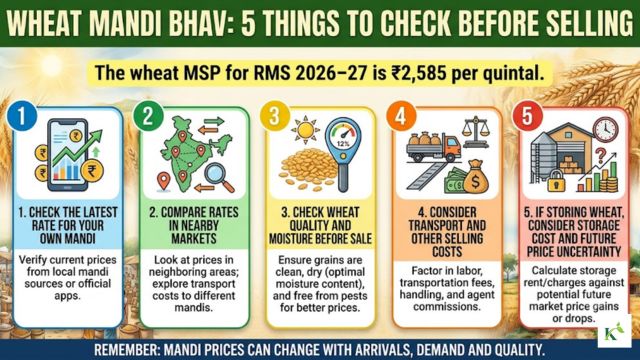
MSP is your guaranteed floor price. If open-market rates at your mandi fall below ₹2,585 per quintal in 2026-27, you have the option to sell to the government procurement agency at MSP instead of accepting distress pricing from private traders.
MSP trend and current benchmark
MSP has risen consistently every year, which has also helped anchor open-market mandi bhav. Traders are reluctant to bid far below MSP because farmers with access to procurement centres can simply walk away from the private market. Over the four years from 2023-24 to 2026-27, MSP has climbed from ₹2,125 to ₹2,585 per quintal, a compound rise of roughly ₹115 per quintal per year on average. This steady upward movement has progressively raised the floor at which trader bidding begins, particularly in well-served procurement districts.
| Marketing year | MSP (₹/quintal) |
|---|---|
| 2023-24 | ₹2,125 |
| 2024-25 | ₹2,275 |
| 2025-26 | ₹2,425 |
| 2026-27 | ₹2,585 |
The increase from ₹2,425 to ₹2,585 per quintal for 2026-27 represents a meaningful rise of ₹160 per quintal. This matters when you are calculating whether it makes sense to wait for open-market prices to recover above MSP before selling. The rising MSP trend also reflects the government's recognition of increasing input costs, giving farmers a stronger negotiating floor each rabi season.
The procurement calendar and why timing matters
Central wheat procurement officially opens on 1 April each year and effectively runs through June, with peak procurement happening in April and May when arrivals are heaviest. In recent seasons, the government has sometimes preponed (brought forward) procurement by a fortnight in certain states when harvesting came early. Central procurement figures confirm the scale of this programme: 266 lakh metric tonnes were procured in 2024-25, compared to 256 lakh metric tonnes in 2025-26.
Farmers who register and sell to procurement agencies during this window get MSP with certainty. However, if your local open-market mandi is already quoting above MSP, as happened in many North India mandis in 2023-24, 2024-25, and 2025-26, it is worth tracking the daily bhav before joining the queue at a procurement centre. The procurement window is your safety net, not necessarily your best option every year.
Historical wheat rates at Sri Ganganagar and Nohar: what the data shows
Sri Ganganagar and Nohar are two of Rajasthan's largest APMC centres for gehun, and their mandi bhav data over recent seasons confirms the April dip and June, August recovery pattern clearly for Rajasthan farmers.
Regional timing: best time to sell wheat after harvest
In April, rates at Sri Ganganagar APMC have historically clustered in the lower band of the prevailing price range as arrivals surge from Ganganagar district and neighbouring farming areas. In 2023, wheat modal prices at Sri Ganganagar opened around ₹2,167 per quintal in mid-April and dipped slightly to ₹2,150 in late May. By June-end, rates had recovered to ₹2,191 per quintal, reaching ₹2,200 by August. By late 2024 and into 2025, the broader price regime had shifted upward, with modal prices around ₹2,612 per quintal recorded at Sri Ganganagar Grain mandi in October 2024, and Suratgarh in Ganganagar district quoting ₹2,535, ₹2,588 per quintal in early April 2025. For Nohar in Hanumangarh district, wheat was trading at ₹2,475 per quintal at the end of August 2025, while the broader Rajasthan August 2025 average stood at ₹2,595 per quintal. The August 2024 Rajasthan average was ₹2,580 per quintal and August 2023 was ₹2,383 per quintal, confirming the recovery trend in most years.
How arrival volumes at local mandis shifted prices in recent seasons
Looking across recent rabi seasons, the pattern at these two mandis repeats with predictable consistency. In years when government procurement was robust and absorption of grain was high, open-market April rates stayed relatively close to MSP, reducing the gap between an immediate sale and a held sale three months later. In years when procurement was slower or the crop was abundant, April prices dropped more noticeably below MSP, making the case for storage stronger for farmers with the capacity and cash flow to hold.
The critical lesson here is that national average data from Delhi or Mumbai trading desks is largely irrelevant to a kisaan in Hanumangarh or Sri Ganganagar. Local mandi data, specifically from the APMC you actually sell at, is the only number that matters for your decision.
The real cost of storing wheat: calculating whether it pays
Storing wheat costs roughly ₹10, 30 per quintal per month when you add up warehouse rent, handling, interest on the value locked up in stored grain, and weight loss. The price rise you are waiting for must comfortably exceed these combined costs, or storage is not the right choice.
On-farm kothi vs. warehouse storage: understanding your options
On-farm storage in a pucca kothi or concrete bin carries no rental cost, but the hidden costs are real. Studies by agricultural research institutions document total wheat losses in pucca kothi storage at around 4.97%, covering insect damage, moisture absorption, and rodent losses. That translates to quality degradation that reduces your grain's sale price, not just its weight. The other hidden cost is the interest foregone on capital locked in stored grain: if your wheat is worth ₹2,500 per quintal and you are holding 100 quintals, that is ₹2.5 lakh sitting idle rather than working for you.
Warehouse storage at a CWC (Central Warehousing Corporation) or SWCA (State Warehousing Corporation) godown is the more disciplined option. Rental in government-linked warehouses runs approximately ₹5, 10 per quintal per month, with one-time handling fees (loading, grading, and unloading) in the range of ₹20, 30 per quintal, figures that vary by warehouse and location, so confirm the applicable tariff schedule before committing. Under proper warehouse management, wheat dry matter losses are documented at less than 0.3% over three years, dramatically lower than on-farm storage losses. The significant advantage of warehouse storage is eligibility for an electronic Negotiable Warehouse Receipt (e-NWR) loan: you can borrow 60, 75% of the assessed value of your stored grain and still wait for prices to peak before selling.
Doing the maths: is 3 months of storage worth it?
Here is a worked example so you can apply the logic to your own situation. Assume your wheat is valued at ₹2,300 per quintal in April. Three months of warehouse storage costs approximately ₹30 per quintal in rent, plus ₹25 in handling fees, plus roughly ₹2 in weight and quality loss value. Your total storage cost comes to approximately ₹57 per quintal, presented here as an illustrative figure based on typical reported ranges; your actual cost will depend on your specific warehouse's tariff and loan interest if applicable. This means you need at least ₹2,357 per quintal in July simply to break even on the storage decision. If July open-market prices at your mandi are ₹2,500 per quintal or above, as seen in stronger years, your net gain is ₹143 per quintal or more. On 100 quintals, that is ₹14,300 in additional income. The numbers work, but only if you know what July prices are actually doing at your specific mandi before you make the decision, not after prices have already moved.
Forward contracts and price hedging: locking in a price before you sell
Beyond the hold-or-sell decision, some farmers and farmer-producer organisations (FPOs) use forward contracts to reduce price uncertainty. A forward contract is a simple agreement with a flour mill, trader, or aggregator to deliver a fixed quantity of wheat at a pre-agreed price on a future date, say, July or August. If you agree in April to sell 50 quintals at ₹2,450 per quintal in July, you lock in that price regardless of where the mandi moves between now and then.
The advantage is certainty: you know your revenue in advance and can plan cash flow accordingly. The trade-off is that if open-market rates climb above ₹2,450 by July, you have given up that upside. For farmers with high input loans or tight household cash flow, the certainty of a forward price often outweighs the possibility of capturing a higher spot rate. Larger FPOs sometimes negotiate forward contracts directly with flour mills or procurement agencies, effectively hedging part of their collective stock while selling the remainder on the open market. If you are part of an FPO or can aggregate with neighbouring farmers, this approach is worth exploring with your local APMC or a registered commodity broker as a way to manage downside risk without giving up all flexibility.
Sell now or hold? A practical framework for your decision
The right answer depends on your storage access, grain quality, credit position, and, most importantly, what prices are actually doing at your local APMC right now. Selling immediately makes sense if April mandi rates are at or above MSP and cheap storage is not available. Holding for two to three months is worth considering when storage costs are low, grain quality is strong, and current rates are well below the typical June, August range for your region.
When selling immediately makes financial sense
There are clear situations where holding simply does not pay, regardless of what prices might do later. Selling immediately is the right call when:
- Local mandi bhav is already at or near MSP (₹2,585 in 2026-27), leaving little room for further upside
- You carry high-interest loans, Kisan Credit Card debt, or input loans that need repaying, the cost of capital makes holding grain an expensive luxury
- Your wheat has moisture issues or was affected by unseasonal rain during or after harvest, meaning quality will degrade further in storage
- Your on-farm storage is not pest-proof and you cannot access or afford a certified warehouse
When holding for 2, 3 months is worth the wait
The case for storing your gehun becomes strong when conditions align in your favour. Consider holding when current mandi bhav is ₹200 or more below the June, August historical average for your region. Access to a certified warehouse and the ability to take an e-NWR loan against stored grain means you manage cash flow without distress-selling. Your grain quality is solid, moisture below 12%, clean, sortable, and suitable for flour mill demand. Most importantly, you are actively tracking daily mandi bhav at your local APMC so you can sell the moment rates hit your target price, rather than guessing when the peak might arrive. Holding grain without a monitoring plan is speculation; holding grain with a daily price target and a platform to track rates is a marketing strategy.
How to track daily wheat bhav and catch the price peak
The only way to know when wheat prices in your mandi have actually peaked is to watch daily auction rates, not weekly newspaper figures, not WhatsApp forwards from traders who have their own buying interest, and not national commodity exchange prices that bear little relation to what your arhatiya (commission agent) is actually bidding.
Why real-time mandi data changes the sell decision
There is a meaningful gap between hearing "prices are good this week" from your local arhatiya and seeing verified daily auction rates from live bidding. Prices can shift by several dozen rupees per quintal within a single week in June or July when demand from flour mills and exporters picks up suddenly, a move that has been observed in active trading seasons. A farmer acting on yesterday's information misses this window entirely. A farmer tracking live bhav captures it and loads his tractor with a price target already in mind. This is the difference between reacting to prices and managing your fasal (crop) like a business.
Using KhetiKisaan to time your wheat sale
KhetiKisaan reports daily wheat bhav for Sri Ganganagar, Nohar, and other major Rajasthan mandis, giving farmers a reliable reference point before loading their tractor. A kisaan in Hanumangarh or Suratgarh can check today's Sri Ganganagar wheat rate, compare it with the Nohar rate, and decide which mandi offers the better price that specific day. That practical comparison converts a vague "hold or sell" debate into a specific, actionable decision. The platform also provides historical rate data, so you can assess whether today's price is near a seasonal high or still climbing, giving you the confidence to wait or to act. If you want to track wheat rates at your nearest APMC and build your own sell-timing plan, visit KhetiKisaan to check today's mandi bhav and start monitoring your market.
When is the best time to sell wheat after harvest in India, summary
The answer to when is the best time to sell wheat after harvest to get maximum price in India is not a fixed date, it is a window shaped by your state's harvest calendar, local mandi arrivals, storage costs, credit position, and daily gehun bhav at your specific APMC. In most rabi seasons, April is the worst month to sell and June to August delivers the best open-market rates for farmers with good storage and an active monitoring habit. MSP is your floor; warehouse storage and e-NWR finance are your tools; and daily mandi data is your timing signal. Use all three together and the best time to sell wheat after harvest becomes a decision you make with numbers, not a guess you make under pressure.