







Why Crop Rotation is Important: Should Farmers Change Crops Every Season?
 Aug 15, 2026
 by Pankaj Sihag



Why Crop Rotation is Important: Should Farmers Change Crops Every Season?
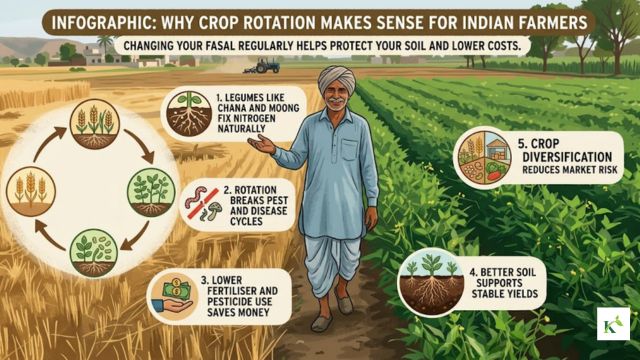
- The benefits of crop rotation include better soil health, lower fertiliser costs, fewer pests, and more stable yields over time.
- Growing the same fasal on the same zameen year after year drains nutrients and allows pests to build up.
- Nitrogen-fixing crops like chana, moong, and arhar naturally replenish soil nitrogen and reduce urea dependency.
- Common crop rotation patterns in Punjab, Haryana, and Uttar Pradesh include dhan–gehun–pulse and sarso–dhan–chana.
- Crop rotation is one of the simplest sustainable farming practices and usually does not require major extra investment.
 Table of Contents
- What is Crop Rotation and What are Its Benefits?
- What Happens to Zameen Without Crop Rotation?
- How Does Crop Rotation Improve Soil Health?
- Common Crop Rotation Examples for Indian Farmers
- What are the Benefits of Crop Rotation Beyond Soil Health?
- Is Crop Rotation Useful for Small and Marginal Kisaans?
- Final Thoughts
- FAQs
What is Crop Rotation and What are Its Benefits?
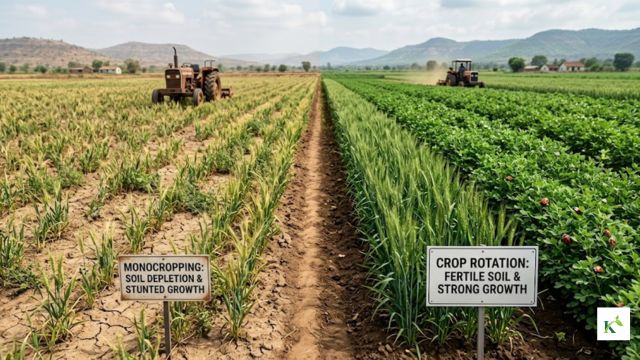
Crop rotation means growing different fasals on the same piece of zameen in a planned sequence across seasons or years instead of sowing the same crop repeatedly.
The benefits of crop rotation are simple but important. It helps maintain soil fertility, reduce pest attacks, and lower the need for chemical fertilisers.
The reason is practical. Different crops use different nutrients and affect the soil in different ways. If the same crop is grown again and again, the same nutrients keep getting used while crop-specific pests and diseases become stronger.
What Happens to Zameen Without Crop Rotation?
Growing the same crop repeatedly weakens the soil over time.
In states like Punjab and Haryana, the dhan–gehun cycle has been repeated for decades.
Many farmers have noticed falling yields even after increasing fertiliser use.
Here is what usually happens:
- Nitrogen and other nutrients get depleted faster
- Soil becomes harder and holds less water
- Crop-specific pests and diseases build up
- Weeds become harder to control
- Fertiliser and pesticide costs rise
This affects small and marginal kisaans the most because input costs directly impact profits.
How Does Crop Rotation Improve Soil Health?
Soil health improves because different crops support the soil in different ways.
Cereal crops like gehun and dhan are heavy feeders. They take a lot of nitrogen from the soil.
Pulse crops like chana, moong, arhar, and masoor work differently. These are nitrogen-fixing crops. They pull nitrogen from the air through root bacteria and store it in the soil.
When you grow chana or moong after gehun, the pulse crop helps improve nitrogen availability for the next season.
This reduces the need for urea and adds to long-term soil health improvement.
Crop rotation also:
- Improves soil structure through different root depths
- Adds organic matter through crop residue
- Supports better microbial activity in the soil
- Improves water absorption and moisture retention
Common Crop Rotation Examples for Indian Farmers
Crop planning depends on your region, water availability, and local mandi demand.
Here are some useful examples:
| Region (Kshetra) | Kharif Fasal | Rabi Fasal | Summer / Zaid Fasal |
|---|---|---|---|
| Punjab, Haryana, Uttar Pradesh | Dhan | Gehun | Moong / Chana |
| Rajasthan, Madhya Pradesh | Makka / Guar | Sarso / Gehun | Chana / Fallow (Khaali) |
| Uttar Pradesh, Bihar | Cotton / Makka | Gehun | Arhar / Lentil (Masoor) |
The dhan–gehun cycle is common, but adding even one pulse crop every two or three years can improve land productivity
What are the Benefits of Crop Rotation Beyond Soil Health?
The crop diversification benefits go beyond just better soil:
- Pest and Disease Control: Most pests and diseases affect specific crop families. Rotating crops removes their food source and reduces their spread. This can lower pesticide use over time.
- Lower Input Costs: When pulse crops improve soil nitrogen naturally, farmers spend less on urea. Lower pest pressure can also reduce pesticide expenses.
- More Stable Income: If one crop gets weak mandi rates, having another crop in rotation reduces risk. This gives farmers a better income balance.
- Better Water Management: Different crops need different amounts of water. This improves water use and helps avoid soil compaction.
Is Crop Rotation Useful for Small and Marginal Kisaans?
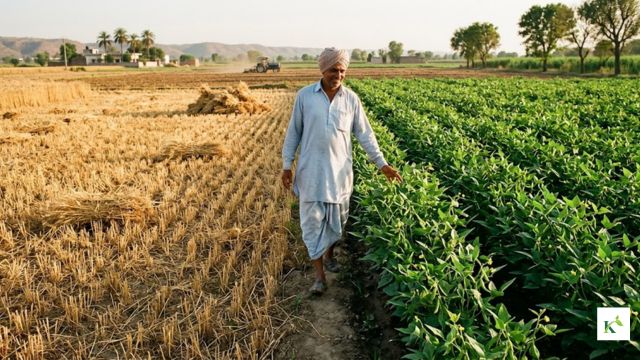
Crop rotation does not need expensive machinery or major changes. It mostly requires better agriculture planning.
A few simple tips:
- Start with a basic two-crop cycle
- Alternate cereals with pulses
- Use locally suitable crops
- Check mandi bhav before choosing the next fasal
- Take advice from your nearest Krishi Vigyan Kendra (KVK)
Final Thoughts
Crop rotation should be part of your planning over a two- to three-year cycle. Even one pulse crop every two years can improve your zameen’s condition.
This is not a new idea. Traditional Indian farming used crop rotation for generations before the same cropping became common.
Long-term soil stress from repeated monocropping has been widely observed.
Before choosing your next fasal, check both your soil condition and mandi demand.
KhetiKisaan helps farmers track mandi bhav, crop trends, and practical farming updates so you can plan better.