







Mandi Bhav Today: Live Crop Rates Across India
 Sep 01, 2026
 by Pankaj Sihag



Mandi Bhav Today: Live Crop Rates Across India
- Mandi bhav today is the actual transaction price from this morning's APMC auction, not the MSP, not a national average, and not last week's rate.
- Every mandi publishes three price points per crop: minimum, maximum, and modal. Base your sell decision on the modal price, which reflects the rate at which the highest volume traded. Note that higher- or lower-quality lots may fetch figures above or below modal.
- Prices can vary substantially across mandis in the same district on the same day; reported differences of ₹50 to ₹300 per quintal between nearby yards are common in active markets.
- Many government portals carry a 12 to 24-hour data lag due to batch uploads from mandi committees. Check a source with physical presence at the auction yard for the most current wholesale market prices.
- 2026-27 MSP reference: Wheat ₹2,585/qtl, Mustard ₹6,200/qtl, Chana ₹5,875/qtl, Cotton (medium staple) ₹8,267/qtl.
 Table of Contents
- Live Crop Rates Across India
- What mandi bhav today actually tells you (and what it doesn't)
- How APMC auction yards set the day's crop price
- State-wise mandi bhav today: snapshot for major crops
- What's pushing mandi prices up or down right now
- Where to find today's most accurate mandi bhav
- Hold or sell: using mandi bhav today to make the right call
- How to compare rates across mandis before you load the tractor
- Make today's bhav work for you, not against you
- FAQs
Live Crop Rates Across India
Mandi bhav today means the actual price your crop fetched at an APMC auction yard this morning during live bol-chaal (competitive bidding). Not yesterday's closing rate. Not the MSP. Not a national average pulled from a government server at midnight. The number that matters is the price traders paid for your specific crop, in your specific mandi, in this morning's session. That single figure determines whether your trip to the mandi earns you a fair return or costs you money you cannot recover.
The gap between mandis is real and financially significant. On any given day, the same variety of sarso (mustard) can fetch ₹5,700 per quintal at one mandi and ₹5,950 at another 40 kilometres away. For a 50-quintal lot, that difference is ₹12,500 in your pocket or out of it. Multiply that across a season and you understand why checking verified crop prices today before loading the truck is not optional. It is the single most important habit a profitable kisaan builds.
KhetiKisaan aims to report rates sourced from field correspondents present at APMC yards during the bol-chaal session across key mandis in Rajasthan, Haryana, and Punjab, closer to actual transaction prices than delayed government feeds or estimated averages. By the end of this article, you will know exactly how mandi rates are set, where to find the most accurate figures, and how to use today's data to decide whether to sell or hold your fasal.
What mandi bhav today actually tells you (and what it doesn't)
Mandi bhav today is the transaction price recorded at an APMC auction for a specific crop, a specific grade, and a specific market. It is not the MSP, not a retail price, and not an average blended across the country. When you read "wheat bhav today at Karnal: ₹2,550 per quintal," that number describes what licensed buyers actually paid for wheat lots at Karnal's mandi yard this morning. Nothing more.
Every APMC mandi publishes three price points for each crop traded that day: the minimum (sabse kam bhav), the maximum (sabse zyada bhav), and the modal price, the rate at which the highest volume of the crop was sold. These three numbers tell a complete story about the day's trade if you know how to read them.
Modal price, minimum price, and maximum price: what each one means
The minimum price shows the floor the market accepted that day. It typically reflects a lot with poor quality, high moisture, or foreign matter that buyers discounted heavily. The maximum price represents what a peak-quality lot fetched, often purchased by a specific buyer with premium requirements. The modal price is the realistic expectation for an average-quality lot, and it is the number you should anchor your selling decision to, comparing it against the minimum and maximum gives you a sense of how wide the quality spread was that session.
A common mistake is reading the maximum price as "the going rate" and then feeling cheated when your lot receives less. If the mandi reports wheat at a minimum of ₹2,200, modal of ₹2,450, and maximum of ₹2,700, your well-cleaned, properly dried lot will realistically land near the modal figure. Plan around that number, not the maximum.
Why today's mandi rate is not the same as MSP
The MSP (Minimum Support Price) is a government-declared benchmark, not a market guarantee. For 2025-26, the MSP for wheat is ₹2,425 per quintal, for mustard it is ₹5,950 per quintal, and for chana it is ₹5,650 per quintal. When mandi arrivals are heavy after harvest or when export demand weakens, open market rates can fall below MSP, and no law forces private traders to pay the MSP floor. When open market rates dip below MSP, government procurement schemes through agencies like FCI or NAFED become relevant. Knowing this gap helps you choose between selling in the open mandi and registering for government procurement, and that decision starts with knowing today's actual mandi bhav.
How APMC auction yards set the day's crop price
APMC mandi prices are set through bol-chaal, an open competitive oral auction where licensed traders bid against each other on crop lots brought in by farmers or their commission agents (arthiyas). The entire session happens inside the mandi premises, typically starting in the early morning hours, and the final agreed price is recorded by the market committee. No price is fixed in advance; it emerges purely from buyer competition on that day.
The bol-chaal bidding process, step by step
- The farmer or his agent brings the produce to the mandi and obtains an entry pass at the gate.
- The lot is unloaded at the commission agent's platform and displayed for inspection.
- Traders and mandi officials physically inspect the lot, checking quality, moisture content, and appearance.
- The auctioneer announces the start of bidding for the lot, and licensed traders begin calling out prices verbally.
- Bidding continues in rapid succession until no trader bids higher.
- The highest bid is declared the winning price; the rate is recorded and stamped by the mandi committee.
- The lot is weighed, deductions for mandi fee, arhatiya commission, and labour are calculated, and the net amount is paid to the farmer.
The whole process for a single lot can close in under five minutes. Quality differences between lots mean two farmers selling the same crop at the same mandi on the same morning can walk away with noticeably different rates.
How arrival volume and buyer demand shift the price
When a large volume of a crop floods the yard on a single day, common right after harvest, traders have more options and can afford to bid lower. On low-arrival days, competition among buyers intensifies and rates move up. This dynamic explains why mandi bhav for the same crop can vary ₹50 to ₹300 per quintal within the same week at the same mandi, without any change in MSP or government policy.
State-wise mandi bhav today: snapshot for major crops
The table below gives illustrative APMC modal prices for major crops across key mandis in North India, shown as a reference guide. These figures are for indicative purposes only; actual wholesale market prices change with every auction session. Check KhetiKisaan's daily mandi report for rates updated from this morning's bol-chaal.
North India mandis: wheat, sarso, guar, cotton, and chana
| Crop | Mandi | State | Indicative Modal Price (₹/qtl) | Trend |
|---|---|---|---|---|
| Wheat (Gehun) | Karnal | Haryana | ₹2,550 | Stable |
| Wheat (Gehun) | Abohar | Punjab | ₹2,520 | Stable |
| Mustard (Sarso) | Sri Ganganagar | Rajasthan | ₹5,800 | Tezi (rising) |
| Mustard (Sarso) | Nohar | Rajasthan | ₹5,750 | Tezi (rising) |
| Guar | Sri Ganganagar | Rajasthan | ₹4,200 | Mandi (softening) |
| Cotton (Narma) | Sirsa | Haryana | ₹8,200 | Stable |
| Cotton (Narma) | Sri Ganganagar | Rajasthan | ₹8,100 | Stable |
| Chana | Nohar | Rajasthan | ₹5,580 | Mandi (softening) |
| Basmati (Dhaan 1509) | Pundri | Haryana | ₹4,890 | Tezi (rising) |
Note: These are illustrative modal prices for reference only and are not drawn from a specific dated session. Mandi prices today will differ. Always verify current APMC mandi prices from a live, timestamped source before making sell or transport decisions.
Notable movers in recent sessions
Mustard (sarso) is showing a tezi trend across Rajasthan mandis, driven by tightening local arrivals as the post-harvest flush clears out. Sri Ganganagar and Nohar are both reporting rates above ₹7,700, with quality lots touching higher figures. Guar and chana, on the other hand, are in a mandi (softening) phase. Heavy kharif arrivals have widened the gap between buyer bids and seller expectations, making this a hold-or-negotiate moment for guar farmers rather than a rush-to-sell one. Cotton (narma) rates at Sirsa and Sri Ganganagar are holding steady above ₹8,400, well above the MSP of ₹8,267, giving sellers a comfortable margin at current levels.
What's pushing mandi prices up or down right now
Five primary factors drive daily mandi bhav movement: arrival volume, government procurement activity, weather and transport disruption, export demand, and seasonal crop cycles. On any given morning, one or two of these dominate the session. Identifying the dominant factor helps you judge whether tomorrow's rate is likely to be higher or lower than today's crop prices.
Seasonal arrivals and how they create tezi or mandi
Post-harvest months flood mandis with supply, pulling prices into mandi territory. As the season progresses and farm stocks deplete, arrivals thin out and prices recover to tezi. This cycle plays out differently for Rabi crops (wheat, sarso, chana, harvested March to May) versus Kharif crops (cotton, guar, moong, harvested September to November). Knowing where your crop sits in its seasonal cycle is the starting point for any hold-or-sell decision.
Wheat rates, for instance, typically dip in April and May when arrivals peak, then recover between July and September as stored stocks draw down. A kisaan who holds well-stored gehun from May to August often captures a meaningful premium over the harvest-time rate, provided storage costs and quality losses are kept in check.
Government procurement windows and MSP as a price floor
When government agencies like FCI or NAFED open procurement centres, they absorb supply and effectively lift the market floor. The 2026 rabi procurement window for wheat and chana was active through late June; its closure allows market rates to find their own level again, which often means a modest softening for stored grain. Transport disruptions also create localised price spikes. In recent weeks, landslide-related highway closures in northern hill districts reduced arrivals at several mandis, temporarily pushing local rates up by ₹50 to ₹80 per quintal before roads reopened. Watching procurement calendars and regional weather bulletins is as important as watching the mandi bhav itself.
Where to find today's most accurate mandi bhav
The most accurate mandi bhav today comes from sources with physical presence at the auction yard, not from portals that pull data from government feeds hours after the session ends. For volatile crops like cotton or onion, where prices can shift sharply within a single session, acting on yesterday's rate as today's guidance is a costly mistake.
Why official portals and aggregator apps often show yesterday's rates
Government APMC portals and most price aggregator apps receive data through batch uploads from mandi committees. These uploads typically happen once a day, often in the evening or overnight, creating a significant lag between the actual auction and what you read on screen. The exact delay varies by state and portal, but a gap of 12 to 24 hours is commonly reported.
If prices are moving fast due to a sudden weather event, a government procurement announcement, or an export tender, the mandi prices today that you see on screen may already be outdated. Acting on stale data in a fast-moving market is no different from navigating with a map that is a day out of date.
How sourcing rates from live auctions gives you a real-time edge
Sourcing rates from correspondents present at live APMC auctions rather than relying on batch-uploaded government feeds gives you a material data advantage at the point of sale. KhetiKisaan's daily mandi report aims to reflect this approach, publishing crop-wise, mandi-wise APMC mandi rates for Rajasthan, Haryana, and Punjab based on field-sourced data from the morning bol-chaal session. For a farmer deciding whether to load 100 quintals of sarso today or wait three more days, that timeliness is the difference between a confident decision and a guess.
Hold or sell: using mandi bhav today to make the right call
Whether to sell today or hold your fasal depends on three things: where today's rate sits relative to your cost of production, what the short-term price trend has been over the last 5 to 7 days, and what your storage cost and capacity allow. Checking mandi bhav today without these three reference points gives you a number without context.
Signs that today is a good day to sell your fasal
Consider selling today when these conditions align: the modal price is above your cost of production with a margin you are comfortable with; arrivals at the mandi are light, meaning fewer sellers and stronger buyer competition; government procurement is active, adding a floor to prices; and a forecast of heavy arrivals next week signals a likely price drop ahead. When all four line up, holding stock to chase marginal upside often costs more than it gains.
When holding for a few more days makes financial sense
If arrivals are unusually heavy today and the modal price has dipped below the seasonal average, holding stock for 5 to 7 days often allows recovery. Start by calculating your daily storage cost, this will vary depending on warehouse grade, insurance, and pest-control requirements, so use your own facility's actual figure rather than a generic estimate.
Compare that carrying cost against the likely price recovery based on the recent trend. If your storage cost for seven days is ₹14 per quintal and the market is likely to recover ₹80 per quintal as arrivals thin out, the arithmetic clearly favours holding. If storage cost exceeds the expected gain, sell today and deploy the capital elsewhere.
How to compare rates across mandis before you load the tractor
Before transporting your crop, check state-wise mandi bhav at two or three nearby mandis and calculate the net price at each after deducting transport cost and arhatiya commission. The mandi quoting the highest gross rate is not always the most profitable destination once you account for the full cost of getting your produce there and selling it.
Calculating your actual net price after transport and arhatiya commission
The formula is straightforward: Net price = Mandi rate per quintal, minus transport cost per quintal, minus arhatiya commission (typically 1 to 2.5% of the sale value), minus mandi fee (0.5 to 2% depending on state).
An illustrative example (figures are indicative, not from a specific live report): A farmer in Sri Ganganagar has 100 quintals of wheat. Mandi A quotes ₹2,550/qtl. After deducting transport of ₹40/qtl, 2% arhatiya commission (₹51/qtl), and 1% mandi fee (₹25.50/qtl), the net at Mandi A works out to approximately ₹2,434/qtl. Mandi B quotes ₹2,500/qtl but with only ₹10/qtl transport, 1.5% arhatiya (₹37.50/qtl), and 1% mandi fee (₹25/qtl), giving a net of approximately ₹2,427/qtl. Mandi A still wins, but the gap narrows significantly once all costs are counted. Run this calculation before every trip.
Which mandis are known to pay well for specific crops
Sri Ganganagar and Nohar mandis in Rajasthan are often reported to offer competitive rates for sarso and guar, reflecting strong buyer participation from oil mills and export traders in the region. Karnal in Haryana is frequently cited for wheat quality premiums, particularly for higher-grade lots destined for roller flour mills.
For cotton, Guntur in Andhra Pradesh is a well-known southern reference point for the Kharif season, while Sirsa remains the benchmark for Narma cotton in North India. Build a personal reference list of your best-performing mandis by crop over two or three seasons, and use it alongside KhetiKisaan's daily mandi report to narrow your transport decision every time.
Make today's bhav work for you, not against you
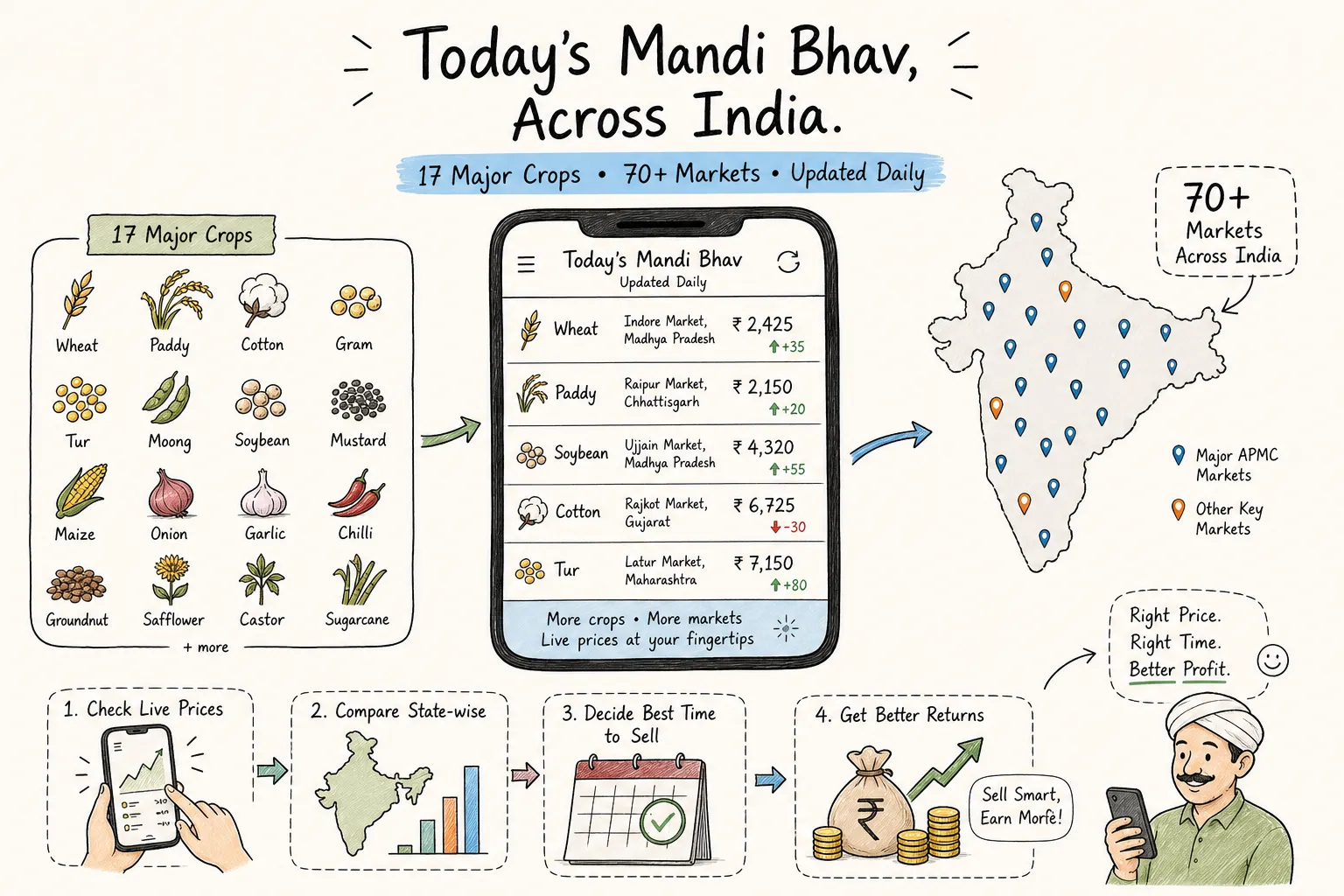
Mandi bhav today is not just a number. It is the information that determines whether you walk away from the auction platform with a fair return or leave money on the table. Prices shift every morning based on arrivals, buyer competition, government procurement activity, and seasonal supply cycles. The kisaan who checks verified rates before heading to the mandi is always in a stronger position than one who drives in blind and accepts whatever is offered at the platform.
Sourcing data from correspondents present at live auctions rather than relying on batch-uploaded government feeds gives you a material timing advantage at the point of sale. Bookmark KhetiKisaan's daily mandi report, run your net-price calculation before you load the truck, and compare at least two nearby mandis for every significant lot you plan to sell. Check mandi bhav today on KhetiKisaan's daily mandi report before your next trip to the yard.
One habit, practised consistently, often separates a profitable crop season from a frustrating one: check your mandi bhav today before you move your fasal. The few minutes you spend on that single step can be worth thousands of rupees per lot, season after season.