







How Textile Industry Demand Influences Cotton Prices in India
 Sep 07, 2026
 by Pankaj Sihag



How Textile Industry Demand Influences Cotton Prices in India
| Today's Cotton Rate Snapshot | |
|---|---|
| National weighted average | ₹67.89/kg | ₹6,789/quintal (rounded) |
| Gujarat average (62 mandis) | ₹7,431/quintal |
| Candy rate (356 kg) | ₹55,500 |
| NCDEX 29mm Cotton spot | ₹33,376.50 (▼0.19%) |
| MSP 2026-27 (medium staple kapas) | ₹8,267/quintal (effective 1 Oct 2026) |
| MSP 2026-27 (long staple kapas) | ₹8,667/quintal |
| Kharif 2026 acreage | 29.66 lakh hectares (down from 45.36 lakh in 2025) |
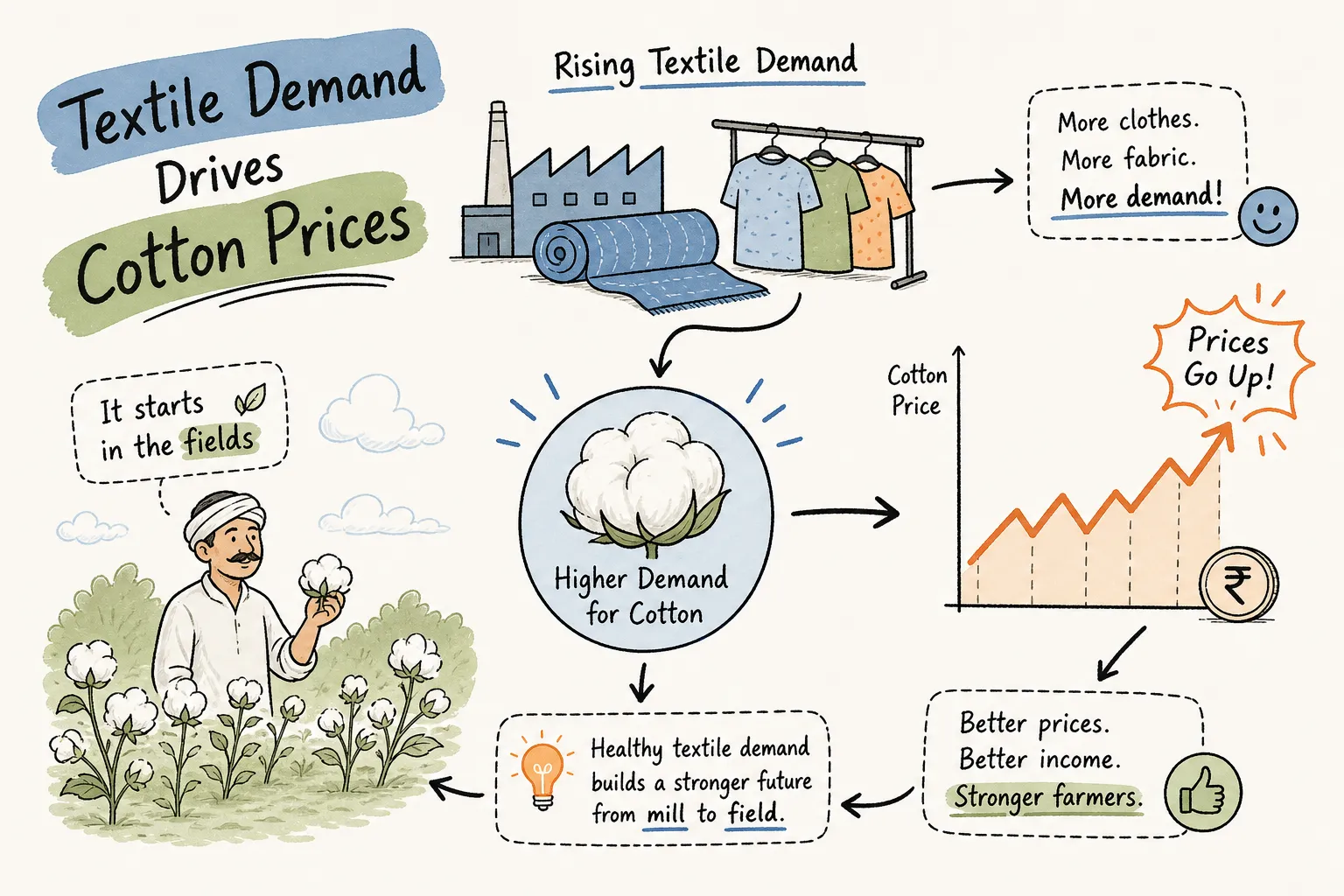
Cotton prices in India are averaging ₹67.89 per kg or ₹6,789 per quintal at the national weighted level, but the mandi nearest to your farm may be paying several hundred to a few thousand rupees per quintal more or less than that figure, spreads of that magnitude have been observed across Gujarat mandis alone. That gap comes down largely to what textile mills are willing to bid on a given day. Spinning mills are the single largest buyer of raw cotton (kapas) in India, and when their procurement desks move, many APMC yards across the country respond within days. Understanding that demand chain is not just market theory; it directly determines whether the price you get this week for your fasal is fair or short.
This article breaks down the current cotton rate in India across key benchmarks, spot rates, candy prices, mandi averages by state, and NCDEX cotton futures prices, and explains what is driving prices right now, where they are likely to go, and what you should do with that information before your next sale. For North India farmers growing Narma cotton in Rajasthan, Haryana, and Punjab, KhetiKisaan tracks live APMC auction rates sourced directly from on-ground contacts at bol-chaal sessions, so you can benchmark your local mandi price against national data before making a sell call.
 Table of Contents
- How textile mills decide what your kapas is worth
- Where cotton prices in India stand right now
- Cotton price movement over 7, 30 and 365 days
- MSP and government procurement: the price floor that protects farmers
- Monsoon, arrivals, and the kharif supply picture
- Export demand and global futures: the international price link
- Local APMC rates vs national benchmarks: why the gap can cost you thousands per quintal
- Practical next steps: sell, store, or watch this week?
- The bottom line on cotton prices in India this season
- FAQs
How textile mills decide what your kapas is worth
From loom to mandi: the demand signal travels fast
Spinning mills in Gujarat's Saurashtra belt and Maharashtra's Vidarbha region are the primary buyers of raw cotton in India. When their yarn inventory runs low or a fresh export order arrives from a garment manufacturer, their buying desks raise their bid at the nearest APMC auction within the same week. This is the demand signal that sets the initial price floor at any mandi, not the farmer's asking rate, and not the government portal's published average. The mill's raw cotton spot price requirement is the starting point of the entire pricing chain.
This matters practically because a rise in garment export orders can lead to stronger buying at Saurashtra mandis within a short window. Once Gujarat prices move, North India mandi rates tend to follow because traders and aggregators arbitrage the gap quickly. The clearest thing a cotton farmer can do is watch what mills are bidding, not just what the government is publishing.
Why North India textile hubs matter too
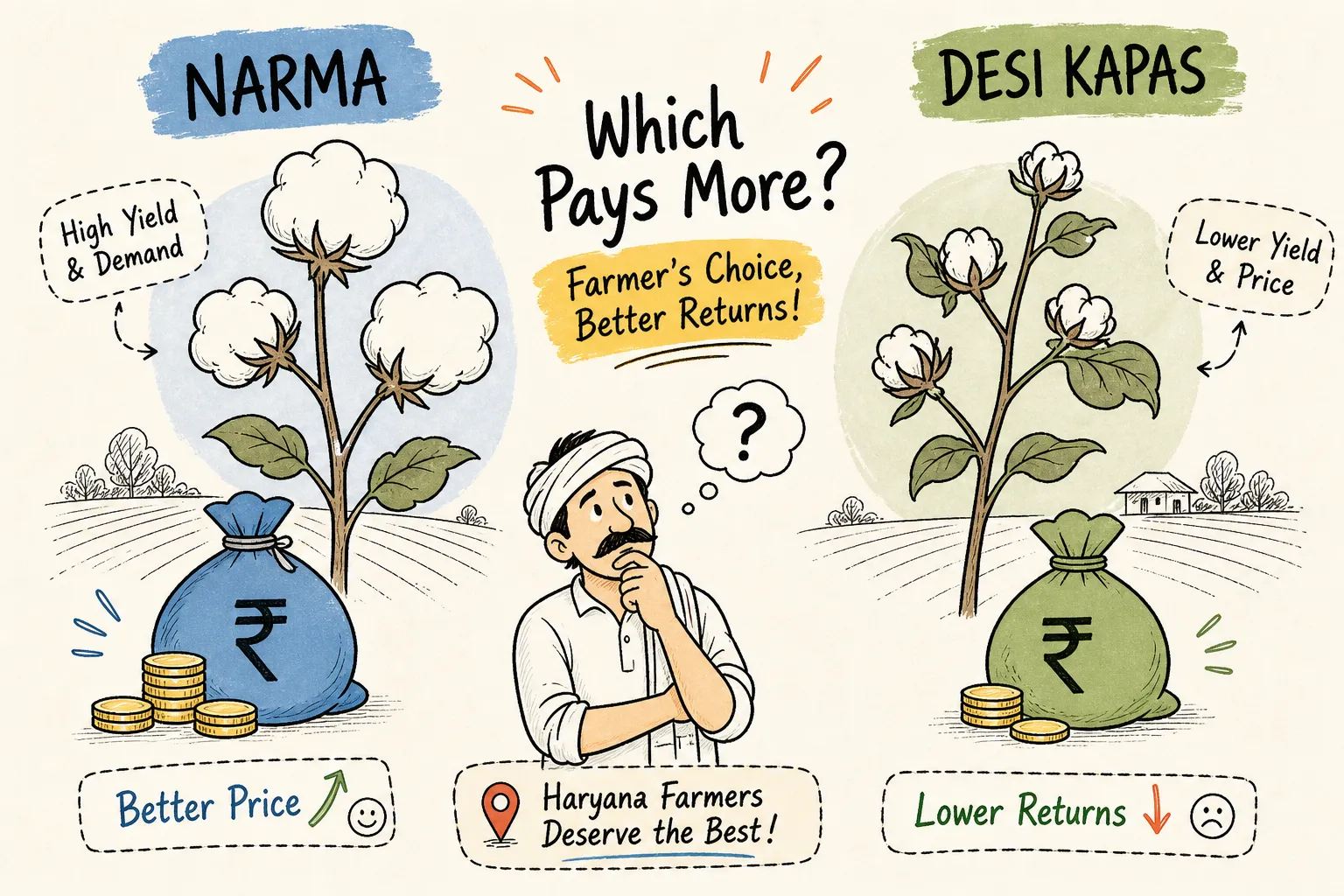
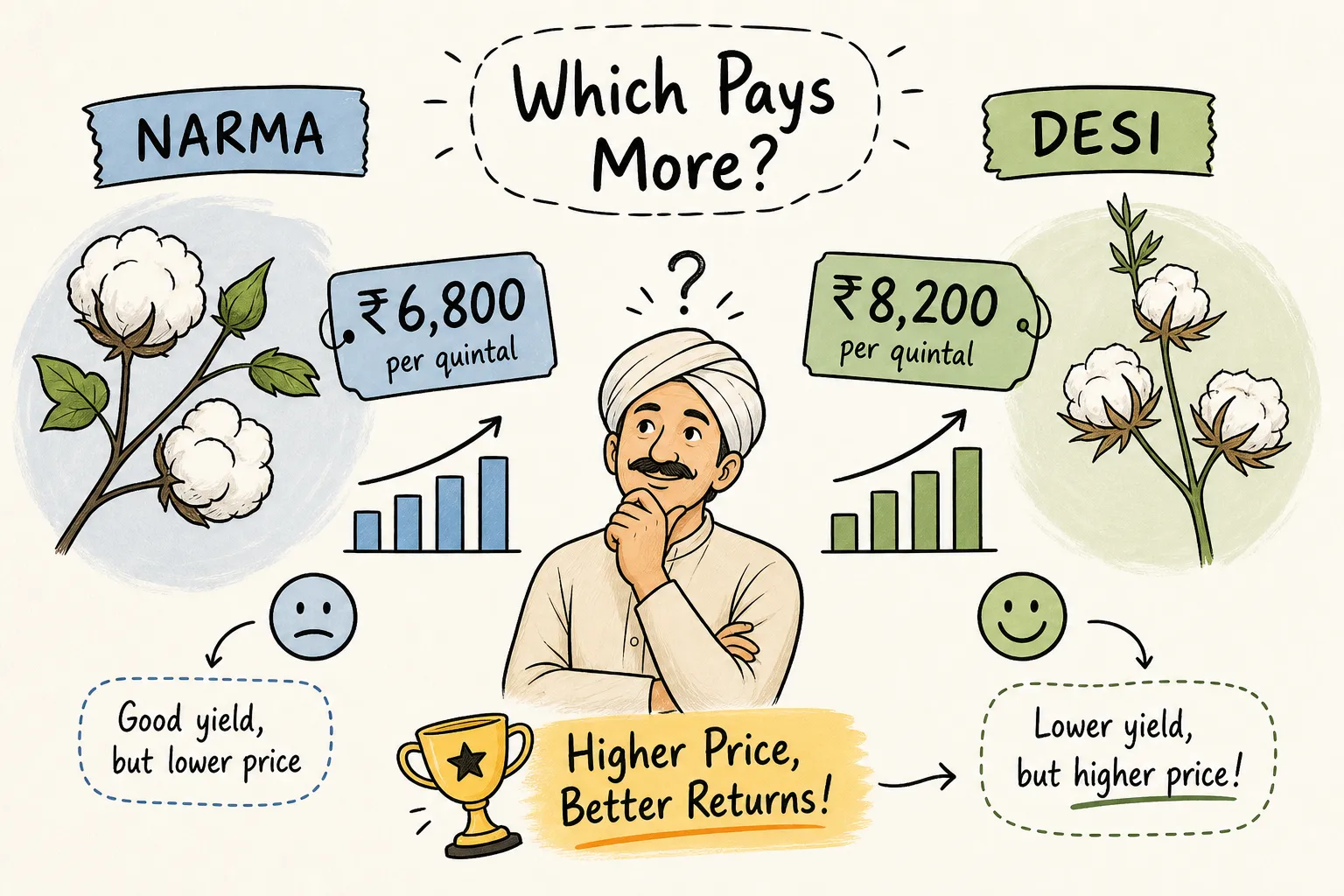
Ludhiana, Panipat, and the broader Haryana textile cluster form a secondary demand centre for Narma cotton, the American variety preferred for its longer staple, grown across Punjab and Haryana. These mills focus on spinning and weaving for domestic apparel and home furnishings, and they prefer the longer staple length of Narma over desi cotton varieties. This is why narma bhav and desi cotton prices move at different times and by different amounts: different mill types are driving each market. When the Ludhiana spinning sector runs at full capacity, Narma procurement in Haryana and Punjab APMC yards picks up noticeably, pushing regional cotton mandi rates above the national average.
Where cotton prices in India stand right now
National average and the Gujarat mandi picture
The national weighted average cotton price is ₹67.89 per kg or ₹6,789 per quintal (rounded). Gujarat is the primary reference point for domestic spot pricing because it handles the largest share of auction volume, and its current average across 62 mandis is ₹7,431 per quintal, considerably above the national figure. But even that state average conceals enormous variation. Botad APMC has seen modal rates of ₹9,000 per quintal, while some Jamnagar arrivals have cleared near ₹5,000 per quintal. The difference comes down to variety, moisture content, ginning outturn percentage, and the specific buyer mix in the auction hall on that particular day, not just geography.
This intra-state spread in Gujarat illustrates why a single national average is insufficient for making a sell decision. A farmer with Shankar-6 variety cotton at 8% moisture content is in a very different price bracket from a farmer selling mixed-grade kapas with higher moisture at a smaller mandi with fewer buyers present.
What regional cotton mandi rates look like outside Gujarat
For Maharashtra, Punjab, Haryana, and Telangana, reliable state-wide daily averages from aggregated sources are harder to come by because APMC reporting lags vary significantly by state. Available data for Haryana shows an average of approximately ₹6,694 per quintal with a high-low range of ₹3,400 to ₹8,760 per quintal. Punjab shows an average of roughly ₹7,407 per quintal across three active markets. For Haryana specifically, New Grain Market in Jind showed cotton at ₹6,600 per quintal in recent sessions. These are working estimates, not certified uniform rates, which is precisely why on-ground sourcing from active APMC bol-chaal sessions gives a more reliable kapas price today than any government portal update.
Cotton price movement over 7, 30 and 365 days
Short-term: the candy price story and recent stability
Over the last seven days, the candy rate, the traditional Indian cotton volume unit of 356 kg, has held steady at ₹55,500. The price has shown no breakout in either direction over the most recent trading sessions, which on the surface suggests stability. Flat market quotes, however, can mask tightening fundamentals underneath. USDA data indicates that Shankar-6 seed cotton prices rose approximately 4% over the past month, driven by declining arrivals at mandis as the harvest concluded. That monthly rise in farm-gate prices was not fully captured in the quoted candy rate, which suggests the underlying supply is firmer than the headline number implies.
The year-on-year trend: 10% up and still climbing
Looking at the full 365-day picture, Indian cotton prices moved from ₹59,400 to ₹65,800 per candy, an increase of approximately 10.8% year-on-year. CAI (Cotton Association of India) data for some domestic benchmarks shows rises of up to 18% in the same period, reinforcing that the annual uptrend is real and broad-based. Three forces drove this move: tighter domestic supply, stronger mill demand as garment exports recovered, and a rising MSP floor that set a higher baseline each season. The cotton rate India trend over the past year reflects a structural shift, not a temporary seasonal spike, and the current price environment is consistent with that.
MSP and government procurement: the price floor that protects farmers
How the kapas MSP sets a market floor in APMC yards
The government's Minimum Support Price for kapas acts as a guaranteed buying rate when open-market prices fall below it. For the 2026-27 kharif season, the MSP has been set at ₹8,267 per quintal for medium-staple kapas and ₹8,667 per quintal for long-staple kapas, effective from 1 October 2026. This is an increase of ₹557 per quintal over the 2025-26 rate. When the MSP rises, it effectively raises the floor that mills must bid above to attract supply, because farmers who find market rates unsatisfactory can route their kapas through CCI (Cotton Corporation of India) procurement instead.
Currently, the medium-staple market rate reported in some mandi trackers sits at approximately ₹8,200 per quintal, only about ₹67 below the announced MSP for that grade. This narrow gap has real implications: the market is effectively operating at near-MSP levels, with mills having limited room to negotiate prices downward without triggering CCI procurement activity.
When procurement kicks in and what it means for your mandi rate
When market rates are comfortably above MSP, CCI procurement stays largely inactive and farmers sell directly to mills and private traders at open-market rates. When market prices drift toward MSP territory, CCI begins buying, removing kapas from the open market, tightening available supply, and pushing market prices back up. This self-correcting mechanism is the price floor in action. For you as a farmer, the practical signal is straightforward: track the gap between your mandi's daily rate and the MSP. A narrowing gap means government procurement may become active, which historically tightens the market and supports prices within weeks.
Monsoon, arrivals, and the kharif supply picture
How delayed arrivals are keeping raw cotton prices firm
After the main harvest period concludes, cotton arrivals at mandis drop sharply. When those arrival flows are also delayed by late monsoon rains or slow picking, the supply reaching APMC yards tightens even if the total crop size is unchanged. USDA data has flagged declining arrivals as a driver behind the recent uptick in Shankar-6 seed cotton prices. Fewer quintals reaching the auction floor each day means more mill buyers competing for the same available kapas, and that competition pushes bids higher. Declining arrivals are a short-term price support factor that works independently of the crop-size story.
Crop estimates for 2025-26 and 2026-27: the acreage story is serious
The production numbers and the acreage data are telling two different stories right now. USDA estimates 2025-26 output at approximately 24.5 million 480-lb bales, with 2026-27 projected slightly lower at 23.5 million bales. CAI has placed 2025-26 estimates at 339 lakh bales. These numbers are meaningful but not critically low.
The far more significant data point is acreage: kharif 2026 cotton sowing stands at just 29.66 lakh hectares, compared with 45.36 lakh hectares in kharif 2025. That is a reduction of 15.70 lakh hectares, a 34.6% drop in planted area year-on-year. This acreage shortfall will not show up in production data immediately, but it signals that 2026-27 supply will tighten considerably from the current season. For farmers currently holding stored kapas, this is one of the strongest medium-term price-support signals in the market right now.
Export demand and global futures: the international price link
When international cotton futures move, Indian mandis follow
NCDEX 29mm Cotton futures and ICE cotton futures in the United States are closely tracked by large traders, mills, and aggregators in India. Reports from the 2025-26 season indicate that a surge in international futures lifted Indian physical prices within the same week. The candy rate and raw cotton spot price in India are therefore not isolated domestic numbers, they track global supply-demand through the trade channel in near real time. When the NCDEX cotton futures price shifts notably in a session, physical mandi rates in Gujarat and Maharashtra often respond within a few trading sessions, though the timing and magnitude vary.
Export parity, the rupee, and what it means for your fasal
India's cotton exports for 2025-26 are estimated at 1.50 million bales, a 16.7% decline from 1.80 million bales in 2024-25. Bangladesh remains the dominant destination, accounting for over 85% of raw cotton shipments, with smaller volumes going to China, Vietnam, and Indonesia. The export decline reflects a specific dynamic: when domestic cotton prices run at a premium to international benchmarks, Indian cotton becomes less competitive for overseas buyers, and mills shift partially toward cheaper imported cotton.
This export-versus-import balance acts as a natural cap on the upside. If domestic prices in certain grades push significantly above export parity, buying pressure from overseas eases and mills start importing, which relieves the supply tightness that was pushing prices up. Tracking the NCDEX cotton futures price is a free, practical way for traders and larger farmers to gauge how far domestic prices can rise before that import pressure kicks in.
Local APMC rates vs national benchmarks: why the gap can cost you thousands per quintal
Why the national cotton price in India average doesn't tell the full story
The Gujarat state average of ₹7,431 per quintal conceals a spread of over ₹4,000 between the highest-paying mandi (Botad at ₹9,000) and the lowest (some Jamnagar arrivals near ₹5,000). For a farmer selling 100 quintals of kapas, that difference equals ₹4 lakh in realisation from the same crop. The national weighted average of ₹6,789 per quintal is even further from either extreme. This spread exists because regional cotton mandi rates vary by cotton variety, moisture content, ginning outturn percentage, and the buyer mix present at the auction on a specific day. As an illustration, two mandis within 80 km of each other can clear the same variety at a ₹600 per quintal difference on the same morning, simply because one mandi has more active mill buyers at that session.
How KhetiKisaan's APMC data helps North India farmers benchmark before selling
For North India cotton farmers, KhetiKisaan addresses this data gap directly. The platform sources cotton auction rates from ground-level contacts physically present at live bol-chaal sessions at APMC yards in Rajasthan, Haryana, and Punjab, not from delayed government data feeds or aggregated weekly summaries. This means a Narma cotton grower in Sri Ganganagar or Nohar can check the previous day's actual clearing rates at multiple mandis, compare them against the national benchmark, and make an informed decision about whether to sell locally or move produce to a better-paying APMC yard nearby.
That comparison, local mandi rate versus national average versus neighbouring mandi rate, is where the real money is made or lost at sale time. It requires data that is current and verified, not two days old and averaged across 60 mandis. Check KhetiKisaan's daily mandi bhav updates before your next sale.
Practical next steps: sell, store, or watch this week?
Reading the current market signals as a cotton farmer
The current market setup, taken together, points toward a firm price environment with meaningful medium-term upside risk. Prices are stable in the short term (7-day candy rate flat at ₹55,500), up modestly over 30 days, and up 10.8% over the year. The 34.6% drop in kharif 2026 acreage is a forward supply signal that has not yet been fully priced into current rates but will become increasingly relevant as the season progresses.
MSP is providing a floor, global futures have been broadly supportive, and declining arrivals are keeping mill procurement competitive at APMC yards. For farmers with storage access and manageable cash-flow requirements, the case for holding rather than distress-selling is supported by specific supply and price data, though individual decisions will ultimately depend on storage quality, cash-flow position, and each farmer's own risk tolerance.
Three things to monitor daily before making your next sale
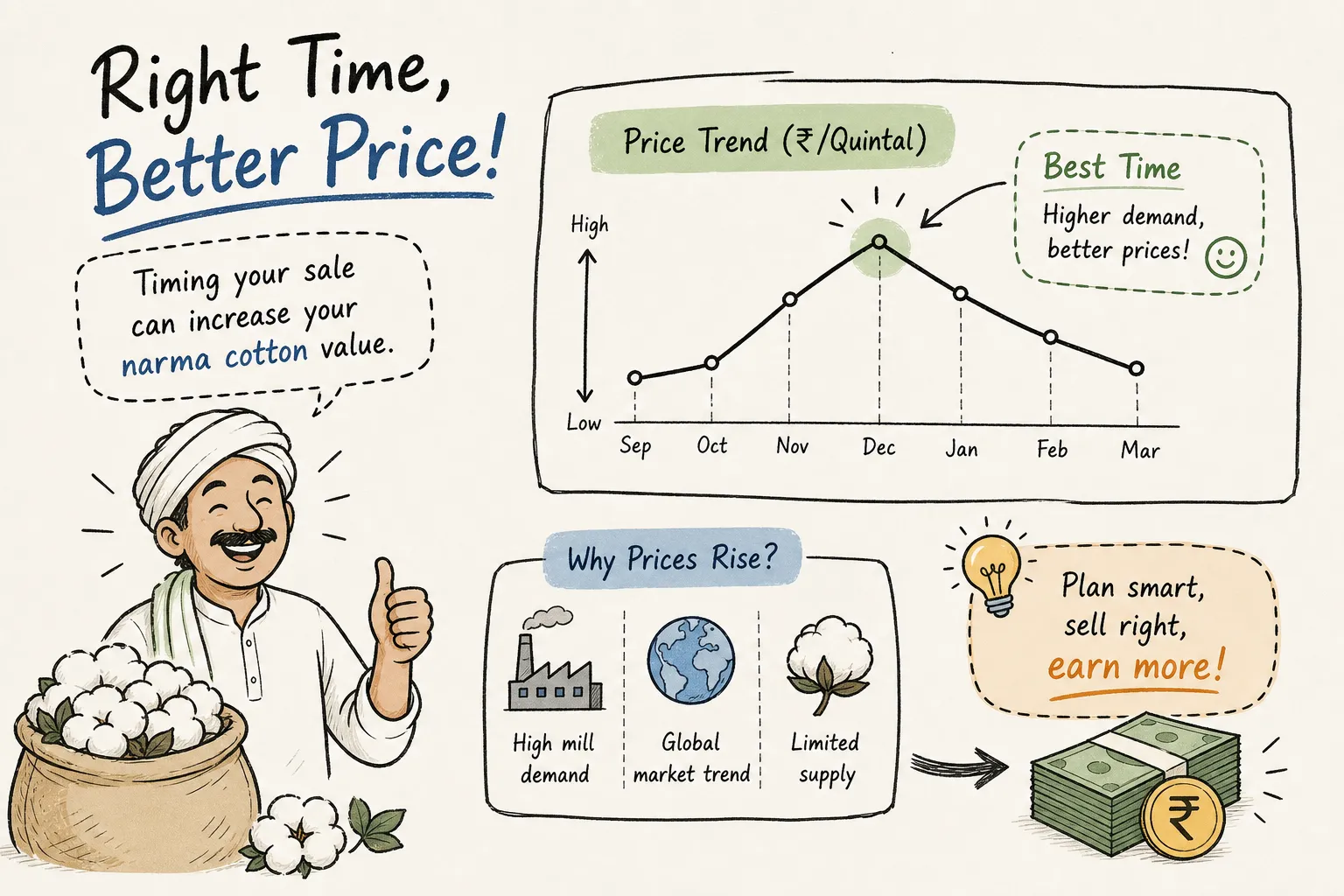
- Check your nearest APMC's daily cotton mandi rates against the national average. A premium above the national average of ₹6,789 per quintal means your mandi is performing well; a discount means you should evaluate whether a nearby market offers better realisation on that day.
- Track the candy rate on NCDEX 29mm Cotton for directional cues. When the candy rate moves above ₹55,500 with volume behind it, physical mandi rates may follow within a few sessions. Use this as a directional heuristic rather than a precise rule, a sustained break below ₹55,500 would be an early warning that short-term momentum has shifted.
- Watch for CCI procurement announcements. When CCI begins active procurement, it signals that market rates are approaching MSP territory. This typically tightens available supply at mandis and pushes prices back up, but it also means you may have missed the window to sell above MSP voluntarily.
KhetiKisaan publishes daily mandi bhav updates for North India mandis, making step one straightforward and reliable. Getting into the habit of checking rates before you load your trolley to the mandi is the most actionable change a kapas farmer can make this season.
The bottom line on cotton prices in India this season
Textile industry demand is the primary price-setter for cotton in India, but MSP, monsoon-driven arrivals, and global futures all shape how that demand translates into what your local mandi actually pays on a given day. The current environment, stable candy rates, a 10.8% year-on-year gain, and a 34.6% drop in kharif 2026 acreage, points to a structurally firm market with meaningful upside potential over the coming months as the acreage shortfall becomes visible in arrival data.
The gap between the national average of ₹6,789 per quintal and the best-performing mandis at ₹9,000-plus per quintal makes one thing clear: knowing the national benchmark is the starting point, not the endpoint. The real money in kapas marketing comes from benchmarking your specific mandi, on a specific day, against both the national average and the rates at neighbouring APMC yards. That comparison requires current, ground-sourced data.
Cotton prices in India today vary widely enough that selling without verified local data is leaving money on the table. Use KhetiKisaan's daily mandi bhav updates to make that comparison quickly and accurately before every sale. Selling your kapas with verified data instead of guesswork is the simplest way to close the gap between what the market is offering and what you actually receive at the mandi gate.
FAQs
Related Blogs

Oct 02, 2026
by Pankaj Sihag

Sep 12, 2026
by Pankaj Sihag
Sep 02, 2026
by Pankaj Sihag
Aug 27, 2026
by Pankaj Sihag

Apr 11, 2026
by Pankaj Sihag
Apr 08, 2026
by Pankaj Sihag