







Narma vs Desi Cotton Price: Which Variety Pays More?
 Aug 27, 2026
 by Pankaj Sihag



Narma vs Desi Cotton Price: Which Variety Pays More?
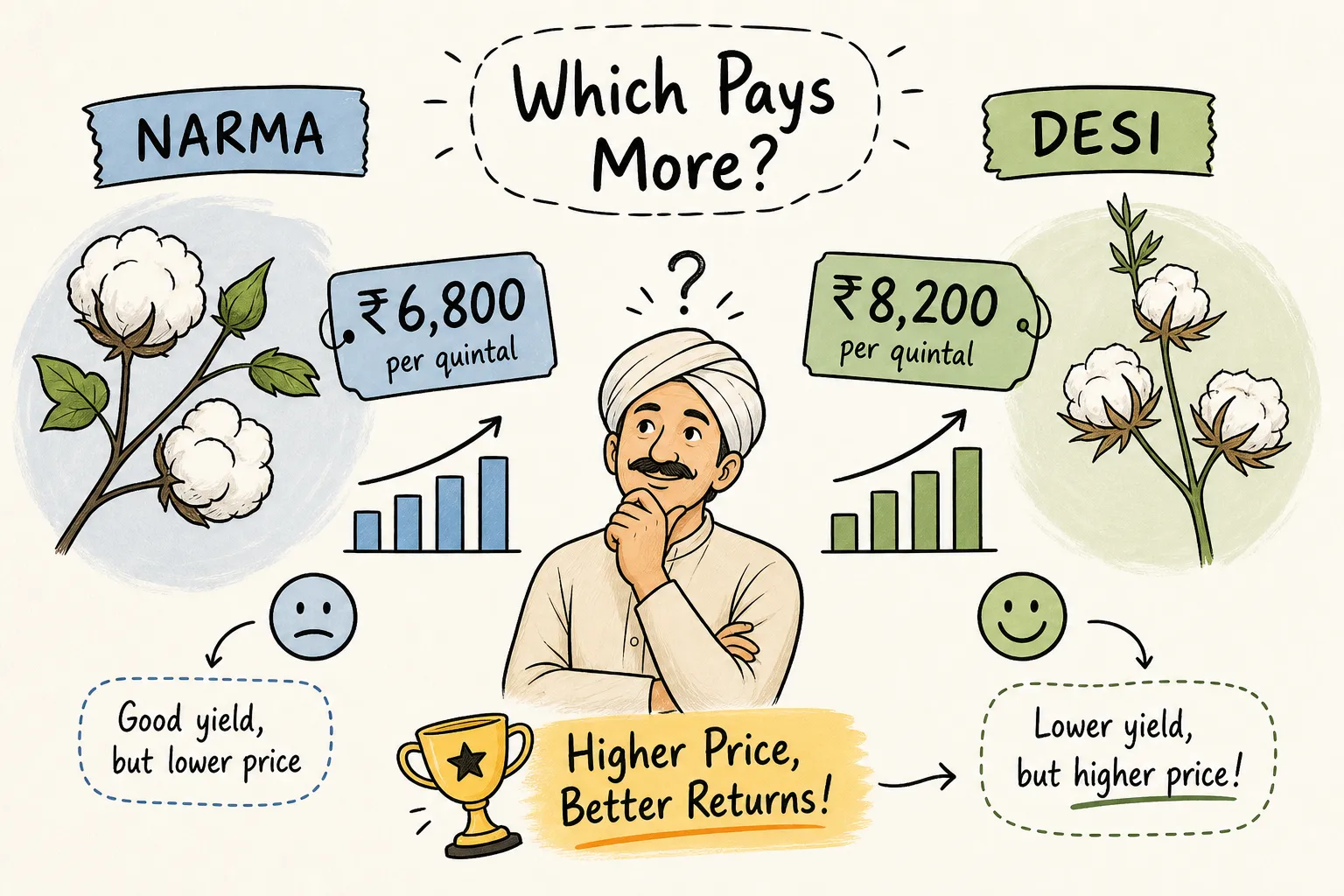
- MSP 2026: Desi kapas (long-staple government category) = ₹8,667/quintal; Narma/American cotton (medium-staple government category) = ₹8,267/quintal, Desi holds the higher government floor price under the kharif 2026 MSP notification.
- Market price range (Aug 2026): Narma trading at ₹8,400, 8,600/quintal at mandis like Sri Ganganagar; Desi kapas at ₹7,500, 8,200/quintal across observed North India markets. Ranges are indicative, reported by KhetiKisaan ground contacts and verified at individual APMC auctions; verify live bhav before selling.
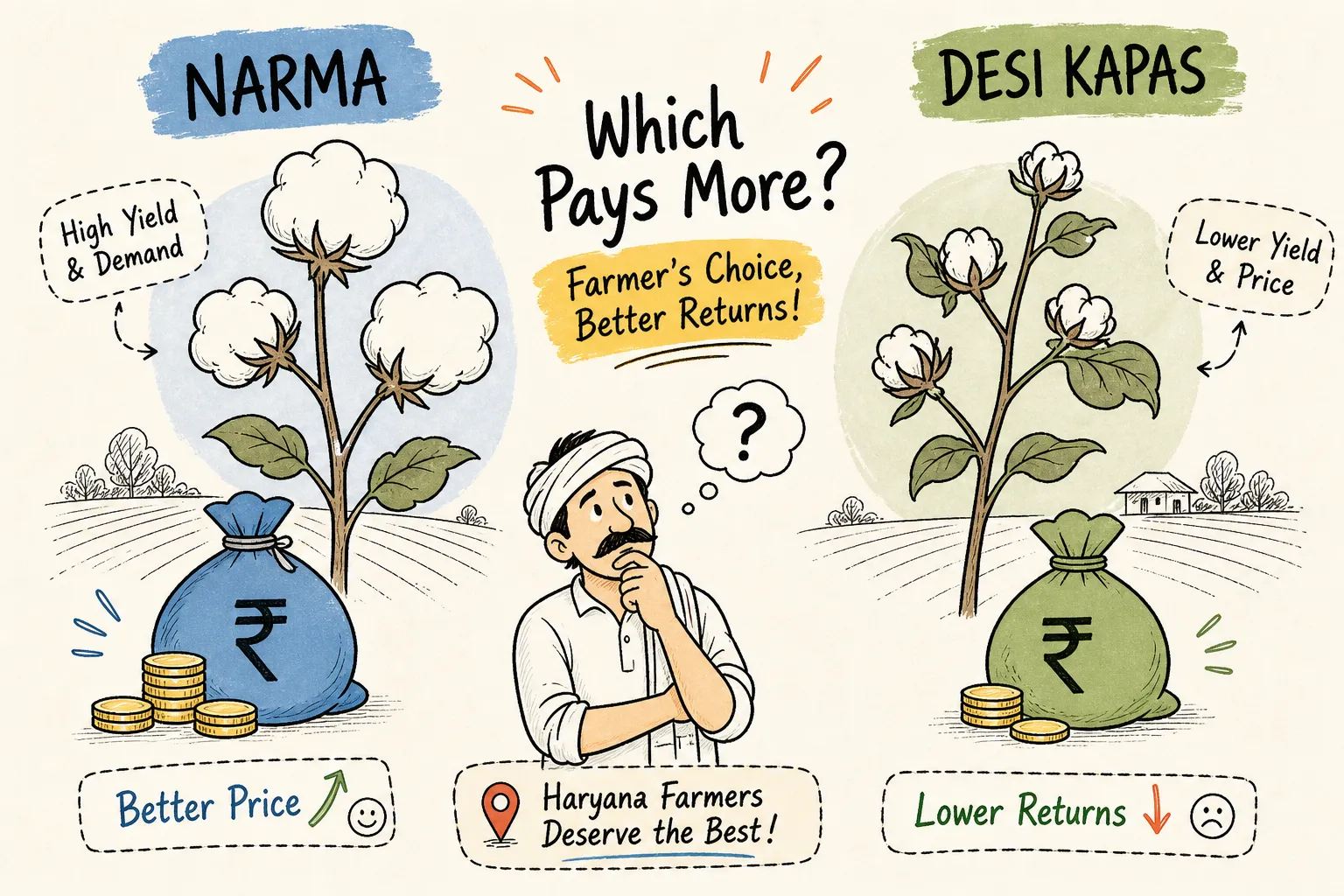
- One-line verdict: Despite a lower MSP, Narma cotton has fetched more at auction in many observed North India mandis because textile mills pay a measurable premium for its longer staple and spinning performance, though the gap varies by mandi and date.
 Table of Contents
- Does Narma BT cotton or Desi kapas get a better rate at the mandi?
- What Separates Narma Cotton from Desi Kapas
- Narma vs Desi Cotton Price, Mandi Comparison
- Why Textile Mills and Ginners Pay More for Narma Cotton
- What Pushes Cotton Prices Up or Down Within the Same Season
- How to Sell Your Kapas at the Best Available Price
- Conclusion: Making the Narma vs Desi Cotton Price Comparison Work for You
- FAQs
Does Narma BT cotton or Desi kapas get a better rate at the mandi?
Every cotton farmer in Haryana and Rajasthan asks the same question before loading kapas on the tractor: does Narma BT cotton or Desi kapas get a better rate at the mandi? This guide breaks down the narma vs desi cotton price difference across Haryana and Rajasthan mandis so you can decide when and where to sell. The answer matters more than most farmers realise, the price gap between the two varieties can reach ₹300, 800 per quintal on the same auction day at the same market. Getting this wrong means leaving real money on the table across multiple pickings over an entire kharif season.
KhetiKisaan tracks live auction rates from mandis including Sri Ganganagar and Nohar in Rajasthan and Sirsa and Fatehabad in Haryana, sourced from contacts physically present during bol-chaal (live bidding). This comparison draws from that ground-level data, not delayed government feeds or estimated averages. Below, you will see the current price spread between both varieties, understand exactly why mills price them differently, and find out what you can do to sell at the top of the range.
What Separates Narma Cotton from Desi Kapas
The price difference between Narma and Desi cotton at the mandi is not arbitrary. It flows directly from measurable differences in fibre quality, and textile mills assess those differences before placing a single bid. Both factors show up directly in a buyer's bid at the mandi.
Fibre Profile: Staple Length, Micronaire, and What Mills Measure
Narma BT cotton (American cotton) has a staple length in the range of 28, 32 mm, while Desi kapas typically falls in the 20, 24 mm range. Staple length is among the most important factors in a cotton bale's assessed value at the mill gate, standard quality analyses used by Indian ginners and mills attribute roughly 20% of a bale's assessed value to staple length, with cleanliness accounting for an even larger share (approximately 23%). Micronaire measures fibre fineness; a lower micronaire value means a finer, more uniform fibre that spins into smoother yarn. Narma generally has more consistent micronaire scores across a crop than traditional Desi varieties.
Mills send buyers to mandis with specific quality targets. When a buyer sees Narma kapas with 30 mm staple, they know it can meet premium yarn specifications. Desi kapas with 22 mm staple cannot meet those same targets, no matter how cleanly it has been picked, and the bid reflects that reality immediately.
Where Each Variety Grows Across North India
Narma BT cotton dominates the cotton belts of Sri Ganganagar, Hanumangarh, Sirsa, Fatehabad, and Abohar. These districts have the irrigation infrastructure and input supply chains that BT cotton cultivation requires. Desi kapas is grown in smaller pockets, often on lighter or rain-fed soils where the higher seed and pesticide costs of BT cultivation are harder to justify financially.
This geographical split influences which buyers show up at each mandi. At Sri Ganganagar, private ginners and textile traders source Narma for spinning mills in Gujarat and Rajasthan. Desi kapas mandis attract a different buyer profile, which directly influences how competitive the bidding becomes at auction.
Narma vs Desi Cotton Price, Mandi Comparison
In many North India mandis during the current season, Narma cotton has been trading above Desi kapas by a margin of ₹300, 600 per quintal, despite having a lower government MSP. This gap has been reported by KhetiKisaan's on-the-ground contacts at multiple APMC auctions, though premiums vary by mandi and date. Raw cotton price India-wide is also subject to global demand signals, which means local mandi bhav can shift week to week even when crop quality remains constant.
Narma vs Desi Cotton Price: Rajasthan Mandis
| Mandi | Narma BT Cotton (₹/quintal) | Desi Kapas (₹/quintal) | Approx. Gap |
|---|---|---|---|
| Sri Ganganagar | ₹8,450, 8,600 | ₹7,800, 8,100 | ~₹400, 500 |
| Nohar | ₹8,200, 8,450 | ₹7,600, 7,900 | ~₹400, 500 |
| Pilibanga | ₹8,100, 8,350 | ₹7,400, 7,700 | ~₹500, 600 |
| Hanumangarh | ₹8,200, 8,500 | ₹7,700, 8,000 | ~₹400, 500 |
Source: KhetiKisaan ground contacts, Aug 2026. Prices are sample reported ranges from live APMC auctions, verify live bhav before selling.
The Sri Ganganagar mandi shows strong Narma arrivals and active private buyer participation. KhetiKisaan's contacts confirmed a Narma rate of ₹8,551/quintal at Sri Ganganagar on 18 August 2026, which falls within the range above and reflects buyer competition for quality cotton in peak procurement weeks.
Haryana Mandi Rates: Sirsa, Fatehabad, and Adampur
| Mandi | American/Narma Cotton (₹/quintal) | Desi Kapas (₹/quintal) | Approx. Gap |
|---|---|---|---|
| Sirsa | ₹7,400, 7,860 | ₹7,000, 7,300 | ~₹300, 500 |
| Fatehabad | ₹6,900, 7,200 | ₹6,500, 6,800 | ~₹300, 400 |
| Adampur | ₹7,125, 7,400 | ₹6,800, 7,100 | ~₹300, 350 |
Source: KhetiKisaan network, APMC auction data. Rates are sample historical/reported ranges; always verify today's live bhav before selling.
Sirsa remains the most active cotton mandi in Haryana, with Narma arrivals drawing private ginners offering above-MSP rates on good-quality lots. Rania APMC in Sirsa district has recorded modal rates as high as ₹8,900/quintal for top-grade cotton in strong buying periods.
How MSP Compares to Actual Auction Rates for Both Varieties
The government has set kharif 2026 MSP at ₹8,667/quintal for long-staple cotton and ₹8,267/quintal for medium-staple cotton, per the kharif 2026 MSP notification. In common usage, Desi kapas falls under the long-staple government category while Narma BT hybrids fall under medium-staple, note that local Desi varieties can themselves vary in actual fibre length, so the government categories do not map perfectly onto fibre-test mm values.
Desi kapas holds the higher MSP by ₹400/quintal, yet auction data from observed mandis shows Narma trading above Desi in many markets. Understanding this gap prevents farmers from mistakenly assuming Desi will automatically fetch more just because its MSP is higher. MSP is a floor, not a market price; private buyers bid based on what they need, not what the government schedule says.
Why Textile Mills and Ginners Pay More for Narma Cotton
The price premium for Narma is not sentiment; it is a direct consequence of what mills can produce from it. Understanding the mill's calculation helps you understand your mandi rate.
Staple Length, Spinning Count, and What Mills Need to Make Quality Yarn
Longer-staple Narma cotton can be spun into finer yarn counts, typically in the 30s, 40s range, used in premium shirting, fine knitwear, and export-quality fabric. Shorter-staple Desi kapas is suited to coarser counts in the 10s, 20s range, which command lower prices in the yarn market. A mill producing 40s-count yarn can charge more per kilogram for its output than one producing 16s-count yarn, so it is willing to pay more per quintal at the mandi for the raw material that makes that possible. These count bands are typical industry ranges; actual spinning outcomes depend on fibre cleanliness and moisture as well.
Longer fibres also produce fewer defects during spinning. They overlap better during drafting, break less on ring spinning frames, and result in smoother, more uniform yarn with fewer thick-and-thin places. Mills processing fine-count yarn experience less production waste and fewer rejected lots when working with long-staple Narma kapas. These efficiency gains are factored into every quintal bid at the mandi. Standard quality analyses used by ginners and mills attribute roughly 20% of a bale's assessed value to staple length, making it one of the dominant quality factors alongside cleanliness.
Ginning Outturn and How It Factors into Buyer Decisions
Ginning outturn is the percentage of clean lint a ginner extracts from seed cotton (kapas). Desi cotton varieties show higher average ginning outturn, around 40, 41%, compared to Narma BT cotton hybrids, which typically range from 33, 35% across different varieties. A ginner bidding in a mandi factors this in, which is one reason Desi kapas does not fall as far below Narma in price as staple-length differences alone would suggest.
However, the higher ginning outturn of Desi kapas is not enough to offset the premium mills pay for Narma's longer staple. A ginner who processes Desi cotton extracts more lint per quintal, but that lint can only be sold to mills making coarser yarn at lower yarn prices. The final lint value at the mill gate still favours Narma, which is why buyers bid more aggressively for it at auction despite Desi's outturn advantage. The desi cotton premium in ginning is real, it simply does not translate into a higher mandi price because lint quality matters more than lint volume to textile buyers.
What Pushes Cotton Prices Up or Down Within the Same Season
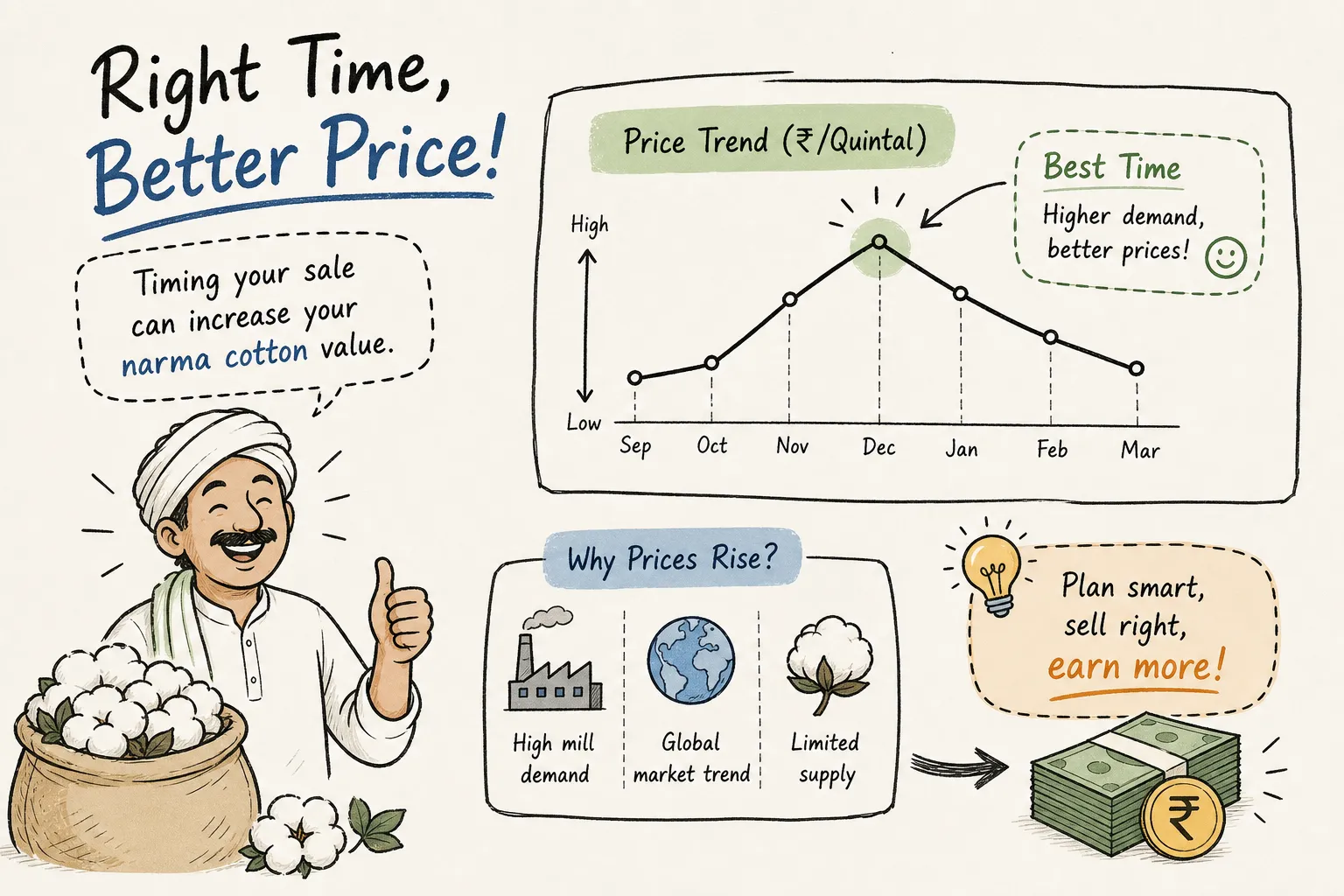
Even with good Narma cotton in hand, timing your sale well can add meaningfully to your per-quintal realisation. Farmers who have tracked mandi rates carefully in previous seasons have reported differentials of ₹200, 500 per quintal by adjusting arrival timing, though actual gains vary by mandi, date, and quality. Seasonal and demand patterns are predictable enough to plan around.
Arrival Timing and the Harvest Pressure Effect
Cotton prices in Haryana and Rajasthan are typically firmer in October, before peak arrivals flood the mandi. Once November and December bring heavy supply from multiple pickings, price pressure builds and mandi bhav can soften by ₹300, 500/quintal compared to early-season rates. Farmers who sell their first and second pickings, which are also cleaner and lower in moisture, tend to report better rates than those who hold everything for a single large sale in peak arrival weeks.
Holding later pickings too long without proper storage also costs money. Moisture content rises, trash levels increase, and buyers discount aggressively for any kapas that shows signs of deterioration. If your storage is not adequate, selling at a moderate price in October is frequently better than waiting and selling deteriorated cotton in December at a steep discount.
Export Demand, Global Cotton Markets, and Your Local Mandi
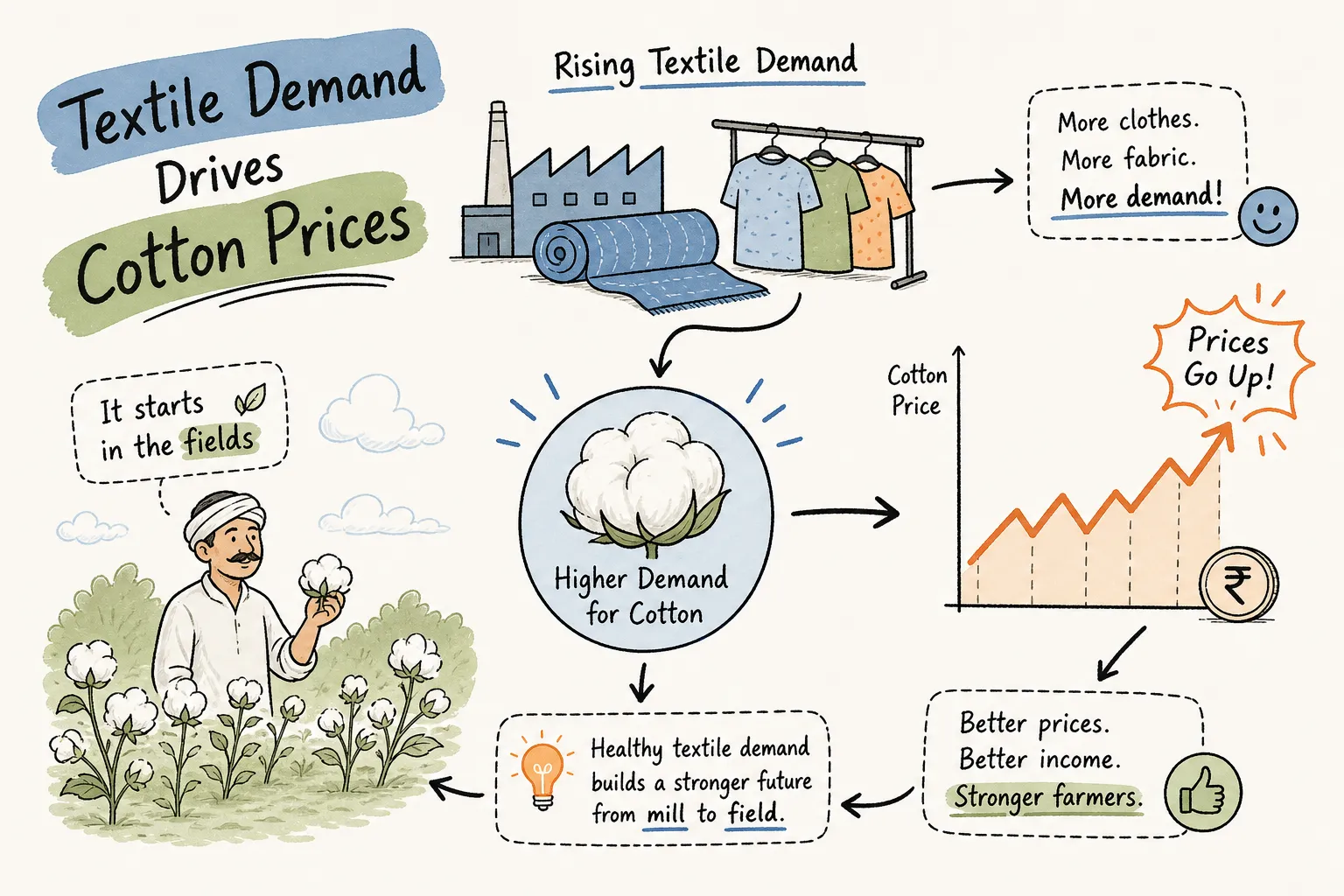
When Chinese textile mills are active and Indian yarn exports are strong, traders at APMC mandis bid more aggressively because they have forward orders to fill. This tezi (price rise) lifts both Narma and Desi cotton rates at the local level. Conversely, a global demand lull, such as the seasonal textile off-season from May to August when major export orders slow, or a heavy Indian crop estimate in trade forecasts can push mandi bhav down weeks before arrivals even begin.
Monitoring these demand signals does not require access to international commodity markets. Watching whether your local mandi's buyer attendance is rising or falling, and tracking daily cotton bhav across multiple mandis, gives you a reliable read on whether tezi or mandi (price fall) conditions are prevailing. This is exactly what KhetiKisaan's live price pages are designed to show you before you decide to sell.
How to Sell Your Kapas at the Best Available Price
Good cotton sold at the wrong mandi on the wrong day earns less than average cotton sold with proper price intelligence. These steps make a measurable difference to your per-quintal realisation.
Choosing the Right Mandi and the Right Time to Arrive
Bring kapas early in the season if quality is good, cleaner, drier, first-picking cotton commands clear premiums. Before loading the tractor, compare rates across at least two mandis; the gap between Sri Ganganagar and Nohar, or between Sirsa and Fatehabad, can sometimes reach ₹200, 400/quintal on the same day for equivalent quality. Avoid peak arrival days when supply pressure compresses prices, and plan to arrive when buyer attendance is high and supply is thinner.
If your kapas has high moisture content, allow it to dry before bringing it to the mandi. Buyers discount heavily for moisture, and the markdown often exceeds the cost of a few extra days of proper drying. Cleanliness matters equally: hand-picked first lots earn premiums that machine-gathered mixed lots do not.
Tracking Daily Cotton Mandi Bhav Before You Load the Tractor
Before hauling kapas to the mandi, check today's Narma bhav and Desi kapas rates on KhetiKisaan's live price pages. Rates are sourced from contacts physically present at APMC auctions during live bol-chaal, which means they reflect actual transactions, not 48-hour-old government feeds or estimated averages. Knowing the day's opening rate before you arrive puts you in a stronger negotiating position and helps you decide whether to sell immediately or hold for one more day.
Comparing the narma vs desi cotton price across mandis covered on KhetiKisaan, including Sri Ganganagar, Nohar, Sirsa, and Fatehabad, takes only a few minutes. Farmers who make this comparison before committing to a mandi have reported savings in the ₹200, 400/quintal range in several seasons, though actual outcomes vary. Over a crop of 20, 30 quintals, even a modest improvement per quintal adds up significantly.
Conclusion: Making the Narma vs Desi Cotton Price Comparison Work for You
The narma vs desi cotton price gap is not accidental, it is driven by fibre quality, mill demand, and spinning economics that play out at every APMC auction across Haryana and Rajasthan. In many observed mandis this season, Narma has fetched ₹300, 600 more per quintal than Desi kapas, even though Desi holds the higher MSP floor.
Understanding why that gap exists, staple length, micronaire consistency, ginning outturn, and mill yarn targets, puts you in a far stronger position when negotiating at auction. Combine that knowledge with live, ground-sourced price data from KhetiKisaan before each sale, and you have the two tools that consistently separate farmers who sell well from those who leave money at the mandi.
FAQs
Related Blogs

Oct 02, 2026
by Pankaj Sihag

Sep 12, 2026
by Pankaj Sihag
Sep 02, 2026
by Pankaj Sihag

Apr 11, 2026
by Pankaj Sihag
Apr 08, 2026
by Pankaj Sihag