







Lahsun Mandi Rate Today: Understanding Daily Garlic Price Changes
 Sep 08, 2026
 by Pankaj Sihag



Lahsun Mandi Rate Today: Understanding Daily Garlic Price Changes
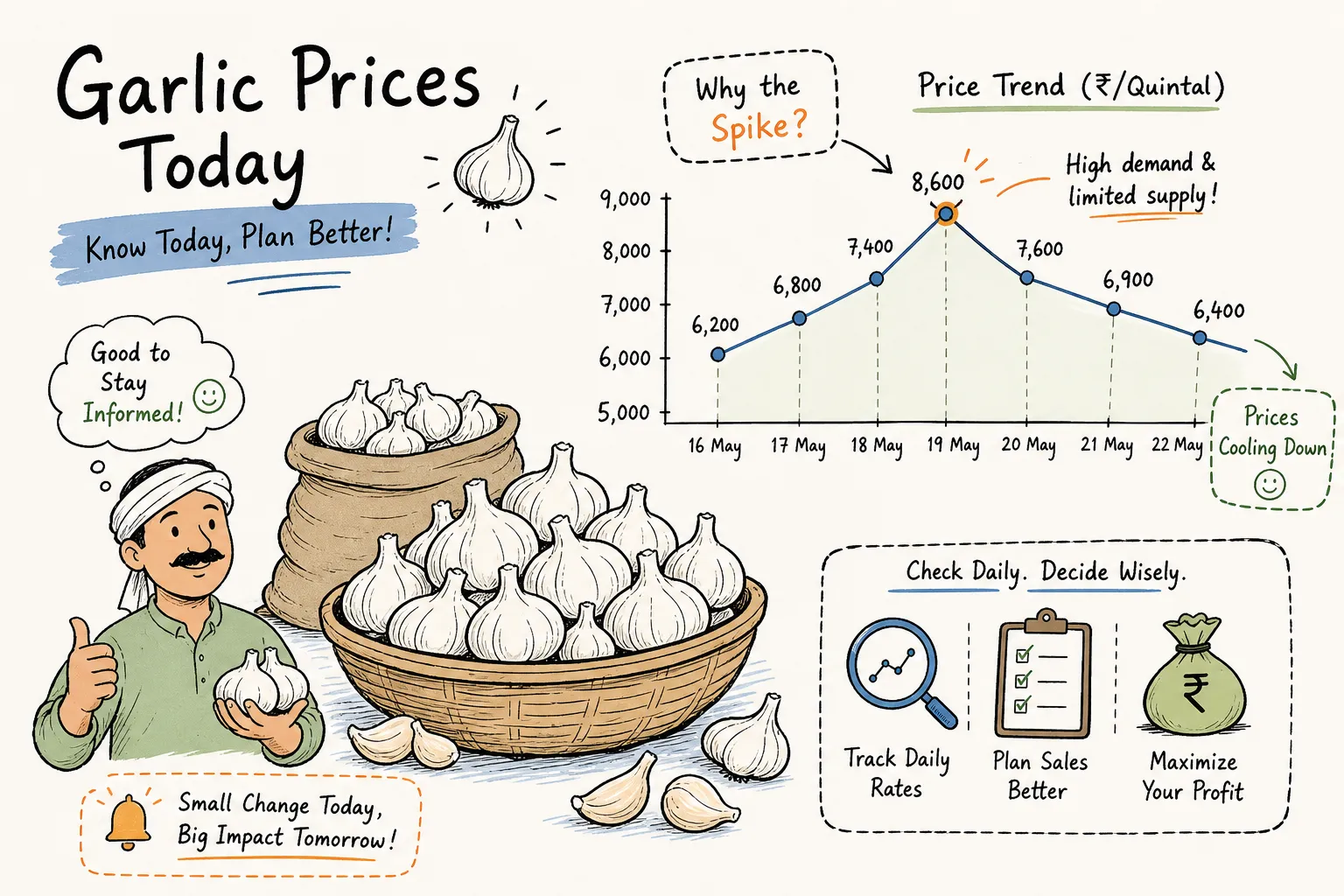
Check the lahsun mandi rate today before you load your trolley, garlic rates change at every morning auction based on that day's arrivals and buyer demand. The difference between a profitable trip to the mandi and a regrettable one is often just knowing the right bhav in advance. Many lahsun growers use KhetiKisaan to check live garlic mandi price today each morning and decide whether to move their stock that day or hold for a better session. The numbers below come from the latest APMC auction records across multiple states.
 Table of Contents
- Lahsun mandi rate today: garlic prices at major APMC yards
- State-wise lahsun mandi bhav: a quick reference table
- Why lahsun mandi rates shift every single morning
- What modal, minimum, and maximum prices actually mean
- Quick quintal-to-kg garlic price conversion
- 30-day price direction: tezi or mandi for lahsun?
- Sell now or hold your stock: reading the signals correctly
- Check lahsun mandi rate today before you decide
- FAQs
Lahsun mandi rate today: garlic prices at major APMC yards
Kota, Neemuch, and Sri Ganganagar: what the auction books show
These three mandis serve as benchmark yards for anyone tracking lahsun bhav in North and Central India. Kota sits in the heart of Rajasthan's garlic belt, Neemuch anchors MP's Malwa region, and Sri Ganganagar handles the seasonal lahsun flow from North Rajasthan's irrigated farming tracts. These mandis are widely watched across North and Central India, and price movements here tend to set the tone for the broader region.
| Mandi | State | Min Price (₹/qtl) | Modal Price (₹/qtl) | Max Price (₹/qtl) |
|---|---|---|---|---|
| Kota APMC | Rajasthan | ₹4,000* | ₹6,000 | ₹10,000* |
| Neemuch APMC | Madhya Pradesh | ₹2,500* | ₹5,800* | ₹9,000* |
| Sri Ganganagar APMC | Rajasthan | ₹4,500* | ₹8,487 | ₹11,500* |
* Min and max figures are indicative ranges based on available session data. Verify the confirmed figures for your target mandi before making a sell decision.
The modal price is the single most reliable number to reference here. It reflects the rate at which the largest volume of garlic actually changed hands during the session. Min and max values show the full auction range, but your lot is most likely to land near the modal unless your quality is exceptional or below average.
Ramganjmandi: the market setting today's national high
Ramganjmandi in Rajasthan is reporting the national high at ₹45,003 per quintal in the current session. This maximum likely reflects high-quality large-bulb garlic with low moisture and clean sorting, the tier that traders and processors are willing to pay top price for, though specific grade details for this lot were not available in the auction records. Buyers sourcing for export processing units and inter-state wholesale networks specifically target this quality tier.
Contrast that with the ₹500/quintal floor at Jaora in Madhya Pradesh, and you see the full price spectrum a lahsun farmer operates within. The ₹500 lot likely represents lower-quality, distress-sale stock, possibly wet, unsorted, or affected by disease, though the APMC records do not detail its specific condition. These two numbers are not averages any farmer should plan around; they mark the extremes of quality within a single trading session.
Other APMC yards with active garlic arrivals today
Farmers in Uttar Pradesh and Punjab have active mandis reporting garlic transactions this session. Note that Hoshiarpur is showing two distinct price points, likely reflecting different lot grades or variety categories traded in the same session. Here is a quick state-wise reference for these markets.
| Mandi | State | Modal Price (₹/qtl) |
|---|---|---|
| Bareilly APMC | Uttar Pradesh | ₹7,686 |
| Ghiraur Mainpuri APMC | Uttar Pradesh | ₹8,500 |
| Muradabad | Uttar Pradesh | ₹6,924 |
| Hoshiarpur (Tanda Urmur) | Punjab | ₹11,000 to ₹13,000 |
These figures give you a regional cross-check. If you are in western UP and your nearest mandi is quoting well below Mainpuri's ₹8,500, it may be worth enquiring whether routing through a bigger yard makes financial sense after accounting for transport.
State-wise lahsun mandi bhav: a quick reference table
Rajasthan, Madhya Pradesh, and Uttar Pradesh rates
| State | Representative Mandi | Latest Modal (₹/qtl) |
|---|---|---|
| Rajasthan | Ramganjmandi | ₹45,003 |
| Rajasthan | Sri Ganganagar | ₹8,487 |
| Madhya Pradesh | Indore F&V | ₹3,131 |
| Madhya Pradesh | Jaora | ₹500 (floor lot) |
| Uttar Pradesh | Bareilly APMC | ₹7,686 |
| Uttar Pradesh | Mainpuri (Ghiraur) | ₹8,500 |
| Uttar Pradesh | Muradabad | ₹6,924 |
The wide range between MP and Rajasthan comes down to garlic grade, variety, and whether the stock is fresh-harvest or coming out of cold storage. MP's Malwa region is India's single largest garlic-producing belt. Neemuch, Mandsaur, and Ratlam districts together account for the bulk of national supply. Because so much garlic originates here, local supply is high and prices tend to stay lower than in states that depend on incoming stock from MP.
Punjab, Maharashtra, and Gujarat: what the numbers look like
Punjab's Hoshiarpur market is quoting ₹11,000 to ₹13,000 per quintal, which reflects the fact that Punjab does not produce large volumes of garlic itself. What trades there is mostly stock transported from Rajasthan and MP, and the added freight cost gets baked into the price. Maharashtra's Pune APMC is holding steady between ₹15,000 and ₹16,500 per quintal, driven by consistent urban retail demand from one of India's largest city markets.
Gujarat tells a different story. Rajkot's modal price has dropped from ₹8,500 to ₹6,600 per quintal over the past 30 days, with a 30-day average of ₹7,410. That is a clear downward trend. If you are a Gujarat farmer still holding stock, this trajectory is a warning signal worth taking seriously before deciding to wait further. Surat shows an even flatter picture at ₹4,750 per quintal with very limited trading volume.
Why rates differ so sharply between states
Garlic has no Minimum Support Price (MSP) from the central government. Unlike wheat or paddy, where a floor price gives farmers a baseline safety net, lahsun prices are entirely driven by local supply and demand at each APMC auction. A mandi with heavy arrivals and few active buyers will see modal prices fall sharply. A mandi with thin supply and strong trader demand will see them rise just as fast.
Distance from the major producing belts of MP and Rajasthan also adds freight-adjusted value in distant states. The same garlic that fetches ₹5,000 in Neemuch might reasonably fetch ₹8,000 to ₹9,000 in Hoshiarpur once road freight and handling are accounted for. This is why checking your own state's garlic price statewise matters far more than watching the national average alone.
Why lahsun mandi rates shift every single morning
The relationship between arrivals and price is direct and predictable. When large volumes of garlic arrive at the mandi on a single day, buyers have more choice and negotiate harder. When arrivals are thin, traders compete with each other to secure stock and push modal prices higher. APMC boards publish arrival figures in quintals on notice boards every morning before bol-chaal (bidding) begins, and experienced farmers check this number before they even think about what price to expect.
Farmers who track arrivals from the day before can anticipate the next morning's auction tone. If yesterday's arrivals were 600 quintals and today's are expected at 900, a price-softening session is likely. If arrivals dropped from 400 to 180 quintals, sellers are likely to be in a stronger position. This is not guesswork; it is reading the market the way a trader does.
Demand signals that move garlic prices within a week
Several demand drivers can shift modal prices meaningfully within 48 hours. First, retail and wholesale trader restocking ahead of festivals or weekend peaks creates a short burst of buying pressure. Second, export inquiries from processing units buying dehydrated garlic flakes or garlic paste for international shipment pull large volumes off the market quickly, tightening local supply. Third, inter-state stock movement happens when one region's surplus is diverted to meet another region's deficit; this can lift prices in the receiving state mandi almost overnight.
Watching news about export demand and festive purchasing cycles gives you a two-to-three day advance signal on likely price direction. KhetiKisaan tracks these arrival and rate changes daily so you can check the morning numbers without making a phone call to every commission agent (arhatiya) in the district.
Seasonal and weather factors that create price volatility
Lahsun is a once-a-year Rabi crop, harvested between March and April. From May onwards, the market runs entirely on stored stock. Cold storage capacity, electricity costs, and anticipated next-season planting area all feed into trader price expectations through the monsoon and early winter months. When a trader believes next year's planting area will shrink, they hold stock longer and accept higher prices for it.
Unseasonal rain during the March, April harvest window can damage bulb quality and tighten supply almost immediately. The premium prices currently visible at Ramganjmandi partly reflect this dynamic: quality stock that survived the season cleanly is commanding a significant premium over average lots. This gap between premium and ordinary garlic widens during tight-supply periods.
What modal, minimum, and maximum prices actually mean
The garlic modal price is the rate at which the highest quantity of garlic was transacted in a single auction session. It is the most realistic price a farmer with an average-quality lot can expect to receive when they bring their stock to the yard. The minimum price is what the worst lot fetched; the maximum is what the best lot fetched. A common mistake is expecting the maximum price and feeling short-changed when the mandi pays the modal instead.
When you check the garlic rate per kg on any mandi platform, always look at the modal first. The maximum makes headlines, but the modal tells you what the market actually paid for typical stock on that day.
How lot quality determines which price band you fall into
APMC buyers grade garlic visually during bol-chaal. Bulb size uniformity, skin cleanliness, moisture level, and the absence of disease patches all push a lot toward the maximum price band. A wet, mixed-grade lot with inconsistent bulb sizes typically falls below modal. Sorting and drying garlic properly before taking it to the mandi is one of the simplest ways to shift from the minimum to the modal price band, and in strong markets, a well-presented lot can push toward the maximum.
Invest half a day sorting your lot at the farm. Remove damaged, sprouted, or undersized bulbs. Let the stock dry adequately before loading. This basic effort can meaningfully raise your realisation per quintal, the exact premium varies by market day and quality gap, but the direction is consistent: better-presented stock earns more.
Reading a full mandi price report without confusion
A standard APMC garlic price report row shows: commodity name, variety, grade, minimum price, modal price, maximum price, and arrivals in quintals. When you see "variety: Other" in an APMC listing, it is a catch-all label for local or unclassified varieties. It does not mean inferior quality; it just means the mandi's system does not have a separate category for that particular strain.
Cross-reference the modal price with arrivals. A high modal price on low arrivals (say, 50 quintals) is less reliable than the same modal on 500 quintals of arrivals. Heavy-volume sessions give you a more representative modal price because more buyers participated in setting it.
Quick quintal-to-kg garlic price conversion
The formula and why both units matter
The conversion is straightforward: divide the quintal price by 100 to get the per-kg price. So ₹20,920 per quintal equals ₹209.2 per kg. The national high of ₹45,003 per quintal equals ₹450.03 per kg. The Gujarat Rajkot modal of ₹6,600 per quintal equals ₹66 per kg. Farmers sell in quintals at the mandi, but retail buyers, restaurants, and small traders buy in kg. Knowing both units helps you check whether the wholesale mandi price aligns with what your local sabzi market is charging, and whether there is a gap worth capturing directly.
Ready-reference conversion table for common garlic price points
| Price (₹/quintal) | Price (₹/kg) |
|---|---|
| ₹5,000 | ₹50 |
| ₹7,500 | ₹75 |
| ₹10,000 | ₹100 |
| ₹12,500 | ₹125 |
| ₹15,000 | ₹150 |
| ₹18,000 | ₹180 |
| ₹20,920 | ₹209.2 |
| ₹25,000 | ₹250 |
| ₹35,000 | ₹350 |
| ₹45,003 | ₹450 |
30-day price direction: tezi or mandi for lahsun?
National price trend in September 2026
The national picture shows significant inter-market variability rather than a single clean trend. Depending on which set of mandis an aggregator covers, the reported national modal for garlic ranges from ₹12,583 to ₹20,920 per quintal. The Ramganjmandi high at ₹45,003 confirms that premium-grade stock is firmly in tezi (bullish) territory. Standard-grade stock, however, is trading at much more modest levels across most of the country.
National averages can mask regional divergence almost entirely. A farmer in Gujarat looking at a ₹20,920 national modal while Rajkot is quoting ₹6,600 will only confuse themselves. Track your own state's mandi direction first; the national number is useful context, not a price target.
State-specific trend signals worth tracking
Here is the current directional reading by state, based on the latest available auction data:
- Maharashtra (Pune APMC): Sideways to upward, ₹15,000 to ₹16,500 range, moderate volatility. Urban demand is holding the floor firm.
- Madhya Pradesh (Indore F&V):Downward. 30-day average ₹3,652; current modal ₹3,131. Prices have dropped noticeably within the month.
- Gujarat (Rajkot): Downward. From ₹8,500 to ₹6,600 over 30 days, with a 30-day average of ₹7,410. A clear bearish signal for Gujarat-based sellers.
- Uttar Pradesh (Bareilly): Soft, with a recorded -6.6% day-over-day move. Latest modal at ₹7,686. Volatile and trending weaker.
Do not plan your sell decision around another state's trajectory. Your break-even and your nearest mandi's trend are the only two numbers that matter for your specific situation.
What cold storage stock levels mean for October outlook
As September progresses, the fresh-harvest garlic from the March, April season is running down. What trades in the market now is cold-storage stock. When that stored inventory gets thin, prices typically firm up going into winter. The mechanism is simple: fewer quintals available for sale, more buyers competing, higher modal prices.
If you have storage access and can absorb the holding cost financially, this seasonality historically favours waiting into October, November for a better price. Storage is not free, though. Every extra week in a cold facility costs money, and that cost needs to enter your calculation alongside the price trend. If the current modal at your nearest mandi covers your cost of production with reasonable profit, selling now is a legitimate decision, not a mistake.
Sell now or hold your stock: reading the signals correctly
Consider selling this week if these signals are aligned for your nearest mandi. First, arrivals have been below 200 quintals per day for three or more consecutive sessions, thin supply means buyers genuinely need your stock and will bid closer to the maximum. Second, the state modal price has risen for two or more consecutive days, meaning momentum is with sellers right now. Third, your cold storage cost is eating into your net realisation every additional week you hold.
The break-even math should drive your decision as much as price direction. KhetiKisaan tracks daily arrival volumes and rate movements so you can check all three signals from your phone before deciding whether to book a vehicle or wait another few sessions. Knowing the numbers before you leave the farm is always better than finding out at the yard. These are advisory heuristics based on observed market patterns; conditions at your specific mandi may vary.
Conditions that favour waiting
Hold your stock if these signals apply to your situation. First, arrivals at the mandi have been heavy at 500+ quintals per day and the modal price has dropped more than ₹1,000 per quintal over the past week, a heavy-arrival, falling-price week is not the time to add more supply to the yard. Second, a major local mandi is reporting festival demand pickup expected within the next 10 to 14 days. Festive buying reliably creates a short-term price bump. Third, your garlic is in good storage condition with low sprouting risk and you have the financial headroom to wait without cash-flow stress.
In past seasons, farmers who held through temporary price dips have in some cases received meaningfully higher realisations per quintal, though outcomes vary by market, season, and quality. That kind of gain is real money on even a modest 20-quintal lot.
The one calculation every lahsun seller must do before going to the mandi
Run this break-even check before you load the trolley. Take today's modal price and subtract mandi commission, this typically ranges around 2 to 3% of the transaction value, though the exact rate varies by mandi and state APMC rules. Then subtract your transport cost per quintal. Then subtract any sorting or grading labour you paid. What remains is your actual net realisation per quintal.
Compare that net figure to your cost of production per quintal. If net realisation covers cost of production with a margin that makes sense for your household, selling is the right call regardless of what the market might do next week. Price forecasting involves uncertainty. Your cash flow is real and immediate. Profitable selling at today's modal beats speculative waiting into a market that may not co-operate.
Check lahsun mandi rate today before you decide
Garlic prices move every session, and the gap between a well-timed sale and a poorly timed one can run into thousands of rupees per quintal. Check the lahsun mandi rate today for your nearest APMC, run the break-even calculation, and weigh it against the arrival and trend signals described above. The decision to sell or hold should be grounded in your own numbers, not national averages or another state's trajectory. KhetiKisaan updates mandi-wise garlic rates daily to help you make that call with confidence.
FAQs
Related Blogs

Oct 08, 2026
by Pankaj Sihag

Oct 02, 2026
by Pankaj Sihag
Oct 02, 2026
by Pankaj Sihag
Sep 28, 2026
by Pankaj Sihag