







Why Mungfali Prices Differ Across Indian Mandi's
 Sep 08, 2026
 by Pankaj Sihag



Why Mungfali Prices Differ Across Indian Mandi's
Two farmers from neighbouring villages load their mungfali (groundnut) onto trucks on the same October morning. Same kharif season, same district, roughly the same crop. One reaches his nearby mandi and gets ₹5,200 per quintal. The other travels to a different APMC and walks away with ₹6,800 per quintal. That ₹1,600 gap on a single day, multiplied across 50 quintals, means one farmer earned ₹80,000 more than the other for the exact same fasal (crop). This is not an unusual case. It is the everyday reality of why mungfali prices differ across major Indian mandis, and understanding the reasons behind it can change how much you earn this season.
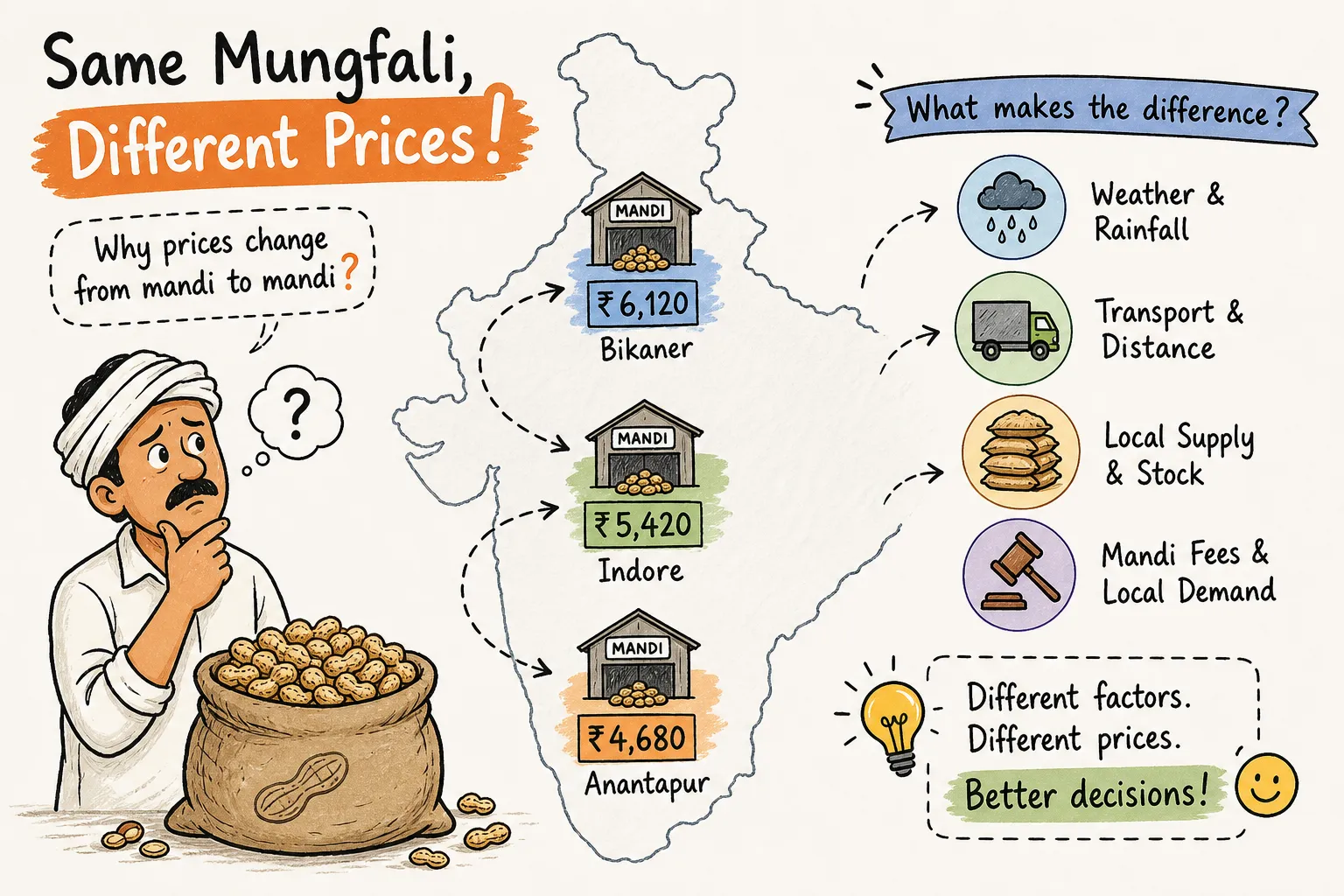
Mungfali mandi rates are not random. They follow a predictable logic rooted in local supply conditions, buyer competition, quality differences, processing infrastructure, and cost structures. Once you understand these drivers, you stop treating the mandi bhav (market price) as something that happens to you and start treating it as a variable you can influence. This article breaks down exactly why peanut mandi bhav differs so sharply across markets, and how you can use that knowledge to make a smarter sell decision, starting with checking live mandi data on platforms like KhetiKisaan before you load a single bag.
| Gujarat mandi price range (same day, multiple APMCs) | ₹5,410 to ₹8,750 per quintal (indicative range across mandis; figures vary by date and source) |
| Variety premium: JL-24 vs ordinary groundnut | Often ₹1,000+ per quintal, and sometimes several thousand rupees, depending on mandi and date |
| All-in mandi deductions by state | ~1% (Maharashtra) to ~8.5% (Punjab) |
| MSP for mungfali, Kharif 2026, 27 | ₹7,517 per quintal |
| Groundnut Bold Kernel price range, Kurnool | ₹5,019 to ₹8,610 per quintal |
 Table of Contents
- 1. How arrival volume at a mandi sets the day's groundnut price
- 2. Oil mill and crusher proximity: the regional price anchor most farmers overlook
- 3. Moisture content and kernel grade: quality gaps that directly cut your price
- 4. Transport costs and mandi fees: the hidden cuts between the quoted price and your pocket
- 5. How trader demand and export buying move peanut mandi bhav by region
- 6. MSP and government procurement: the price floor that protects you when markets fall
- 7. Why comparing mungfali prices across mandis before you sell makes a real difference
- Conclusion: the informed farmer is the one who gets paid better
- FAQs
1. How arrival volume at a mandi sets the day's groundnut price
The most immediate factor driving groundnut price variation is how much mungfali arrives at a mandi on a given day. When large volumes arrive simultaneously after a harvest flush, traders in the bol-chaal (live auction bidding) know they have leverage. Farmers are under time pressure, storage is limited, and the buyer can afford to wait. Bids come in conservatively, and prices fall. When arrivals are thin, the same buyers compete harder for limited stock, and prices climb.
This supply-and-demand dynamic is common at APMC auction yards across India and is frequently visible in live auction data. It is not manipulation, it is basic market economics operating in real time at the mandi level, and it is one of the clearest reasons why mungfali prices differ across Indian mandis from one day to the next.
Why harvest timing across states creates inter-mandi price windows
Mungfali is primarily a kharif crop, but the harvest calendar staggers significantly across producing states. Gujarat's main kharif groundnut arrives at mandis from October through November. Rajasthan harvests from September to October. Andhra Pradesh and Karnataka peak in April to May. Tamil Nadu runs from May through July. This staggered calendar means that at any given point in the year, one state's mandis are under supply pressure from a fresh harvest while another state's mandis are operating on thin arrivals with firmer prices.
The practical result is a natural regional price spread that shifts month by month. A farmer in Rajasthan harvesting in October is competing with a Gujarat harvest happening at the same time, which can soften prices across both states simultaneously. Understanding this calendar lets you anticipate when your regional mandi is likely to face supply pressure and when it is likely to recover.
Reading arrival volumes before you decide to transport
APMC notice boards and digital platforms report daily arrival volumes alongside prices. Before loading your fasal and heading to a mandi 80 kilometres away, check whether that mandi has seen heavy arrivals over the past few days. High arrivals combined with a falling price trend is a warning signal. Low arrivals with a rising price trend is the opposite. KhetiKisaan tracks daily mandi bhav data sourced from ground-level contacts at live auctions, giving you this picture before you make a transport decision that cannot be undone.
2. Oil mill and crusher proximity: the regional price anchor most farmers overlook
One of the most consistent patterns in mungfali mandi rates across India is the price advantage that mandis near oil-crushing clusters hold over mandis in areas without local processing. This is not coincidence. It is structural, and it directly affects how much bargaining power a farmer has at any given auction.
How nearby processors set the daily bid
Edible oil crushers and oilseed mills buy mungfali for immediate crushing, which means they participate in daily auctions with genuine urgency. When three or four active oil mills are bidding for the same lot of groundnut, each one pushes the price up to secure their daily requirement. This competitive buyer presence creates a price floor that holds firm even when arrivals are moderate. A mandi with multiple processor buyers will almost always deliver a better price than a mandi where the only buyer is a local trader who plans to re-sell the lot to a distant processor, adding his own margin in the process.
Why Saurashtra mandis stay firm even when other markets soften
Gujarat's Saurashtra region consistently shows some of the strongest groundnut mandi rates in India. Recent mandi data shows Tharad APMC quoting modal rates of around ₹8,750 per quintal and Himatnagar at around ₹8,330 per quintal, while mandis elsewhere in the country quote significantly lower for comparable crop. A key reason is that processor demand in Saurashtra is concentrated, active, and competitive. Oil mills in this region bid directly at the mandi rather than through intermediary traders, maintaining a firm bid floor even during periods of high arrivals.
Compare this with mandis in central or northern India that are farther from processing clusters. The same groundnut, with the same quality, fetches a lower price because the buyer pool is thinner and less competitive.
What happens when your nearest mandi has no crusher
If the only buyer at your local mandi is a trader rather than a processor, you are effectively paying for an extra layer of the supply chain through a lower farm-gate price. The trader adds his margin before re-selling to the distant oil mill, and that margin comes out of your realisation. Understanding who your buyer actually is at the auction is not just interesting information. It is a direct input into deciding whether a slightly farther mandi with active crusher presence is worth the additional transport cost.
3. Moisture content and kernel grade: quality gaps that directly cut your price
Every groundnut farmer knows that quality matters, but few calculate exactly how much it matters in rupees per quintal. The gap between a premium-grade lot and a mixed or poorly dried lot is not a small rounding error. It can run into hundreds or even thousands of rupees per quintal at the same mandi on the same day.
How moisture levels lead to direct deductions at the mandi
Most APMC mandis grade mungfali arrivals for moisture at the point of arrival. The acceptable standard is typically around 7% to 8% moisture by weight, Agmark specifications cite 7% as the compliant level in some grades, while 8% is commonly used in practice across many state markets. Deduction practices, however, are market- and state-specific; there is no single nationwide per-percentage-point schedule. Each state APMC operates its own deduction chart or moisture band system. A farmer whose lot arrives above the acceptable threshold will face deductions applied before final payment is calculated, and the exact cut varies depending on which mandi and which state you are selling at.
The most cost-effective preparation step you can take before transport is thorough drying. Bringing your fasal down to or below the acceptable moisture level protects your headline rate from being eroded by quality deductions at the mandi gate. Check the applicable moisture deduction chart for your specific target mandi before you travel.
Variety premiums in practice: JL-24 vs ordinary groundnut
Variety is one of the single largest variables in groundnut price variation, and it is a factor a farmer can influence at the crop-planning stage. In Gujarat mandis, JL-24 has been quoted at ₹7,215 per quintal while generic "other" groundnut from the same state has traded as low as ₹2,750 per quintal on the same reporting day, a gap of over ₹4,000 per quintal for the same crop from the same state, driven purely by variety recognition. In Tamil Nadu, "Big With Shell" groundnut has been reported at ₹11,000 per quintal in certain mandi listings, demonstrating that variety-specific premiums can be substantial.
The implication is clear: growing a premium-recognised variety like JL-24 and then selling at a mandi where that variety is actively traded and recognised by buyers will yield a significantly different result than selling at a mandi where buyers treat all groundnut as a generic commodity.
Bold kernel vs oil-grade groundnut: why grading before you arrive matters
Kernel grade segmentation is visible in mandi price data. Groundnut Bold Kernel prices in Kurnool have ranged from ₹5,019 to ₹8,610 per quintal, a spread that reflects the premium buyers attach to well-graded, clean bold kernel lots versus ordinary oil-grade arrivals. When a mixed or poorly cleaned lot arrives at an auction, the buyer's default is to quote it at the lower end of the range, because they are pricing in the cost of the cleaning and grading they will need to do themselves. Arriving with a clean, properly graded lot removes that discount from the buyer's calculation. It is extra work before you leave the farm, but it pays directly in your per-quintal realisation.
4. Transport costs and mandi fees: the hidden cuts between the quoted price and your pocket
A farmer sees ₹6,500 per quintal quoted at a mandi 120 km away and ₹6,100 per quintal at the local mandi. The distant mandi looks obviously better. But this comparison is incomplete until all cost layers are included. Many farmers make the mistake of comparing headline mandi rates without accounting for what those rates cost to access.
Understanding market fee, arthiya commission, and handling charges
Every APMC transaction involves a stack of statutory and operational deductions that vary significantly by state. In Maharashtra, the market fee is approximately 0.8% to 1% of the transaction value. In Punjab, the combined all-in deduction from market fee, cess, and commission can reach around 8.5%. Gujarat typically falls in the moderate range, with market fees of 0.5% to 1.5% and arthiya (commission agent) charges around 1.5%. On top of this, physical handling costs at the mandi add up: gunny bags at roughly ₹30 per quintal, cleaning at ₹40 per quintal, weighment at ₹10 per quintal, and sometimes additional transport within the market yard.
The combined effect of these deductions means the effective price you receive is always lower than the quoted mandi rate. How much lower depends entirely on which state's mandi you are selling at.
A worked example: distant mandi vs local mandi
Consider this calculation. Mandi A is 120 km away and quoting ₹6,500 per quintal. Mandi B is 20 km away and quoting ₹6,100 per quintal. Truck hire and loading for the 120 km route costs approximately ₹300 per quintal. Mandi deductions at Mandi A are 3%. Mandi deductions at Mandi B are 2%.
- Mandi A net: ₹6,500 − ₹195 (3% fees) − ₹300 (transport) = ₹6,005 net per quintal
- Mandi B net: ₹6,100 − ₹122 (2% fees) − ₹80 (transport) = ₹5,898 net per quintal
The distant mandi wins, but only by ₹107 per quintal, and that calculation assumed everything goes smoothly. A single extra day's delay, spoilage, or higher-than-expected handling cost can erase that advantage entirely. The point is not that distant mandis are never worth it. The point is that you cannot know without running the full calculation first.
Calculating your true net realisation before choosing a mandi
Use this simple formula before committing to any mandi:
Net Price = Quoted Rate − (Mandi Fee % + Commission %) − Transport Cost per Quintal − Handling Charges
This is the number you should compare across mandis, not the headline rate you see posted on a board or app. It takes five minutes to calculate and can save you thousands of rupees on a single shipment.
5. How trader demand and export buying move peanut mandi bhav by region
Supply conditions explain a lot, but they are only half the price equation. The demand side, particularly from exporters, institutional traders, and large processing buyers, can lift or suppress regional mungfali mandi rates independently of how much crop arrives at auction.
When exporters enter the market, competition lifts local prices
Mandis with strong export connectivity, particularly in Gujarat and Saurashtra where groundnut is exported as raw peanut, blanched peanut, and groundnut oil, benefit from an additional layer of buyer competition that is entirely absent at inland mandis. When global peanut demand is firm and exporters are active in the local auction, they outbid domestic crushers for quality lots, pulling prices higher across connected mandis. A farmer selling at a mandi where exporters are active is benefiting from global demand without ever leaving their district.
Local consumption demand and how it differs by region
Some mandis serve dense urban consumption markets where demand for roasted, processed, or confectionery-grade groundnut keeps retail-linked buying active year-round. These mandis tend to hold prices better across seasons because buyer demand is not solely tied to oil-mill economics. Other mandis, particularly in interior agricultural zones, are almost exclusively oil-mill driven. When groundnut oil prices weaken, the oil mill's bid weakens directly, and mandi prices in those zones follow quickly with no alternate buyer to provide support.
Reading demand signals before you transport your fasal
Before deciding on a mandi, check whether it has active exporter presence, multi-buyer competition, or is largely a single-buyer market. This information is not always easy to find through informal networks, but platforms that track daily auction activity can give you an indication of whether prices at a particular mandi have been rising or holding steady over recent weeks, which often reflects buyer diversity. A mandi where prices are consistently strong relative to surrounding mandis is usually one with a more competitive buyer base, worth confirming before you commit to transport.
6. MSP and government procurement: the price floor that protects you when markets fall
The MSP (Minimum Support Price) for mungfali is an important tool in your selling strategy, but it is often misunderstood. It is not the price you should aim to receive. It is the minimum price the government guarantees when open market rates fall below a declared threshold.
What MSP means for mungfali and when procurement actually kicks in
For Kharif 2026, 27, the government has declared the MSP for groundnut at ₹7,517 per quintal. This is the rate at which NAFED or designated state agencies will procure your mungfali if open-market prices fall below this level. In practice, procurement under Price Support Scheme (PSS) operations requires advance registration with the state agency, happens over a limited window, and involves queue times and logistical requirements that are different from a direct mandi sale.
Why MSP is a floor, not the best price you can get
When market prices are trading above MSP, which they often are in years with lower production or strong export demand, selling through government procurement at MSP means leaving money on the table. Looking at recent Gujarat mandi data, with modal prices at Tharad reaching ₹8,750 per quintal, selling at the government procurement price of ₹7,517 would cost a farmer over ₹1,200 per quintal in foregone income. Know the MSP as your safety net, not your target price.
Using MSP awareness alongside market intelligence
If your regional mandi is trading close to MSP or below it, that is a signal worth acting on. It tells you that open-market demand in your area is weak relative to supply, and that either a neighbouring mandi with stronger buyer competition may offer better rates, or that short-term storage while arrival pressure eases could improve your realisation. MSP awareness combined with live mandi bhav data gives you a complete picture of where you stand and what your realistic options are.
7. Why comparing mungfali prices across mandis before you sell makes a real difference
All the factors discussed above, arrivals, crusher proximity, quality, transport costs, and buyer demand, combine differently at every mandi. The straightforward answer is to compare multiple mandis before you commit. Most farmers do not do this because they do not have easy access to reliable, current price data from mandis outside their immediate area. That information gap is likely to cost the farming community significant sums every season.
The information gap that costs farmers crores every season
The Gujarat example makes the scale of this gap visible. On a single day in available mandi data, Rajula APMC in Gujarat was quoted at ₹4,550 per quintal while Tharad APMC in the same state was quoted at ₹8,750 per quintal, a spread of ₹4,200 per quintal for mungfali within the same state. A farmer selling 50 quintals at Rajula instead of Tharad would leave ₹2,10,000 on the table in a single transaction, before accounting for transport costs. Readers should note that same-day comparisons depend on the specific data feed and timestamp; the figures here are drawn from documented live mandi records. The broader point, that intra-state mungfali price spreads across major Indian mandis can run into thousands of rupees per quintal, is well supported by ongoing price data.
How KhetiKisaan helps you track live mungfali mandi bhav across regions
KhetiKisaan publishes daily verified mandi bhav for mungfali and other major crops, sourced from ground-level contacts physically present at live APMC auctions during the bol-chaal (bidding process). Farmers can compare mandi-wise groundnut rates across multiple markets, identify which mandis are trading at a premium for their variety and grade, and factor that into their sell decision before loading a single bag. The platform uses Hindi crop names, mungfali, sarso, gwar, chana, making it accessible to farmers who are not comfortable navigating English-language databases.
A practical checklist before you decide where to sell your mungfali
- Check live mungfali mandi rates at three to four mandis within your viable transport range on KhetiKisaan, look at both modal price and recent trend.
- Subtract transport cost and all mandi deductions (market fee + arthiya commission + handling) from each quoted rate to calculate your net realisation per quintal.
- Confirm whether your variety and grade is actively recognised at that mandi, JL-24 and bold kernel lots command premiums only where buyers specifically seek them.
- Check recent arrival volumes at each shortlisted mandi, high arrivals over the past week signal supply pressure and conservative bidding.
- Identify the buyer type at each mandi: crusher, exporter, or trader. Crusher and exporter presence means competitive bidding. Trader-only mandis mean weaker bargaining conditions.
- Dry and grade your lot thoroughly before transport so moisture deductions and presentation discounts do not erode the quality premium you worked to earn.
Conclusion: the informed farmer is the one who gets paid better
Why do mungfali prices differ across major Indian mandis? The answer lies in a predictable set of factors: arrival volumes, processor proximity, quality grades, state-level fee structures, and the depth of buyer competition at each auction. None of this is random. A farmer who understands these drivers can make a genuinely informed decision about where and when to sell, rather than defaulting to the nearest mandi by habit.
The gap between the lowest and highest mandi quote on a given day can run into thousands of rupees per quintal. Across a full season's harvest, that difference represents real, significant income. Checking live mungfali mandi bhav across multiple mandis using KhetiKisaan's ground-verified daily data is the most direct step you can take to protect your earnings this kharif season. Compare at least three nearby mandis, run the net realisation calculation, and make the sell decision with complete information rather than incomplete headline rates.