





Why chana prices are rising or falling this season
 Sep 23, 2026
 by Pankaj Sihag



Why chana prices are rising or falling this season
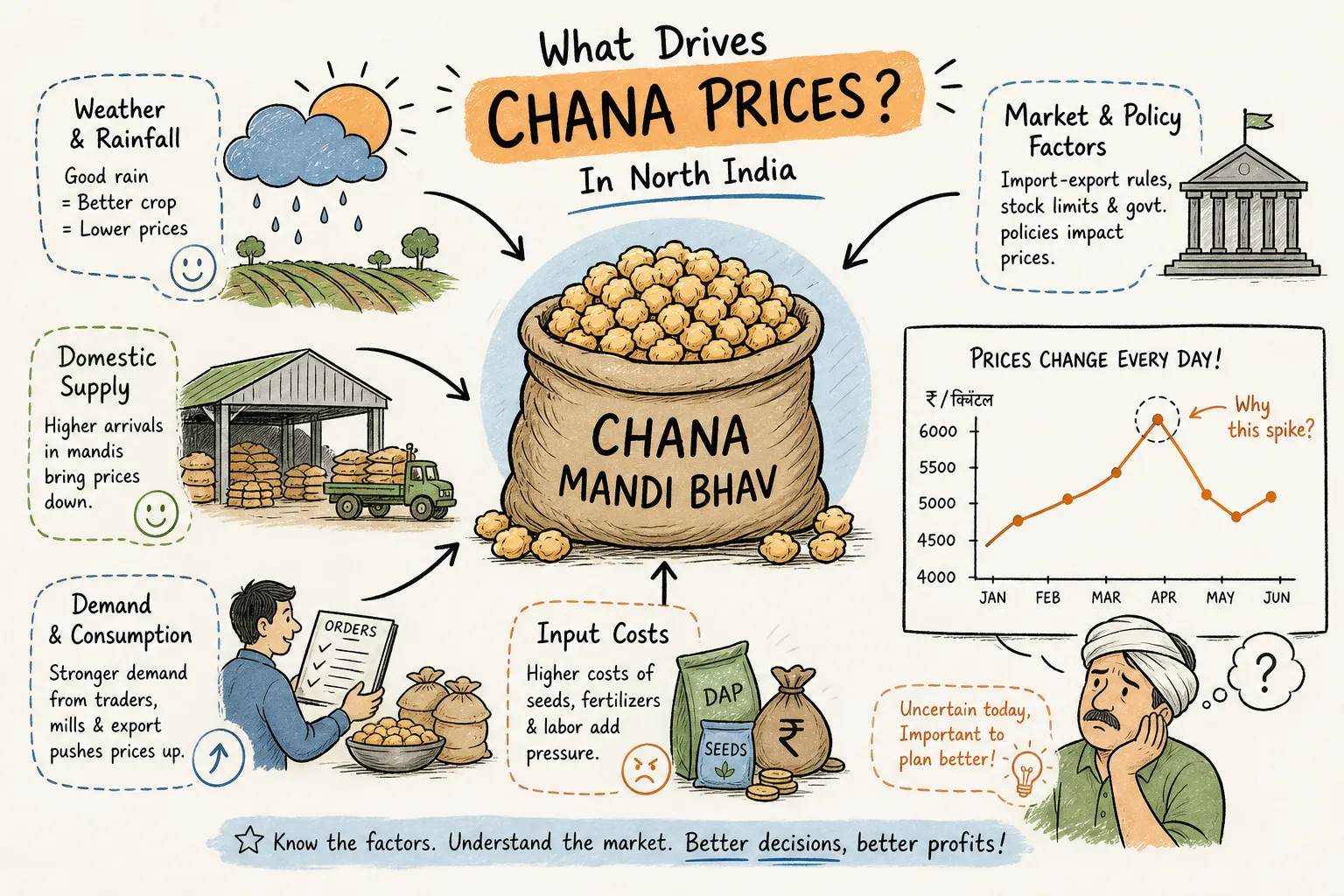
Why is chana price increasing or decreasing in India this season? Desi chana is trading at ₹5,800 to ₹6,000 per quintal in most mandis right now, and kabuli chana has touched ₹7,700 per quintal at some Madhya Pradesh markets. Yet a kisan in Rajasthan was accepting ₹5,054 per quintal just a few months ago in April 2026. That swing of nearly ₹1,000 per quintal did not happen by accident. Six distinct forces are pulling chana (gram) prices up or down simultaneously this season, and understanding each one is the difference between selling at the right moment and watching your per-quintal margin shrink at the mandi gate.
Farmers and traders across Rajasthan are increasingly tracking chana bhav (market price) across mandis like Sri Ganganagar and Nohar through online platforms before deciding whether to load the trolley that morning. Checking arrivals and auction rates together, rather than relying on word of mouth at the gate, is what separates a reactive seller from one who consistently captures better prices. This article breaks down every major driver behind this season's chana price movement, and why chana prices are rising or falling in India this season, so you can apply the same discipline to your selling decisions.
Before diving into the drivers, here is the current season snapshot at a glance.
| Desi chana MSP (2026-27) | ₹5,875/quintal (up ₹225 from last season) |
|---|---|
| Season arrivals (Jan, Sep 2026) | 19.93 lakh tonnes, down 11% year on year |
| Crop area (2025-26) | 9.59 million hectares, up 5.1% |
| Estimated production (2025-26) | ~11.5 MT vs ~12.1 MT last season |
| Price stabilisation buffer | 10 lakh tonnes; 3 lakh tonnes released under Bharat Chana Dal scheme |
| Import duty on desi chana | 10% reimposed April 2025 (was duty-free) |
 Table of Contents
- Where chana bhav stands this season: prices across major mandis
- Why is chana price increasing or decreasing in India this season: monsoon and arrivals
- Arrival volumes: the single most reliable signal for chana price trends in India
- MSP and government procurement: the floor that protects the chana farmer
- How MSP and import duty explain why chana price is increasing or decreasing in India this season
- Dal mill demand and the consumer side: what drives prices between seasons
- How to act on these price signals: a practical guide for kisans and traders
- Track all six drivers together, not any one in isolation
- FAQs
Where chana bhav stands this season: prices across major mandis
Before explaining why chana prices are rising or falling in India this season, it helps to anchor the analysis in real numbers from the ground. The desi chana mandi rate in most major markets currently sits between ₹5,800 and ₹6,000 per quintal, while kabuli chana is considerably higher at ₹7,000 to ₹7,700 per quintal. These are wholesale auction rates, not retail estimates.
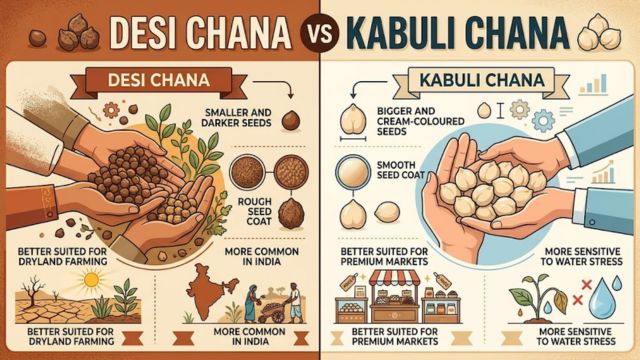
Desi chana vs kabuli chana: understanding the price gap
Desi chana, also called Bengal gram, is the raw material of choice for dal mills across the country. It has a large domestic production base, which keeps supply relatively higher and gram prices in India lower than its counterpart. Kabuli chana, by contrast, has a narrower supply base, is used predominantly in value-added food products, restaurants, and export markets, and commands a consistent premium. That structural difference explains why the two varieties price so differently in the same mandi on the same day, and is central to understanding chickpea price trends in India more broadly.
| Mandi (Madhya Pradesh) | Desi Chana Rate (₹/quintal) |
|---|---|
| Harda APMC | ₹6,458 |
| Kareli APMC | ₹6,200 |
| Khurai APMC | ₹6,101 |
| Ganjbasoda APMC | ₹6,000 |
State-wise mandi snapshot for this season
Madhya Pradesh leads the price picture this season, with a statewide median of ₹6,004 per quintal for desi chana and ₹7,210 per quintal for kabuli chana across 94 APMC markets as of 18 September 2026. Rajasthan saw chana rates at ₹5,054 per quintal in April 2026, though prices have firmed since then. Complete statewide data for Maharashtra and Uttar Pradesh is not fully available in current reporting, which itself limits precise intra-state comparisons; monitoring local mandis for early signs of supply pressure or price divergence remains the practical workaround. Rajasthan buyers often react within one to two weeks when MP arrivals shift sharply, so watching the MP arrivals curve is as useful as watching your own district's rates.
Why is chana price increasing or decreasing in India this season: monsoon and arrivals
Supply shocks rarely stem from production estimates alone. Weather-related quality damage often matters more to mandi rates than raw output figures, because buyers discount damaged lots heavily and good-quality chana commands a visible premium at the auction yard. Chana price volatility this season has been driven as much by what happened in the fields as by what any policy notification said.
Rainfall damage to crop quality and yield
Unseasonal rains near harvest time this season caused discolouration, moisture-related grain damage, and inconsistent seed size across parts of Rajasthan, Madhya Pradesh, and Maharashtra. Skymet's April 2026 forecast estimated a 5% to 10% yield loss in affected Alwar areas due to rain and thundershowers. The impact on mandi prices is direct: when a significant portion of arriving chana carries moisture or surface damage, buyers offer lower rates per quintal for those lots, widening the gap between good-quality and average-quality arrivals at the same mandi on the same day. Industry observers consistently note that clean, dry chana commands a meaningful premium over moisture-damaged stock at APMC auction yards, the differential typically reflects the cost a miller must absorb to process or re-dry damaged grain before use.
Area up but production slightly lower: what the official estimates say
Crop area for 2025-26 reached 9.59 million hectares, up 5.1% from last season. Despite more land under chana cultivation, estimated production at 11.5 million tonnes fell short of the previous season's approximately 12.1 million tonnes. This gap between area and production points clearly to yield drag caused partly by weather stress. More area planted does not automatically mean more chana reaching the mandi, especially when moisture stress or untimely rain cuts into yield per hectare. This is one of the primary reasons chana arrivals and stocks have been lower this season than many traders anticipated based on the sowing area reports from November 2025.
Arrival volumes: the single most reliable signal for chana price trends in India
Production estimates and policy announcements take weeks to filter into price action. Arrival volumes, the quantity of chana physically reaching APMC auction yards each day, reflect the real-time supply-demand balance at the mandi level. When you check arrivals, you are looking at the most immediate leading indicator of where the chana bhav is headed.
Reading the arrivals curve for this season
Total arrivals from January to September 2026 came in at 19.93 lakh tonnes, down 11% year on year. In April 2026, weekly arrivals dropped 27.6% week on week, a sharp seasonal tapering. By June, fortnightly arrivals were running at 1.33 lakh tonnes against 1.76 lakh tonnes in the comparable May period. This declining trend in chana arrivals and stocks matters because when fewer quintals land at the auction yard each day, buyers compete more aggressively for available supply and prices firm up. The inverse is equally true: a sudden rise in arrivals from one or more large producing states puts immediate downward pressure on rates.
Why state-wise arrivals diverge and how to use that information
Madhya Pradesh and Maharashtra remained the largest contributors to arrivals this season, while Rajasthan's volumes showed a measurable decline. When a major producing state like MP records a sharp weekly drop in arrivals mid-season, prices at consuming-state mandis, including Rajasthan buying centres, tend to harden within one to two weeks. That lag window is where a trader or kisan can act: if arrivals in MP are clearly tapering, holding your Rajasthan stock for another fortnight is often worth more than an immediate sale at today's rate. Conversely, if MP arrivals surge, selling promptly is the more prudent choice before the price softens at your local mandi.
MSP and government procurement: the floor that protects the chana farmer
The minimum support price sets the psychological and practical lower boundary for chana rates every season. Understanding how MSP and import duty together explain why chana price is increasing or decreasing in India this season is as important as knowing the announced number itself.
MSP hike to ₹5,875/quintal and what it means for mandi rates
The government raised the MSP for desi chana to ₹5,875 per quintal for 2026-27, an increase of ₹225 over the previous season's ₹5,650. This hike matters for two reasons. First, it raises the floor below which government procurement agencies will actively step in and buy, preventing mandi rates from collapsing during peak arrival months. Second, it shifts the reference point for farmer cost calculations upward, meaning farmers planting next season's crop will factor in this higher floor when deciding how much chana area to sow. When open market chana bhav at a mandi slips close to the MSP level, agency buying activity stabilises or lifts prices because supply is absorbed before it can depress rates further.
Procurement approvals and their effect on mandi sentiment
The Centre approved procurement of 2.8 million tonnes of chana under the price support scheme this season, covering Rajasthan, Madhya Pradesh, Maharashtra, and Gujarat. A separate approval covers 2.3 million tonnes specifically for buffer replenishment. These numbers shape market sentiment even before procurement begins, because traders know agencies will absorb a significant share of available supply. Beyond that, the government is processing 3 lakh tonnes of chana from the price stabilisation buffer into Bharat Chana Dal for consumer sale, which draws down buffer stocks and reduces the inventory overhang that would otherwise push wholesale prices lower.
The current total chana buffer stands at 10 lakh tonnes, a level large enough to influence market expectations if released quickly. The Bharat Chana Dal distribution channel processes this stock separately from open-market auction yards, which means its direct effect on wholesale mandi rates is more muted than many farmers assume. Steady retail offtake does, however, keep the dal mill and wholesale buyer pipeline active throughout the season.
How MSP and import duty explain why chana price is increasing or decreasing in India this season
Trade policy is often the fastest-moving variable in the chana price equation. A single duty notification can alter the effective supply base overnight, and this season saw exactly that kind of shift, one that interacts directly with the MSP floor to set the band within which desi chana mandi rates are currently operating.
The duty-free import window and why the government closed it
Until April 2025, the government had permitted duty-free imports of desi chana to supplement domestic supply and keep retail dal prices in check after a period of elevated consumer prices. In April 2025, a 10% import duty on desi chana was reimposed. This effectively raised the landed cost of imported gram and made it significantly less competitive against domestic produce. The structural effect was immediate: the supplementary supply that importers had been providing to the market was sharply reduced, leaving domestic mandis as the primary source of supply.
How reimposing the import duty affects chana mandi bhav
With import competition reduced, domestic stocks now meet demand without an external buffer. Traders and dal mills that had been waiting for cheaper imported supplies turned to domestic mandis more aggressively, lifting buying volumes and supporting prices. This is one structural reason why desi chana is holding at ₹5,800 to ₹6,000 per quintal despite lower production this season, rather than falling sharply as it might have during the earlier duty-free window. The landed cost of imported desi chana under the current 10% duty structure works out to approximately ₹6,050 to ₹6,200 per quintal from a CIF of ₹5,500 to ₹5,650 per quintal, which keeps domestic chana competitive rather than undercut. For farmers tracking chana bhav, any future reversal of this duty is a clear bearish signal worth monitoring immediately.
Dal mill demand and the consumer side: what drives prices between seasons
Most farmers focus on supply drivers. Demand-side dynamics, particularly dal mill procurement cycles and buffer stock management, are equally important and often more predictable as a timing tool.
How dal mill procurement cycles push and pull chana prices
Dal mills in major consumption centres such as Maharashtra, Gujarat, and Uttar Pradesh buy chana in bulk at the start of the processing season, creating a demand surge that typically lifts mandi bhav over a short period. Industry seasonality data consistently shows this pattern, though the precise uplift varies by season and location. When mills have covered their near-term requirements and are running at capacity, incremental buying slows and prices soften. The seasonal rhythm is fairly consistent: the December to March window sees peak dal-processing activity coinciding with new-crop arrivals, western mills absorb a significant portion of supply, and North India mandi prices are supported by that buying pull. Mid-season, when mills pause to process existing inventory, spot demand weakens and prices can drift lower even without a corresponding increase in arrivals.
Buffer stock releases and the Bharat Chana Dal effect on retail prices
The government's release of 3 lakh tonnes from the price stabilisation buffer through the Bharat Chana Dal programme is intended to cap retail dal prices for consumers. The direct effect on wholesale mandi rates is more indirect than many farmers assume: buffer chana is processed and distributed through government scheme channels rather than landing at the same auction yards where a Rajasthan kisan brings his fasal. However, by keeping retail prices stable, the scheme prevents consumers from switching to cheaper substitute pulses in large numbers. This sustained retail demand feeds back into steady offtake from mandis, which means the dal mill and wholesale buyer pipeline remains active rather than slowing sharply. For the farmer, stable consumer demand at the retail end translates into relatively steady wholesale demand at the mandi level throughout the season.
How to act on these price signals: a practical guide for kisans and traders
Understanding why chana prices are rising or falling in India this season is only useful if it leads to a concrete decision. Here is how to combine the signals from this season's data into a practical framework before you load your chana onto a trolley.
Key indicators to check before you sell your chana this season
Before every selling decision, three data points deserve your attention. Check weekly arrival volumes for your state and for Madhya Pradesh, arrivals data is available through APMC reports and platforms such as KhetiKisaan. Compare the current mandi bhav against the MSP of ₹5,875 per quintal; a comfortable margin above MSP generally supports a hold decision. Finally, scan for any import policy or procurement news from the past two weeks. If arrivals are falling, prices are above MSP by a meaningful margin, and no new duty-free import window has been announced, conditions support holding stock for a better rate. If arrivals are rising sharply or a policy reversal is signalled in government notifications, selling promptly is the more conservative and defensible choice.
Using daily chana mandi bhav from Sri Ganganagar and Nohar to time your sale
For farmers in Rajasthan, the daily auction rates at Sri Ganganagar and Nohar are the most relevant price benchmarks. KhetiKisaan publishes verified desi and kabuli chana mandi rates from these APMC markets daily, sourced through on-ground contacts present at live bidding sessions rather than delayed government feed averages. The key habit to build is tracking the rate across three to five consecutive days before acting on a single day's number. A steady upward trend with declining arrivals is a hold signal. A flat or falling rate with rising arrivals signals that moving stock promptly will protect your margin better than waiting for a price that may not come.
When to store, when to sell, and when to hedge using futures
Short-term storage of two to four weeks is worth considering if the open market chana bhav sits comfortably above your cost of production, arrivals are visibly tightening, and you have access to a clean, dry warehouse. Beyond that window, quality degradation risk and carrying costs reduce the effective advantage of holding. Larger traders can use NCDEX & MCX chana futures as a partial hedge against price falls on physical stock, locking in a portion of margin while keeping the option to sell the balance at spot rates if prices improve, though margin requirements and contract liquidity should be reviewed carefully before entering any futures position. For small farmers, the simpler and more reliable rule is: sell when the mandi bhav is comfortably above your production cost and when arrivals are clearly falling. Trying to time the seasonal top is a game that costs more in missed opportunities than it gains in occasional perfect timing.
Track all six drivers together, not any one in isolation
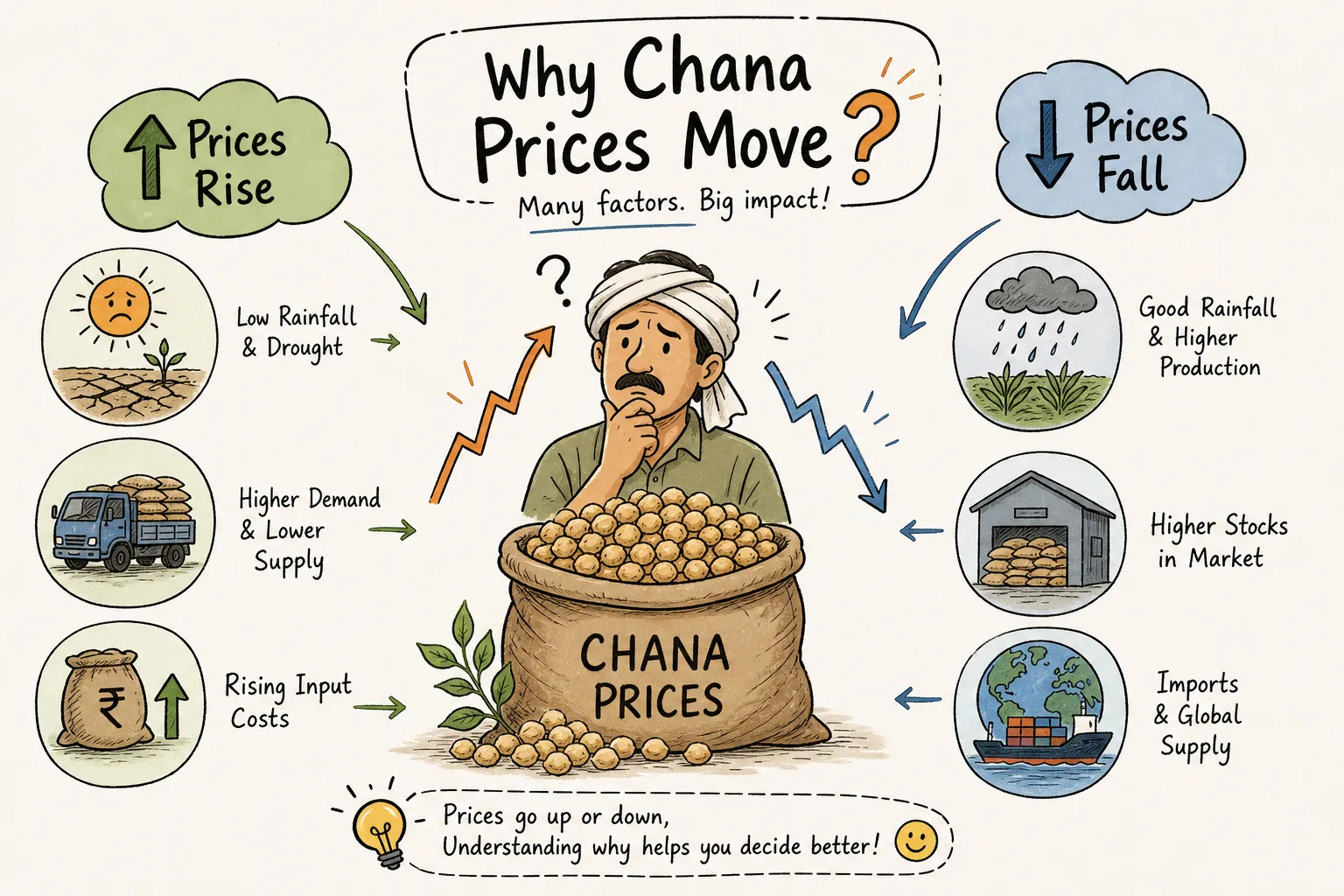
Why is chana price increasing or decreasing in India this season? The answer lies in six forces working simultaneously: arrival volumes, crop quality from unseasonal weather, area and production estimates, MSP and procurement policy, import duty status, and dal mill demand cycles. No single factor is driving chana price volatility on its own. It is the combination and direction of all six that tells you whether the market is tightening or softening at any given point in the season.
The practical sequence is straightforward. Check daily arrivals and chana mandi bhav first. Compare the current rate against the MSP of ₹5,875 per quintal. Then factor in the policy environment: is procurement active in your state, and has the import duty situation changed? If all three signals point in the same direction, your selling decision becomes much clearer and less dependent on guesswork or advice from a commission agent whose interests may not align with yours.
Make chana bhav tracking a daily habit before the fasal season closes, not a last-minute scramble the morning you are ready to go to the mandi. Platforms like KhetiKisaan update verified chana rates from Rajasthan mandis daily, using that data before you load the trolley is the simplest way to act on timing rather than urgency.