Trusted Source for Mandi Bhav Updates






Select Mandi
Trusted Source for Mandi Bhav Updates
Select Mandi

 Sep 14, 2026
 by Pankaj Sihag



Chana Mandi Bhav: What Drives Prices in North India
| Factor | Key Detail |
|---|---|
| Crop type | Rabi pulse; sown October, November; harvested February, March |
| Peak mandi arrivals | March, April; prices typically at seasonal lows during this window |
| MSP for 2026-27 rabi season | ₹5,875 per quintal (up ₹225 from 2025-26 season) |
| Futures correlation with spot | NCDEX chana futures show 81, 98% historical correlation with mandi spot prices (based on commodity-market studies covering FY05, FY14; MCX correlation broadly similar) |
| Top procurement agencies | NAFED and NCCF under MSP operations |
| Key North India mandis | Major mandis often cited include Bikaner, Jaipur, Sri Ganganagar, Hanumangarh (Rajasthan) and Kanpur (UP) |
| Primary demand drivers | Dal mill offtake, besan demand, festival consumption |
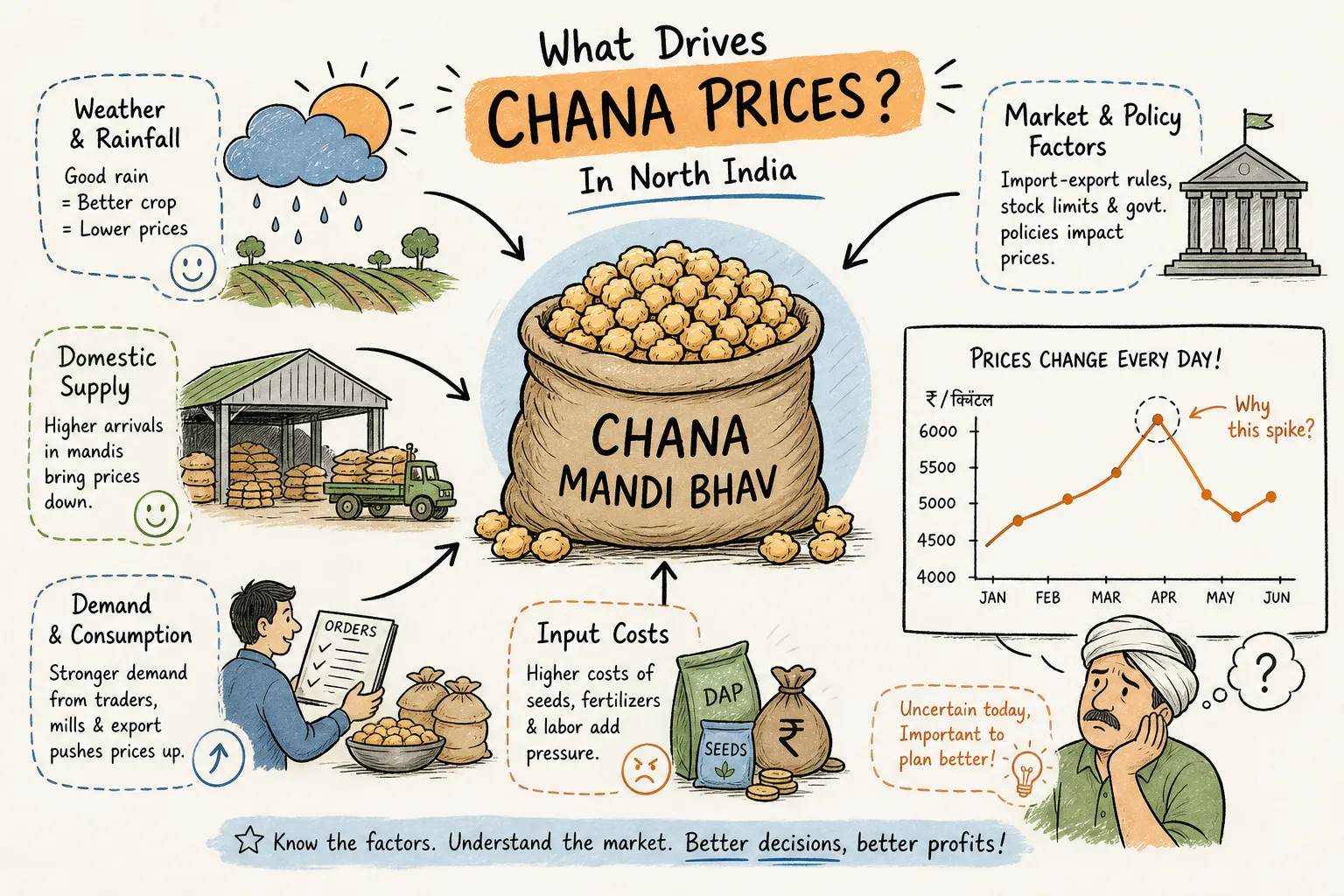
Chana (gram) is one of the most actively traded rabi pulses across North India, and its mandi bhav can swing by several hundred rupees per quintal within a single fortnight. Farmers in Rajasthan, Madhya Pradesh, and Uttar Pradesh who grow chana often watch these numbers daily, but watching a price without understanding why it moved is like driving without a map. The number alone tells you nothing about what comes next. If you have ever asked yourself what factors affect chana mandi bhav in North India, this article gives you the complete answer.
The real skill is connecting price movements to the forces driving them. Is today's bhav soft because arrivals surged overnight? Is it firm because NAFED began MSP procurement in your district? Did a policy announcement on import duties just shift the floor? Each of these drivers works differently, operates on a different timeline, and calls for a different response from the kisaan (farmer). Once you understand all six drivers together, you can move from reacting to individual price quotes to planning your sales around the actual signals that matter.
KhetiKisaan tracks daily chana mandi rates from live APMC auction yards across North India, covering the actual bol-chaal (bidding) rather than delayed government feeds. This article explains the six core factors that drive chana mandi bhav: arrivals and stocks, weather and sowing, MSP policy, buffer and trade policy, demand-side forces, and MCX futures. By the end, you will also have three practical steps to apply this knowledge at your own mandi.
 Table of Contents
The most immediate driver of chana mandi bhav on any given day is straightforward: how much chana is physically arriving at the APMC yard, and how much stock traders already hold locally. Everything else, policy, weather, futures, ultimately flows through this real-time supply picture on the mandi floor.
Chana is a rabi crop, harvested in February, March and arriving at mandis in volume through March and April. During this peak-arrival window, buyers at the APMC yard have more lots to evaluate, bidding competition softens, and modal prices typically fall. The rule is straightforward: more arrivals, softer bhav; fewer arrivals, firmer bhav. Heavy arrival days within the same region can produce noticeably different chana mandi bhav at neighbouring yards on the very same date, because local inflow, buyer turnout, moisture content, and grade quality all vary from yard to yard.
This day-to-day volatility is the reason mandi prices are not a smooth trend line. They reflect real physical supply hitting the trading floor every morning. A kisaan in Hanumangarh and another in Sri Ganganagar may hear very different rates on the same afternoon because each yard is responding to what arrived that morning, not to a national average.
From July onward, fresh arrivals drop sharply. Stocks held by traders and dal processors begin tightening, and buyers have to compete more aggressively to secure supply. This is when chana bhav typically finds support or starts trending upward. The dynamic is not complicated, but many farmers miss it because they stop monitoring prices after selling their harvest.
The practical lesson is to watch arrival data alongside price quotes, not price alone. A rate of ₹6,200 per quintal means something very different if 10,000 bags arrived at the mandi today versus 2,000. KhetiKisaan's ground-level coverage from live APMC auctions captures exactly this combination: the bhav and the market context behind it.
Rainfall and agronomic data influence chana prices months before the crop reaches the mandi. Farmers and traders who read these signals early can position themselves ahead of the market, rather than reacting to price moves after the fact.
Deficient southwest monsoon rainfall between June and September affects soil moisture going into the rabi sowing season. Lower moisture levels reduce the area that farmers sow under chana, signalling less future supply. Traders price this expectation into mandi bhav well before harvest, because the market is always forward-looking. Historically, deficient rainfall linked to tighter pulse supply has driven firmer chana prices across major North India mandis.
Higher sowing area, on the other hand, signals more supply and can soften prices. Reports from state agriculture departments on acreage progress are closely watched by large traders and dal millers, who adjust their buying strategies based on whether the crop looks large or small before it matures.
Here is the scenario that catches many farmers off guard. Sowing numbers looked strong, acreage was healthy, and the pre-harvest outlook was bearish for prices. Then, untimely or excessive rain in February, March damages standing chana during crop maturity, reduces yield, and worsens quality grades. Markets respond by pushing prices upward, even though early-season data pointed the other way.
Watch both pre-sowing forecasts and late-season weather advisories. The two can point in completely opposite directions. A farmer who locked in a forward sale based on large acreage alone, without tracking late-season crop-condition reports, can end up selling below what the open market later offers. Weather is not just a pre-sowing variable; it matters right up to harvest.
The Minimum Support Price (MSP) for chana is one of the most discussed numbers in the pulse market, yet one of the most misunderstood in terms of what it actually does to your mandi bhav. Getting this distinction right matters directly to your selling decision.
MSP is a reference price, not a guaranteed market price. For 2026-27, the government set chana MSP at ₹5,875 per quintal. But if government procurement is delayed, limited in volume, or absent at your nearest mandi, open-market arrivals pile up and bhav can slip below MSP, especially when dal mill demand is also running slow. This has happened in multiple seasons: heavy March, April arrivals with sluggish procurement pushed mandi rates below the announced MSP in several North India yards.
Farmers who understand this plan their storage and selling windows accordingly. Holding stock in the hope that the open market will match MSP on its own, without active procurement in your district, is a risky strategy. The MSP is a policy signal; procurement is what actually moves prices.
When NAFED or NCCF begins buying at MSP, it removes a significant portion of supply from the open market. Traders, knowing fewer lots remain available, stop pushing bids down. This creates a floor-like effect during peak arrivals, the very period when prices are most vulnerable. Available market reports indicate that NAFED and NCCF together procured roughly 2 lakh tonnes of chana in each of the 2024-25 and 2025-26 seasons, enough volume to meaningfully tighten the open-market supply picture, though final season totals are subject to revision as procurement data is consolidated.
The reverse scenario is equally important. When buffer stocks are already adequate and open-market prices are above MSP, farmers prefer selling in the open market rather than to agencies. Procurement slows, fewer lots are absorbed by the government, and the dynamic near the season's peak shifts. Track when your district's procurement centres open each season. That date is often the single most important event for your selling strategy.
Government policy reaches beyond MSP procurement. Three additional levers directly shift the domestic supply-demand balance for chana: buffer-stock targets, import duties on chickpeas and competing pulses, and export restrictions. All three can move chana mandi bhav within days of a policy announcement.
Buffer-stock operations run throughout the year, not just at harvest. The government builds reserves to meet welfare scheme distribution and price-stabilisation needs across seasons. When agencies are actively building buffers, they absorb a consistent chunk of domestic supply, which prevents sharp price falls even after heavy-arrival months. When buffers are already well-stocked, buying slows and the open market must absorb more supply on its own, softening prices in the process.
The practical point is that buffer-stock policy creates an ongoing demand signal in the market, separate from MSP procurement at harvest. A trader or large farmer who tracks procurement tender announcements throughout the year gains a meaningful informational edge. Someone who only watches daily bhav does not have that advantage.
Import duty changes on chickpeas and competing pulses directly affect how much competition domestic chana faces from imported product. As of 2026, the import duty on Kabuli chana sits at around 11% (10% Basic Customs Duty plus 1% Social Welfare Surcharge), while yellow peas carry a 30% duty. Note that applicable notifications, IGST, and preferential trade routes can alter effective duty rates for specific consignments. When import duties fall, cheaper imported pulses enter the market and cap domestic chana prices. When duties rise, the import route becomes less competitive and domestic prices firm up.
Export restrictions work in the opposite direction. When the government restricts or bans chana exports, domestic supply cannot move into global markets. More chana stays inside India, competition among sellers increases, and bhav comes under pressure. When export windows open, domestic prices often firm up because supply now has two outlets rather than one. These policy announcements can shift factors affecting chana prices in North India within days of notification, which is why platforms that report mandi rates alongside policy news are more useful than those that only track numbers.
Supply factors determine the ceiling for chana mandi bhav. Demand factors determine whether prices hold at that ceiling or collapse below it. The demand side of the chana market is driven primarily by dal mills, besan manufacturers, festival consumption cycles, and competition from other pulses.
Dal mills and besan manufacturers are the single largest category of buyers at APMC yards during chana auctions. When their margins are healthy and retail orders are strong, mills buy aggressively, absorbing arrivals and keeping bhav supported. When mill margins are squeezed, either because chana prices are high relative to the selling price of chana dal, or because retail demand is slow, mill offtake drops sharply. This leaves more lots unsold on the trading floor, softening prices even when supply has not actually increased.
Weak mill offtake is one of the clearest near-term price-pressure signals in the chana market. You do not need to visit a mill to gauge this; you can see it in the proportion of lots passing without buyers at the morning auction. When the same buyer who usually takes 50 bags is taking 20, the signal is already there.
Seasonal retail demand creates predictable pockets of support for chana prices. Festivals like Navratri, Diwali, and Ramzan typically boost chana dal and besan consumption, encouraging mill buying and firming bhav in the weeks before these periods. Traders often position ahead of these demand spikes, buying earlier and reducing open-market availability.
But there is a ceiling to this effect. When chana prices become significantly higher than tur, moong, urad, or imported yellow peas, households and processors substitute toward the cheaper option. Demand weakens even during peak consumption periods, and the price premium chana commands narrows. Traders track the price spread between chana and competing pulses as a live signal for how durable current demand actually is. If yellow peas are available at ₹1,000 per quintal cheaper than desi chana, mills already have a reason to switch, and they will.
Futures markets are not only for large traders and commodity funds. The MCX chana futures price is directly relevant to the bhav a kisaan in Rajasthan or Uttar Pradesh receives at a local APMC yard, because futures prices absorb new market information faster than physical mandis do.
Indian commodity-market studies show that MCX and NCDEX chana futures are cointegrated with North India spot mandi prices, meaning the two markets share a long-run relationship and consistently move together rather than diverging permanently. The historical spot-futures correlation for chana has been measured in the 81, 98% range in commodity-market research, with the strongest documented evidence referencing NCDEX data. Futures absorb new information, a policy announcement, a weather forecast, a crop-condition report, faster than physical mandis do, because traders across the country can react electronically within minutes.
The practical implication is that a directional move in MCX chana futures often gives mandi bhav a multi-day lead signal in the short run. Market studies have also found bidirectional causality between futures and spot returns: Jaipur mandi prices and NCDEX spot prices are positively associated with futures prices, and the two markets correct toward each other over time. Watching MCX chana futures alongside your local mandi rate gives you a combined signal that is far more reliable than either number alone.
The connection between global chickpea prices, from Australia, Canada, or Turkey, and North India mandi bhav is real but indirect. International prices act mainly through import parity calculations: when global chickpea prices fall and imported product becomes cost-competitive after duties, it puts background pressure on domestic chana bhav. This effect is slower and less consistent than the MCX-mandi link.
For a farmer in Rajasthan or Uttar Pradesh deciding whether to sell today or hold for a week, MCX futures are the more useful real-time signal. Global prices matter most when import duty structures change and a wave of cheaper imported pulse is about to land in Indian ports, exactly the kind of policy news that KhetiKisaan flags alongside its daily chana mandi bhav updates.
Understanding the six drivers above is only half the job. The other half is applying them to a clear decision-making process at your local mandi. The framework below combines the signals from arrivals, futures, and policy news into one practical approach to what drives chana mandi bhav in North India.
Step 1: Check daily arrival data at your nearest mandi. If arrivals are rising and MSP procurement has not yet started in your district, prices are likely to soften over the next few days. Hold only if your storage conditions are good, your chana quality is strong enough to avoid moisture damage, and you can absorb the storage cost. If arrivals are thin and stocks are tight, the market has natural support and there is less urgency to sell immediately.
Step 2: Check MCX chana futures direction. If futures are trending down over two or three consecutive sessions, mandi bhav usually follows within a few days. If futures are firming up, the open market tends to respond similarly. This does not require a trading account, futures prices are publicly available and update throughout the trading day.
Step 3: Watch for policy triggers. MSP procurement commencement in your district, import duty change notifications, and export restriction announcements are high-impact events that can move mandi bhav sharply in either direction within days. Combining all three signals, arrivals, futures, and policy news, is consistently more reliable than reacting to price quotes alone.
KhetiKisaan's network of on-ground contacts, physically present at live APMC auctions, gives farmers real-time chana mandi bhav sourced from the actual bol-chaal (bidding) rather than from delayed government feeds or estimated averages. This matters because a price valid at 10 AM in Bikaner may look very different from what Jaipur or Sri Ganganagar quoted by noon, based on buyer turnout and local arrivals in each yard.
By comparing chickpea mandi rates across multiple yards on the same day, you can quickly determine whether your local mandi's price reflects a genuine market move or simply a low-arrival anomaly that will correct tomorrow. That distinction alone can mean the difference between selling too early at a soft price and holding a few extra days for a firmer one. Knowing what factors affect chana mandi bhav in North India is step one; having live, verified data to act on is step two, and that is exactly what KhetiKisaan is built for.