








Gwar
Gwar: All Prices Are in Quintal
Description
To look at a gwar plant standing in a sandy Rajasthan field, you would not guess that its small, hard seeds end up in oil wells in Texas, ice cream factories in Germany, and pharmaceutical tablet presses in Japan. That gap between what gwar looks like and what it actually does in global industry is exactly why this crop deserves serious attention from every kisaan who grows it or plans to. This guide covers the full gwar crop description and explains what moves guar mandi bhav, so you can make sharper planting and selling decisions.
Gwar, or cluster bean, is one of Rajasthan's most important kharif fasal crops and a significant agricultural export earner for India. It is also one of the most volatile crops to trade because its mandi bhav responds not just to local monsoon rainfall but to crude oil prices, US drilling activity, and rupee-dollar exchange rates, all at the same time. Understanding why that happens is the key to making better decisions at every stage.
This article covers two things: first, what gwar is and how it is grown; second, what actually moves guar mandi bhav and how you can use that knowledge to sell smarter. Gwar seed prices at Rajasthan mandis shift daily with global events. Platforms such as KhetiKisaan publish guar mandi rates sourced from APMC auction floors in Rajasthan, always verify the rate source and timestamp before acting on any figure, since bhav can shift sharply within a single session.
Note: "Gwar" and "guar" refer to the same crop, Cyamopsis tetragonoloba. "Gwar" is the common Hindi name used in farming contexts; "guar" is the standard spelling used in trade and export documentation. Both terms appear throughout this article.
| Quick Facts | |
|---|---|
| Crop type | Kharif (rainfed) |
| Scientific name | Cyamopsis tetragonoloba |
| Primary state | Rajasthan (~80% of India's area) |
| Key product | Guar gum (galactomannan) |
| Top export destination | United States |
| Typical harvest window |
September, October |
What exactly is the gwar plant and why does it matter to Indian farmers?
Gwar (Hindi: गवार) is the common name for cluster bean; its scientific name is Cyamopsis tetragonoloba, and it belongs to the legume family. The plant is erect and bushy, typically reaching 60, 90 cm in height, and produces pods in clusters along its stem, which is how it earned the name "cluster bean." The part that makes gwar commercially extraordinary is not the pod but the seed endosperm: it contains a polysaccharide called galactomannan, which is the raw material for guar gum. For certain industrial uses, notably fracking, there is no widely available substitute at the same scale; in food and pharma, alternative hydrocolloids exist, but guar gum remains the preferred choice for cost and performance reasons.
It is worth clarifying one common confusion: the gwar grown industrially is not the same as the tender gwar phalli sabzi you buy at the vegetable market. Both come from the same species, but industrial selections are typically focused on seed yield and galactomannan content, rather than pod tenderness. A kisaan growing industrial gwar is essentially cultivating a chemical-grade raw material, not a vegetable.
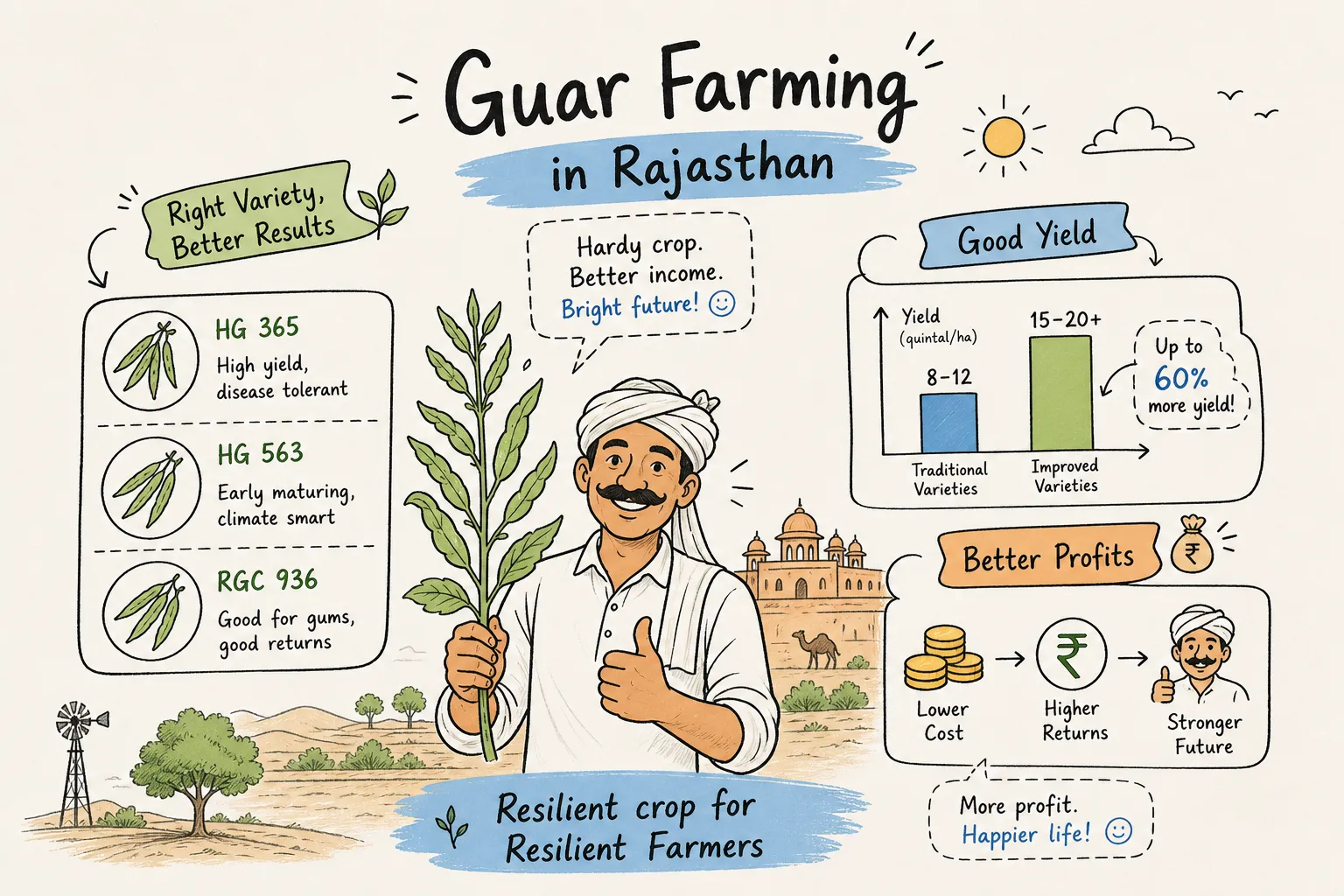
Beyond its industrial value, gwar offers real agronomic advantages that make it attractive as a rotation crop. It fixes atmospheric nitrogen into the soil, improving fertility for the next season's crop. It thrives on sandy loam soils and is tolerant of the low rainfall typical of western Rajasthan, generally performing well at temperatures between 25 and 35°C. This makes it perfectly suited to Rajasthan's arid belt, where other crops struggle to survive. Because guar gum faces limited substitution in several industrial applications, demand is relatively inelastic for certain uses, particularly fracking. Buyers cannot simply switch to another product when guar supply tightens. This inelasticity is what makes guar price swings sharper and faster than those for foodgrains like wheat or chana.
Where gwar grows in India and how the crop cycle works
Rajasthan accounts for roughly 80% of India's guar cultivation area and around 77% of total seed production. Haryana and Gujarat are the next significant producers, but their combined contribution remains well below Rajasthan's dominant share. The key districts include Sri Ganganagar, Hanumangarh, Bikaner, Churu, Nagaur, and Barmer, the same names you will find on the most actively traded mandi lists for guar seed across the state.
Western Rajasthan suits gwar so well because the crop is built for exactly the conditions this region offers: low and erratic rainfall, sandy soils, and long dry spells after flowering that actually aid seed setting. A crop that needs more reliable moisture simply would not survive here; gwar thrives precisely because it does not. Production can swing 20, 25% from one season to the next based purely on how the monsoon performs across these districts, a major driver of price volatility.
The cultivation timeline follows a clear seasonal pattern. Sowing happens in June, July, ideally timed to the first good monsoon showers; delayed sowing reduces seed yield significantly. The crop goes through its vegetative phase in July, August, when it needs at least two to three good rainfalls. Pod setting and seed maturity happen in August, September, and excess rainfall during this stage can damage seed quality even if the earlier rains were ideal. Harvest runs from September through October, with threshing, cleaning, and bagging following before the crop reaches the mandi.
Under rainfed conditions, yields vary considerably depending on monsoon adequacy and farm management, official state-level averages have ranged widely across seasons, with some Rajasthan district averages falling well below 600 kg per hectare in drought years. In a good monsoon year, well-managed plots in better districts can push considerably higher. This yield variability, driven almost entirely by monsoon behaviour, is one of the primary reasons guar mandi bhav moves so sharply from year to year.
From gwar seed to guar gum: the value chain explained
Understanding how raw gwar seed becomes the guar gum that global industries buy helps explain why mandi bhav behaves the way it does. The seed has three distinct parts: the outer hull (husk), the germ (embryo), and the endosperm, which holds the galactomannan. Processing involves de-hulling the seed, splitting it to separate the endosperm from the germ, and then grinding the endosperm into guar gum powder. The by-product of this process is guar meal, a protein-rich animal feed that has its own market value and partially offsets processing costs.
The Jodhpur and Bikaner districts host one of the world's largest and most concentrated clusters of guar gum processing units. Raw gwar seed is procured directly from mandis in surrounding districts, processed at these factories, and then exported as gum powder or specialised derivatives. This geographic concentration means that the procurement decisions of a handful of large processors in the Jodhpur belt can move gwar seed prices across all Rajasthan mandis within days.
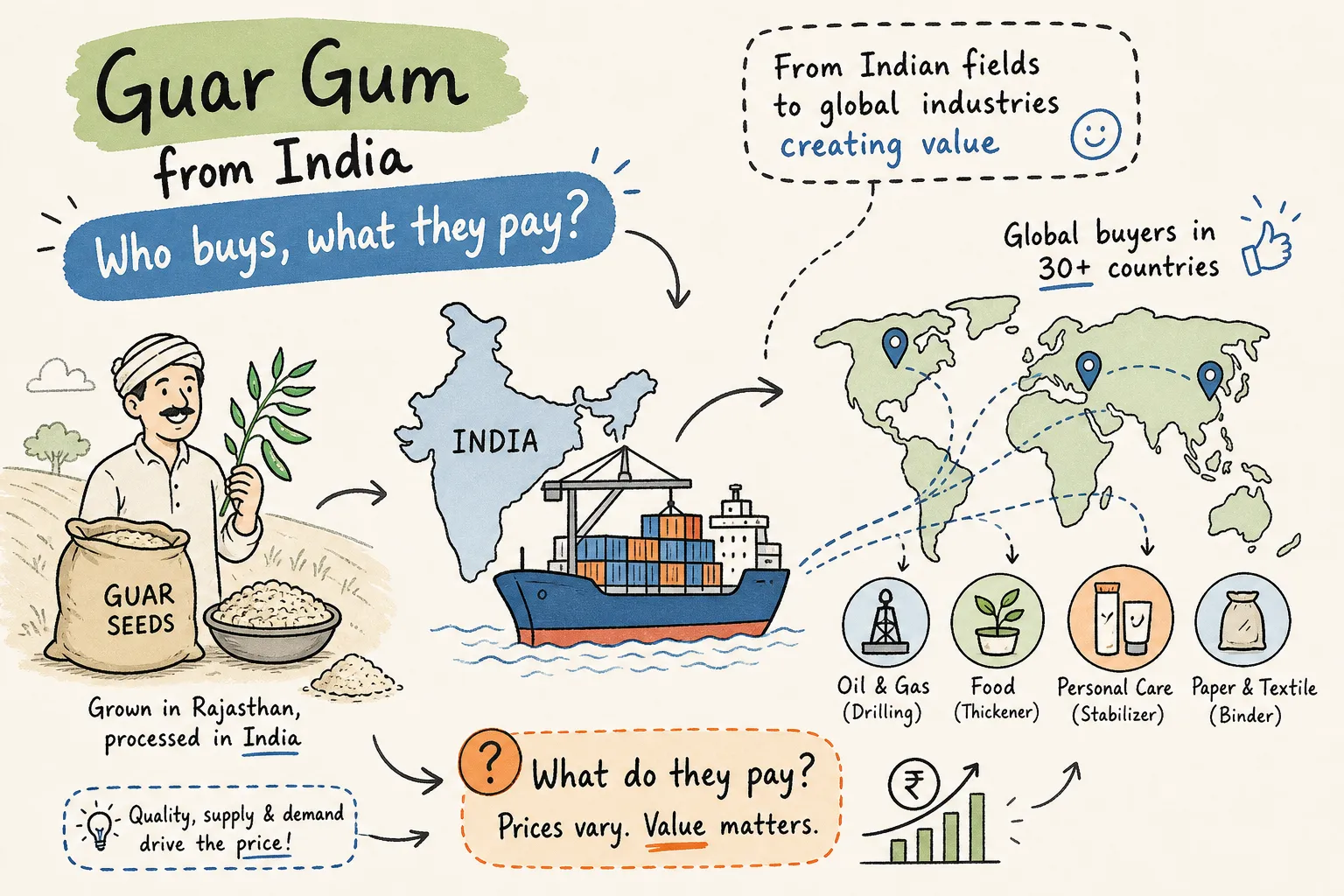
Roughly 90% of guar gum processed in India is exported, and the export price is quoted in US dollars. This is a critical point for every gwar-growing kisaan to understand: the price you receive at your local mandi is ultimately shaped by what a buyer in Houston or Rotterdam is willing to pay in USD, converted through the current rupee-dollar exchange rate. A weaker rupee makes Indian guar gum cheaper for foreign buyers and lifts mandi bhav; a stronger rupee does the opposite. This global-local linkage is what makes guar mandi bhav far more complex than the bhav for, say, bajra or moong.
Global industries that run on guar gum and why this matters for guar mandi bhav
The single biggest demand driver for guar gum is the oil and gas drilling industry, specifically hydraulic fracturing or "fracking." Guar gum is used as an essential thickener in fracking fluids that are pumped underground at high pressure to crack open shale rock and release trapped oil or gas. There is no widely available substitute that performs as well at the scale the US shale industry operates. When shale drilling activity in the US rises, American oilfield-service companies place large orders with Indian guar gum processors, who then bid more aggressively for seed at Rajasthan mandis. The bhav posted at Sri Ganganagar or Nohar on a given morning partly reflects what happened at US drilling sites the previous month.
The US shale oil boom between 2011 and 2013 pushed gwar seed prices in Rajasthan mandis to record highs that shocked the farming community. When shale activity subsequently slowed and then collapsed during the 2020 oil price crash, prices corrected with equal sharpness. This means a kisaan in Hanumangarh is indirectly exposed to crude oil prices and US drilling rig counts, a fact experienced mandi traders track carefully but many individual farmers do not.
The food, pharmaceutical, and other industrial sectors provide a more stable demand base. In the food industry, guar gum is an approved low-calorie thickener and stabiliser used in ice cream, baked goods, dairy products, sauces, and gluten-free foods across the EU, US, and India, and this demand grows steadily each year. In pharmaceuticals, it serves as a binder and disintegrant in tablet manufacturing and as an active ingredient in laxative products. Textile sizing, paper manufacturing, cosmetics, and water treatment chemicals round out the demand picture. These sectors collectively create a demand floor that prevents guar prices from collapsing entirely even when oil-sector demand weakens.
The seasonal price cycle every gwar farmer should understand
Gwar mandi bhav follows a broadly predictable seasonal pattern that repeats year after year, and understanding it can directly improve your munafa (profit). Peak arrivals at Rajasthan mandis happen between October and December, when the freshly harvested crop floods into the market. When large volumes arrive simultaneously, buyers have every advantage: they can be selective, move slowly, and let sellers compete against each other. Historical Rajasthan mandi data indicates gwar prices can run below the annual average in September, when early arrivals begin and trader sentiment is cautious. Farmers who sell immediately after harvest, without checking arrival volumes and export order status, regularly leave money on the table.
From January onward, the situation tends to shift in the seller's favour. Arrivals slow significantly as market stocks are absorbed, processing units draw down mandi purchases, and export orders for the next quarter begin materialising. Rajasthan mandi rates for gwar seed have historically recovered to above the annual average by March, April, partly because export-linked buying pressure builds through the first quarter of the calendar year. The practical implication is straightforward: if your storage facility and cash flow allow it, holding a portion of your gwar stock through January and selling in February, March has historically yielded meaningfully better guar mandi bhav than distress-selling during peak arrivals.
This does not mean you should always hold stock. The decision to hold or sell must be made with current information: live export order status, actual arrival volumes at your target mandi, and rupee-dollar movement. The seasonal pattern provides the historical framework; live mandi bhav data tells you whether that pattern is playing out normally in a given year or being disrupted by an external shock, such as a sudden change in US drilling activity or a policy change from DGFT.
What affects guar mandi bhav: key factors explained one by one
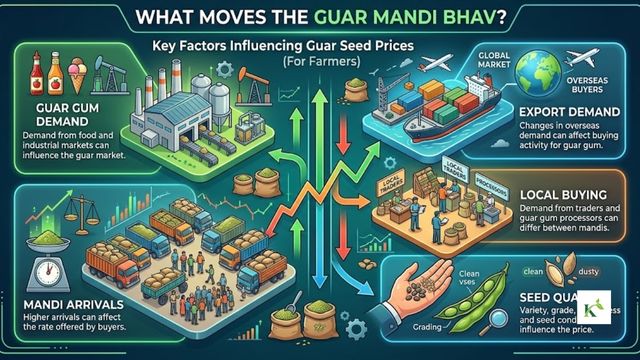
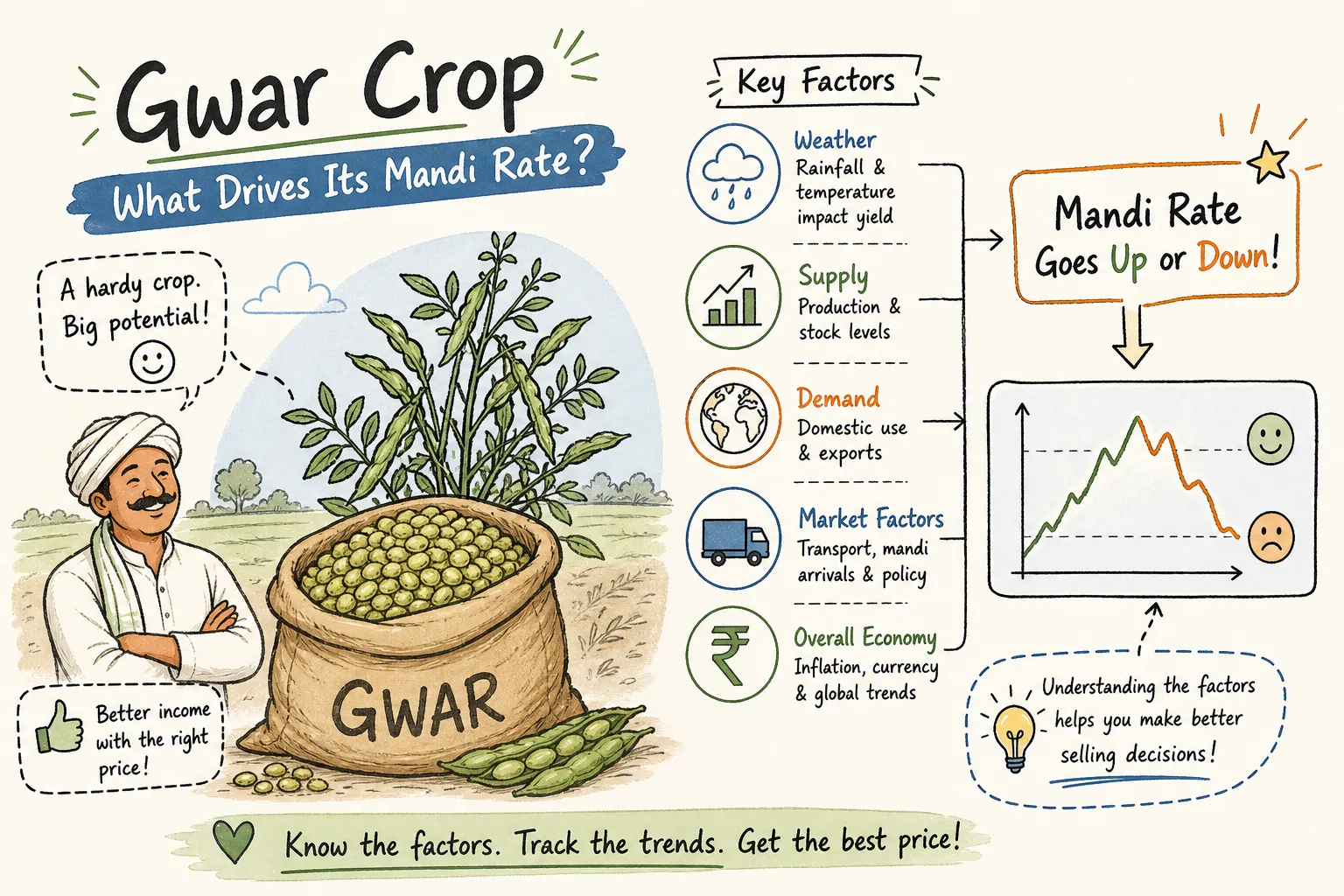
Gwar mandi bhav is shaped by several overlapping forces. Understanding each one helps you read the market rather than just react to it. The five main drivers are US shale drilling activity, monsoon rainfall and sowing acreage, export demand and rupee-dollar movement, mandi stock levels, and government policy. Here is how each works.
US shale oil drilling activity is the single most powerful external driver. Track the weekly Baker Hughes US rig count as a leading indicator of guar gum export demand from American oilfield-service companies. When rig counts fall, as happened during the 2020 oil crash and again during tariff-related uncertainty in early 2026, Indian guar gum exporters defer or cancel purchase orders, and mandi bhav for seed softens within weeks. The relationship is not perfectly linear because other factors also operate simultaneously, but sustained multi-week moves in rig counts consistently precede direction changes in guar mandi prices.
Monsoon rainfall and sowing acreage are the dominant domestic supply factors. Research has documented a high rainfall-to-production correlation for gwar in Rajasthan. A deficient monsoon reduces sowing acreage, cuts yields, tightens supply, and pushes bhav higher. A good monsoon expands acreage and production, adding supply pressure that weakens prices at harvest. Because Rajasthan holds approximately 80% of India's gwar area, production there can swing 20, 25% based on monsoon adequacy alone, making June, August monsoon progress the most important domestic price signal of the year.
Export demand and the rupee-dollar exchange rate are closely linked. A large share of India's total guar production, estimated at 75, 90% across various product forms, is exported annually. A weaker rupee makes Indian guar gum competitively cheaper for foreign buyers, stimulating demand and lifting mandi bhav. A stronger rupee compresses export margins and can cool mandi rates. US tariff actions in 2026, which temporarily raised import duties on Indian goods including guar gum, demonstrated how quickly export-policy news translates into mandi-level price moves. When tariff pressures eased, buying resumed and prices recovered.
Mandi stock levels and carry-forward inventory act as a ceiling or floor on prices. High carry-forward stock from the previous season caps price rises even when the current monsoon is below average. Low stock from the previous year gives bulls more room to push bhav higher on any supply concern. Traders physically present at major Rajasthan mandis during live bol-chaal (bidding) sessions watch bid volumes and the speed at which lots are cleared as real-time stock-demand indicators that do not appear in any data feed.
Government policy and the absence of MSP are structural factors that amplify gwar price volatility. Unlike wheat or paddy, gwar has no meaningful Minimum Support Price procurement system behind it. Farmers are fully exposed to market forces, which is why price swings in gwar are sharper than in supported crops. DGFT notifications in 2026 introduced or amended export compliance requirements for guar gum, check the DGFT website for the exact amendment details, adding regulatory friction for exporters and causing near-term uncertainty at mandis. The earlier delisting of guar seed and guar gum futures from Indian commodity exchanges removed an important price-discovery and hedging tool, another reason mandi rates can move sharply on rumour alone.
How to track today's gwar mandi bhav before deciding to sell
Not all mandi rate sources are equal, and the difference matters when bhav can shift by ₹100, ₹200 per quintal within a single session. Government APMC portals are often updated with a 24, 48 hour delay, while many price aggregator websites use estimated or extrapolated figures rather than actual auction transaction rates. A day-old rate is not the same as today's bhav, especially in a crop as volatile as gwar, where a single export order or a weak US rig count report can move prices significantly before noon.
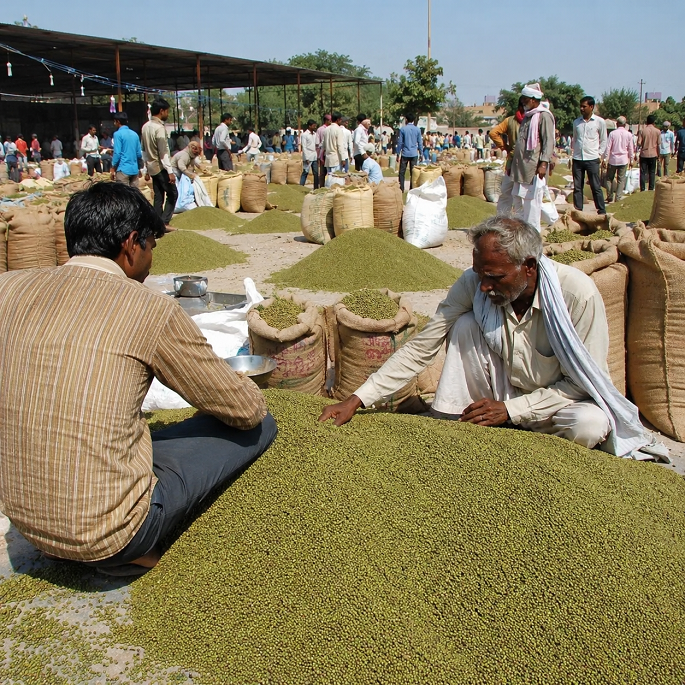
The only reliable source for guar mandi bhav is one with a ground-level contact physically present at the auction yard during the live bol-chaal session, watching actual lots clear and recording the prices at which buyers actually transact. This is fundamentally different from reading a government data feed that arrives hours later and may reflect modal prices rather than the range of actual trades.
KhetiKisaan publishes daily gwar mandi bhav for major Rajasthan markets including Sri Ganganagar, Nohar, Bikaner, and other key APMC centres, sourced from on-ground contacts at live auctions each morning. Beyond rate listings, KhetiKisaan's guar crop section covers export news, US rig count updates, and monsoon sowing progress, context that helps you understand not just what bhav is today but why it moved. As with any source, cross-check important figures against Agmarknet or your local APMC before making a final selling decision. Check KhetiKisaan's guar mandi rates daily before heading to your mandi.
Guar Mandi Bhav Today
Guar Mandi Bhav today helps farmers check the latest rates of guar in different mandis. Guar, or cluster bean or Gwar, is a thick crop that can grow in dry areas. It is grown mainly in Rajasthan, Haryana and Gujarat and its seed is worth is renowned.
Guar is a plant that does not take much water, and it can grow in sandy soil. It is planted at the beginning of the monsoon in July and the harvest is collected between November and October. The crop is grown in a semi-arid climate and it needs dry heat in order to grow properly. It also helps improve soil quality.
The main value of Guar comes from its seeds. Guar Gum is extracted from such seeds and utilized in oil work, foodstuffs, as well as items of daily use. Due to this, Guar is in high demand both locally and internationally.
Key Factors Affecting Guar Mandi Bhav
- Less water crop, good for dry areas
- Grown in sandy and well-drained soil
- Demand depends on export and the global market
- Oil industry demand affects prices
- Quality of seeds changes mandi rate
Guar Mandi Bhav today can change quickly based on demand. Farmers check prices daily to decide the right time to sell. Tracking Guar Mandi Bhav Today helps in getting a better price and planning the sale in the mandi.
| Mandi | Price | Date |
|---|---|---|
| Pillibanga | 6,615.00/- | 24 Sep, 2026 |
| Nohar | 6,600.00/- | 24 Sep, 2026 |
| Sri Ganganagar | 6,801.00/- | 24 Sep, 2026 |
| Rawastar | 6,480.00/- | 24 Sep, 2026 |
| Sirsa | 6,450.00/- | 24 Sep, 2026 |
| Ellenabad | 6,250.00/- | 24 Sep, 2026 |
| Bikaner | 6,571.00/- | 23 Sep, 2026 |
| Rawla | 6,455.00/- | 24 Sep, 2026 |
| Aadampur | 6,720.00/- | 24 Sep, 2026 |
| Bhattu | 6,325.00/- | 24 Sep, 2026 |
| Ghadsana | 6,300.00/- | 23 Sep, 2026 |
| Hanumangarh | 6,255.00/- | 24 Sep, 2026 |
| Siwani | 6,455.00/- | 24 Sep, 2026 |
| Medta City | 6,400.00/- | 24 Sep, 2026 |
| Sangaria | 6,700.00/- | 24 Sep, 2026 |
| Nokha | 6,100.00/- | 24 Sep, 2026 |
| Jaitsar | 6,400.00/- | 24 Sep, 2026 |
| Rajgarh (Sadulpur) | 6,200.00/- | 24 Sep, 2026 |
| Nagaur | 6,406.00/- | 24 Sep, 2026 |
| Deoli | 6,200.00/- | 24 Sep, 2026 |
| RaisinghNagar | 6,600.00/- | 24 Sep, 2026 |
| Abohar | 5,923.00/- | 23 Sep, 2026 |
| Sardarshahar | 6,655.00/- | 24 Sep, 2026 |
| Padampur | 6,560.00/- | 24 Sep, 2026 |
| Arjunsar | 6,480.00/- | 24 Sep, 2026 |
| Phalodi | 6,200.00/- | 24 Sep, 2026 |
| Goluwala | 6,455.00/- | 24 Sep, 2026 |
| Anoopgarh | 6,500.00/- | 24 Sep, 2026 |
| Degana | 6,400.00/- | 24 Sep, 2026 |
| Nimbahera | 6,300.00/- | 24 Sep, 2026 |
| Charkhi Dadri | 6,300.00/- | 24 Sep, 2026 |
| Osian | 6,300.00/- | 24 Sep, 2026 |
| Sadulsahar | 6,250.00/- | 24 Sep, 2026 |
| Sri Vijaynagar | 5,855.00/- | 24 Sep, 2026 |
| Mohangarh | 6,355.00/- | 24 Sep, 2026 |
| Gajsinghpur | 6,035.00/- | 24 Sep, 2026 |
| Kesarisinghpur | 5,580.00/- | 24 Sep, 2026 |
| Suratgarh | 6,351.00/- | 24 Sep, 2026 |
| Sri Karanpur | 6,200.00/- | 24 Sep, 2026 |
| Bhadra | 6,406.00/- | 24 Sep, 2026 |
| DabliRathan | 6,100.00/- | 24 Sep, 2026 |
| Khajuwala | 6,200.00/- | 24 Sep, 2026 |
| Sri Dungargarh | 5,900.00/- | 24 Sep, 2026 |
| Pugal Road | 5,951.00/- | 24 Sep, 2026 |
| Dooni | 5,600.00/- | 24 Sep, 2026 |
| Alwar | 5,600.00/- | 24 Sep, 2026 |
| Barodamev | 5,500.00/- | 24 Sep, 2026 |
| Chaksu | 6,100.00/- | 24 Sep, 2026 |
| Bagru | 5,689.00/- | 24 Sep, 2026 |
| Kishangarh | 6,155.00/- | 24 Sep, 2026 |
| Bassi | 5,990.00/- | 24 Sep, 2026 |
| Dausa | 6,100.00/- | 24 Sep, 2026 |
| Lalsot | 6,200.00/- | 24 Sep, 2026 |
| Bandikui | 5,906.00/- | 24 Sep, 2026 |
 Sep 14, 2026
 by
by