





Guar Farming in Rajasthan: Varieties, Yield and Profits
 Aug 24, 2026
 by Pankaj Sihag



Guar Farming in Rajasthan: Varieties, Yield and Profits
| Crop type | Kharif legume (cluster bean / gawar) |
| Sowing window | June to mid-July (rainfed); 15, 30 June (irrigated) |
| Maturity | 80 to 100 days depending on variety |
| Average yield | 4 to 12 quintals per hectare |
| Current mandi bhav | ₹5,150, ₹6,050 per quintal (Rajasthan APMCs) |
| Key mandis | Sri Ganganagar, Nohar, Bikaner, Jodhpur, Hanumangarh |
Guar farming in Rajasthan is one of the few Kharif crop choices that actually thrives where others struggle. Low rainfall, sandy loam soils, and punishing summer heat describe most of western and north-western Rajasthan, and these are precisely the conditions where cluster bean farming makes the most sense. The crop is drought-tolerant, fixes atmospheric nitrogen in the soil, and feeds a booming global export market for guar gum used in oil drilling, food processing, and textiles. The downstream demand is industrial, consistent, and largely insulated from the domestic consumption swings that affect dal or vegetable crops.
Many farmers in Rajasthan have a long history of cultivating guar, yet a significant number still lose income at two critical points: choosing the wrong variety for their zone, and selling the harvest without checking mandi bhav across nearby markets. The sections below cover variety selection, sowing timing, crop protection, and selling strategy. According to KhetiKisaan, the platform tracks live guar mandi bhav via contacts at active APMC auction yards, including Sri Ganganagar and Nohar, so farmers can compare mandis before loading the tractor.
 Table of Contents
Why guar is the right Kharif crop for Rajasthan
Drought tolerance and soil health benefits
Guar requires only 250, 500 mm of rainfall over the Kharif season, which aligns well with rainfall patterns across the arid and semi-arid belts of western Rajasthan. The crop's deep root system accesses soil moisture that remains after light rains and keeps the plant productive even when the monsoon is erratic. Unlike most Kharif crops, guar fixes atmospheric nitrogen through Rhizobium bacteria in its root nodules, directly reducing the urea input cost for the rabi crop that follows. For small farmers cultivating marginal zameen, this dual benefit, cash income from the current fasal plus improved soil fertility for the next, is difficult to match with any other Kharif option in the region.
Industrial demand and guar gum market pull
The value chain behind guar gum farming is one of its biggest advantages. Farmers sell guar seed at the mandi; processors convert it into guar splits and guar gum powder; that powder is exported for industrial use in oil-well drilling fluids, food additives, and pharmaceutical products. This export linkage means buyer demand at Rajasthan mandis does not depend solely on domestic consumption, unlike chana or moong. Current guar seed prices across Rajasthan's APMCs range between ₹4,750 and ₹5,050 per quintal, with select mandis like Sri Karanpur and Padampur at times recording averages above ₹5,300 per quintal in post-harvest arrival periods. For context on the broader guar gum market price in India, export-driven processor demand from Gujarat and Rajasthan processing hubs tends to keep a floor under mandi rates during peak oil-sector activity.
Best guar farming varieties for Rajasthan
Varieties for arid and low-rainfall districts
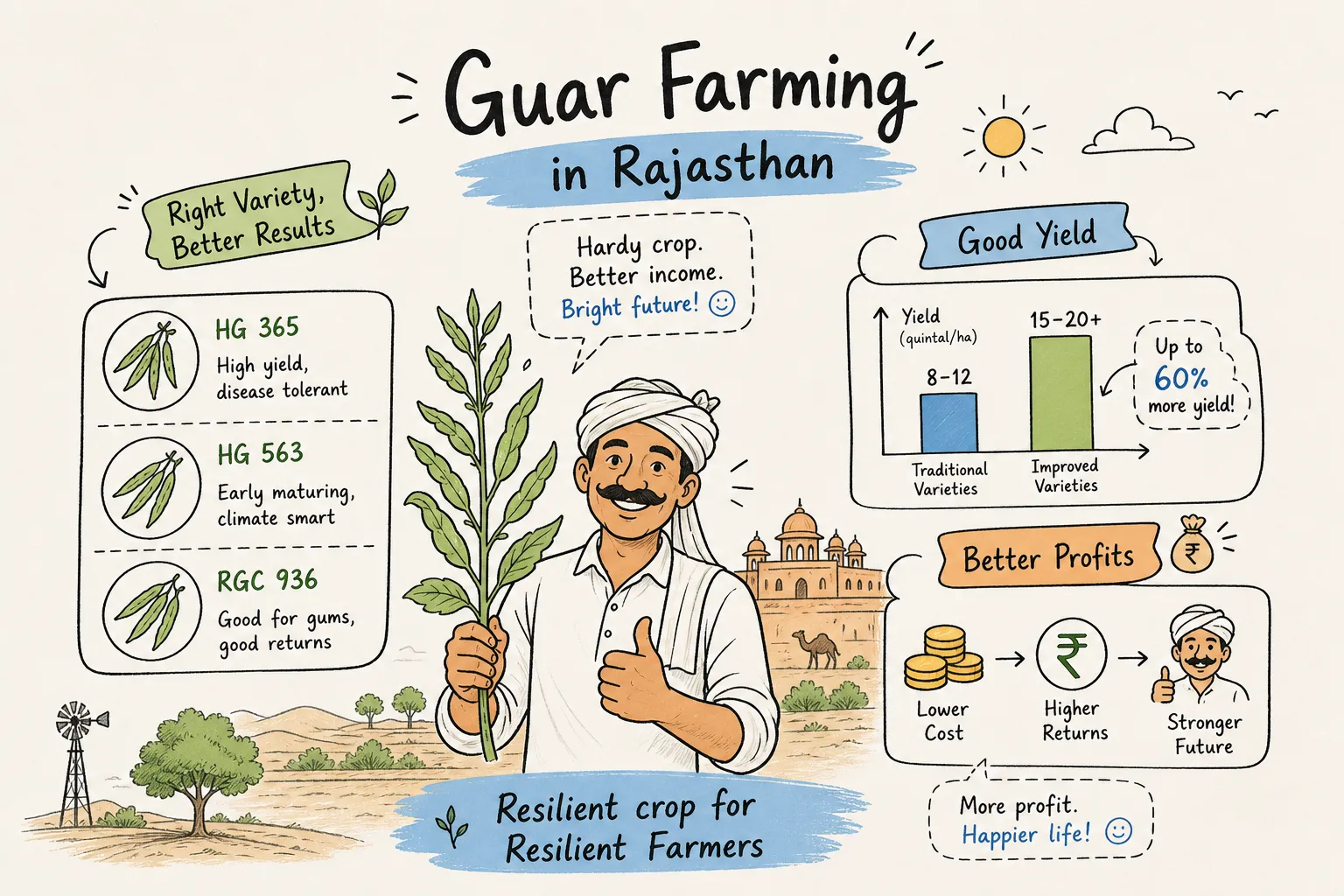
For the arid western belt covering Jaisalmer, Barmer, Bikaner, and Churu, RGC 936 is the standout all-rounder. It performs consistently across humid, semi-humid, and arid rainfall zones and matures in 85, 90 days, giving it a useful buffer against a shortened monsoon window. HG 365 is an early-maturing alternative suited for areas where the monsoon breaks late and exits early; reported maturity ranges between 80 and 85 days in most state advisory sources, though local observations may vary, so check with your district agriculture office before selecting this variety. Both varieties handle sandy soils well and appear in state agriculture advisories for rain-deficit zones.
Varieties for irrigated and semi-humid zones
For the irrigated north, Sri Ganganagar, Hanumangarh, and the south-eastern districts with better soil moisture, higher-yielding, medium-duration varieties make more sense. RGC 1003, RGC 1017, and RGM 112 (Surya) mature between 90 and 100 days and offer higher yield potential under better moisture conditions. RGM 112 is particularly useful because it is suited to both summer and Kharif sowing, giving irrigated farmers flexibility in crop sequencing. Always source certified seed from a registered nursery or the state agriculture department; spurious seed is common and quietly reduces yield before you even notice.
|
Variety |
Zone |
Maturity (days) |
Key strength |
|---|---|---|---|
|
RGC 936 |
All regions, especially arid |
85, 90 |
Best all-rounder; suits drought-prone sandy soils |
|
HG 365 |
Arid, late-monsoon districts |
80, 85 (verify locally) |
Earliest maturing; escapes late-season disease pressure |
|
RGC 1003 |
Rainfed, semi-arid |
85, 95 |
Good yield on light sandy soils |
|
RGC 1017 |
Semi-arid to irrigated |
90, 100 |
Higher yield potential with moderate moisture |
|
RGM 112 (Surya) |
Irrigated north and south-east |
92, 95 |
Dual-purpose; suitable for summer and Kharif sowing |
Guar farming: sowing calendar and seed rate
Sowing window and timing by region
Sow guar with the first effective monsoon rain, ideally between the first week of June and the fourth week of July. Rainfed fields should go in as early as possible after monsoon onset; delaying beyond mid-July on rainfed land noticeably reduces grain yield. Irrigated fields work best with sowing between 15 June and 30 June. For summer guar on irrigated land, the recommended window is late February to early March, with one pre-sowing irrigation before the bed is prepared.
Field preparation and seed rate
Guar does not need deep tillage. Two to three passes with a cultivator after the previous crop's residue is incorporated is sufficient. The critical requirement is good drainage; guar tolerates drought very well but is sensitive to waterlogging at any stage. Recommended seed rate is 15, 20 kg per hectare for row sowing. Row spacing should be 60 × 10 cm in low-rainfall arid zones and 45 × 10 cm in semi-arid districts with moderate monsoon. Treat seed with Rhizobium culture before sowing to support nitrogen fixation, and combine with a fungicide treatment, thiram or carbendazim, to protect against seed-borne diseases. Check product label instructions and local extension guidance to confirm compatibility before tank-mixing. This combined treatment helps reduce fertiliser costs and limit early establishment losses, two factors that directly affect your munafa (profit) per acre.
Water, fertiliser, pests and disease management
Irrigation and fertiliser inputs
Guar is primarily a rainfed crop, but one or two supplemental irrigations at the branching and pod-filling stages can meaningfully lift yield when monsoon breaks are erratic. The fertiliser recommendation for sandy loam soils in Rajasthan is 20 kg nitrogen per hectare and 40 kg phosphorus (P₂O₅) per hectare, both applied as a basal dose at sowing. Because Rhizobium inoculation handles most of the nitrogen demand after establishment, avoid over-applying urea; it suppresses nodule formation and wastes money. Total fertiliser cost is roughly ₹2,000 per hectare, making guar a cost-efficient Kharif crop to manage from an input standpoint.
Major pests and how to manage them
The key pests in Rajasthan guar fields are jassids, whiteflies, aphids, and hairy caterpillars. Scout your crop regularly rather than spraying on a calendar basis; most pest losses in guar come from delayed scouting, not from absence of a good chemical. For jassids and whiteflies, apply dimethoate or imidacloprid only when populations cross the economic threshold. For hairy caterpillars, hand collection during the gregarious larval stage is the recommended first action; use chemical control only if the infestation is severe and spreading quickly.
Diseases to watch and field-level control
The four diseases that matter most in Rajasthan are bacterial blight, Alternaria leaf spot, wilt or root rot, and powdery mildew. For bacterial blight, treat seed with hot water at 56°C for 10 minutes or apply streptocycline-based seed treatment before sowing; a foliar spray of streptocycline combined with copper oxychloride helps if symptoms appear on the standing crop. For Alternaria leaf spot, use mancozeb-based fungicide sprays and prefer short-duration varieties like HG 365 or RGC 936 that naturally escape late-season humidity. For wilt and root rot, ensure field drainage is proper, treat seed with carbendazim or thiram, and incorporate Trichoderma enriched in FYM into the soil before sowing. Powdery mildew responds well to wettable sulphur sprayed at first appearance. Choosing the right variety remains your first and cheapest line of disease defence.
Yield per acre, input costs and selling your harvest
What to realistically expect from your field
Yield outcomes across Rajasthan span a wide range. Rainfed farms in arid districts typically yield 1.5, 2 quintals per acre (roughly 4 quintals per hectare), while better-managed farms in semi-arid and irrigated zones can reach 4, 5 quintals per acre (10, 12 quintals per hectare). Note that 1 hectare equals approximately 2.47 acres. Total production cost from land preparation to transport runs to approximately ₹7,900 per hectare, or around ₹3,200 per acre under a typical rainfed system.
A practical floor-level calculation frames the decision clearly. At a mandi bhav of ₹4,800 per quintal and a yield of 2 quintals per acre, gross income is ₹9,600 per acre against an input cost of ₹3,200, a net margin of roughly ₹6,400 per acre. Push the yield to 4 quintals per acre through better variety choice and one supplemental irrigation, and gross income rises to ₹19,200 per acre on the same input base. That difference of over ₹9,000 per acre comes almost entirely from agronomy decisions made before sowing, not from luck.
Mandi routes and contract farming channels
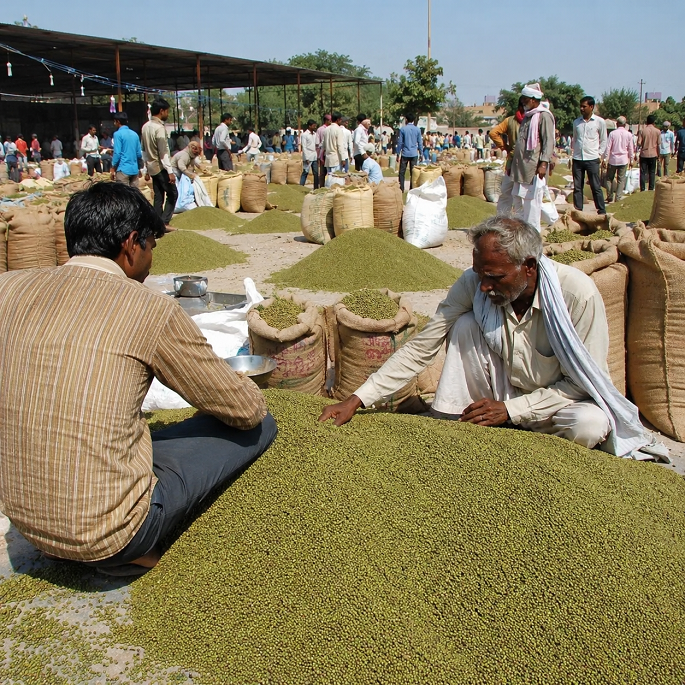
Rajasthan farmers have three main routes to sell guar seed. The local APMC mandi is the most common route and offers transparent price discovery. Active guar markets include Sri Ganganagar, Nohar, Hanumangarh, Bikaner, and Jodhpur, with Padampur and Sri Karanpur recording some of the stronger averages in the Sri Ganganagar district. The second route is processor linkage, where farmers or FPO-aggregated groups sell directly to guar gum manufacturers, cutting out commission layers. The Sustainable Guar Initiative in Jodhpur and Barmer is one example of this model. The third route is through trader or exporter networks via commission agents, though farmers usually access exporters indirectly. Some processors also offer forward or contract arrangements that lock in a price before harvest; these reduce price risk but cap your upside if mandi bhav spikes post-harvest.
Tracking live guar mandi rates before you sell
Guar farming in Rajasthan involves real price volatility, seed prices can swing between ₹4,000 and ₹5,100 per quintal depending on the market, season, and daily arrivals. Inter-mandi price differences on the same day can be significant, and selling at the wrong yard without checking nearby rates first is an avoidable cost. According to KhetiKisaan, the platform tracks live guar mandi bhav via contacts at active APMC auction yards, including Sri Ganganagar and Nohar, two of the busiest guar markets in northern Rajasthan. Check rates on KhetiKisaan before you load your tractor, compare two or three nearby mandis, and sell when prices are firm rather than on the heaviest arrival days when rates soften under supply pressure.
The decisions that determine your guar income
Guar farming in Rajasthan rewards farmers who get three things right: the correct variety for their agro-climatic zone, timely sowing with the monsoon onset, and selling at the right mandi on the right day. For most of Rajasthan, RGC 936 remains the most reliable variety choice. Sow in June or early July, protect the crop with need-based pest management rather than blanket spraying, and target 2, 4 quintals per acre under rainfed conditions. The production side is straightforward once you have variety and timing in order.
The bigger opportunity, and the more common mistake, is on the selling side. Price differences of ₹300, ₹500 per quintal between mandis on the same day are real and frequent. Check KhetiKisaan for daily guar rates from Sri Ganganagar, Nohar, and other active APMCs before deciding where to sell. Whether you are choosing a crop for this Kharif season or ready to move your harvest to market, having accurate, up-to-date mandi bhav is the simplest and most profitable habit a kisan can build.