Trusted Source for Mandi Bhav Updates






Select Mandi
Trusted Source for Mandi Bhav Updates
Select Mandi

 Sep 14, 2026
 by Pankaj Sihag



Guar gum exports from India: who buys, what they pay
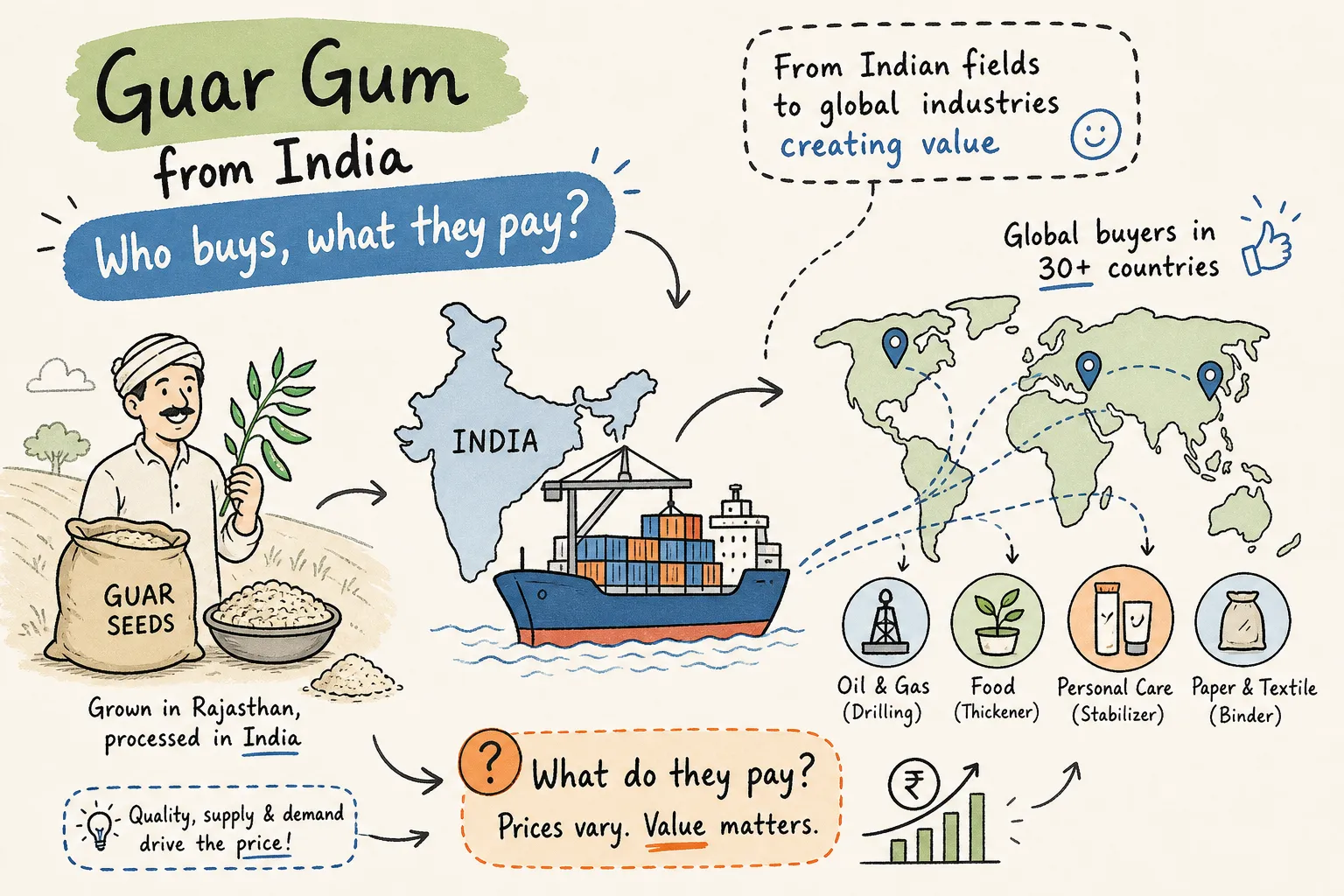
Guar gum export from India reached over 4.74 lakh metric tonnes in FY25, earning more than USD 550 million in foreign exchange. That figure belongs to a crop grown largely on dry, rocky soil in Rajasthan's Barmer, Bikaner, and Nagaur districts, the same crop a kisaan there may call simply "gwar." Today, that gwar is pressurising oil wells in Texas, thickening yoghurt on supermarket shelves in Germany, and binding pharmaceutical tablets in Japan. The global guar gum market sits at roughly USD 1.49 to 1.55 billion in 2026, expanding at a compound annual growth rate of 5 to 6.6%, forecasts project continued growth at this pace through the decade's end. This article covers exactly who is buying Indian guar gum, what they are paying per metric tonne by grade, what certifications they demand, and, most critically for farmers, how those export cycles quietly write the gwar mandi bhav you see posted each morning. For live gwar mandi bhav across Rajasthan mandis, KhetiKisaan tracks daily rates from APMC auction yards so farmers can follow these signals in real time.
 Table of Contents
India supplies roughly 80 to 85% of the world's entire guar gum requirement. No other country comes close. In FY25, APEDA data confirms guar gum export from India at 4,74,519.44 metric tonnes valued at USD 550.12 million. To put that in context, FY24 exports stood at approximately 4.50 lakh metric tonnes valued at USD 585.41 million. Volume has grown year on year while unit prices have fluctuated with global demand cycles, a pattern that tells you the market is structurally growing even as individual price years vary.
India's dominant share meaningfully influences global supply and price dynamics. It also means Indian farmers and processors are uniquely exposed to shifts in global demand. When the world's guar gum buyers increase orders, they have only one reliable source to turn to. When they cut back, Indian mandis feel it within weeks. Understanding this dependency is the starting point for every gwar-growing kisaan who wants to sell smarter.
Rajasthan is the heartland of this export story. Guar, what Rajasthan farmers call gwar ki kheti, thrives in semi-arid conditions, and districts like Bikaner, Barmer, Jaisalmer, Churu, and Hanumangarh together account for the largest share of the state's planted area. Processing units in Jodhpur, Sri Ganganagar, Bikaner, and Alwar then convert raw gwar beej (guar seed) into refined guar gum powder and derivatives before export. The farm-to-export chain is short and tightly connected: what a food manufacturer in Hamburg decides to order this quarter directly affects what a farmer in Barmer receives per quintal at the local mandi next month.
The United States is the single dominant buyer of Indian guar gum, accounting for approximately 79% of global import shipments from India by volume in trade-data records, with 470 tracked shipments. The driver is the American shale oil and hydraulic fracturing industry, which uses guar gum-based fracturing fluids intensively to extract oil and gas from tight rock formations. When U.S. drilling activity accelerates, as measured by weekly rig-count data from the U.S. Energy Information Administration, Indian guar gum export demand rises. Rising American rig counts are therefore a key market signal for Indian gwar farmers to monitor, though the price response at the mandi reflects the entire chain of export procurement rather than a single direct trigger.
APEDA's FY25 destination data lists the top buyers as Germany, the USA, Russia, Norway, and China. Germany's demand comes primarily from the food processing and pharmaceutical industries, where guar gum functions as a natural thickener and binder. Russia and Norway source it mainly for industrial and oilfield chemical applications. China uses it across food processing and industrial sectors. Beyond these top five, Tridge's global import data for 2024 shows the Philippines (41 shipments), Brazil (18 shipments), Japan (14 shipments), and Indonesia (12 shipments) as consistent buyers, reflecting the spread of guar gum across food manufacturing industries worldwide.
Each of these markets pulls different product grades. The USA oilfield sector wants high-viscosity hydroxypropyl guar and fast-hydration grades. Germany's food industry wants food-grade guar gum powder certified as E412. Japan's pharma manufacturers want tighter purity specifications and batch documentation. This diversity of demand is a genuine strength for Indian exporters: no single market collapse can wipe out the entire export base. For farmers, it also means demand signals can come from multiple directions simultaneously, making it worth tracking more than just U.S. rig counts.
Guar gum is an essential ingredient in hydraulic fracturing (fracking) fluids used to extract shale oil and natural gas. Once dissolved in water, the gum forms a gel that carries sand particles deep into rock fractures to prop them open and allow oil or gas to flow. Specific derivatives like hydroxypropyl guar (HPG) and high-viscosity grades are formulated for use at high temperatures and pressures within wellbores. When global crude prices rise and U.S. drilling picks up, guar gum export demand from India spikes almost immediately, which is why oilfield demand is the single most important price signal for Indian gwar farmers to follow.
Guar gum carries the European food additive code E412 and functions as a natural thickener and stabiliser in ice cream, yoghurt, sauces, gluten-free bakery products, and dairy beverages. European and North American food manufacturers are the largest buyers of food-grade guar gum powder, and this segment accounted for approximately 40.11% of global guar gum revenue in the most recently reported year (2025). Unlike oilfield demand, which swings with crude oil prices and drilling economics, food industry demand is comparatively stable and growing, driven by rising consumption of processed foods and clean-label natural ingredients. This segment provides the base floor for Indian export volumes even when oilfield demand softens, which is why food-grade guar gum powder remains in consistent production at Indian processing units throughout the year.
Pharma-grade guar gum is used as a binding and disintegrating agent in tablet manufacturing and as a thickener in topical personal care products. It is projected to grow at a CAGR of 8.35% from 2026 to 2031 across global pharmaceutical and nutraceutical applications, making it the fastest-expanding segment in the guar market. This segment commands the highest FOB prices, often USD 1,800 to 2,200 or more per metric tonne, with certified organic grades reaching EUR 4,000 to 4,100 per metric tonne. While volumes are smaller than food or oilfield orders, pharma business adds significant value for Indian exporters who can consistently meet tighter viscosity, purity, and documentation standards.
The most defensible FOB India price range for mainstream guar gum powder over the past 12 months is approximately USD 1,300 to 1,600 per metric tonne, with grade and specification determining exactly where a shipment falls within that band. Standard industrial-grade guar gum powder typically quotes at USD 1,300 to 1,500 per MT FOB India. Food-grade (E412) powder quotes at USD 1,400 to 1,600 per MT FOB, with fast-hydration grades in the USD 1,450 to 1,550 range. Specialty food-grade quotes from Indian suppliers, particularly for higher viscosity ranges, can reach USD 1,600 to 2,100 per MT depending on specification and order volume.
The premium end of the market is significantly higher. Pharma-grade and organic-certified guar gum regularly trades at USD 1,800 to 2,200 or more per MT FOB India, with some certified organic grades quoted at EUR 4.0 to 4.1 per kg, translating to roughly USD 4,300 to 4,500 per MT at current exchange rates. Reaching this price tier requires meeting stricter viscosity specifications (typically 5,000 to 6,000 cps), providing tighter batch-level documentation, and holding third-party certifications relevant to the buyer's market.
One important clarification for exporters new to guar gum trade: CIF prices to key destinations can appear different from FOB India prices in market snapshots, and the relationship can seem counterintuitive at first glance. One 2026 market note, for example, shows CIF China at approximately USD 810 per MT and CIF USA at approximately USD 787 per MT against an FOB India of roughly USD 700 per MT in that same snapshot. These higher CIF figures include freight and insurance costs layered on top of the FOB India base price, but apparent inversions between snapshots can also arise from variations in quote basis and the underlying grade being quoted. Always confirm the price basis in writing in every export contract to avoid post-shipment disputes.
Every serious importer of guar gum will ask for three numbers before placing an order: viscosity, mesh size, and moisture content. Viscosity, measured in centipoise (cps), varies by grade: food grade typically runs 3,000 to 8,000 cps, with most mainstream food applications concentrating in the 4,500 to 6,000 cps range; industrial grade runs 2,000 to 7,000+ cps; pharmaceutical grade sits at 5,000 to 6,000 cps with tighter consistency requirements. Particle or mesh size is specified by buyers as 100, 200, or 300 mesh depending on the end application. Moisture, or loss on drying, must typically not exceed 10 to 12%. Galactomannan (gum content) purity is expected at a minimum of 80% for most commercial grades.
Beyond these three core parameters, a full Certificate of Analysis (COA) for every shipment should cover pH, protein content, hydration time, and hydration rate where relevant. For modified guar derivatives such as hydroxypropyl guar (HPG), buyers also specify the degree of substitution and alkaline pH range, typically 9.0 to 11.0.
Standard export packing is 25 kg multiwall paper bags or 50 lb bags, palletised for container loading. European and American buyers are increasingly requesting non-GMO declarations, allergen statements, and supply chain traceability documentation alongside the standard COA. Exporters should prepare these as part of their standard documentation set rather than waiting for the buyer to ask.
Guar gum exports operate under a "Free" export policy under India's DGFT (Directorate General of Foreign Trade), meaning no separate export licence is required. The core document set for all markets includes a commercial invoice, packing list, bill of lading, certificate of origin where requested by the buyer, and the COA or product specification sheet. The applicable HS code for treated and pulverised guar gum powder is commonly 13023230 under India's 8-digit classification, though different product forms may carry different codes, exporters should verify the exact code against their specific product on DGFT's ICEGATE system or with a customs broker before filing the shipping bill. An IEC (Importer Exporter Code) from DGFT is mandatory for any Indian exporter, without exception.
The single most important compliance checkpoint for exporters targeting the European Union is the requirement for a Health Certificate issued through SHEFEXIL (the Shellac and Forest Products Export Promotion Council, headquartered in Kolkata), authorised by the Ministry of Commerce and Industry. This certificate is mandatory for EU-bound guar gum shipments intended for food or animal feed use. Alongside it, exporters must provide a PCP (penta-chlorophenol) analytical report from an approved testing agency, confirming that PCP levels do not exceed 0.01 mg/kg. Missing this documentation is a common reason EU-bound Indian guar gum shipments face delays or rejection at European ports.
For the USA and Middle East destinations, there is no equivalent India-issued sectoral licence for guar gum. Compliance is driven by the buyer's specifications and the destination country's import requirements. For food-use shipments to any market, exporters should carry appropriate food-safety documentation as specified by the importer. Guar gum is not an APEDA-scheduled product, so APEDA registration or an RCMC is generally not required. The standard IEC plus the applicable shipping documentation is sufficient for non-EU markets.
The link between a global export order and a local mandi price is faster and more direct than most farmers realise. When U.S. drilling activity picks up or European food manufacturers increase procurement, Indian processors and exporters start competing more aggressively for raw gwar beej at Rajasthan APMC mandis. This heightened procurement pressure pushes mandi bhav upward, sometimes sharply and within a matter of weeks. The reverse is equally true: when oilfield demand softens or a major import country restricts procurement, mandi rates can fall before the next season's crop is even harvested. A farmer in Nagaur holding gwar stock in a warehouse needs to be watching export demand signals as actively as local weather or MSP announcements.
To understand what this means in practical terms, consider the current picture at Rajasthan mandis. Sri Ganganagar's grain mandi was last recorded at approximately ₹5,100 per quintal, with the Sri Ganganagar Anaj Mandi touching ₹5,300 per quintal earlier this year. Sadulshahar APMC in Ganganagar district showed ₹5,900 per quintal in early September 2026. These differences across mandis within the same district reflect local supply, buyer presence, and, most importantly, which mandis are seeing active procurement from processing units responding to live export orders. Delayed selling after an export-driven price surge has peaked can materially reduce farmgate returns, making timely information the difference between maximum munafa and a missed opportunity.
KhetiKisaan tracks live guar mandi bhav (guar mandi rates) from APMC auction yards, giving farmers a clearer picture of where rates are moving across markets. A farmer who checks KhetiKisaan's daily gwar bhav across multiple mandis, including Sri Ganganagar and Nohar, can spot when export-driven buying is simultaneously lifting prices across several markets. That pattern is a reliable signal that now may be the right time to sell rather than hold. That intelligence, accessible on a mobile phone before the morning's first auction, is the practical bridge between global guar gum export trends and a farmer's actual munafa per quintal at the mandi gate.
India's position as the world's largest guar gum exporter is not just a trade statistic. It is a market force that directly shapes what a Rajasthan farmer earns per quintal each season. Global demand from U.S. fracking sites, European food factories, and Japanese pharma manufacturers feeds back into Rajasthan mandi bhav in patterns that become predictable once you know what to watch. Volume growth in guar gum export from India is clear: FY25's 4.74 lakh metric tonnes exceeds FY24's 4.50 lakh metric tonnes, and the global market is forecast to reach USD 1.68 billion or more by 2028.
For farmers growing gwar, the practical takeaway is this: the mandi price you see posted today is partly being written by a drilling report in Texas or a food manufacturer's procurement decision in Hamburg. The more informed you are about those upstream signals, the better your chances of selling at the right time rather than the convenient time. Check live gwar mandi bhav on KhetiKisaan daily, compare rates across mandis, and watch for simultaneous price rises across multiple APMC centres. That pattern usually means export-driven buying is active and the window to sell may be narrowing.
Sep 01, 2026
by Pankaj Sihag
Aug 24, 2026
by Pankaj Sihag
Jul 16, 2026
by Pankaj Sihag