





Kisan Credit Card Scheme: Complete Guide for Farmers

 Sep 22, 2026
 by Pankaj Sihag



Kisan Credit Card Scheme: Complete Guide for Farmers
Many kisaans (farmers) across India continue to borrow from sahukaars (moneylenders) at high interest rates, even though a government-backed credit facility exists that can bring the cost of Kisan Rin (agricultural credit) down to just 4% per annum. Lack of awareness is widely cited as a key reason farmers miss out, many simply do not realise they qualify. That facility is the Kisan Credit Card scheme, and it has been operational since 1998 with one purpose: to give Indian farmers affordable, flexible access to formal credit.
This guide covers everything you need in one place. By the time you finish reading, you will know whether you qualify, which documents to carry, what interest rate you will actually pay, how much you can borrow, and exactly how to apply, either online or at your nearest bank branch. Pairing your KCC with real-time fasal (crop) price tracking on KhetiKisaan before deciding when to sell gives you both the credit and the market intelligence to run your farming operation more profitably.
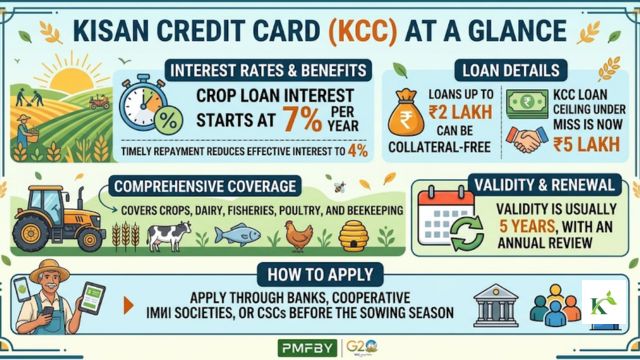
| Effective interest rate (timely repayment) | 4% per annum |
|---|---|
| Nominal lending rate | 7% per annum |
| Government interest subvention to bank | 1.5% per annum |
| Prompt Repayment Incentive (PRI) to farmer | 3% per annum |
| MISS-eligible loan limit | Up to ₹3 lakh (concessional subvention) |
| Enhanced KCC loan limit (2025, 26 Budget) | Up to ₹5 lakh |
| Collateral-free limit (from Jan 2025) | Up to ₹2 lakh |
| Card validity | 5 years, subject to annual review |
| Application routes | Bank branch, bank website, PM-KISAN portal, JanSamarth portal |
| Who qualifies | Owner cultivators, tenant farmers, sharecroppers, SHGs, JLGs, allied-activity farmers |
 Table of Contents
- What is the Kisan Credit Card scheme and why does it matter?
- Who qualifies for a KCC?
- KCC eligibility documents: full checklist before you apply
- KCC interest rates and loan limits explained
- What you can and cannot use your KCC credit for
- How to apply for a Kisan Credit Card scheme: step by step
- Choosing the right bank and planning your repayment to save more
- Final takeaway: the KCC scheme works, but only if you use it
- FAQs
What is the Kisan Credit Card scheme and why does it matter?
The core idea behind KCC
The Kisan Credit Card (KCC) scheme is a revolving credit facility introduced by the Government of India that gives farmers flexible access to short-term agricultural credit through a single credit card-linked account. The word "revolving" is what makes it genuinely useful: once a limit is sanctioned, you can draw money, repay it after selling your fasal, and draw again for the next crop cycle, all without submitting a fresh loan application each time. This is fundamentally different from a conventional term loan, where you borrow once, repay in fixed instalments, and restart the entire process whenever you need funds again.
A standard crop loan forces a farmer to make multiple visits to the bank, submit paperwork repeatedly, and wait for fresh sanctions every season. The Kisan Credit Card scheme eliminates that friction. Your sanctioned limit is available throughout the crop cycle, and as long as your account is in good standing, the credit renews annually after a simple review.
What activities does the KCC cover?
The scheme is broader than most farmers realise. KCC credit can be used for crop cultivation expenses such as seeds (beej), fertiliser (khad), pesticides, irrigation charges, and labour costs. It also covers post-harvest expenses including storage, transportation, and handling before your fasal reaches the mandi. Marketing costs, mandi fees, and commission charges are permitted. A portion can also fund limited household consumption needs of the farmer family.
Beyond crops, KCC credit is available for maintenance of farm assets and for allied agricultural activities: dairy, poultry, fisheries, beekeeping, sericulture, and mushroom cultivation all fall within the scheme's scope. This breadth means the Kisan Credit Card scheme is relevant far beyond those who grow wheat or mustard alone. Any kisaan running an allied enterprise on or off the farm can potentially access this credit.
Who qualifies for a KCC?
Core eligibility categories
The KCC scheme is designed to be inclusive. The main eligible categories are listed below:
- Individual owner-cultivator farmers, whether applying singly or as joint borrowers
- Tenant farmers, oral lessees, and sharecroppers who cultivate land they do not own
- Self-Help Groups (SHGs) and Joint Liability Groups (JLGs) of farmers, including groups formed entirely by tenant farmers
- Farmers engaged in allied sectors: dairy, fisheries, poultry, beekeeping, and sericulture
The minimum age requirement is 18 years. Many banks set an upper age limit of around 75 years; if you are older than that, a co-borrower or legal heir is typically required for the application to proceed. The most important misconception to clear up: tenant farmers without land ownership are fully eligible for KCC. Many sharecroppers and oral lessees do not apply because they incorrectly believe land ownership is mandatory. It is not.
Special note for allied activity farmers
A farmer does not need to own agricultural land to qualify under the allied-activities category. A dairy farmer, a fisherperson, or a poultry operator can access KCC credit for working capital related to their enterprise. The key requirement is proof that the allied activity genuinely exists, such as records of livestock ownership, a fish pond agreement, or a poultry unit registration. Aadhaar linkage is increasingly mandatory across banks for KCC disbursement, so ensure your Aadhaar is linked to your bank account before you apply.
KCC eligibility documents: full checklist before you apply
Identity, address and photograph
For most farmers, an Aadhaar card serves both identity and address proof in a single document, which simplifies the entire checklist. Carry it regardless of which other documents you bring. The address on your proof must match your current residential address; a mismatch is one of the most common reasons for application delays.
| Document type | Acceptable forms |
|---|---|
| Identity proof | Aadhaar Card, PAN Card, Voter ID, Driving Licence, Passport |
| Address proof | Aadhaar Card, Passport, utility bill, ration card, bank statement |
| Photograph | Two recent passport-size photographs |
Land, cultivation and category-specific documents
Land document names differ across states, but they all serve the same purpose: proving ownership or cultivation rights. Farmers in Rajasthan should carry their Jamabandi (ideally the e-signed copy from Apna Khata) and their Girdawari as cropping proof. In Haryana and Punjab, the Fard or Jamabandi from the Patwari office is the standard land record accepted at bank branches. Visiting the bank with a complete set avoids delays and repeat visits.
| Document type | Acceptable forms / state examples |
|---|---|
| Landholding / ownership proof | Jamabandi (Rajasthan, Punjab), Fard/Jamabandi (Haryana), Khasra-Khatauni, 7/12 extract (Maharashtra), Patta, RoR, land passbook |
| Cultivation / cropping proof | Cropping pattern certificate, Patwari certification, Girdawari (Rajasthan), self-declaration |
| Tenant / sharecropper proof | Lease deed, rent agreement, tenancy certificate, affidavit confirming cultivation rights |
| Bank details | Savings account passbook or account details (for existing account holders, KYC may already be done) |
| Higher loan limit (above threshold) | Additional security documents as specified by the individual bank |
KCC interest rates and loan limits explained
How the Kisan Credit Card scheme's interest subvention structure works
The Modified Interest Subvention Scheme (MISS) is what makes the Kisan Credit Card scheme genuinely affordable. Banks lend at 7% per annum for short-term crop loans. The Government of India then pays 1.5% subvention directly to the lending bank, and farmers who repay on time receive an additional 3% Prompt Repayment Incentive (PRI). The result: your effective interest cost is just 4% per annum if you repay by the due date.
| Bank | Nominal KCC rate | Effective rate with timely repayment |
|---|---|---|
| SBI | 7% p.a. | 4% p.a. |
| PNB | 7% p.a. | 4% p.a. |
| Indian Overseas Bank | 7% p.a. | 4% p.a. |
| UCO Bank | 7% p.a. | 4% p.a. |
Note: Many public-sector banks offer KCC at 7% under MISS; rates shown are indicative. Verify the current rate with your bank before applying.
Missing the repayment deadline forfeits the entire 3% PRI benefit. Your effective rate reverts to 7%, which is still far below what a sahukar charges, but you do lose a significant saving. The subvention is calculated from the date of disbursement or drawal (withdrawal) until actual repayment or the due date, whichever comes first, subject to a maximum of one year.
Loan limit tiers: what you can borrow
The Union Budget 2025, 26 enhanced the KCC lending limit under MISS from ₹3 lakh to ₹5 lakh. The concessional MISS subvention benefit is clearly documented for the portion up to ₹3 lakh. For the ₹3 lakh to ₹5 lakh range, check with your specific bank for the current interest terms applicable to the enhanced portion. Above ₹5 lakh, banks apply commercial lending rates with no MISS benefit.
The actual sanctioned limit depends on the scale of finance for your specific crop, your landholding size, and the bank's own assessment. Do not assume the maximum limit applies automatically. A farmer with two acres of mustard cultivation will receive a different limit compared to one cultivating ten acres of basmati. The collateral-free limit for short-term agricultural loans has also been raised to ₹2 lakh per borrower (effective January 2025), making access easier for small and marginal farmers.
What you can and cannot use your KCC credit for
Permitted uses across the crop cycle
KCC credit is ring-fenced for agricultural and allied purposes. Here is a clear breakdown of what is permitted:
- Crop cultivation: seeds (beej), fertiliser (khad), pesticides, irrigation charges, and hired labour costs
- Post-harvest: storage, transportation, and handling costs before the fasal reaches the mandi
- Marketing: mandi fees and commission charges when selling produce
- Household consumption: limited personal and family needs of the farmer household
- Farm asset maintenance: equipment repairs,soil testing, weather services
- Allied activities: working capital for dairy units, poultry operations, fisheries, and beekeeping enterprises
KCC credit is not meant for non-agricultural personal loans, property purchases, or business activities outside the agricultural value chain. Using it for such purposes can lead to account irregularities and affect your renewal eligibility.
Why applications get delayed or rejected
Many KCC delays and rejections stem from avoidable issues, incomplete documentation, unverifiable land or cropping proof, and similar gaps that can be resolved before you visit the branch. Treat the points below as a pre-submission checklist.
- Documents are incomplete or the address on your proof does not match bank records
- Cultivation area or crop pattern cannot be verified from the land records submitted
- Applying for allied-activity credit without any proof that the allied enterprise exists
- Loan purpose stated outside permitted KCC fund-use categories
- Existing overdue or default with the same bank
Cross these off before you walk into the branch. A complete, accurate application processed in one visit saves weeks of back-and-forth. If you already have a savings account at your chosen bank with linked Aadhaar KYC, the process moves significantly faster because the bank has already verified your identity.
How to apply for a Kisan Credit Card scheme: step by step
Online application via PM-KISAN portal and JanSamarth
- Visit the PM-KISAN portal (pmkisan.gov.in) or the JanSamarth portal (jansamarth.in) and navigate to the KCC or Agriculture Loan section.
- Click "Apply" or "KCC Form" and enter your Aadhaar number and registered mobile number. OTP verification may auto-fill details from the PM-KISAN database if you are a registered beneficiary.
- Fill in your landholding details, crop type, and existing bank account information accurately.
- Upload scanned copies of your Aadhaar, land record (Jamabandi, Fard, or relevant state document), and a passport-size photograph.
- Review all details carefully before submitting. Once submitted, save your application reference number.
- Monitor your application status using the reference number. The bank will contact you for verification or a field visit if required.
- After approval,the KCC is issuedand linked to your account. You can begin drawing credit as needed for your crop cycle.
Bear in mind: even after completing the online form, some banks, particularly in rural areas, require you to print the completed application and submit physical copies of documents at the nearest branch. Confirm with your bank's agriculture loan helpdesk before assuming a fully paperless process. Several public-sector banks (for example SBI, PNB, Bank of India, and Union Bank of India) are reported to be linked to the JanSamarth portal for KCC applications; check the JanSamarth portal for the current list.
Applying directly at your bank branch
- Visit the nearest branch of a public sector bank such as SBI, PNB, Bank of Baroda, Canara Bank, or your localRegional Rural Bank (RRB).
- Request the KCC application form from the agriculture loan officer or download it from the bank's official website before your visit.
- Fill in the form completely: farming details, crop pattern, landholding area, and your existing bank account number.
- Attach all documents from the checklist: identity proof, address proof, land records, cultivation proof, and two passport-size photographs.
- Submit the complete set to the agriculture loan officer and collect your acknowledgement receipt with a reference number.
- Processing typically takes 7 to 14 working days for complete applications; cases requiring field verification may take 30 to 45 days. These are indicative timelines that vary by bank and branch. SBI customers applying through the YONO digital route with existing e-KYC may see a faster turnaround of 5 to 10 working days.
Choosing the right bank and planning your repayment to save more
How to pick the best bank for your KCC
Many major public-sector banks, including SBI, PNB, Indian Overseas Bank, and UCO Bank, offer KCC at the 7% nominal rate under MISS in 2026, making the effective interest rate difference between banks negligible for most farmers. What actually matters for your daily farming life is branch proximity, your existing banking relationship, and the branch's processing efficiency.
Choose a bank with a branch near your village or mandi town so that repayments do not require a full day of travel. If you already receive PM-KISAN transfers at a particular bank, applying there is faster because your KYC is already complete. Regional Rural Banks (RRBs) and cooperative banks are often more accessible for small and marginal farmers in interior blocks. Confirm that your RRB participates in the MISS scheme before applying so you can access the 4% effective rate.
Using mandi price data to never miss a repayment and get 4% interest
The 3% Prompt Repayment Incentive substantially lowers your effective borrowing cost from 7% to 4%, making timely repayment one of the most financially significant actions you can take under the Kisan Credit Card scheme. To claim it, you must sell your fasal at a good mandi bhav (market rate) at the right time and repay your Kisan Rin before the due date, and that requires price intelligence, not guesswork.
KhetiKisaan is a practical tool for exactly this purpose. Before selling your gehun (wheat), sarso (mustard), chana, or moong, check the daily mandi bhav across APMC mandis on KhetiKisaan. Mandi prices for major North Indian centres, including Sri Ganganagar and Nohar, are published regularly, allowing you to track rates and time your sale more effectively. Knowing when bazar rates are favourable lets you sell at a good price, repay your KCC account on time, and lock in the 3% PRI saving every year. Holding your crop without any price data is a financial risk; tracking daily mandi rates is the informed alternative.
Final takeaway: the KCC scheme works, but only if you use it
The Kisan Credit Card scheme is one of the most cost-effective sources of agricultural credit available to any Indian farmer today. At 4% effective interest for timely repayers, it is simply not comparable to informal borrowing. Eligibility is far broader than most farmers assume: tenant farmers, sharecroppers, SHG members, and allied-activity operators all qualify, often without needing to own land.
With the right documents in hand and a suitable bank chosen based on proximity and existing relationship, the application process is straightforward. Apply online through the PM-KISAN or JanSamarth portal, or walk into your nearest public sector bank branch with your Jamabandi, Aadhaar, and cultivation proof. The credit will follow.
Once your Kisan Credit Card scheme account is active, pair it with real-time mandi bhav tracking on KhetiKisaan to decide the best moment to sell your fasal, repay your Kisan Rin on time, and claim the 3% PRI every year. That combination, affordable formal credit and live market price data, is what shifts a farming operation from surviving one season to planning for the next.