







Kisan Credit Card (KCC) Scheme Explained: Loan Benefits, Limit and Eligibility for Farmers
 Jul 02, 2026
 by Pankaj Sihag



Kisan Credit Card (KCC) Scheme Explained: Loan Benefits, Limit and Eligibility for Farmers
-
The Kisan Credit Card scheme gives kisaans easy access to short-term crop loans for seeds, fertilisers, irrigation, and other farm needs.
-
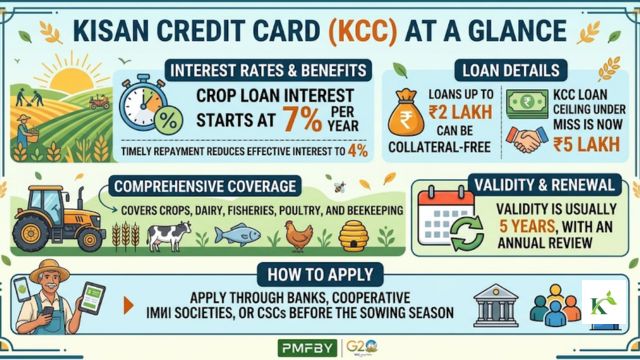
Under Budget 2025–26, the loan ceiling under the Modified Interest Subvention Scheme (MISS) was increased from ₹3 lakh to ₹5 lakh.
-
The standard crop loan interest rate is 7%, but timely repayment can reduce the effective rate to 4%.
-
Loans up to ₹2 lakh are now collateral-free from January 2025.
-
Tenant farmers, sharecroppers, and farmer groups can also apply under the KCC eligibility criteria
 Table of Contents
- What is the Kisan Credit Card Scheme and How Does it Help You?
- Who Can Apply? Understanding Eligibility Criteria
- KCC Loan Limit: How Much Can You Borrow?
- Loan Structure
- What is the Crop Loan Interest Rate Under KCC?
- What Can Farmers Use KCC Loans For?
- How to Apply for a Kisan Credit Card
- Final Thoughts
- FAQs
What is the Kisan Credit Card Scheme and How Does it Help You?
The Kisan Credit Card scheme is a government-backed agriculture loan initiative that helps farmers get low-interest institutional credit for farming expenses.
It was introduced in August 1998 based on the recommendations of the R.V. Gupta Committee, which was constituted by the Reserve Bank of India (RBI) and the National Bank for Agriculture and Rural Development (NABARD) to look into the credit delivery system for farmers. Over the last two decades, it has become one of India’s most widely used farm credit systems.
Instead of taking separate loans before every sowing season, farmers get a revolving credit line that can be used whenever needed.
This helps cover:
-
Fertilisers
-
Pesticides
-
Labour
-
Irrigation
-
Post-harvest costs
-
Allied farming needs
The biggest benefit is that repayment is linked to harvest cycles, which makes cash flow easier for farmers.
Who Can Apply? Understanding Eligibility Criteria
The KCC eligibility criteria are wider.
Eligible applicants include:
-
Individual owner-cultivators
-
Joint borrowers
-
Tenant farmers
-
Sharecroppers
-
Cultivators with valid tenancy arrangements
-
Self Help Groups (SHGs)
-
Joint Liability Groups (JLGs)
-
Dairy farmers
-
Fishery farmers
-
Poultry farmers
-
Beekeeping farmers
Age Limit
Applicants are usually between 18 and 75 years old. Those over 60 may be asked to provide a co-borrower, depending on the bank's policy.
Documents Required
-
Aadhaar card
-
PAN card (if required)
-
Land records or tenancy proof
-
Bank account details
-
Crop details
-
Passport-size photos
Before applying, it is important to check local bank requirements.
KCC Loan Limit: How Much Can You Borrow?
The KCC loan limit depends on:
-
Landholding size
-
Crop type
-
Cost of cultivation
-
Input costs
-
Irrigation expenses
-
Post-harvest needs
-
Allied farming activities
How Banks Calculate It
Year 1 Limit:
Scale of finance X area cultivated
-
10% for post-harvest and household needs
-
20% for farm maintenance and crop insurance
Banks usually review the account every year.
The limit may increase by 10% annually if repayment stays regular.
Loan Structure
|
Loan Amount |
Interest Rate |
Collateral Required |
|
Up to ₹2 lakh |
7% (can drop to 4% with prompt repayment) |
No collateral (100% security-free access) |
|
₹2 Lakh to ₹5 lakh |
7% (subject to scheme guidelines) |
Crop hypothecation (standing crop acts as security) |
|
Above ₹5 lakh |
As per individual bank policy |
Land mortgage / Third-party guarantee |
Marginal farmers may also get Flexi KCC, where banks can sanction a flexible credit limit between ₹10,000 and ₹50,000 based on landholding, crop needs, and small farm expenses.
What is the Crop Loan Interest Rate Under KCC?
The normal crop loan interest rate under KCC is 9% per year.
This works through:
-
1.5% interest subvention from the government for lending institutions
-
3% prompt repayment incentive (PRI) for farmers who repay on time
This can bring the effective borrowing cost down to 4%.
Important points:
-
Timely repayment is needed for the extra benefit
-
Banks may ask for Aadhaar linking for subsidy processing
-
Late repayment can increase the total interest cost
What Can Farmers Use KCC Loans For?
The Kisan Credit Card scheme supports many farming needs.
It can be used for:
-
Seeds
-
Fertilisers
-
Pesticides
-
Irrigation
-
Labour costs
-
Storage
-
Transport
-
Machinery repair
-
Dairy
-
Poultry
-
Fisheries
-
Mushroom farming
-
Beekeeping
This makes KCC useful across the full crop cycle.
How to Apply for a Kisan Credit Card
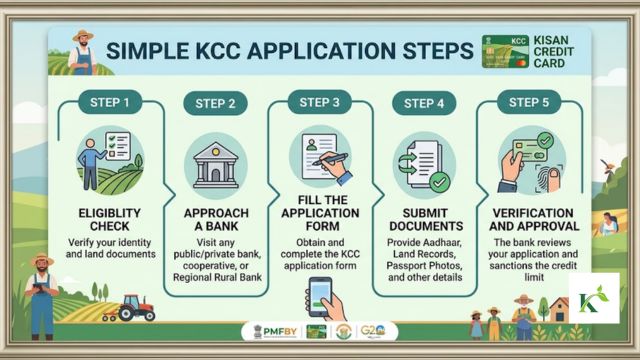
The process is simple:
Step 1
Visit:
-
Commercial banks
-
Regional Rural Banks (RRBs)
-
Cooperative banks
-
Small finance banks
-
Common Service Centres (CSCs)
Major banks include the State Bank of India, Punjab National Bank, and Bank of Baroda, among others.
Step 2
Ask for the KCC application form.
Some banks also provide online forms.
Step 3
Submit:
-
Identity proof
-
Land documents
-
Crop details
-
Loan requirement details
Step 4
Bank verification begins.
Step 5
After approval, most banks issue a KCC debit card linked to the account.
Final Thoughts
Input costs are rising every season.
Seeds, fertilisers, labour, diesel, and irrigation all cost more now.
The Kisan Credit Card scheme gives farmers access to timely credit without depending on high-cost informal borrowing.
With:
-
4% effective interest
-
₹2 lakh collateral-free access
-
₹5 lakh MISS ceiling
KCC remains one of the most practical financial tools for Indian farmers.
Before every sowing season, planning your credit need can help avoid unnecessary debt pressure.
For mandi bhav, farming updates, and government scheme alerts, keep checking KhetiKisaan.
FAQs
Related Blogs

Sep 22, 2026
by Pankaj Sihag