







Castor Oil Uses, Benefits & Why It Drives Arandi Prices in India
 Oct 12, 2026
 by Pankaj Sihag



Castor Oil Uses, Benefits & Why It Drives Arandi Prices in India
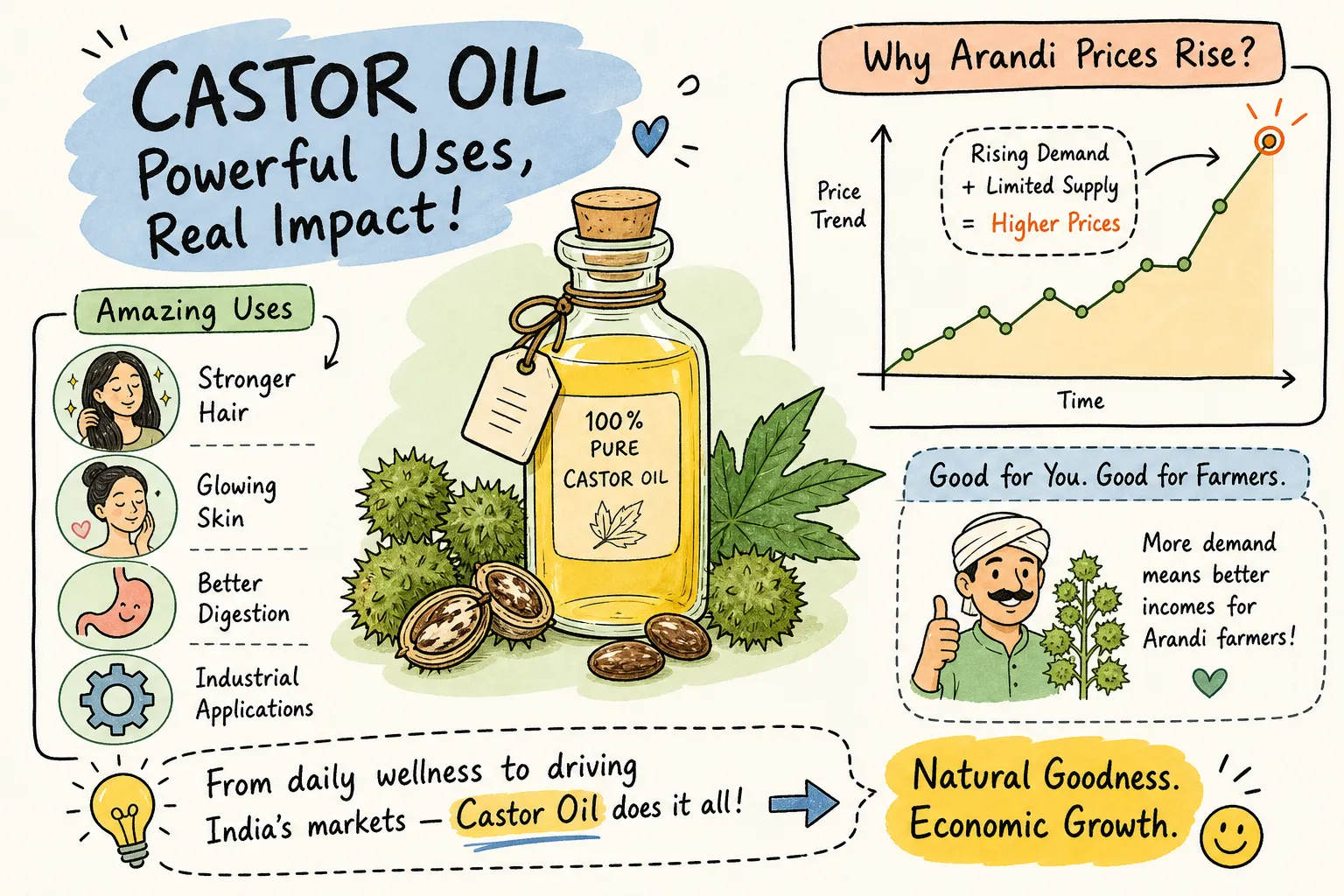
Arandi ka tel (castor oil, cold-pressed from the seeds of Ricinus communis ) quietly occupies two entirely different worlds at the same time. On bathroom shelves across India and beyond, it is a familiar household remedy for hair conditioning, dry skin, and digestive relief. In global industrial supply chains, it is an irreplaceable raw material that polymer manufacturers, lubricant producers, and pharmaceutical companies source almost entirely from Indian farms.
Understanding both worlds matters. Consumers deserve an honest, evidence-based picture of what this oil can and cannot do for their hair, skin, and digestion. Arandi kisaans (growers) in Rajasthan, Gujarat, and Andhra Pradesh deserve to understand why their fasal (crop) commands a premium at the mandi long after the harvest season ends. This guide covers both honestly.
 Table of Contents
- Quick Facts
- What makes castor oil unlike any other plant oil
- Castor oil for hair: what the science actually shows
- Skin benefits and safe application methods
- Oral castor oil as a laxative: dosage, effects, and who should avoid it
- How to read castor oil labels and choose a quality product
- Industrial uses: the real engine behind castor oil's global premium pricing
- How global castor oil demand shapes Arandi mandi bhav in India
- Conclusion: one crop, two very different value stories
- FAQs
Quick Facts
- India supplies over 85% of global castor oil exports, making it the world's dominant producer by a considerable margin.
- Ricinoleic acid accounts for 85, 90% of the oil's fatty-acid profile; no other commercially available plant oil comes close.
- The global castor oil market is projected to reach approximately USD 3.1 billion by 2030, growing at around 5.2% annually.
- Arandi mandi bhav (market auction prices for castor seed) responds directly to international export demand cycles, often within weeks of a shift in overseas procurement.
- Oral castor oil is FDA-approved as a stimulant laxative; the evidence for hair growth, by contrast, does not currently meet clinical proof standards.
What makes castor oil unlike any other plant oil
The ricinoleic acid factor
Castor oil's entire identity comes from a single compound: ricinoleic acid, a hydroxy fatty acid that accounts for roughly 85, 90% of the oil's fatty-acid profile. No other commercially available vegetable oil approaches this concentration. The hydroxyl group on ricinoleic acid gives the oil unusual polarity, extreme viscosity, and high chemical reactivity. This is precisely why it behaves so differently from coconut oil or olive oil, whether you are using it in a hair-care routine or in an industrial lubricant. These are not marketing claims; they are the structural reason Arandi tel has remained industrially irreplaceable for over a century.
Cold-pressed vs. solvent-extracted: why the process changes everything
Castor oil is produced by two main methods. Mechanical or cold-pressed extraction uses a screw or hydraulic press without added chemical solvents or deliberate external heat, preserving more of the oil's natural characteristics. Solvent extraction, typically using hexane, is faster and yields more oil per seed, but residual solvent traces remain unless the oil is fully refined. Cold-pressed is a process claim, not a safety or quality guarantee on its own. A cold-pressed oil that has not been properly tested for contaminants is not automatically safer than a well-refined solvent-extracted grade. This distinction becomes critical when you read product labels, which is covered in detail below.
Castor oil for hair: what the science actually shows
Conditioning and shine vs. hair growth: separating the two claims
Social media has made bold claims about this oil's ability to regrow hair, but the clinical picture is far more modest. No good randomised controlled trial has demonstrated that topical castor oil increases hair growth, reverses androgenetic alopecia, or meaningfully reduces hair loss. What does exist is a preclinical, laboratory-level finding: ricinoleic acid may inhibit prostaglandin-D2 synthesis, a pathway associated with male-pattern hair loss. That is a mechanistic observation, not proof that applying the oil to the scalp will regrow hair in people. One small study did report increased hair lustre, which is a cosmetic improvement, not a growth finding. What Arandi tel genuinely does for hair is condition it, add shine, and reduce breakage caused by dryness. These are real, useful benefits; they just do not match the more dramatic claims circulating online.
Practical application: dilution, timing, and frequency
Because castor oil is exceptionally viscous, applying it undiluted makes it difficult to spread and nearly impossible to wash out cleanly. Dilute one part with one to two parts of a lighter carrier oil such as jojoba, argan, coconut, or grapeseed oil. Section the hair into four to six portions, apply a small amount along the scalp partings, and massage gently with fingertips for three to five minutes. Smooth any remainder over mid-lengths and ends, leave for thirty minutes to two hours, then apply shampoo to the oily hair before wetting it, lather thoroughly, and rinse. Begin with once weekly to assess how your scalp responds, and stop immediately if itching, redness, or scaling develops.
Skin benefits and safe application methods
What the clinical evidence says about moisturisation and wound care
The evidence for castor oil on skin is preliminary but somewhat more credible than the hair-growth claims. It functions as an emollient, forming a surface barrier layer that slows moisture loss and supports the skin's natural defence. Small clinical and formulation studies have examined its effects on wound epithelialisation and atopic skin barrier function, but none of these establish it as superior to standard dermatological treatments. One study of a castor-oil-containing wound dressing for donor sites (skin areas from which a graft is taken) reported reasonable healing outcomes, but the design did not isolate the oil as the sole responsible factor. Pure castor oil can cause allergic contact dermatitis and should never be applied to open, infected, or severely inflamed skin without medical advice.
Face, body, and castor oil packs: how to apply safely
For facial use, patch-test by applying a small amount to the inner arm for several days before applying to the face. Dilute one part with two parts jojoba or a similarly light carrier oil, then apply only one to three drops to clean, slightly damp skin at night. For the body, a one-to-one blend with a body oil works well when massaged into dry areas after bathing while skin is still slightly damp. For a castor oil pack, saturate three to four layers of unbleached cotton or wool flannel with the oil, place the cloth on the target area (commonly the abdomen), cover it with a plastic sheet, and apply gentle warmth for thirty to sixty minutes. Limit pack use to one to three times weekly. Be clear about what a pack is: it is a comfort practice, not a clinically proven treatment for any internal condition.
Oral castor oil as a laxative: dosage, effects, and who should avoid it
Recommended doses and the short-term rule
This is the best-supported medical application of Ricinus communis seed oil. The US FDA classifies it as an approved stimulant laxative for temporary, occasional constipation, and clinical studies have documented reduced straining and softer stools in older adults. It works within two to six hours of a single oral dose, best taken on an empty stomach. Oral castor oil is strictly a short-term measure, generally no longer than one week without clinician guidance. Standard dosage guidelines are as follows:
| Age group | Typical single dose |
|---|---|
| Adults and children 12 years and older | 15, 60 mL (1, 4 tablespoons) |
| Children aged 2 to under 12 years | 5, 15 mL (1, 3 teaspoons) |
| Children under 2 years | Do not use without direct medical advice |
Use the smallest dose that achieves the desired effect. Mixing with juice can make it easier to take. Seek medical advice for severe or persistent constipation, rectal bleeding, vomiting, or suspected bowel obstruction before using any laxative, including this one.
Castor oil side effects, drug interactions, and who must avoid it
Common side effects include abdominal cramping, nausea, diarrhoea, dehydration, and electrolyte loss, particularly potassium. Severe or prolonged diarrhoea can lead to weakness, dizziness, muscle cramps, and irregular heart rhythm. Clear contraindications include suspected bowel obstruction, appendicitis, inflammatory bowel disease, blood in the stool, or unexplained abdominal pain. On the drug-interaction side, combining it with diuretics (water pills) raises the risk of dangerously low potassium; faster intestinal transit can also reduce the absorption of antibiotics and other oral medicines. Consult a pharmacist or clinician before use if you take regular prescription medicines.
A firm caution for pregnant women: oral use can trigger strong uterine contractions and cause dehydration, both of which may affect foetal well-being. Pregnant women should not use oral castor oil unless an obstetric clinician directly recommends and supervises it. For constipation during pregnancy, ask your doctor about better-established, safer alternatives.
How to read castor oil labels and choose a quality product
What "cold-pressed," "hexane-free," and "organic" actually guarantee
Label claims on castor oil products carry very different levels of reliability. Indian consumers, in particular, frequently encounter unlabelled or inadequately labelled products in local markets, making it especially important to know what each term does and does not mean before purchasing.
| Label claim | What it reliably tells you | Key limitation |
|---|---|---|
| Food grade / edible grade | Intended to comply with applicable food regulations or a stated food standard | Weak unless backed by a named standard, manufacturer, and batch-specific COA |
| USP / NF designation | Strong evidence of defined identity and quality when legitimate and traceable | Verify with lot documentation; does not automatically approve every intended use |
| Cold-pressed | Mechanical extraction with limited or no deliberate external heat applied | Not a universal legal quality grade; does not prove absence of contaminants |
| Hexane-free / solvent-free | No chemical extraction solvent was used during processing | Prefer a manufacturer declaration or COA; the label alone is not independent verification |
| Certified organic | Verified farming and handling under a recognised certification scheme | Does not by itself establish edible-grade safety or nutritional superiority |
What to look for before buying
For any cold-pressed castor oil you intend to consume orally, three things are non-negotiable. First, confirm a clear food-grade, edible-grade, or USP/NF designation; "cosmetic grade" is not equivalent and should never be ingested. Second, the ingredient list should contain only Ricinus communis seed oil with no added fragrances, carrier oils, or preservatives. Third, obtain or locate a batch-specific Certificate of Analysis (COA) from a third-party laboratory, confirming the ricinoleic acid profile, acid value, peroxide value, and residual solvent testing. Colour and thickness are useful secondary checks but cannot reliably confirm food safety or product purity on their own.
Industrial uses: the real engine behind castor oil's global premium pricing
Why no synthetic substitute has replaced it
Ricinoleic acid gives this oil a combination of properties that petrochemical alternatives cannot replicate at comparable cost: extreme-temperature stability, natural biodegradability, high lubricity, and strong chemical reactivity for polymer synthesis. These properties make it indispensable across several precision industries. High-performance lubricants, including jet engine and racing applications, rely on it. So do nylon-11 and nylon-12 polymer production lines that manufacture flexible fuel lines, automotive components, and medical devices. Based on 2026 market estimates, lubricants and greases alone account for approximately 32, 34% of global castor oil demand, while industrial chemicals and polymers represent another 24, 29%. These are applications where buyers accept premium pricing and negotiate stable, long-term supply contracts rather than spot purchases.
Pharmaceuticals, cosmetics, and the sustainability push
Beyond heavy industry, pharmaceutical manufacturers use castor oil as an excipient, a carrier ingredient in drug formulations, and as a surfactant in certain delivery systems. Cosmetics manufacturers rely on it as a base ingredient in lipsticks, conditioners, and creams because of its film-forming properties and viscosity. Cosmetics and personal care account for approximately 20, 26% of global demand, while pharmaceuticals contribute roughly 13, 25% depending on how derivatives are counted. The sustainability angle is increasingly significant: as global regulations push industries toward bio-based feedstocks over petroleum-derived alternatives, Arandi tel is positioned as a credible industrial "green" raw material. The global market is projected to grow from approximately USD 2.4 billion in 2025 to USD 3.1 billion by 2030, driven substantially by this bio-based demand shift. This sustainability premium is a demand driver that Arandi kisaans rarely hear discussed, but its effect reaches all the way to the mandi floor.
How global castor oil demand shapes Arandi mandi bhav in India
India's role in the global castor oil supply chain
India accounts for 85, 90% of global castor oil exports, with Gujarat as the dominant producing state, followed by Rajasthan and Andhra Pradesh. When industrial buyers in Europe, China, or the United States increase their procurement, Indian export prices rise, and this pressure transmits directly to Arandi auction rates at APMC yards within weeks. The supply chain works like this: Arandi seeds are purchased at the mandi during bol-chaal (live bidding), processed at oil-crushing units, refined for export-grade oil, and shipped through Gujarat ports such as Kandla and Mundra. As of October, Gujarat castor seed was trading at approximately Rs. 80,500 per tonne ex-mandi, while first-grade oil was quoted around USD 1,660 per tonne FOB Kandla, illustrating how directly the two prices are connected.
Reading export demand signals to time your Arandi sale
Arandi mandi bhav follows identifiable seasonal patterns tied to the kharif crop cycle, global purchasing cycles, and monsoon-linked output. Prices are generally most vulnerable when fresh arrivals peak after harvest, roughly November through February, and export buying is quiet. They tend to firm up when arrivals thin, lean-season stock tightens, and overseas orders improve, typically between May and June and again when Q4 export inquiries pick up from European and North American buyers.
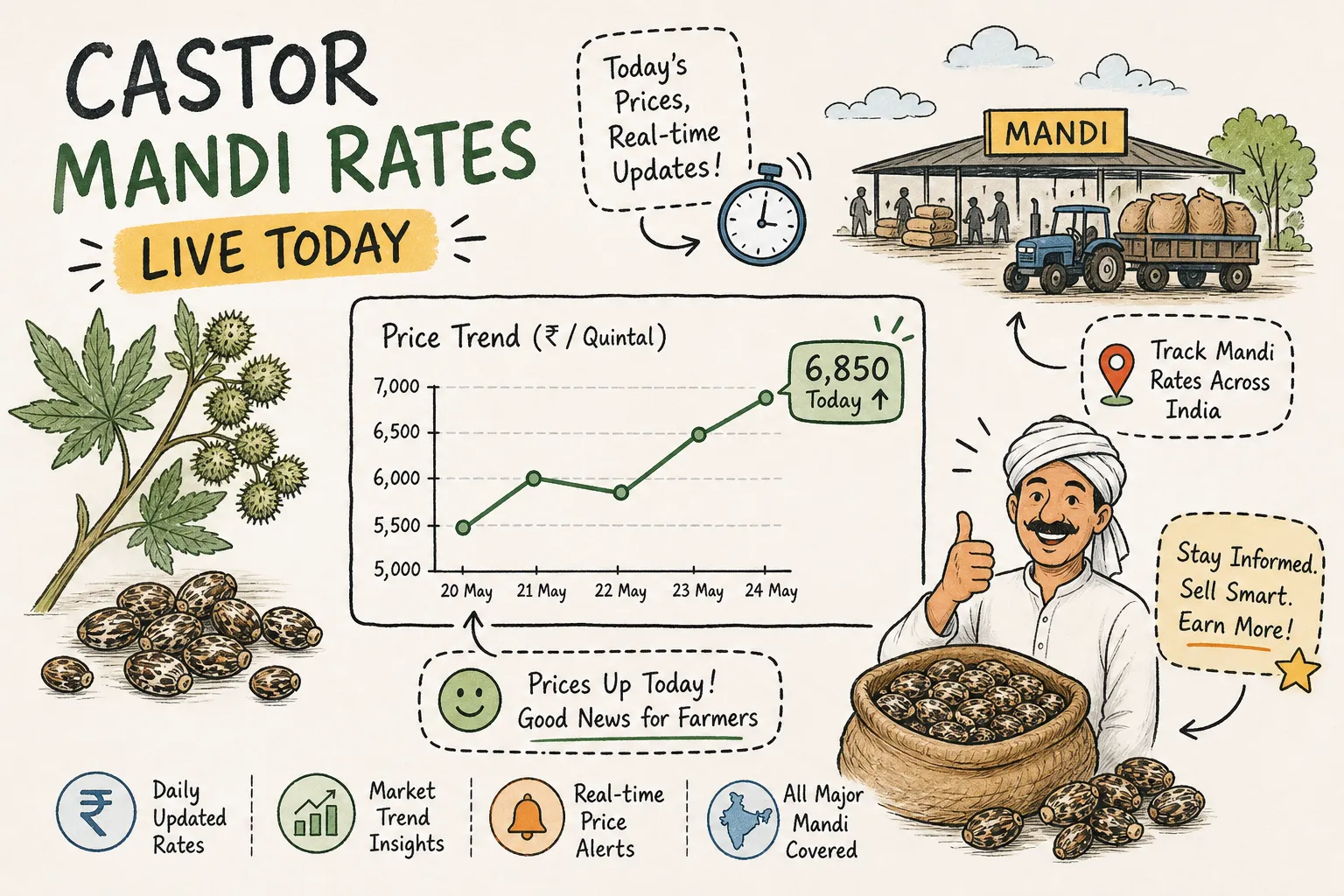
Growers who monitor live Arandi auction rates across multiple APMC yards can spot these price movements early, well before a middleman or commission agent (arhatiya) volunteers the information. On KhetiKisaan, daily Arandi mandi bhav from major APMC centres across Rajasthan and Gujarat is updated with data sourced from ground-level contacts physically present at live bidding sessions. This hyper-local price intelligence lets Arandi kisaans make the sell-or-hold decision on their own terms, rather than accepting whatever rate is offered at the yard on the day they arrive. Tracking the relationship between domestic mandi rates and export FOB prices is the single most useful habit an Arandi grower can develop to improve munafa (profit per quintal) over a full season.
Conclusion: one crop, two very different value stories
Castor oil is one of those rare agricultural outputs with documented, practical value across consumer health, global manufacturing, biodegradable materials, and pharmaceutical formulations simultaneously. For consumers, the honest summary is this: it works reliably as a skin emollient and as a short-term stimulant laxative; it conditions hair and improves shine; but the hair-growth claims need rigorous clinical trials before they can be accepted as clinically established. Follow dosage guidelines for oral use, choose food-grade products with verifiable batch documentation, and treat topical application as a supplement to, not a replacement for, medical advice when dealing with genuine dermatological concerns.
For Arandi kisaans, the larger takeaway is that their fasal is not a commodity in the ordinary sense. It supplies an industrial raw material with no easy petrochemical substitute, and that structural scarcity is what keeps Arandi prices from collapsing even in years of good harvest. The growing global push toward bio-based industrial feedstocks adds a long-term demand tailwind that most farm-level discussions never address. Understanding this value chain, staying current on export demand signals, and timing mandi sales around arrival cycles and overseas buying patterns is the practical edge that separates a profitable Arandi season from an average one. Check daily Arandi mandi bhav on KhetiKisaan to start building that edge.
FAQs
Related Blogs

Sep 28, 2026
by Pankaj Sihag