





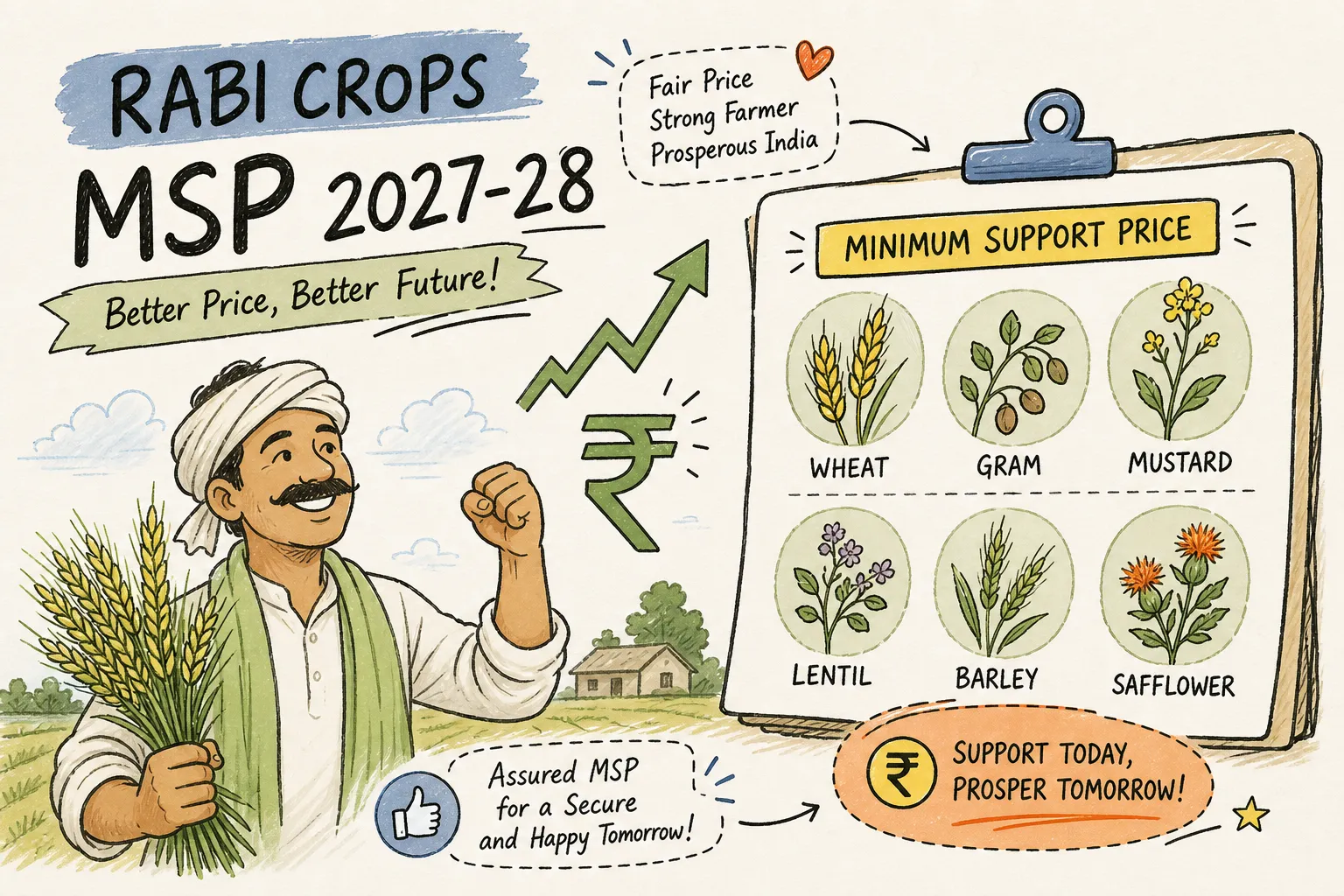
MSP for Rabi Crops 2027-28: Complete Price List
 Sep 30, 2026
 by Pankaj Sihag



MSP for Rabi Crops 2027-28: Complete Price List
The Union Cabinet approved the Minimum Support Price (MSP) for all six rabi crops for the 2027-28 marketing season on 30 September 2026, setting wheat (gehun) at ₹2,610 per quintal and mustard (sarso) at ₹6,613 per quintal. These are not advisory numbers. MSP is the government-mandated floor price below which central and state procurement agencies are obligated to purchase your crop if the open-market rate falls short. Whether the local mandi bhav stays above or dips below that floor will directly determine how much money lands in your account this rabi season. If you have been searching for msp rabi crops 2027 28 rates, every declared figure is laid out in the table below.
The practical problem most kisaans face is that MSP is declared months before harvest, but mandi bhav moves daily. Sitting on that annual announcement without checking current APMC rates is like knowing your crop's minimum value but not knowing what buyers are actually paying today. Platforms like KhetiKisaan track live auction prices from APMC yards, so any farmer can compare that day's mandi rate against the declared MSP floor without waiting for a newspaper or a commission agent's version of events.
This article gives you the complete 2027-28 rabi MSP table, a crop-by-crop comparison with 2026-27, the policy logic behind the bigger hikes, and a clear step-by-step guide to registering for government procurement before your fasal reaches harvest.
 Table of Contents
- Quick facts at a glance
- Complete MSP rate list for rabi crops 2027-28
- How much did each crop's support price rise from 2026-27?
- Why mustard and masoor got the biggest hikes: MSP rabi crops 2027-28 policy explained
- Mandi bhav vs MSP: reading the price gap before you sell
- Track rabi MSP and live mandi rates on KhetiKisaan
- State-wise procurement: what farmers in Punjab, Haryana, Rajasthan, and UP must know
- Step-by-step guide to claiming MSP for your rabi crop
- What every rabi farmer in North India needs to know before selling this season
- FAQs
Quick facts at a glance
- What this article covers: Every officially declared rabi MSP for 2027-28, a year-on-year comparison with 2026-27, and a practical selling-strategy guide for kisaans deciding whether to sell at the mandi or wait for government procurement.
- Who should read this: Wheat, mustard (sarso), gram (chana), masoor, barley, and safflower growers in Rajasthan, Haryana, Punjab, and Uttar Pradesh.
- Key tool: KhetiKisaan's live mandi bhav tracker, which lets you place today's APMC auction rate right next to the official MSP floor so you can spot the gap instantly.
- Cabinet approval date: 30 September 2026, covering all six mandated rabi crops for the 2027-28 marketing season.
- Highest MSP crop: Lentil (masoor) at ₹7,390 per quintal.
- Biggest absolute hike: Safflower at +₹675 per quintal over 2026-27.
Complete MSP rate list for rabi crops 2027-28
The Union Cabinet has declared the following official support prices per quintal for all six mandated rabi crops for the 2027-28 marketing season. These are the rates at which government agencies, including state procurement bodies, NAFED, and FCI, are obligated to procure your crop if open-market rates fall below this level.
Official crop-wise support prices declared by the Union Cabinet
| Rabi crop | Common name | MSP 2027-28 (₹/quintal) |
|---|---|---|
| Wheat | Gehun | ₹2,610 |
| Barley | Jau | ₹2,286 |
| Gram | Chana | ₹5,958 |
| Lentil | Masoor | ₹7,390 |
| Rapeseed & Mustard | Sarso | ₹6,613 |
| Safflower | Kusum | ₹7,215 |
Which crop carries the highest government floor price this season
Ranked from highest to lowest, the 2027-28 rabi MSP order is: masoor (₹7,390), safflower (₹7,215), sarso (₹6,613), gram (₹5,958), wheat (₹2,610), and barley (₹2,286). Masoor and safflower carry the strongest government price protection per quintal this season. Barley sits at the lowest floor, which is a useful signal when evaluating what to sow on mixed-use land. The next section shows how much each crop's rate actually moved compared to last year.
How much did each crop's support price rise from 2026-27?
The Cabinet approved higher MSPs for all six crops compared to the previous season, but the size of the increase varies sharply. Wheat, the dominant rabi crop in North India, received the smallest absolute hike. Many analysts read this as a deliberate policy signal favouring pulses and oilseeds over cereals, rather than an oversight.
A crop-by-crop view of the annual hike
| Rabi crop | MSP 2026-27 (₹/quintal) | MSP 2027-28 (₹/quintal) | Increase (₹/quintal) |
|---|---|---|---|
| Wheat | ₹2,585 | ₹2,610 | +₹25 |
| Barley | ₹2,150 | ₹2,286 | +₹136 |
| Gram | ₹5,875 | ₹5,958 | +₹83 |
| Lentil (Masoor) | ₹7,000 | ₹7,390 | +₹390 |
| Rapeseed & Mustard | ₹6,200 | ₹6,613 | +₹413 |
| Safflower | ₹6,540 | ₹7,215 | +₹675 |
Wheat's ₹25 per quintal increase is the smallest hike in the entire rabi basket this cycle. For a farmer selling 100 quintals of gehun, that translates to just ₹2,500 in additional MSP-floor income over the entire season. Compare that with sarso, where a ₹413 per quintal hike means ₹41,300 more floor protection on the same volume. If you have land that can grow either wheat or a competing oilseed, this year's MSP structure clearly favours the oilseed decision.
Return-on-cost margins: what the numbers actually mean for your profit
The government sets MSP at a minimum of 1.5 times the all-India weighted average cost of production (the A2+FL cost, which includes actual paid-out costs plus the imputed value of family labour). The reported return margins for 2027-28 are: wheat at 106%, mustard at 96%, masoor at 92%, gram at 59%, barley at 58%, and safflower at 50%. A higher margin percentage means the government is providing more cushion above production cost for that crop. However, a high margin does not automatically mean a higher price per quintal. Wheat's 106% margin still produces the lowest absolute rate in the basket because its production cost is lower. Always read the margin percentage alongside the actual ₹ per quintal figure before making a sowing or selling decision.
Why mustard and masoor got the biggest hikes: MSP rabi crops 2027-28 policy explained
The larger increases for sarso and masoor reflect a clear government priority to reduce India's dependence on imported edible oils and pulses by making these crops more financially attractive for farmers to grow. This is not a coincidence; it is the CCEA's stated direction for the season.
The government's crop diversification push for oilseeds and pulses
India imports a significant volume of edible oils every year, and pulse imports have historically spiked during domestic shortfall years. The government's logic is straightforward: if sarso (rapeseed/mustard) and masoor (lentil) carry a substantially higher MSP floor than wheat, farmers on marginal and semi-arid land, particularly in Rajasthan and Haryana, will find it financially rational to shift some acreage. Rajasthan has a mustard acreage target of 40.50 lakh hectares as per the state agriculture department's target, and a ₹413 per quintal increase in the floor price strengthens the case for farmers to commit to that crop rather than default to wheat.
According to official Cabinet announcements, the overall procurement target declared alongside the MSP decision is 324 lakh tonnes across all six crops, with an estimated payout of ₹90,962 crore. This signals that the government intends to back its diversification policy with actual procurement capacity, not just price incentives.
The Finance Ministry advisory against state bonuses above MSP
There is an important caveat that every rabi farmer in North India should be aware of. The Finance Ministry has issued an advisory to states warning against declaring bonuses above the central MSP for wheat and paddy. The reasoning is direct: when states offer a generous bonus on cereals, farmers rationally shift acreage back toward those cereals, which undermines the very diversification the oilseed and pulse MSP hikes are trying to achieve. Do not assume a state bonus exists until your state agriculture department officially confirms it in writing for 2027-28. Treat the central MSP rates in the table above as your confirmed floor and wait for your state's procurement circular before factoring in any premium above that figure.
Mandi bhav vs MSP: reading the price gap before you sell
Knowing the MSP is only half the equation. The number that actually determines your income is the gap between the MSP floor and what buyers are paying at your local APMC mandi on the day you bring your fasal to market.
When mandi rates are above MSP: the sell-now window
When the local APMC mandi bhav for a crop is trading above the declared MSP, open-market selling is almost always the better decision. You capture the market premium and avoid the administrative delays that often come with government procurement queues. Take mustard as a concrete example: if your nearest mandi is paying ₹6,900 per quintal while MSP sits at ₹6,613, selling at the mandi earns you ₹287 more per quintal. On 50 quintals, that gap is over ₹14,000 in your pocket that you would not collect through government procurement. Whenever the mandi bhav is above MSP, sell at the mandi. The MSP is a floor, not a ceiling, and the market occasionally pays significantly above it during export demand cycles or post-monsoon tightening of supply.
When mandi rates dip below MSP: government procurement is your protection
The reverse scenario is equally important to plan for. If the mandi bhav falls below MSP due to seasonal oversupply, a bumper crop in competing regions, or export restrictions, the government procurement machinery, through state agencies, NAFED, and FCI, is obligated to step in and buy at the floor price. This is the core safety net the MSP system provides.
The practical challenge is that price dips during peak arrival season can arrive and correct within days, based on observed market patterns from recent rabi cycles. If you find out a week late that procurement was active in your region, that window may already be closed. Real-time price monitoring, not weekly newspaper updates, is what separates a farmer who uses the safety net from one who sells below MSP because they did not know the procurement window was open.
Why checking mandi bhav daily matters more than reading annual forecasts
Annual MSP announcements give you the floor. Daily mandi bhav gives you the actual number to act on. Crop prices for sarso, chana, and masoor can move by ₹100, 200 per quintal within a single week during peak arrivals, driven by local supply, trader sentiment, and export news. An annual price forecast published in October cannot tell you what your local mandi will pay in March. Only a live mandi rate tracker can do that, and the decision to sell or hold should be based on that live number placed directly against the MSP benchmark you now have from this article.
Track rabi MSP and live mandi rates on KhetiKisaan
Knowing the official support prices for 2027-28 is a good start. Acting on them profitably requires knowing what your local mandi is paying right now, this morning, before you load your trolley.
How KhetiKisaan closes the gap between government MSP and ground-level prices
KhetiKisaan reports live mandi bhav sourced from on-ground contacts at APMC auction yards during the active bidding session (bol-chaal). The rate you see on the platform reflects what buyers paid that morning at your target mandi. Unlike a government data feed that can lag 24, 48 hours or an estimated average figure, this gives you an immediate, actionable read: is the market paying a premium above MSP, or should you be registering for government procurement right now?
That clarity helps you avoid the two most common selling mistakes: selling too early during a rising market, and selling below the floor during a price dip because you did not know procurement was available. Farmers should verify KhetiKisaan's data-collection methodology on its platform for full details on coverage and sourcing.
Crops and mandis covered: what North India rabi farmers will find
KhetiKisaan covers the major rabi crops relevant to North India, gehun (wheat), sarso (mustard), chana (gram), masoor (lentil), and barley, across key APMC centres in Rajasthan, Haryana, and Punjab, including Sri Ganganagar and Nohar. Check the platform's coverage page to confirm the mandis active in your district. Before your fasal reaches harvest, bookmark KhetiKisaan so that when prices move, you are the first to know. Selling without a live price reference is the most avoidable way to leave money on the table this rabi season.
State-wise procurement: what farmers in Punjab, Haryana, Rajasthan, and UP must know
Central MSP is a uniform national floor, but procurement operations, quality norms, and any bonuses are managed at the state level. What applies in Punjab does not automatically apply in Rajasthan. Here is what each major rabi state looks like for 2027-28.
Punjab: relaxed grain quality norms and what they mean for wheat sellers
Punjab has secured a relaxation in wheat procurement specifications for 2027-28, as documented in the relevant Ministry and state procurement circulars. The tolerance limit for shrivelled and broken grains has been raised to 15%, compared to the standard 6% applicable in most other states. Lustre loss allowance has also been raised to 70%, though damaged and slightly damaged grains combined must still not exceed 6%.
In practical terms, wheat lots that would ordinarily be rejected at a procurement centre in Haryana or Rajasthan may now be accepted in Punjab and Chandigarh under these relaxed norms. Wheat procured under these relaxed specifications must be stacked and accounted for separately at the procurement centre. No confirmed state bonus above the central MSP of ₹2,610 per quintal has been announced for Punjab as of this writing; watch for a separate state procurement circular before banking on a premium.
Haryana and Rajasthan: central MSP applies, bonus still unconfirmed
As of the time of writing, neither Haryana nor Rajasthan has officially announced a bonus above the central MSP for any rabi crop in 2027-28. Farmers in both states should treat the declared central rates, as listed in the table above, as their confirmed floor price. The Finance Ministry advisory against cereal bonuses makes a large bonus for wheat in these states unlikely, but the situation can change. Monitor your state agriculture department's official portal for any update before your crop reaches harvest.
Uttar Pradesh and the Decentralised Procurement Scheme explained
Uttar Pradesh participates in the Decentralised Procurement (DCP) scheme, under which the state bears the cost of procurement above the central pool requirement. Any bonus declared in UP for wheat or other rabi crops is a state expenditure, not a central one. No UP-specific bonus for rabi 2027-28 has been confirmed in the official announcements reviewed for this article. UP farmers should not factor in any bonus when planning their selling strategy unless the state agriculture or food department explicitly declares one through an official circular.
Step-by-step guide to claiming MSP for your rabi crop
Government procurement at MSP is available to you, but only if you are registered before the procurement window opens. Many farmers miss the procurement benefit not because the system failed, but because they arrived at the centre without the right documents or missed the registration deadline.
Documents every farmer must keep ready before the procurement window opens
Gather these documents before sowing, not after harvest. Missing even one can delay your payment by weeks or block it entirely.
- Valid Aadhaar card (original and photocopy)
- Land records: khasra or khatauni for the plot you are sowing
- Girdawari or crop sowing entry confirming the rabi crop on your land
- Aadhaar-linked bank account details for direct MSP payment
- Registered mobile number (used for SMS confirmation at procurement centre)
How to register on your state procurement portal
Registration windows typically open in October, November, well before rabi harvest in March, April. Act early because centres often hit capacity limits and late registrations may be redirected to distant centres. Many states restrict new registrations once procurement is underway, check your state's portal for exact rules and deadlines.
- Visit your state's official agriculture or food department portal during the registration window (typically October, November for rabi crops).
- Enter your Aadhaar number, land record details, and the specific rabi crop you plan to sell under MSP.
- Select your nearest government procurement centre from the available list.
- Submit the form and save your registration slip or SMS confirmation immediately.
- On harvest day, carry all original documents and your registered mobile number to the procurement centre; do not rely on photocopies alone.
Register before sowing, not after harvest. Early registration also gives you time to fix document errors without missing the queue.
What every rabi farmer in North India needs to know before selling this season
The official support prices for all six rabi crops are confirmed for 2027-28: wheat at ₹2,610, barley at ₹2,286, gram at ₹5,958, masoor at ₹7,390, sarso at ₹6,613, and safflower at ₹7,215 per quintal. These are your floors, the prices below which government agencies are obligated to buy your crop.
Mustard and masoor received the strongest government support this cycle. For farmers with land that can accommodate either crop instead of defaulting to wheat, the MSP structure this season makes a clear economic case for diversification. At the same time, no state bonus above central MSP has been confirmed in Punjab, Haryana, Rajasthan, or UP as of this writing, treat the central rates as your working floor until your state issues its own procurement circular.
Whether any of this works in your favour depends on staying informed about daily mandi bhav. The MSP tells you the floor; the live mandi rate tells you whether the market is already paying above it or whether you need the safety net. An unregistered farmer at a procurement centre is turned away regardless of the declared MSP. Sort your documents, register on your state portal early, well before the rabi sowing window closes, and use a live price tool to monitor rates right through to harvest.
Visit KhetiKisaan to check today's live mandi bhav for gehun, sarso, chana, masoor, and barley across North India's major APMC yards. Place that live rate next to the 2027-28 MSP figures from this article, and you have everything you need to make a clear, informed decision about when and where to sell your rabi fasal this season.
FAQs
Related Blogs
Apr 10, 2026
by Pankaj Sihag