





Gehun bechne ka sahi samay: sell wheat at the right time
 Sep 03, 2026
 by Pankaj Sihag



Gehun bechne ka sahi samay: sell wheat at the right time
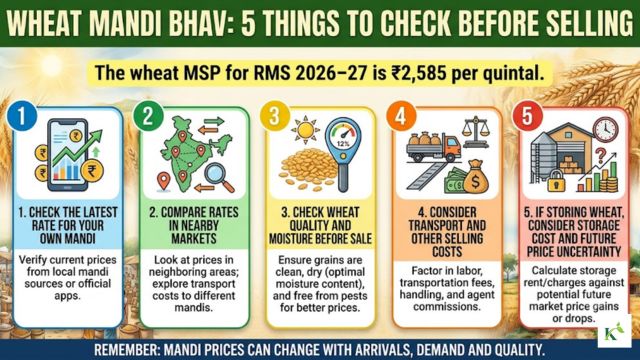
- Wheat MSP 2026-27: ₹2,585 per quintal (up ₹160 from last year)
- Procurement window: April to June in most states; UP: 30 March, 15 June 2026; Punjab and Haryana: till 31 May 2026; Rajasthan and MP: till 15 June 2026
- Typical post-harvest mandi rate: Often ₹50, ₹150 below MSP in April, May (based on APMC spot-price data from major North India mandis)
- Best open-market window: September to December in most North India mandis
- Covered warehouse storage cost: Approximately ₹5, ₹9 per quintal per month
- Spoilage loss (bag storage): Roughly 0.3% per month for the first six months
The question every kisaan (farmer) faces after rabi harvest is the same: gehun bechne ka sahi samay, sell now or wait? The answer is not the same for everyone, and it shifts every year based on MSP procurement dates, open-market price movement, your storage situation, and government policy. This guide gives you a clear framework to decide when to sell your gehun (wheat) for maximum profit, whether you are selling to a government procurement centre or in the open mandi (market).
Two broad paths exist. The first is selling within the government procurement window at the fixed MSP floor of ₹2,585 per quintal for 2026-27. The second is holding stock and selling in the open market when prices recover later in the year. Both are valid strategies, but only under the right conditions for each farmer. Based on historical seasonal price spreads, the wrong choice in either direction can cost you ₹100 to ₹200 per quintal, that is ₹10,000 to ₹20,000 on 100 quintals of wheat.
Read this guide end to end before your next tractorload leaves your farm.
 Table of Contents
- How wheat prices move through the year in India
- The MSP safety net and wheat procurement window
- Gehun bechne ka sahi samay: why April, June is rarely your best open-market window
- Gehun bechne ka sahi samay, storage cost and break-even
- The best months to sell wheat for maximum profit in 2026
- Reading mandi price signals before you decide
- Step-by-step: how to sell wheat at MSP or in the open mandi
- Where can I check today's wheat mandi rates in North India?
- FAQs
How wheat prices move through the year in India
Wheat prices in India follow a predictable seasonal pattern. Prices are weakest between April and June, recover slowly through July and August, and reach their highest open-market levels between September and December. Understanding this cycle is the foundation of every smart decision about gehun bechne ka sahi samay.
The harvest-arrival flood and why it pushes prices down
Every April, millions of quintals of rabi gehun arrive at mandis across Punjab, Haryana, Uttar Pradesh, Madhya Pradesh, and Rajasthan at almost the same time. Supply rises faster than the market can absorb, and mandi rates soften. In April, May, open-market rates in major North India mandis commonly sit ₹50, ₹150 per quintal below the MSP floor, a pattern observed consistently in APMC spot-price data from 2022 to 2026. Traders and arhatiyas (commission agents) hold the negotiating advantage at this stage, they know farmers face storage costs and loan repayment pressure, and they price their bids accordingly. This is the weakest window to sell in the open market if you are targeting the highest price.
The quiet recovery between July and August
Once MSP procurement agencies stop buying and fresh arrivals thin out, the market begins to rebalance. Flour mills start drawing down their stocked inventory, and open-market rates edge upward. The movement is not dramatic in these months, but the direction clearly shifts. Farmers who stored wheat and are monitoring the mandi bhav (market price) will begin to see a gradual firming from late June onwards.
The peak window: September to December
By September, domestic stock levels are tighter, kharif crop activity is absorbing farmer attention, and wheat supply in mandis is much thinner. Mandi price data from North India consistently shows that gehun fetches its highest open-market rates in the September-to-December window. For farmers who stored wheat after harvest, this four-month period is typically the sweet spot for selling. Punjab and Haryana mandis have historically recorded rates ₹100, ₹250 above harvest-time prices during this period, though the exact gain varies with government policy and annual supply conditions.
The MSP safety net and wheat procurement window
The MSP (Minimum Support Price) is the government's guaranteed floor price for your wheat. In 2026-27, the Union Cabinet fixed the wheat MSP at ₹2,585 per quintal, a ₹160 increase over the previous year's rate of ₹2,425. If open mandi rates fall below ₹2,585, you have the option to sell at the guaranteed rate through authorised procurement agencies. This protects you from distress selling at harvest-time lows.
When procurement centres are open in 2026
The procurement window varies by state. Uttar Pradesh ran its 2026 procurement from 30 March to 15 June. Punjab and Haryana closed procurement on 31 May 2026. Rajasthan and Madhya Pradesh remained open until 15 June 2026. These windows are fixed in advance by state governments, and selling within your state's designated period at an authorised procurement centre is the most reliable way to lock in ₹2,585 per quintal with direct bank transfer.
How to check if procurement is still active in your district
State governments announce procurement dates through official state agriculture portals and local mandi boards. If you missed the initial announcement, your nearest Krishi Upaj Mandi Samiti (KUMS) office or the state food and civil supplies department can confirm whether procurement is still running in your district. In Madhya Pradesh, registration was available free of charge at Gram Panchayat and Janpad offices. Gujarat allowed registration at village level through Village Computer Entrepreneurs (VCEs), so farmers did not need to travel to the taluka centre.
Gehun bechne ka sahi samay: why April, June is rarely your best open-market window
Selling at MSP during the procurement window is a strong move. But selling in the open mandi during the same April, June period is almost always the weakest option. Here is the arithmetic of why.
When every farmer in your region brings gehun to the mandi at the same time, buyers hold the negotiating advantage. They know you face storage costs, handling expenses, and often outstanding crop loans. They price their bids accordingly. Open-market rates in peak arrival months frequently sit below what you would get by waiting even 60 days, let alone five months.
The other risk is missing the MSP procurement window entirely. Many farmers miss the registration deadline, face queue delays at procurement centres, or find their block centre is already at capacity. Those who cannot access MSP procurement are then forced to sell in the open market at harvest-time lows, the worst of both outcomes. Registration for MSP procurement must happen before the crop arrives at the mandi, not after.
There is one scenario where April selling in the open market makes sense: if you have no reliable storage, have a high-interest crop loan falling due, or your wheat is already showing signs of moisture or pest risk, sell quickly. Holding damaged or at-risk wheat for five months to chase a ₹100 per quintal gain is not a strategy; it is a gamble with very poor odds.
Gehun bechne ka sahi samay, storage cost and break-even
Storage is not free, and most farmers undercount its true cost. Before deciding to hold your gehun stock, run the numbers honestly.
What storage actually costs in North India
Covered godown or CWC (Central Warehousing Corporation) storage costs range from approximately ₹5, ₹9 per quintal per month, depending on the facility type and state. For a farmer storing 100 quintals for five months in a covered facility, that is ₹2,500, ₹4,500 in storage charges alone, before accounting for handling and transport to the facility. CAP (Cover and Plinth) open storage is cheaper at around ₹2.40 per quintal per month, but carries a higher spoilage and quality-loss risk, particularly through the monsoon months.
Spoilage losses: the hidden cost most farmers undercount
Bag-stored wheat loses roughly 0.3% of its weight per month in the first six months due to moisture absorption, rodent activity, and natural drying. On 100 quintals stored for five months, that is approximately 1.5 quintals lost, worth around ₹3,877 at MSP rates. Add storage charges and handling costs, and the total cost of holding wheat for five months in a covered facility easily reaches ₹6,000, ₹8,000 for 100 quintals.
The break-even price gain you actually need
To make storage financially worthwhile, the mandi rate at the time you sell must be at least ₹60, ₹80 per quintal higher than the harvest-time rate, just to cover costs. This figure is based on a five-month holding period: roughly ₹5, ₹9 per quintal per month in storage charges (₹25, ₹45 total) plus approximately ₹15, ₹25 for handling, transport, and spoilage losses, bringing the total break-even threshold to ₹60, ₹80 per quintal.
The September-to-December price recovery in North India mandis has often exceeded this threshold historically, but recovery is not guaranteed in every year. Government buffer stock releases, export policy shifts, and global wheat price movements can all compress the seasonal price rise. In 2026, India's move towards full wheat export liberalisation improved the recovery outlook compared to the post-2022 export-ban period, when the seasonal rebound was flatter than usual.
The best months to sell wheat for maximum profit in 2026
This comes down to two scenarios. Once you know which one applies to you, the decision on gehun bechne ka sahi samay becomes clear.
If MSP procurement is open and you are registered: sell immediately at the procurement centre. You get a guaranteed ₹2,585 per quintal with direct bank transfer and zero open-market risk. No seasonal gamble is worth taking when a guaranteed floor is available and accessible to you.
If you are selling in the open market with reliable, low-cost storage and no urgent cash-flow pressure, target the September-to-December window. This period consistently sees the tightest wheat supply of the year in North India mandis, before the next rabi crop begins its growth cycle. The seasonal gain has historically ranged from ₹100, ₹250 per quintal above harvest-time prices in Punjab and Haryana mandis.
Three factors can specifically shift your ideal selling month in 2026:
- Government OMSS releases: If the government releases large quantities of wheat from national buffer stocks through Open Market Sale Scheme auctions, as it did in 2024 and 2025, prices may not recover as sharply in the October, December window.
- Export liberalisation: India's move to full wheat export liberalisation in 2026 adds export demand to the domestic market, which tends to support price recovery. This is a positive signal for farmers who can afford to wait.
- Next rabi crop outlook: Early indicators of the next rabi crop size, good monsoon soil moisture and forecasts of a large crop, can put a ceiling on current-season price gains sooner than usual.
Reading mandi price signals before you decide
Do not make a selling decision based on one day's rate or an arhatiya's word. You need at least three data points to make a confident call.
The three price signals that actually matter
Check the current mandi rate for gehun at your nearest APMC yard. Then check the direction of price movement over the past 10, 15 days: rising, flat, or falling. Finally, compare that rate against the MSP floor of ₹2,585 per quintal. If the open-market rate is within ₹50 of MSP and trending upward, waiting has clear potential. If it is ₹100 or more below MSP and trending flat, that gap is unlikely to close without a specific market catalyst.
How KhetiKisaan helps you track live gehun mandi bhav
KhetiKisaan gives you verified daily wheat mandi bhav sourced from on-ground contacts present at live APMC auctions, not delayed government feeds or averaged estimates. You can compare rates across multiple mandis, including Sri Ganganagar, Nohar, and other key North India centres, on the same day. Monitoring the rate movement for 10, 15 days before deciding to sell gives you a concrete data advantage over relying on a single buyer's quote. KhetiKisaan's network is built specifically around the agricultural belts of Rajasthan, Haryana, and Punjab, the states where timing decisions matter most for wheat growers.
Mandi-to-mandi variation: use it to your advantage
Wheat rates are not uniform across mandis, even within the same state. On any given day, one mandi may be ₹60, ₹80 per quintal higher than a neighbouring one, depending on buyer competition, transport access, and local perception of crop quality. In 2025, the Khanna mandi in Punjab was reporting ₹2,700 per quintal while several other Punjab mandis were clustered around ₹2,425, ₹2,440 per quintal on comparable days. Checking rates across two or three mandis before loading your trolley can meaningfully increase your net realisation without requiring you to wait months for the seasonal price recovery.
Step-by-step: how to sell wheat at MSP or in the open mandi
Documents you need for MSP procurement registration
Keep these ready before visiting a registration centre. Missing any one document means a wasted trip.
- Aadhaar card (name must match your land records exactly)
- Khasra, khatauni, or land patta as land proof
- Aadhaar-linked bank account number and IFSC code
- Mobile number registered with Aadhaar (for OTP verification in states like MP)
- Passport-size photograph
- In some states (MP and others): an additional voter ID or alternate photo identity document
- Tenant or sharecropper farmers: lease or contract papers; registration must be done at authorised cooperative society centres in states like MP
Selling at an MSP procurement centre: the step-by-step process
- Check your state's procurement portal or nearest KUMS office for registration dates and designated procurement centres in your block.
- Register as a farmer, online through the state procurement portal or at an approved facilitation centre. In MP, free registration was available at Gram Panchayat and Janpad offices; a paid option at MP Online or CSC kiosks was capped at ₹50.
- Complete Aadhaar-based identity verification through OTP or biometric authentication, depending on your state's system.
- Resolve any name mismatch between your Aadhaar and land records before submitting. This is the single most common cause of delay.
- Receive your registration slip or token with a date and procurement centre allocation.
- Bring dry, clean wheat meeting the state's quality parameters for moisture content and foreign matter to your assigned centre on the allotted date.
- After quality and weight verification, wheat is accepted at MSP. Payment is credited directly to your linked bank account, timing varies by state, so check your state procurement portal for the standard turnaround in your district.
Getting the best rate in the open mandi
If you are selling in the open market, arrive at the mandi early when trading is active and buyer competition is highest. Before leaving your farm, check the day's rate on KhetiKisaan so you know the benchmark at your target mandi. If the first arhatiya's quote is materially lower than what you tracked, ask a second buyer or speak to the mandi secretary about the day's rate range. Clean, dry wheat with low moisture and good grain quality consistently fetches the top end of any day's price band. Preparation at the farm level directly translates into better realisation at the mandi.
Where can I check today's wheat mandi rates in North India?
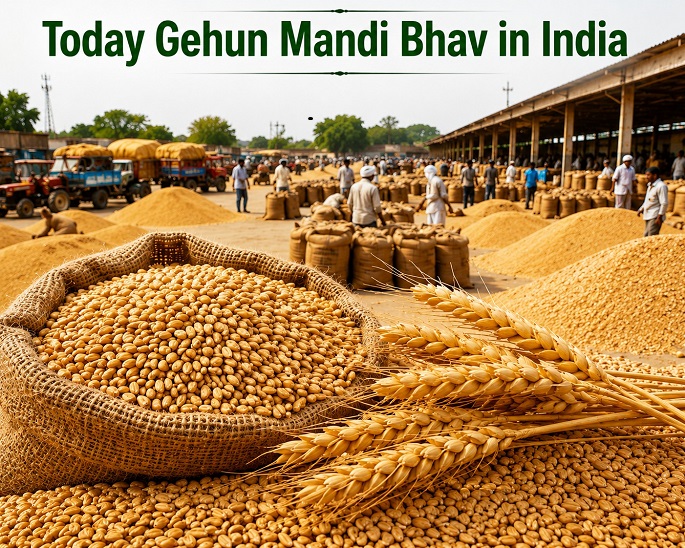
KhetiKisaan publishes verified daily gehun mandi bhav sourced directly from APMC auction floors across North India. On-ground contacts are present at live auctions in mandis across Rajasthan, Haryana, and Punjab, including Sri Ganganagar and Nohar. Tracking price direction on KhetiKisaan over 10, 15 days before you decide to sell gives you a real-time data advantage over relying solely on your local arhatiya's quote, which may not reflect what the full market is paying that day.
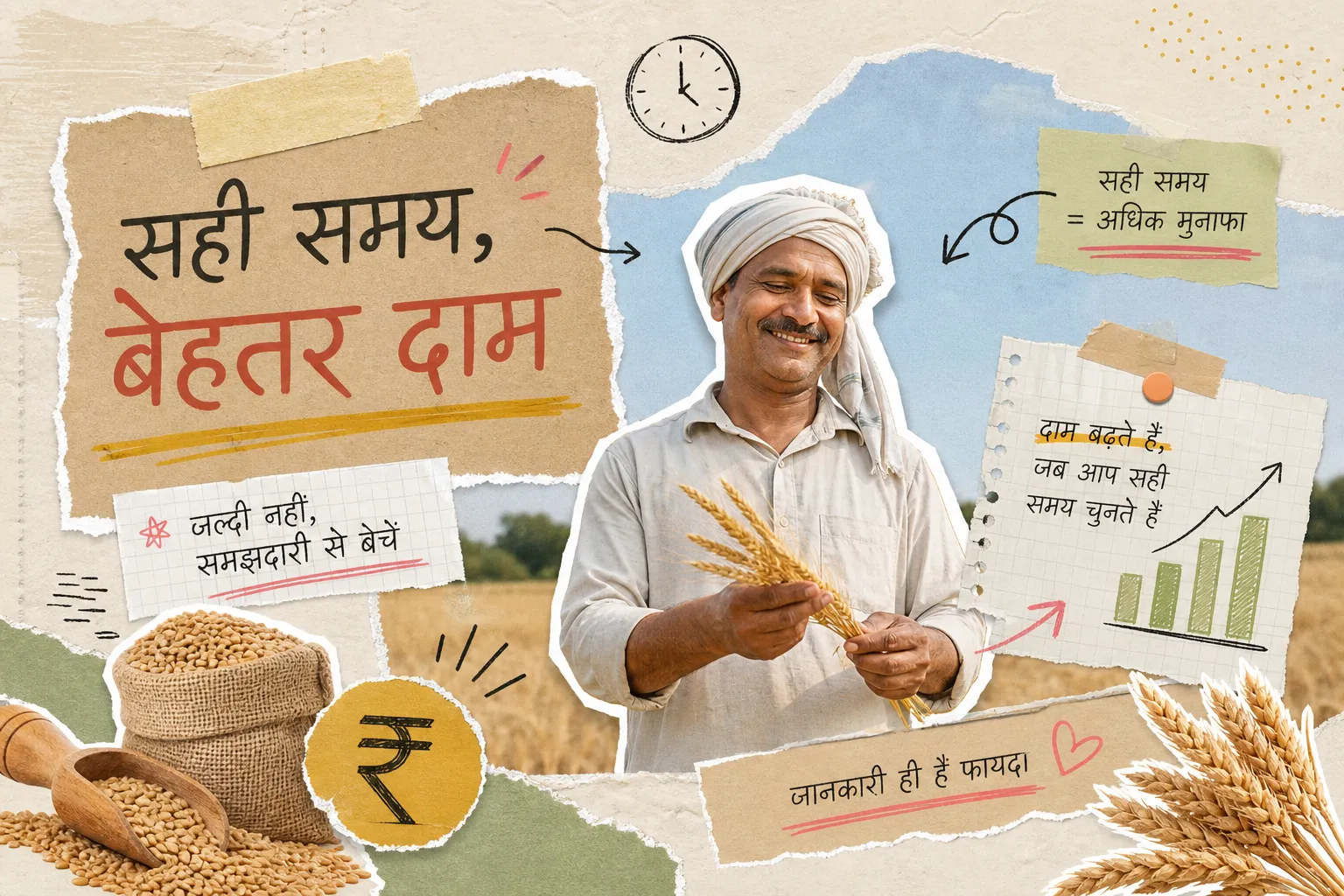
In short, gehun bechne ka sahi samay comes down to three things: whether MSP procurement is open and accessible to you, what your storage costs and cash-flow situation look like, and what the mandi price signals are telling you over the past fortnight. Match your decision to those three factors, not to a neighbour's timetable or a single buyer's word, and you will be in a far stronger position to sell your wheat at the right time and the right price.