







Aaj Ka Mandi Bhav: Today's Live APMC Crop Prices
 Sep 02, 2026
 by Pankaj Sihag



Aaj Ka Mandi Bhav: Today's Live APMC Crop Prices
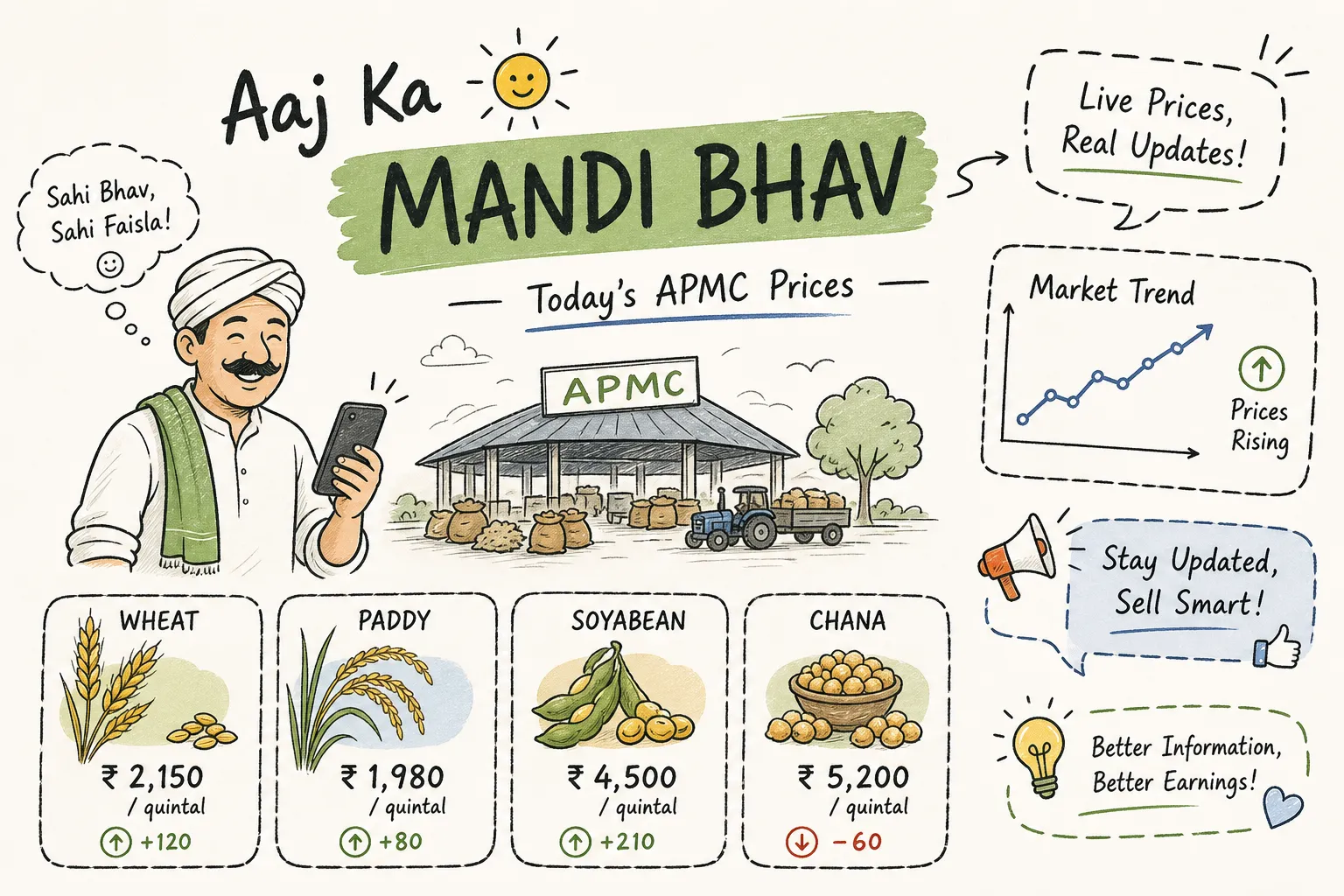
Before you load your trolley and drive to the mandi, spend two minutes checking today's crop prices. That single habit can mean the difference between walking away with a fair return and accepting whatever rate the arhatiya (commission agent) quotes you. Aaj ka mandi bhav is the daily auction price at which a crop changes hands at an APMC (Agricultural Produce Market Committee) yard, confirmed each morning after the bol-chaal (live bidding) session concludes. It is not an estimate and not a weekly average. It is what buyers actually paid for similar produce in that very yard a few hours ago.
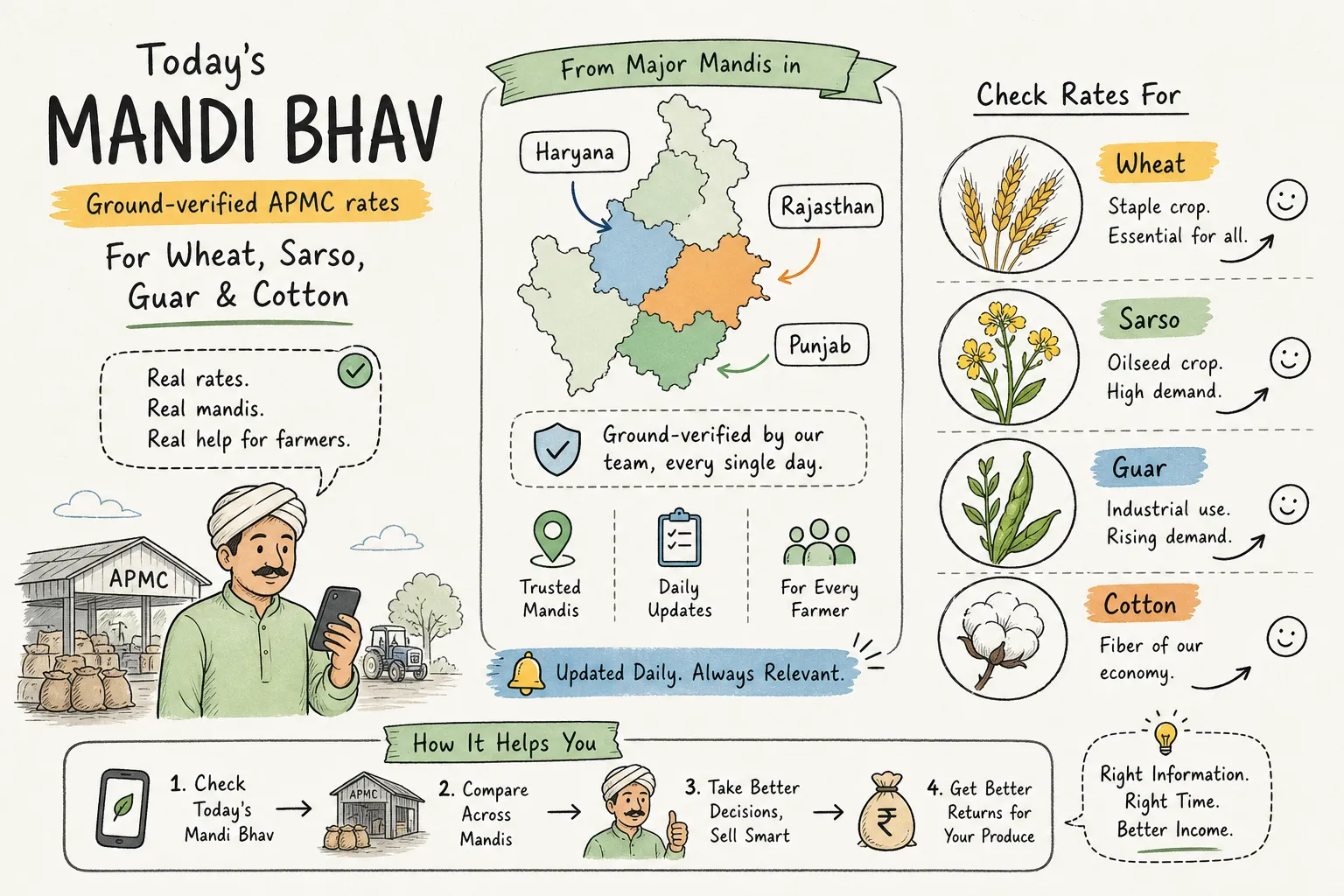
A growing number of kisaans across Rajasthan, Haryana, and Punjab now start their day by checking KhetiKisaan for today's mandi rates, live mandi prices that reflect actual bol-chaal transactions, before deciding whether to sell or hold their fasal (crop). The reason is straightforward: mandi rates shift every single day based on how much produce arrived, how many buyers are active, and what news is circulating about MSP or exports. Relying on yesterday's rates or your neighbour's word-of-mouth is not good enough when real money is at stake.
This article gives you a clear explanation of how aaj ka mandi bhav works, how to read modal and arrival data correctly, recently verified ground rates across major APMC yards, and a practical method for comparing nearby mandis to find your best selling option.
- Bhav is updated each morning after the bol-chaal session at each APMC yard
- Modal rate = the most common transaction price (as defined byAgmarknet/eNAM reporting standards); this is the number to plan around
- Rates vary mandi to mandi, sometimes by ₹50, ₹150 per quintal within the same district
- Arrival volume (aavak) directly influences that day's price: heavy arrivals soften rates, thin arrivals firm them up
 Table of Contents
- What "aaj ka mandi bhav" actually means at the ground level
- How to read mandi price list data correctly
- Today's mandi bhav for major crops across Rajasthan's APMC yards
- Live mandi bhav across Haryana and Punjab today
- Why KhetiKisaan's same-day bhav is more timely than official portal data
- How to compare aaj ka mandi bhav across nearby mandis
- How to download mandi bhav and get daily price alerts
- Final words
- FAQs
What "aaj ka mandi bhav" actually means at the ground level
Every licensed APMC mandi holds a daily auction called bol-chaal, where commission agents bid on the lots of produce a farmer brings in. The price agreed at the end of that bidding round is what becomes the day's bhav for that crop and grade at that yard. This is an actual transaction rate, not an estimate or government calculation.
The sequence works like this: you arrive with your produce and the lot is graded visually by buyers. Bidding then opens among the arhatiyas. The highest bid is finalised and the transaction is recorded. That recorded number is what appears as today's mandi bhav. The entire process can take anywhere from a few minutes to roughly half an hour, depending on the size of your lot and the number of buyers present, a typical range reported by mandi practitioners. What matters for you as a seller is that the rate is set by real competition among real buyers, which means arriving when buyer participation is high generally gives you a better chance of fetching a strong price.
Why bhav changes every single day
Several forces move mandi rates from one day to the next. Arrivals (aavak) play the biggest role: when large volumes of a crop reach the yard on the same day, supply exceeds demand and prices soften. On low-arrival days, buyers compete harder for available stock and rates hold firm or rise. Demand from traders and processors is the second major factor, a flour mill running low on wheat stock will bid more aggressively than one with a full godown. Market news is the third: an MSP revision announcement, an export restriction, or a sudden weather event can shift sentiment and prices within hours.
This daily volatility is precisely why checking aaj ka mandi bhav every single morning matters. Last week's rates or last month's average are not a reliable guide to what the arhatiya will offer you today. The kisaan who checks before leaving has the information needed to negotiate; the one who does not is negotiating blind.
How to read mandi price list data correctly
Modal rate vs minimum and maximum explained
Every mandi bhav listing shows three numbers for each crop. Understanding what each number actually represents stops you from making a costly planning mistake. The modal price, defined by Agmarknet and eNAM as the most frequently occurring transaction price, is the figure that best represents where the bulk of actual trade settled on a given day.
| Rate | Hindi term | What it means | How to use it |
|---|---|---|---|
| Minimum | न्यूनतम | Lowest price any lot fetched that day, usually for distress quality or excess supply | Treat as the floor, not your expected rate |
| Maximum | अधिकतम | Highest price for the best-graded premium lot of that crop | Treat as the ceiling, not a realistic base for planning |
| Modal | प्रचलित | Most common transaction price where the bulk of actual trade happened | Use this number for all your planning and estimation |
The modal rate is the only number a farmer should use when estimating how much a crop lot will realise. The minimum tells you the worst-case scenario; the maximum tells you what the top-grade produce earned. Neither is representative of what an ordinary lot at ordinary quality will fetch. The modal rate is where most of the day's business actually settled.
What arrival data (aavak) tells you before you leave home
Every mandi bhav table worth reading also shows the day's arrival figure in quintals. This number is as important as the modal price. If today's wheat aavak at Sri Ganganagar is significantly higher than the previous few days, you can expect the modal bhav to be softer. Conversely, low aavak with steady buyer demand tends to keep rates firm or push them upward.
Read the aavak figure alongside the modal price, not in isolation. A modal price of ₹2,600/qtl on a day when 10,000 quintals arrived is more fragile than the same rate on a day when only 4,000 quintals arrived. Both numbers together give you a far clearer picture of where prices are heading than price alone. Checking aaj ka mandi bhav alongside aavak data each morning is the habit that separates informed sellers from those who accept whatever rate they are offered.
Today's mandi bhav for major crops across Rajasthan's APMC yards
Wheat, sarso and chana rates at Sri Ganganagar and Nohar mandis
The figures below are indicative ground rates compiled from KhetiKisaan's on-ground contacts at APMC yards. Wholesale crop rates are updated each morning after bol-chaal; verify the most current figures on the KhetiKisaan platform before leaving for the mandi, as exact rates change daily.
| Crop | Mandi | Min (₹/qtl) | Modal (₹/qtl) | Max (₹/qtl) |
|---|---|---|---|---|
| Wheat (Gehun) | Sri Ganganagar | 2,335 | 2,581 | 2,761 |
| Mustard (Sarso) | Sri Ganganagar | 6,200 | 6,551 | 6,650 |
| Chickpea (Chana) | Sri Ganganagar | 4,950 | 5,400 | 5,410 |
| Cotton | Rajasthan (state) | 5,353 | 5,353 | 5,353 |
Note: The cotton row shows identical minimum, modal, and maximum values, indicating either a single-lot trading day or MSP-floor procurement at this level. Verify with your local APMC office for full trading context before making a selling decision.
Sarso rates at Sri Ganganagar are currently holding firm, supported by steady processor demand and a relatively moderate aavak. Wheat modal prices are tracking close to MSP levels, which means government procurement through state agencies remains a relevant option if open-market rates slip below the support price. Chana bhav has stabilised after the volatility seen earlier in the season, and most lots are clearing near the modal level without sharp discounts.
Guar, moong and other kharif crop rates in Rajasthan today
| Crop | Mandi | Min (₹/qtl) | Modal (₹/qtl) | Max (₹/qtl) |
|---|---|---|---|---|
| Guar (Cluster Bean) | Sri Ganganagar | 4,800 | 5,615 | 5,675 |
| Moong (Green Gram) | Rajasthan (state) | 7,000 | 7,400 | 8,200 |
| Arandi (Castor) | Rajasthan (state) | 5,800 | 6,100 | 6,500 |
Guar bhav in the Sri Ganganagar belt is closely linked to export demand from the global oilfield industry. Guar gum derivatives are used in hydraulic fracturing (fracking), and when international oilfield activity rises, guar prices in Rajasthan tend to firm up quickly. If you are holding guar stock, tracking international crude oil activity is as relevant as watching local aavak. Moong rates are currently on the stronger side, reflecting tighter supply post-kharif, which makes it a reasonable crop to hold if your storage is sound and free from moisture risk.
Live mandi bhav across Haryana and Punjab today
Paddy and basmati dhaan rates at Haryana mandis
| Crop / Variety | Mandi | Modal (₹/qtl) | Trend |
|---|---|---|---|
| Paddy Basmati 1121 | Panipat APMC | 3,800 | Firm to rising |
| Paddy Basmati 1121 | Karnal APMC | 3,900 | Firm |
| Common Paddy | New Grain Market, Karnal | 2,389 | Stable near MSP |
Basmati dhaan grades at Panipat and Karnal are showing firm-to-rising movement, driven by steady demand from rice exporters eyeing the upcoming procurement window. Common paddy, however, is largely range-bound near MSP levels. If the market rate for your variety is at or below MSP, the government procurement window becomes directly relevant: you have the right to sell to state agencies at the support price rather than accepting a below-MSP rate from private buyers at the mandi.
Understanding whether your specific paddy variety qualifies for MSP procurement is worth confirming with your local Krishi Upaj Mandi Samiti (KUMS) office or through KhetiKisaan's scheme guides before the selling season peaks.
Narma cotton and wheat bhav in Punjab's key yards
Narma (American cotton) consistently commands a premium over desi cotton at Punjab mandis because textile mills strongly prefer narma's longer staple fibre for spinning finer yarn grades. The price gap between narma and desi cotton can range from ₹200, ₹600 per quintal depending on market conditions, making variety selection at the sowing stage a decision with a direct financial consequence at harvest time.
Wheat rates in Punjab mandis are broadly tracking the national MSP trajectory, with active mandis like Ludhiana and Amritsar showing modest premiums for good-quality, low-moisture lots. If arrivals at your nearest yard have been heavy over the past few days, consider whether waiting a week for aavak to thin out would earn you a better modal rate. Check KhetiKisaan's daily Punjab listings to track that movement before committing to a selling date.
Why KhetiKisaan's same-day bhav is more timely than official portal data
The problem with government portal data (Agmarknet and eNAM)
Agmarknet is the government's primary mandi price database, and it serves an important purpose at the national level. However, its data collection model works like this: APMC markets compile and upload their daily transaction data, and the central portal publishes these figures. The result is that rates a farmer reads on Agmarknet in the morning often reflect the previous day's session, not the current morning's bol-chaal. Research into Agmarknet's reporting cycle indicates that the data entry window for many mandis runs until 11:30 PM the following day, though this may vary by mandi and weekend submission rules can create further variation. The built-in lag is real, even if the exact cut-off differs across yards.
eNAM (National Agriculture Market) integrates mandis onto a digital trading platform and offers faster updates for integrated yards. The issue is that a large number of APMC yards in Rajasthan and Haryana are not yet fully integrated into eNAM, so their rates still appear on Agmarknet with the standard delay. For a farmer deciding whether to load a trolley and drive to the mandi in the next two hours, day-old data is not useful data.
How KhetiKisaan captures prices during the actual bol-chaal session
Platforms that maintain on-ground contacts at APMC yards during the morning bidding session can report actual transaction rates as bol-chaal concludes, giving farmers same-day, ground-level data rather than last evening's government feed. KhetiKisaan operates on this model, which means the bhav on the platform reflects what is happening at the yard that morning rather than an estimated average from the previous day's government upload.
For a farmer making a same-day selling decision, this timing difference is significant. A rate that reflects this morning's bidding is actionable; a rate from yesterday's session may already be obsolete if a large truck convoy arrived at the yard overnight and softened prices. Many farmers in North India's agricultural belt now use KhetiKisaan as their first check of the morning precisely because the rates are sourced from live sessions rather than a government publication cycle. Checking aaj ka mandi bhav on a same-day ground-verified source before heading out has become standard practice among farmers who want to negotiate from a position of knowledge.
How to compare aaj ka mandi bhav across nearby mandis
Which factors beyond price determine the best mandi to sell at
The modal price per quintal is not the only number that determines your final profit from a sale. A mandi 40 km further away may offer ₹100/qtl more on wheat, but that advantage disappears quickly once you account for additional transport cost, weighing charges, arhatiya commission (dalaali), and the time cost of a longer journey. The number that actually matters is net realisation: the amount that reaches your pocket after all deductions.
The formula is straightforward: Net realisation per quintal = modal price at that mandi minus (transport cost per quintal + mandi fee per quintal + commission per quintal + handling charges per quintal). Running this calculation for two or three mandis before you leave takes ten minutes and can save you from a decision that looks good on the price board but costs you on the ground.
Using a two-or-three-mandi comparison to find your best option
The practical approach is to pull aaj ka mandi bhav from two or three mandis within your district or reasonable driving distance, then subtract your estimated transport and commission costs for each option. If Sri Ganganagar is offering ₹30/qtl more than Nohar but the extra distance adds ₹25/qtl in transport cost, your actual advantage is only ₹5 per quintal. For a 50-quintal lot, that is ₹250 extra, which may not justify an extra hour of travel and the added stress on your vehicle.
KhetiKisaan's mandi-wise listings make this comparison quick and consistent. Rather than making multiple phone calls to commission agents at different yards, where the rate quoted may not reflect actual bidding conditions, you can pull verified modal rates for several mandis in one place and run your net calculation in minutes. The best mandi to sell at today may not be the one closest to your farm, but it will always be the one with the highest net realisation after all costs are subtracted.
How to download mandi bhav and get daily price alerts
Most serious mandi bhav platforms allow you to export a filtered mandi price list download as an Excel (.xlsx) or CSV file. The process involves selecting your state, district, mandi, and commodity from the filter options, then clicking the export button above the data table. This is particularly useful for traders, commission agents (arhatiyas), and larger farm operators who track wholesale crop rates across multiple mandis daily or need price records for procurement planning and buyer negotiations.
Agmarknet and eNAM also offer data downloads, but as noted earlier, these reflect end-of-day government feeds rather than live session rates. For daily operational decisions, a download from a ground-verified source is far more useful than a compiled government dataset that may already be 12, 24 hours old by the time you access it.
Setting up daily crop price notifications for your mandi
Daily alert subscriptions work by allowing you to select your preferred mandi and crop, after which you receive a morning update via app notification, SMS, or WhatsApp as soon as the day's bhav is confirmed post bol-chaal. This removes the need to remember to check manually and ensures you never start your decision-making process on stale data.
KhetiKisaan's update channel makes it straightforward to set this up for North India's key crops and mandis. Select your crop, for example, sarso at Sri Ganganagar or basmati dhaan at Karnal, and receive a morning notification with the verified modal, minimum, and maximum rates directly. Over time, these daily alerts also give you a running picture of price direction, which is invaluable for deciding whether to sell now or store and wait for a stronger market.
Final words
Aaj ka mandi bhav is not just a number on a screen. It is the single most important data point for every selling decision you make as a farmer. Reading the modal rate correctly, understanding what the day's aavak means for price direction, and comparing net realisation across two or three nearby mandis puts you firmly in control of your selling outcome rather than at the mercy of whatever rate an arhatiya chooses to quote you at the yard.
Make KhetiKisaan your first check every morning before deciding whether to head to the mandi, which yard to target, and whether today's rates are strong enough to sell or worth waiting out. Ground-verified rates from live bol-chaal sessions across Rajasthan, Haryana, and Punjab are updated every morning so your information is as fresh as the day's auction. The more accurately you read your crop bhav, the more your fasal earns.