







Narma Bhav Today: Live Rates, Trends & Seller Tips
 Aug 26, 2026
 by Pankaj Sihag



Narma Bhav Today: Live Rates, Trends & Seller Tips
- Data collected: KhetiKisaan ground reporters physically present at live APMC bol-chaal (auction) sessions, morning of 26 August 2026
- North India narma bhav range: ₹6,250 to ₹8,551 per quintal (verified mandis; see note below)
- Highest North India mandi today: Sri Ganganagar, Rajasthan (modal ₹8,551/quintal)
- Lowest mandi today: Tosham, Bhiwani district, Haryana (₹6,400/quintal)
- Week-on-week trend: Mild mandaa (price softening), down approx. ₹50/quintal over the last 5 sessions in North India (based on available short-series mandi data; see trend section for detail)
- Kharif 2026 MSP (medium-staple cotton): ₹8,267 per quintal
Note: The upper bound reflects the highest verified rate at covered North India mandis. Karnataka mandis (e.g. Kanakagiri, ₹9,250 modal) are covered separately in Section 1 as a national reference point.
 Table of Contents
- American Cotton (Narma) Ka Bhav Today
- Narma Bhav Today: Key APMC Mandi Rates (₹ per quintal)
- This Week vs Last Week: Reading the Narma Bhav Trend
- What Is Moving Narma Bhav Right Now
- Quality Factors That Affect Your Per-Quintal Narma Rate
- From Mandi Rate to Your Pocket: What You Actually Earn
- Sell Today, Negotiate, or Wait: A Practical Decision for Your Crop
- Final Word: Today's Narma Bhav and What to Do Next
- FAQs
American Cotton (Narma) Ka Bhav Today
Every cotton kisaan loading a trolley this morning is asking the same question: what is the narma bhav today, and is this rate worth selling at? That is exactly the right question to ask before you drive to the mandi yard, not after you have already unloaded your kapas (raw cotton). Today's narma cotton price at key mandis like Sri Ganganagar is sitting above the Kharif 2026 MSP floor, while several Haryana mandis are still trading below that level, making mandi choice as important as timing.
The figures in this article come from KhetiKisaan's network of on-ground contacts who are physically present at APMC bol-chaal sessions during live auctions. What you see here reflects what traders and ginners are actually bidding for your kapas at the yard this morning, not data pulled from delayed government feeds or averaged from last week's reports.
Below you will find mandi-wise rates, a week-on-week trend comparison, the quality factors that shift your per-quintal realisation, a net earnings calculation, and a clear sell-or-wait framework to help you act with confidence.
Narma Bhav Today: Key APMC Mandi Rates (₹ per quintal)
Sri Ganganagar and Nohar: Narma Bhav Today, Live Auction Snapshot
Sri Ganganagar continues to post the strongest narma kapas bhav in Rajasthan. This morning's bol-chaal shows the modal rate at ₹8,551 per quintal, which is above the Kharif 2026 MSP of ₹8,267. Based on reporter observations at the yard, arrivals appear moderate rather than heavy this session, lighter trolley volumes mean less competition among sellers and stronger bidding from ginning mills, which is supporting the rate.
|
Mandi |
Min (₹/quintal) |
Modal (₹/quintal) |
Max (₹/quintal) |
|---|---|---|---|
|
Sri Ganganagar, Rajasthan |
₹7,800* |
₹8,551 |
₹8,900* |
|
Nohar, Hanumangarh belt |
₹7,100† |
₹7,450† |
₹7,700† |
Source: KhetiKisaan ground reporters, 26 August 2026 morning session. *Min/max figures are reporter-observed range estimates; modal rate is the primary verified figure. †Nohar figures are provisional pending full session confirmation, treat as indicative.
Haryana Mandis: Bhiwani and Siwani's Current Range
Narma cotton rates in Haryana's Bhiwani district are running noticeably below both the Rajasthan mandis and the 2026 MSP level. The modal rate at Bhiwani is ₹6,540 per quintal, with a spread from ₹6,250 at the low end to ₹7,150 at the top. Siwani sub-mandi within the same district is showing a stronger ₹7,125. Haryana rates typically track Rajasthan with a slight lag because arrival timing and buyer concentration differ across states.
|
Mandi |
Min (₹/quintal) |
Modal (₹/quintal) |
Max (₹/quintal) |
|---|---|---|---|
|
Bhiwani, Haryana |
₹6,250 |
₹6,540 |
₹7,150 |
|
Siwani, Bhiwani district |
₹6,900 |
₹7,125 |
₹7,300 |
|
Tosham, Bhiwani district |
₹6,200 |
₹6,400 |
₹6,600 |
Karnataka Reference Rate: How Distant Markets Compare
For perspective on the national price spread, narma BT cotton at Kanakagiri mandi in Koppal district, Karnataka is trading at a modal of ₹9,250 per quintal, with a range of ₹8,976 to ₹9,400. This premium over North India rates is not a market inefficiency you can easily exploit. It is driven by local fibre variety differences, higher buyer concentration from domestic spinning mills, and transport costs that make cross-state arbitrage unviable for most kisaans in Rajasthan or Haryana.
This Week vs Last Week: Reading the Narma Bhav Trend
A Simple Comparison: Recent Movement at Top Mandis
Prices in North India have been softening gradually over the last week. The movement is not dramatic, but even a modest daily slip compounds across sessions. Based on available short-series mandi data, the cotton rate aaj at the national level appears to have eased by roughly ₹49 per quintal over five consecutive sessions. For a farmer selling 20 quintals, a ₹49 shift represents approximately ₹980 in gross receipts, enough to matter when choosing which day to bring your lot to the yard.
|
Mandi |
Modal rate last week (₹/quintal) |
Modal rate today (₹/quintal) |
Change |
|---|---|---|---|
|
Sri Ganganagar |
₹8,620* |
₹8,551 |
Down ₹69 |
|
Bhiwani |
₹6,600* |
₹6,540 |
Down ₹60 |
*Previous-session modal figures are based on available reporter series data and should be treated as indicative rather than independently verified. Source: KhetiKisaan mandi data series.
How to Tell if It Is Tezi or Mandaa for Narma Right Now
Tezi means prices are rising; mandaa means they are falling. Right now, the short-term signal is mild mandaa in North India. The two indicators to watch are arrival volumes at the yard and the bidding behaviour of ginning mills. When trolley arrivals increase, sellers compete against each other and rates soften. When ginning mill procurement picks up, rates firm even with high arrivals.
Do not read a single session's movement as a confirmed trend. As a practical rule of thumb, watch at least three consecutive bol-chaal sessions before concluding that the kapas rate today is part of a sustained upswing or downslide, one unusual session can skew your read of the market.
What Is Moving Narma Bhav Right Now
Seasonal Arrivals and Weather-Related Quality Losses
August and September mark peak kharif cotton harvest across North India. New crop arrivals are rising, which typically puts downward pressure on rates. However, rainfall in parts of Haryana and Rajasthan has damaged standing kapas and reduced the quality of recently picked cotton. Rain-hit cotton fetches significantly lower rates at the bol-chaal because it raises moisture content and damages lint quality, deductions of ₹200 to ₹400 per quintal for visibly wet lots are not uncommon.
This quality split is creating a wider-than-usual gap between the top and bottom of the day's rate range at most mandis. Farmers who harvested and dried their first picking properly before the rains arrived are in a noticeably stronger position; those bringing in wet or rain-touched lots from later pickings are seeing visible deductions at the yard.
MSP Floor and Mill Demand: The Bigger Picture
The government's Minimum Support Price for medium-staple cotton in Kharif 2026 is ₹8,267 per quintal, up ₹557 from last season's MSP of ₹7,710. This MSP acts as a floor. Mandis trading below this level, as several Haryana markets currently are, indicate either quality issues, excess local supply, or a failure of procurement agencies to activate.
Domestic spinning mills and yarn exporters remain the main buyers pulling prices above MSP in strong mandis like Sri Ganganagar. Mill procurement agents contacted by KhetiKisaan reporters describe demand as steady to firm, which is providing support to the market even as arrivals rise.
Quality Factors That Affect Your Per-Quintal Narma Rate
Moisture and Contamination: The Two Biggest Deductions
Mandis prefer narma kapas below 8 to 10 per cent moisture content. Cotton brought in above that threshold gets a lower rate and sometimes outright rejection from ginners who cannot afford to process wet lint. Contamination from polythene, leaves, and mixed pickings draws immediate deductions at the bol-chaal, often before any bid is even made. The practical advice: dry your kapas on a clean surface for at least two to three sunny days before loading for mandi, and keep your first picking separate from later pickings.
Micronaire and Fibre Grade: What Ginners Actually Pay For
Micronaire measures fibre thickness, and ginners have a clear preference. A micronaire reading of 3.7 to 4.2 earns a premium; values below 3.4 or above 4.9 attract a discount. This premium or discount is applied on top of the day's bol-chaal rate, so two farmers selling at the same mandi on the same day can end up with different per-quintal outcomes based entirely on their lot's fibre grade.
|
Micronaire range |
Pricing effect |
|---|---|
|
3.7 to 4.2 |
Premium rate |
|
3.5 to 3.6 and 4.3 to 4.9 |
Base / standard rate |
|
Below 3.4 or above 4.9 |
Discount applied |
From Mandi Rate to Your Pocket: What You Actually Earn
Converting ₹ per Quintal to ₹ per kg
The formula is simple: divide by 100. One quintal equals 100 kg. If the narma cotton mandi bhav today is ₹8,551 per quintal, your per-kg rate is ₹85.51. Knowing this per-kg figure matters because local village traders often quote lump-sum deals for a tractor load. Converting both figures to ₹ per kg gives you a clean comparison against what the mandi will pay after all deductions.
Deductions That Reduce Your Net Realisation
The ₹8,551 per quintal shown on the rate board is not the amount that reaches your pocket. Several charges reduce that gross figure before settlement. The table below is an illustrative worked example based on typical Rajasthan mandi fee schedules (market fee ~1.6%, commission 2% to 3%) and estimated transport; actual figures will vary by mandi and distance.
|
Deduction item |
Typical rate |
Amount on ₹8,551/quintal |
|---|---|---|
|
~1.6% of sale value |
≈ ₹137 |
|
|
Commission / adat |
~2% to 3% of sale value |
≈ ₹171 to ₹257 |
|
Hamali (loading/unloading labour) |
₹30 to ₹50/quintal |
≈ ₹40 |
|
Transport (farm to mandi) |
Variable by distance |
≈ ₹150 |
|
Estimated net realisation |
|
≈ ₹7,967 to ₹8,073/quintal |
Always calculate the net before comparing two mandis at different distances. A mandi offering ₹200 more per quintal that is 80 km further away can still leave you with less in hand once transport costs are accounted for.
Sell Today, Negotiate, or Wait: A Practical Decision for Your Crop
Signals That Favour Selling Now
If you want to act on narma bhav today, the current conditions at Sri Ganganagar support selling without delay, but consider why. The modal rate is above MSP, which means you are not dependent on government procurement support to get a fair price. Beyond that, if you are paying for a hired godown, every additional week of storage is eating directly into your munafa (profit). Arrival volumes are also expected to climb further through September as more kharif cotton comes in, which could soften the kapas bhav per quintal further still. Farmers with well-dried, good-quality first-picking lots are in the best position to realise today's rates.
Signals That Favour Holding Your Lot
Holding makes sense if your crop quality is strong and you have dry, secure storage at no extra cost. Rain-affected cotton that has not been properly dried should not be rushed to mandi, it will attract heavy deductions at the bol-chaal regardless of the prevailing rate. If arrivals start thinning at your local mandi over the next two to three sessions and rates tick upward, that is the signal to move your lot. Watch at least three consecutive sessions before committing to a hold strategy.
For daily narma cotton mandi bhav before you load your trolley, check KhetiKisaan's morning rate updates. The platform publishes kapas rate aaj data from Sri Ganganagar, Nohar, Bhiwani, and other key APMC centres based on each day's live bol-chaal sessions, giving you a real negotiating reference rather than an estimate from last week.
Final Word: Today's Narma Bhav and What to Do Next
The narma bhav today at Sri Ganganagar is above the Kharif 2026 MSP floor, a positive signal for farmers with quality lots ready to move. Haryana mandis like Bhiwani are trading below MSP, so kisaans in that belt need to pay closer attention to quality presentation and mandi selection. Knowing your net realisation per quintal after all deductions, not just the rate board figure, is what separates a good sale from a fair one.
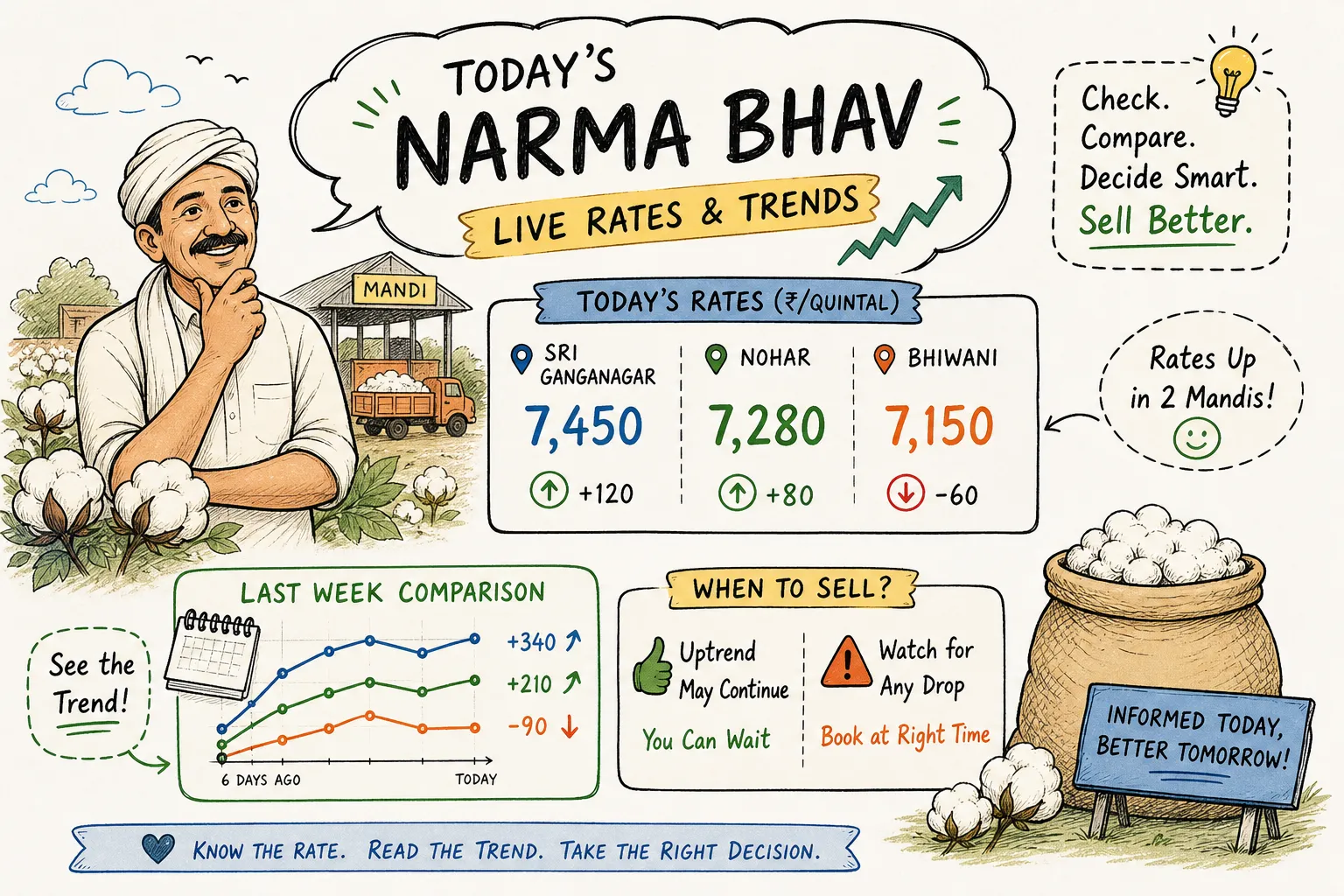
Bookmark KhetiKisaan's daily narma mandi bhav update and check the cotton rate today India-wide every morning before deciding whether to take your crop to the yard. Next week's rates will depend on arrival volumes, mill procurement demand, and any weather disruption in standing cotton areas. Watch the trend across three to four consecutive sessions before making a bulk selling decision, and always dry your kapas properly before loading.