







APMC mandi vs e-NAM: which pays you more per quintal?
 Sep 19, 2026
 by Pankaj Sihag



APMC mandi vs e-NAM: which pays you more per quintal?
- e-NAM is active in 1,656 mandis across 23 states and 4 Union Territories
- Rajasthan leads all states in e-NAM trading volume: 66.09 lakh metric tonnes in FY 2024, 25
- Cumulative trade on e-NAM has crossed ₹4.84 lakh crore since launch
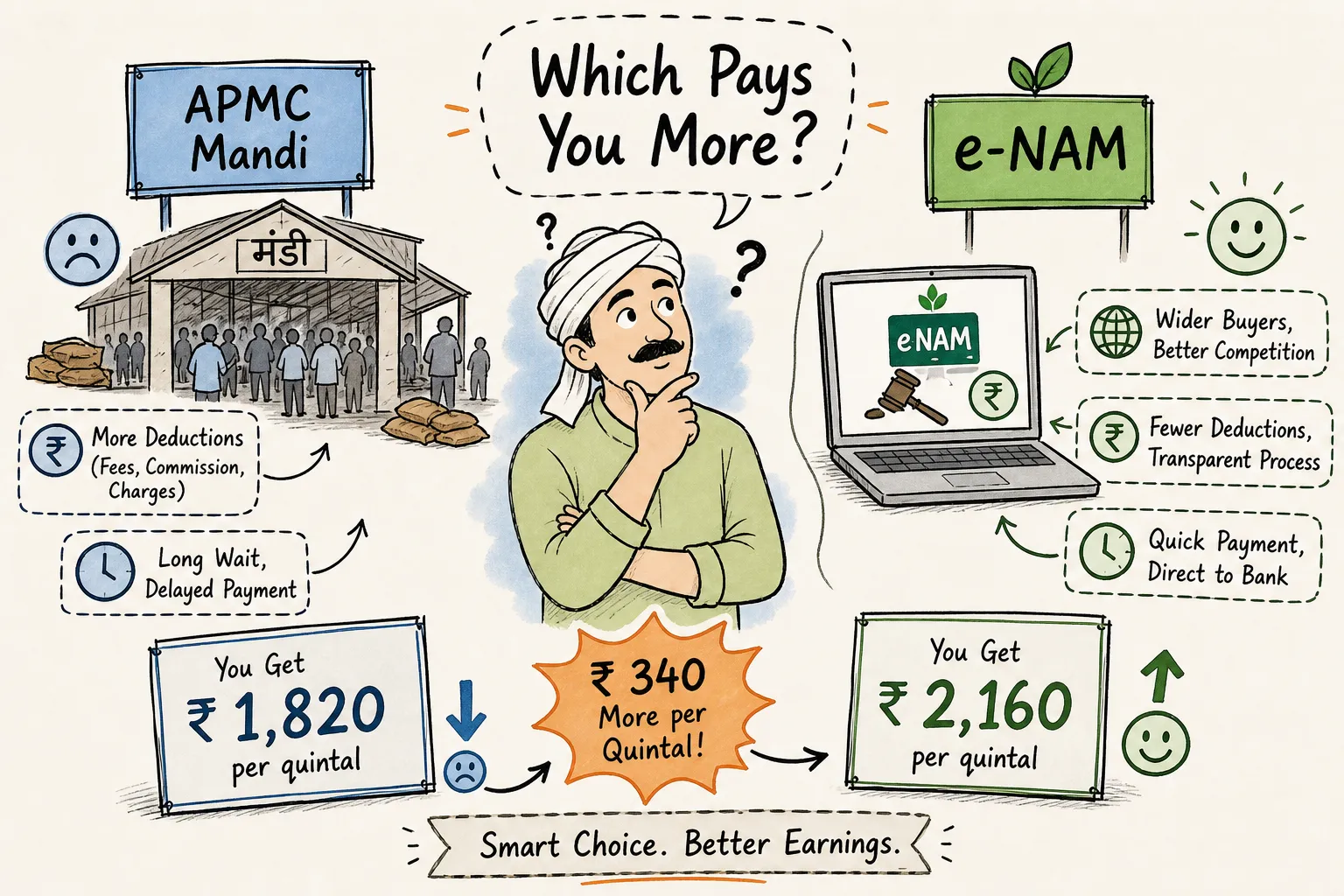
- Studies document 5% to 34% higher price realisation in e-NAM-integrated mandis
- Farmer registration on e-NAM is completely free
When deciding between APMC mandi vs e-NAM, the numbers that matter most are fees, payment timelines, and what you actually walk away with per quintal. Your fasal is ready, the truck is at the gate, and the choice is straightforward to frame but harder to get right without data. Haul the produce to your local APMC mandi yard for the usual bol-chaal (open bidding) process, or sell through the e-NAM digital platform at an integrated mandi. Both are available across many mandis in Rajasthan, Haryana, and Punjab, but the fee structures differ, the payment routes differ, and the price you realise can differ by hundreds of rupees per quintal.
This article gives you a clear, side-by-side picture of both systems. By the time you finish reading, you will know exactly what each option costs you, how long payment takes to reach your account, what documents you need, and what the research says about real price outcomes. No promises, just facts.
 Table of Contents
- How an APMC mandi actually works
- What e-NAM is and how it connects to existing mandis
- APMC mandi vs e-NAM: registration requirements for each
- APMC mandi vs e-NAM: fee structures compared
- APMC mandi vs e-NAM: payment timelines and price realisation
- What the data says: real price outcomes for farmers after e-NAM
- How to benchmark mandi bhav before choosing where to sell
- The bottom line: which route pays you more?
- FAQs
How an APMC mandi actually works
An APMC mandi is a physical, state-regulated wholesale market yard where notified agricultural produce must be sold under the supervision of a market committee formed under State APMC law. The mandi board sets the rules, issues licences to traders and commission agents, oversees the auction process, and collects fees on transactions. Every major Rabi and Kharif crop, from gehun (wheat) and sarso (mustard) to guar and chana, falls under this system in North India.
The open-auction (bol-chaal) process from gate to payment
When you drive your produce into the mandi yard, it is first weighed at the gate and recorded. The lot is then displayed in the auction area where licensed traders gather around it. Bidding happens verbally in the open-outcry bol-chaal format: traders call out prices, the bidding rises, and the highest offer wins. Your arthiya (commission agent) typically facilitates the deal, standing between you and the trader and managing the paperwork on your behalf. After the auction closes, the sale is recorded by mandi staff, and payment is routed through the arthiya before it reaches you, in cash, cheque, or bank transfer depending on the arrangement.
Who are the key players and why they matter
Three parties control every APMC transaction: the mandi board (regulator), the licensed trader (buyer), and the arthiya (facilitator). The arthiya handles weighing disputes, credit, and payment logistics for the farmer, but charges a commission for this service. In Rajasthan, that commission on wheat is around ₹45.67 per quintal; in Haryana it is approximately ₹50.75 per quintal. The farmer is typically the least informed party during bidding. Traders know current prices across multiple mandis; the farmer often knows only the local rate.
Where the APMC system works well and where it does not
The physical APMC mandi has real strengths. The infrastructure is established, familiarity is high, and for farmers who need same-day cash, the arthiya credit system provides liquidity that no digital platform currently replicates. Dispute resolution channels, however informal, exist within the mandi ecosystem. The limitations are equally real: only traders physically present in the yard can bid, which structurally caps competition. Price collusion among a small group of local traders is a documented concern. And the multi-layer fee structure quietly reduces your net realisation before you count a single rupee.
What e-NAM is and how it connects to existing mandis
The most common misconception about e-NAM (National Agriculture Market) is that it is a separate marketplace you send your produce to. It is not. e-NAM is a pan-India electronic trading platform, an online agricultural marketplace, that runs on top of existing APMC mandi infrastructure. The physical mandi yard, the weighing shed, the assaying station, all of it remains exactly where it was. What e-NAM adds is a digital layer: online bidding, electronic invoicing, and direct bank payment settlement.
How the digital layer changes the auction
In an e-NAM transaction, your produce arrives at the mandi gate as usual. It is weighed and quality-assayed by mandi staff, and those quality parameters are uploaded to the e-NAM system. From that point, registered buyers from anywhere in the country can log on and place bids. The highest bid wins. You do not need to take your sarso to five different mandis to find a better price; the offers come to one place. This is the core structural difference from a traditional floor auction where only locally present traders can bid.
e-NAM's current footprint across India in 2026
As of 2026, e-NAM spans 1,656 integrated mandis across 23 states and 4 Union Territories, with 1.80 crore farmers and 2.73 lakh traders registered on the platform. Rajasthan has 173 mandis connected, recording the highest trading volume of any state at 66.09 lakh metric tonnes in FY 2024, 25. Haryana follows with 44.94 lakh metric tonnes. For a kisaan in Sri Ganganagar, Nohar, or Nagaur, this is not a pilot programme; it is an operational electronic mandi platform with substantial transaction history behind it.
APMC mandi vs e-NAM: registration requirements for each
Knowing exactly what to bring saves you a wasted trip. Here is what each route requires.
Entering your local APMC mandi: what documents you need
For a first-time independent seller at a physical APMC yard in Rajasthan, the standard document set is: Aadhaar card as identity proof, a bank passbook copy or cancelled cheque in your name, a mobile number for OTP and alerts, and a passport-size photograph. Some mandis may also ask for a land ownership certificate or a vehicle pass for the produce-carrying vehicle. In practice, many small farmers enter through their arthiya rather than registering independently, which means they operate under the arthiya's mandi licence, a distinction with direct fee implications covered in the next section.
How to register as a farmer on e-NAM: step by step
The registration process is straightforward, and internet access from your end is not required. Mandi staff handle the digital entry on your behalf.
- Visit the e-NAM portal or go to the e-NAM facilitation desk at any linked mandi in your area
- Select "Farmer" as registration type and choose your desired APMC from the list
- Submit your Aadhaar card, bank account details (passbook copy or cancelled cheque), and a passport-size photograph
- Mandi staff enter your details, complete the KYC process, and submit the application for APMC approval
- You receive an SMS and email confirmation with your permanent e-NAM login credentials after approval
- Once registered, your produce can be submitted for assaying and online auction at the mandi gate
The entire registration is free. If you need help, the e-NAM toll-free helpline (1800 270 0224) can guide you through the process in Hindi. Facilitation desks at several e-NAM-linked mandis in Rajasthan, consult the e-NAM state documentation for the full list of active desks, are equipped to handle registration on your behalf.
APMC mandi vs e-NAM: fee structures compared
APMC mandi charges: what the full cost stack looks like
A single APMC transaction carries multiple charges that compound against each other. The mandi cess or market fee typically runs 1, 2% of transaction value, though this varies by state and commodity. Several states also levy a rural development cess on top of this. Then comes the arthiya commission: roughly ₹45, ₹51 per quintal on wheat in North India, as noted above. Add handling, weighing, and loading charges, and a farmer paying all layers together can effectively lose 3, 5% of sale value before receiving any payment. On a 200-quintal lot of sarso at ₹5,500 per quintal, a total of ₹11,00,000, that fee stack amounts to roughly ₹33,000, ₹55,000 out of your net realisation.
What e-NAM costs and what it removes
The e-NAM platform itself carries no separate participation fee for farmers. In trade arrangements where e-NAM operates with farmer-first terms, commission charges are either eliminated or significantly reduced for direct-farmer sales, though this depends on the specific trade arrangement at your mandi and the applicable state APMC rules; e-NAM does not universally eliminate all fees. Andhra Pradesh, as a concrete example, introduced a 0.25% rebate on mandi fees for transactions settled through the e-NAM online payment route. What the platform structurally reduces is the intermediary commission layer, because it connects you directly to buyers without requiring an arthiya to broker the deal.
| Charge | APMC mandi (physical) | e-NAM (digital bidding) |
|---|---|---|
| Market fee / mandi cess | 1, 2% (state and commodity dependent) | May apply at state level; varies by arrangement |
| Rural development cess | Levied in several states | Not an e-NAM-specific charge |
| Arthiya / commission fee | ₹45, ₹51/qtl (wheat, North India) | Reduced or eliminated in direct-trade arrangements; varies by state APMC rules |
| Labour / handling / loading | Commonly charged | Physical service costs may still apply at mandi |
| Platform / registration fee | Not applicable | Nil |
APMC mandi vs e-NAM: payment timelines and price realisation
Two pain points come up in every conversation with kisaans about physical mandis: not knowing whether the price quoted during bol-chaal is actually fair, and waiting days for payment to clear. Both have a direct answer when you compare the two systems.
How price discovery differs: open bidding vs. online competition
In a physical APMC auction, the bidding pool is limited to traders physically standing in the mandi yard that morning. If three of those five regular traders decide not to bid aggressively on a particular lot, the price suffers. In an e-NAM auction, registered buyers from other mandis and other states can also bid online for the same lot. This structurally increases buyer competition without requiring any of them to travel. More bidders competing for the same produce means the price has a higher ceiling. The data section below confirms this with documented outcomes from Haryana and Rajasthan mandis.
Payment timelines: when does the money actually land?
In a physical APMC transaction, payment is typically routed through the arthiya as an intermediary. You may receive cash, a cheque, or a bank transfer, but the timing is tied to the arthiya's settlement cycle, which can stretch to several days or longer. On e-NAM, payment is processed electronically and credited directly to your registered bank account within one business day after the buyer accepts delivery and the APMC approves the trade settlement. Farmers commonly receive payment within 24 to 72 hours of sale confirmation. No arthiya in the middle, no waiting for a cheque to clear, no cash handling risk.
What the data says: real price outcomes for farmers after e-NAM
Price realisation gains reported across key mandis
An average price improvement of 5.5% for farmers selling through e-NAM compared to traditional floor auctions has been documented in multi-state assessments of the platform's outcomes. At Kaithal mandi in Haryana, paddy and wheat prices rose by 10, 34% after e-NAM integration, one of the strongest gains recorded in any single market. A difference-in-differences academic study found a statistically significant wheat price increase of ₹224.2 per quintal attributable to e-NAM adoption. That is one transaction. For a farmer selling 200 quintals of gehun, that figure adds up to ₹44,840 in additional income. Rajasthan and Haryana, the two highest-volume e-NAM states, are also where the concentration of documented gains is strongest, which makes these numbers directly relevant to North Indian farmers.
Where e-NAM works well and where the results are mixed
Credibility requires presenting the full picture. Not every mandi or every crop shows gains. A number of state-level reviews found no significant price advantage after e-NAM adoption, and one 2022 analysis from Chhattisgarh reported a price decline post-implementation. The gains are strongest where three conditions are in place: reliable quality assaying infrastructure at the mandi gate, high trader registration on the platform (so multiple buyers are actually competing), and stable internet connectivity for the bidding process. Where trader participation on e-NAM at a given mandi is thin, you may still face limited competition. The system works best as a tool; it requires a functioning ecosystem to deliver its promised benefits.
How to benchmark mandi bhav before choosing where to sell
The biggest practical mistake farmers make is deciding where to sell without first checking what prices are actually running across mandis that week. Whether you take the APMC route or the e-NAM route, walking into the auction without a price reference puts you at a negotiating disadvantage. Knowing the going mandi bhav for your crop shifts the information balance in your favour.
Why checking prices before you load the truck matters
Consider a scenario: you load 150 quintals of sarso and drive 40 kilometres to your nearest APMC yard. The floor price offered is ₹5,300 per quintal. But an e-NAM-integrated mandi 30 kilometres in the other direction ran ₹5,420 per quintal the previous week, with strong trader participation. That ₹120 per quintal gap across 150 quintals is ₹18,000 in difference. Knowing this before you load the truck lets you make a decision; not knowing it means someone else makes it for you.
Using real-time mandi bhav data to make the comparison yourself
KhetiKisaan tracks live mandi bhav sourced directly from on-ground contacts present at APMC auction yards during live bol-chaal sessions, covering major mandis across Rajasthan, Haryana, and Punjab, including Sri Ganganagar, Nohar, and Nagaur. Before deciding which route to take for your gehun, sarso, gwar, or chana, you can check what prices are running in both physical APMC yards and e-NAM-integrated mandis on the same day, then make your call based on actual data rather than a neighbour's estimate. Even a ₹50, ₹100 per quintal difference is significant across a few hundred quintals of fasal. Get in the habit of checking before the truck leaves the field.
The bottom line: which route pays you more?
The physical APMC mandi offers established infrastructure, familiarity, and arthiya-backed credit liquidity, genuine advantages, particularly for farmers who need same-day cash. Its structural constraint is a limited buyer pool: only traders physically present in the yard that morning can bid, and a multi-layer fee stack quietly reduces your net realisation. e-NAM adds broader buyer competition through its online agricultural marketplace, transparent digital bidding, lower intermediary costs in eligible trade arrangements, and faster direct bank payment. It works best where assaying infrastructure is reliable and trader registration is active on your mandi's network; where those conditions are thin, gains are less reliable.
Ultimately, the APMC mandi vs e-NAM question resolves to one practical step: check current mandi bhav across both physical APMC yards and e-NAM-integrated mandis before the truck leaves your field. The price gap, even ₹100 per quintal, compounds quickly across your full harvest. That information is available to you before you make the decision. Use it.
FAQs
Related Blogs

Sep 11, 2026
by Pankaj Sihag

Sep 10, 2026
by Pankaj Sihag