







eNAM Farmer Registration: A Complete Guide for India

 Sep 11, 2026
 by Pankaj Sihag



eNAM Farmer Registration: A Complete Guide for India
| eNAM full form | National Agriculture Market |
|---|---|
| Registration cost | Completely free for farmers |
| APMC verification time | 2 to 5 working days (varies by mandi) |
| Key documents needed | Aadhaar, bank passbook, land records, email ID |
| Platform access | enam.gov.in or the official eNAM mobile app (Android) |
| eNAM helpline | 1800-270-0224 (toll-free) |
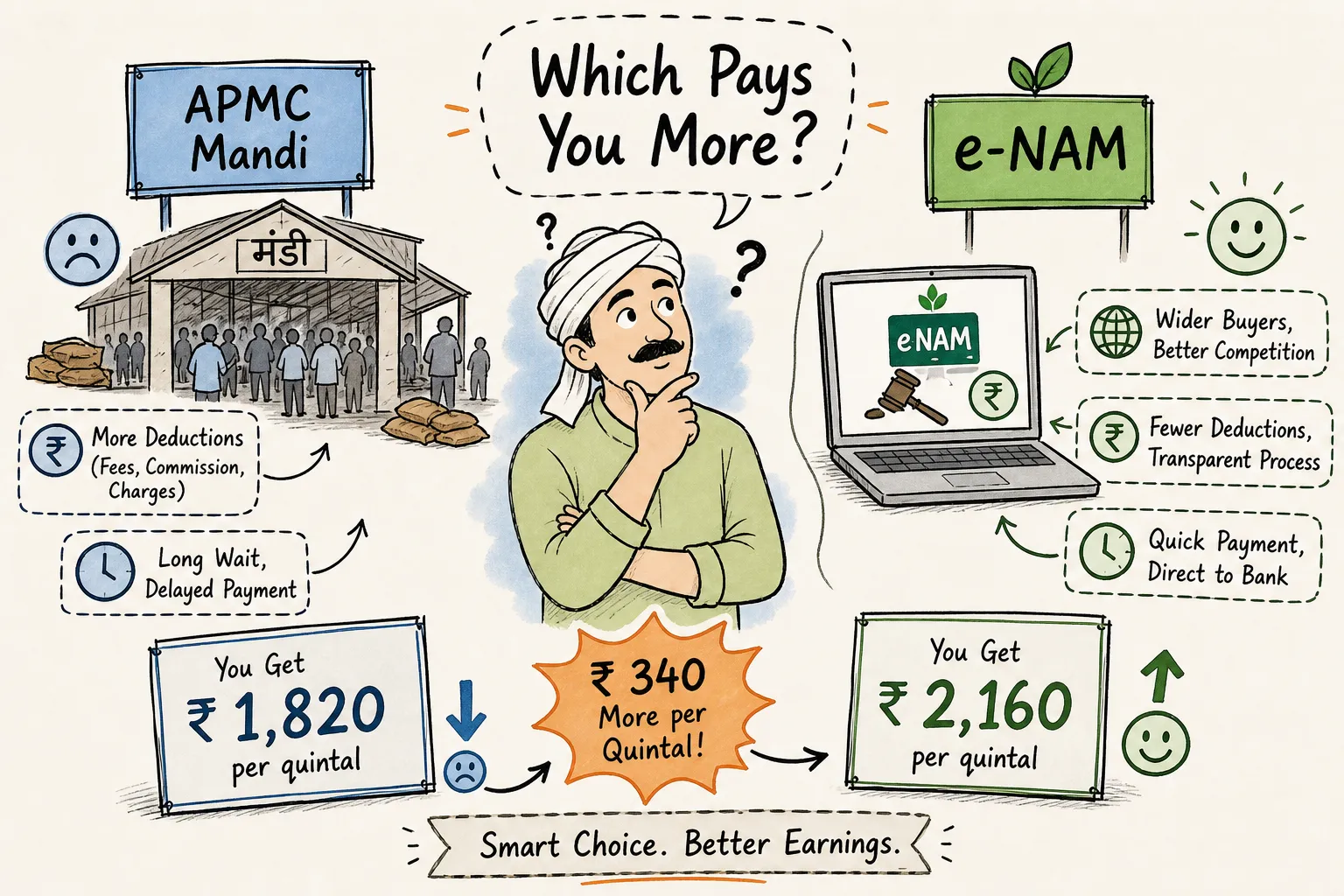
eNAM is India's national online trading platform that connects farmers directly to buyers across registered APMC mandis, removing the need to depend on a single local mandi for the best price. Thousands of APMC yards are now linked to the portal across the country, and a farmer who registers on eNAM can receive electronic bids from traders across multiple districts and states, not just the handful who show up at the local bol-chaal (live auction). That wider competition typically pushes the final rate per quintal higher than what a farmer would get from a tight circle of local arhatiya buyers. Completing eNAM farmer registration in India is free, government-backed, and takes less than a week from form submission to an active trading account.
Kisaans who already track daily mandi bhav (crop auction rates) to decide the best time and mandi to sell their fasal are the ones who benefit most from eNAM. They understand price discovery; eNAM simply gives them a larger pool of buyers. KhetiKisaan has always believed that price information and selling decisions go hand in hand, and this guide is built on that same principle.
This guide covers everything a farmer needs to complete the eNAM sign-up process: the exact documents to gather, the full step-by-step process on both the portal and the mobile app, how APMC verification works, what happens after approval, and how to make your first sale on the platform. Follow this in order and you will have your eNAM farmer account active within a week.
 Table of Contents
- What eNAM is and why Indian farmers are joining it
- Documents to keep ready before you start eNAM registration
- How to complete eNAM farmer registration in India, step by step
- Registering through the eNAM mobile app
- What happens after you submit: APMC verification explained
- Fees and mandi charges: what does eNAM actually cost?
- Listing your fasal and completing your first eNAM sale
- Start with the right documents and the process is simple
- FAQs
What eNAM is and why Indian farmers are joining it
The problem eNAM was built to solve
The traditional local mandi system limits a farmer's bargaining power because only a small group of traders participates in the bol-chaal on any given day. One mandi, a tight circle of buyers, and the kisaan has limited room to negotiate. The crop sells at whatever rate those few traders agree to bid, which is rarely the best possible rate. This is not a criticism of local APMCs; it is simply a structural constraint of geography. Local mandis are not going away, and eNAM does not replace them. It runs alongside the existing APMC system and uses the same mandi infrastructure.
How eNAM changes the fasal-selling equation
eNAM digitises the auction process. The farmer brings produce to the APMC mandi, it is weighed and assayed (tested for quality), and the lot is then visible to registered traders across the eNAM network who can place electronic bids from anywhere. More bidders competing for the same lot generally means a higher final rate. Once the farmer accepts the winning bid, payment settles directly to the registered bank account, cutting out the cash-handling delays and informal deductions that sometimes occur in traditional transactions.
Who is eligible to register on eNAM India
Individual farmers, tenant farmers, Farmer Producer Organisations (FPOs), and Primary Agricultural Credit Societies (PACS) are all eligible to register on eNAM. This guide focuses on individual farmer registration, which covers the majority of kisaans in Rajasthan, Haryana, and Punjab. FPO and PACS registration follows a different document checklist and is best confirmed directly with the APMC office or eNAM helpline.
Documents to keep ready before you start eNAM registration
Mandatory eNAM registration documents for individual farmers
Gather these documents before you open the portal or the app. Starting without them and stopping mid-way through the form causes form errors and wasted time.
| Document type | Accepted options |
|---|---|
| Identity proof | Aadhaar card (preferred), Voter ID, PAN card |
| Bank details | Bank passbook first page or cancelled cheque leaf |
| Land records | Khasra/Khatauni or land ownership certificate |
| Photograph | Passport-size photo (for portal upload) |
Aadhaar is the most straightforward identity document because the KYC process on eNAM is linked to it. Make sure the mobile number registered with your Aadhaar is active before you begin; OTP verification may be required at the KYC stage. A mismatch between the name on your Aadhaar and the name on your bank passbook is one of the most common reasons for APMC verification delays, so check that both match before uploading.
Documents for FPOs and PACS
FPOs and PACS need their registration or incorporation certificate, PAN card, bank details, the authorised person's identity proof, and the organisation's bye-laws or Memorandum of Association. Individual kisaans should focus on the table above. Verify any additional state-specific document requirements directly with your local APMC office before you begin, as some states ask for supplementary records.
One preparation step most farmers overlook
Have a valid, working email ID before starting. The temporary login credentials arrive at this email, and the permanent eNAM Farmer Login ID is sent there after APMC approval. Many farmers in rural areas use a family member's email or a shared account. Use one you can reliably access throughout the registration period and beyond, because you will need it every time you log in to the portal.
How to complete eNAM farmer registration in India, step by step
Creating your initial account on enam.gov.in
- Open enam.gov.in and navigate to theRegistration page.
- Select Registration Type as "Farmer."
- Choose your desired APMC/mandi from the dropdown list.
- Enter your correct email ID. The temporary login credentials are sent here.
- Fill in your personal details: full name, date of birth, sex, address, and mobile number.
- Enter your bank account details as they appear in your passbook.
- Submit the registration form.
- Check your email for thetemporary login ID and password.
Completing KYC on your eNAM dashboard
- Log in to the eNAM dashboard using the temporary credentials from your email.
- Click the flashing link on the dashboard: "Click here to register with APMC."
- Fill in or update the required fields, then upload your KYC documents, Aadhaar card, land records (Khasra/Khatauni), and passport-size photograph, as prompted on each screen.
- Submit the application for APMC approval.
Once you submit for APMC approval, the application moves to your chosen mandi office for verification. You can track the status on the portal dashboard, which shows statuses: Submitted, In Progress, Approved, or Rejected. After APMC approval, the permanent eNAM Farmer Login ID and password are sent to your registered email. This is the account you use for all future activity, including listing produce and accepting bids.
Registering through the eNAM mobile app
Downloading and setting up the app for eNAM mobile app registration
The official eNAM mobile app is available on Android through the Google Play Store, and the registration process mirrors the portal exactly. For farmers in areas with unstable broadband, the app works well on a standard mobile data connection. Search for "eNAM" on the Play Store and verify the developer name before downloading to avoid unofficial clones that are not connected to the actual government platform.
Step-by-step app registration
- Download and open the official eNAM mobile app.
- Tap the Register option on the home screen.
- Select "Farmer" as the registration type.
- Choose your APMC/mandi from the list.
- Enter your email ID and personal details as prompted.
- Upload or photograph your KYC documents, Aadhaar, land records, and passport-size photo, within the app.
- Submit and await APMC approval. Permanent login credentials arrive by email once the mandi office verifies and approves the application.
Portal or app: which should you use?
Both routes lead to the same outcome and the same APMC approval step. Farmers with access to a desktop or laptop at a Common Service Centre (CSC) may find the portal easier for uploading scanned document copies. Those relying on a smartphone on mobile data will find the app more convenient, since it allows you to photograph documents directly from the camera. Choose whichever is more accessible to you.
What happens after you submit: APMC verification explained
Who reviews your eNAM APMC mandi registration
The APMC office at the mandi you selected during registration is responsible for verifying your application and KYC documents. A mandi staff member reviews the submitted details, checks that the land records and identity documents match, and either approves the application or flags it for correction. The eNAM portal does not approve registrations centrally; the local APMC authority is the gatekeeper.
Typical verification timelines
APMC verification is typically completed within 2 to 5 working days after a complete KYC submission. Timelines vary by mandi, the volume of applications the office is handling during peak trading season, and whether your documents are in order. If there is no update after seven working days, visit the APMC office in person or call the eNAM toll-free helpline at 1800-270-0224 to follow up. Do not submit a second application; track and follow up on the existing one.
What to do if your application is rejected or returned
Rejection most commonly happens due to a name mismatch between identity proof and land records, or an incorrect bank account number. If your application is returned, log back in using the temporary credentials, correct the flagged information, and resubmit. The APMC office restarts verification after resubmission. Address the exact reason for rejection rather than making unrelated changes, or the application will be returned again for the same reason.
Fees and mandi charges: what does eNAM actually cost?
Registration is completely free
There is no fee for farmer registration on eNAM, whether you register through the portal, the mobile app, or directly at the APMC mandi office. The Government of India built eNAM as a public service platform, and the registration cost to the kisaan is zero. Any third party asking you to pay for eNAM registration on your behalf is not part of the official process.
Mandi charges that apply when you sell
While the eNAM platform is free, the standard mandi charges do apply when you actually sell produce through the system. These are set by the respective state APMC or State Agriculture Marketing Board and vary by state and commodity. Common charges include:
- Market fee (mandi tax): a percentage of the total transaction value, notified by the state government
- Commission agent (arhatiya) fee: varies by state and whether an arhatiya is involved in the transaction
- Assaying or quality-testing charges: usually nominal, set by the individual mandi
Ask your local APMC office for the current charge schedule before your first eNAM sale. Many mandis also post the full charge schedule on the mandi notice board at the gate, so it is worth checking when you arrive. Knowing the deductions in advance means you can set a realistic minimum acceptable rate before entering the bidding window.
Listing your fasal and completing your first eNAM sale
How lot creation and assaying works at the mandi
A common misconception is that the farmer creates the sale lot from home through the portal. That is not how it works. The lot is created by the APMC mandi system when the produce physically arrives at the mandi gate. The consignment is weighed, assigned a unique lot ID, and a sample is tested for quality parameters such as moisture content, broken grain, foreign matter, and damaged grain. The assay result is uploaded against the lot ID, making it visible to all registered buyers in the eNAM network.
The bidding process and your rights as a seller
Once the lot clears quality assessment and enters the trading window, registered traders from across the eNAM network place electronic bids. When the auction window closes, the highest valid bid is displayed. The farmer retains the right to accept or reject this bid. If the offered rate is below your expected price, you can withdraw the lot. In a traditional bol-chaal, walking away from a low bid was difficult in practice; eNAM makes the right to reject formal and explicit, which is a real advantage for the kisaan.
Check live mandi bhav before accepting any eNAM bid
Before accepting or rejecting the highest eNAM bid, compare it against what the local APMC is currently offering for the same fasal. This comparison is what separates a well-informed selling decision from a guess. KhetiKisaan's real-time mandi bhav data, sourced directly from ground-level contacts present at live APMC auctions across Rajasthan, Haryana, and Punjab, gives farmers this benchmark instantly. If the live rate at the nearest mandi for your gehun or sarso is running higher than the eNAM bid, you know to reject and consider a local sale. If eNAM bids are outpacing local rates, accepting becomes a straightforward call.
Making this comparison before every eNAM sale is how experienced kisaans extract maximum munafa per quintal from their crop. The platform gives you the buyers; real-time price data gives you the power to evaluate their offers properly. Check KhetiKisaan for today's mandi bhav rates before your next auction window opens.
Payment settlement after a successful sale
After the farmer accepts the bid, the consignment is confirmed, a sale receipt is generated, and payment is processed through the eNAM payment module directly to the farmer's registered bank account. Published eNAM guidance indicates that payment is typically credited within T+1 to T+2 working days after bid acceptance, depending on the state APMC's payment rules. The direct bank transfer removes the cash-handling delays that sometimes occur in traditional mandi transactions.
Start with the right documents and the process is simple
eNAM farmer registration in India has four clear stages: gather your documents, complete the sign-up on the portal or the mobile app, wait for APMC verification (2 to 5 working days), and then bring your fasal to the mandi for assaying and electronic bidding. Registration is free, the platform is government-backed, and the process is straightforward once your Aadhaar, bank passbook, and land records are in order.
The real advantage of eNAM shows up at selling time. You get more registered buyers bidding on your lot, transparent price discovery, and payment credited directly to your bank account. The sharpest selling decisions happen when you combine eNAM's wider buyer reach with live, ground-level mandi bhav data. Before you accept or reject any eNAM bid on your gehun, sarso, chana, or any other fasal, check KhetiKisaan's real-time mandi rates first. Our prices are sourced from contacts physically present at APMC auctions across Rajasthan, Haryana, and Punjab, so you know exactly what the local market is paying at that moment.
Must Read: Online mandi vs local APMC
Visit KhetiKisaan for today's mandi bhav before your next crop sale. That one comparison can make the difference between a good price and the best price.
FAQs
Related Blogs
Sep 19, 2026
by Pankaj Sihag

Sep 10, 2026
by Pankaj Sihag