





Gwar Ki Kheti Fayde: 8 Reasons to Grow Guar in Rajasthan
 Oct 02, 2026
 by Pankaj Sihag



Gwar Ki Kheti Fayde: 8 Reasons to Grow Guar in Rajasthan
Picture a Rajasthan farmer standing at the edge of his field in the first week of July. The sky has delivered one decent monsoon shower, roughly 35 mm. The field is light sandy-loam, the kind that dries fast and drains clean. The question in his mind is a familiar one: sow gwar, try something else, or leave the field idle and wait? For a farmer in this position, understanding the full range of gwar ki kheti fayde, the real, field-tested advantages of guar cultivation, makes that decision straightforward rather than stressful.
Guar (cluster bean, botanically known as Cyamopsis tetragonoloba) is far more than a survival crop for bad rainfall years. It is a commercially relevant kharif fasal with a direct connection to global industrial supply chains, a natural soil improver, and one of the lowest-input crops you can grow in North India's semi-arid belt. This article covers eight concrete benefits, from agronomic resilience to mandi pricing intelligence, all explained in plain language with actual numbers.
Platforms like KhetiKisaan now make it possible to connect the agronomic decision, which crop to sow, with the market decision of when and where to sell. Both decisions matter. Getting the agronomy right and then selling on a bad arrival day is a costly mistake. This article addresses both sides of that equation.
 Table of Contents
- Quick Facts: Guar Crop
- What makes gwar the right kharif fasal for dry Rajasthan land
- Benefit 1: Drought tolerance that works without constant irrigation
- Benefit 2 and 3: Nitrogen fixation and lasting soil improvement
- Benefit 4 and 5: Low input costs and realistic earnings per hectare
- Benefit 6: Guar gum export demand and what it does to your seed price
- Benefit 7: Crop flexibility that few kharif fasals can match
- Benefit 8: Choosing the right variety and getting your crop established
- Selling smart: tracking live gwar mandi bhav before you haul to market
- Putting it all together: gwar ki kheti fayde for your zameen
- FAQs
Quick Facts: Guar Crop
| Quick Facts | Guar Crop |
|---|---|
| Crop type | Kharif legume (Cyamopsis tetragonoloba) |
| Rainfall needed | 300, 400 mm seasonal |
| Net return range | ₹15,000, ₹35,000 per hectare (normal rainfed) |
| Key market | Guar gum export to 50+ countries |
| Best-fit states | Rajasthan, Haryana, Punjab |
| Area under cultivation (Rajasthan, 2025, 26) | Approx. 24.82 lakh hectares |
What makes gwar the right kharif fasal for dry Rajasthan land
Before looking at individual benefits, it helps to understand why gwar ki kheti fayde begin at the soil level. The state's dominant soil profile, light sandy and sandy-loam, its erratic monsoon pattern, and its large expanse of marginal zameen all align neatly with what gwar needs to perform. Many other kharif crops that farmers try on such land, moong, groundnut, or even bajra in some pockets, demand more consistent moisture or better soil fertility. Guar asks for neither.
Sandy and loamy soils: where gwar performs best
Guar thrives in well-drained, light-textured soils with moderate alkalinity tolerance. The crop is not fragile; it handles nutrient-poor, sandy conditions that would give most legumes a difficult time. The real enemy for gwar is not dry weather but poor drainage: waterlogged or heavy clay soils will kill a stand far faster than a two-week dry spell. A practical field test: if your khet drains within 24 hours after a heavy monsoon shower, it is suitable for gwar. If water stands longer, either grow something else or invest in ridged sowing to manage drainage.
Sowing window and monsoon dependency
The sowing window runs from late June through July, timed to the first dependable monsoon shower delivering 30, 40 mm of rain. In arid western Rajasthan, the first or second week of July is the practical sweet spot for most districts. Sow too early on dry soil and germination suffers; sow too late and the crop misses the best of the monsoon moisture window. Getting this timing right is one of the simplest ways to protect your yield before the season even starts.
Benefit 1: Drought tolerance that works without constant irrigation
This is the benefit most Rajasthan farmers already know about, but it is worth understanding precisely why gwar handles dry spells rather than just accepting that it does. Gwar is a deep-rooted crop. When the surface soil dries out between monsoon showers, the taproot system reaches down into deeper, still-moist layers to keep the plant alive. This gives it a survival advantage over shallow-rooted crops like maize, which show stress and yield loss within days of surface moisture running out.
How deep roots help gwar survive dry spells
The taproot of a well-established gwar plant can penetrate considerably deeper than most kharif crops grown in the region. This deeper root architecture is the physical reason gwar can bridge a 10, 14 day gap between monsoon showers without the yield collapse you would see in more water-sensitive crops. If supplemental irrigation is available, one or two waterings at flowering and pod-fill stages can lift seed yield meaningfully, but the crop does not require that support to produce a commercially acceptable result.
Comparing gwar's water need to other common kharif crops
Gwar needs approximately 300, 400 mm of seasonal rainfall distributed across three or four spells. Moong needs similar but is more sensitive to timing. Cotton (narma or desi) demands far more water across a longer season. Bajra is comparably drought-tolerant but has less commercial upside in export-linked markets. For a farmer in Rajasthan's Thar belt who cannot predict whether the monsoon will be generous or stingy, gwar is the lower-risk choice in uncertain-rainfall years. It is not the highest-yielding option in a good year, but it is the most reliable option in a bad one.
Benefit 2 and 3: Nitrogen fixation and lasting soil improvement
Gwar is a legume, and like all legumes, it forms a working partnership with soil bacteria called rhizobia. These bacteria colonise the crop's roots, forming small nodules, and capture nitrogen directly from the atmosphere, converting it into a form that plants can use. Under typical rainfed conditions in sandy-loam soils, a gwar crop fixes approximately 30, 50 kg of nitrogen per hectare across the season. In practical terms, that is a meaningful share of the nitrogen fertiliser bill for the following rabi crop, delivered by biology rather than a urea bag.
How gwar feeds your zameen for free
The nitrogen benefit does not stop at harvest. When gwar stubble and root residue are left in the field and decompose over the rabi season, they release that fixed nitrogen slowly into the soil. The next crop in the rotation, typically gehun (wheat) or jau (barley), can draw on this nitrogen during its early growth stages. Farmers who track their fertiliser use carefully often find they need less nitrogen for the rabi crop that follows a gwar season. For a farmer spending ₹25, 30 per kg on urea, that reduction adds up to real rupees.
Crop rotation and long-term soil health
Beyond nitrogen, gwar acts as a break crop that disrupts the disease and pest cycles that build up when the same cereal is grown continuously. Continuous wheat or bajra without a legume break creates conditions where soil-borne pathogens accumulate year after year. Introducing gwar into the rotation breaks that cycle and allows soil biology to recover. Farmers who incorporate gwar stubble as green manure before pod formation, a practice more common when grain prices are weak, also add substantial organic matter that improves soil structure and water retention over multiple seasons.
Benefit 4 and 5: Low input costs and realistic earnings per hectare
Economics is where the conversation moves from interesting to urgent. Gwar ki kheti fayde are particularly clear on the cost side: the crop does not need heavy nitrogen fertilisation because it fixes its own; it does not need frequent irrigation; seed costs are reasonable; and the crop's tolerance for marginal conditions means land-preparation expenditure is not extravagant. The result is one of the more favourable cost-to-return ratios available for a kharif crop on rainfed Rajasthan land.
What does it actually cost to grow gwar on one hectare?
For a normal rainfed farm in Rajasthan, total cultivation costs fall in the range of ₹12,000, ₹25,000 per hectare. This covers seed (15, 20 kg/ha for a grain crop at roughly ₹300, 400/kg), land preparation, sowing, modest fertiliser input (primarily phosphorus and sulphur, not heavy nitrogen), one or two weeding operations, plant protection, and harvesting. Farmers with their own equipment and family labour will sit at the lower end of this range. Those paying for hired labour and machinery across all operations will be closer to the upper end.
Yield expectations: what to realistically expect
A well-managed rainfed gwar crop in Rajasthan produces 6, 10 quintals per hectare (0.6, 1.0 t/ha). Rajasthan's state average for 2025, 26 was approximately 758 kg/ha, which reflects the full range of farm management quality across the state. With current mandi prices for gwar seed running between ₹5,350 and ₹6,265 per quintal (as recorded across major mandis in late September 2026), a 7-quintal yield at ₹5,800 per quintal generates gross revenue of approximately ₹40,600 per hectare. These are real, verifiable figures, not best-case projections.
Net return: what stays in the farmer's pocket
| Production situation | Input cost (₹/ha) | Gross revenue (₹/ha) | Net munafa (₹/ha) |
|---|---|---|---|
| Low-yield rainfed | ₹8,000, ₹15,000 | ₹19,000, ₹33,000 | ₹5,000, ₹20,000 |
| Normal rainfed | ₹12,000, ₹25,000 | ₹29,000, ₹55,000 | ₹15,000, ₹35,000 |
| Good management / irrigated | ₹18,000, ₹35,000 | ₹48,000, ₹82,000 | ₹20,000, ₹55,000 |
For planning purposes, use the normal rainfed row as your baseline. It is honest, it reflects typical Rajasthan conditions, and it still delivers meaningful munafa on land that many alternative crops would struggle to make profitable.
Benefit 6: Guar gum export demand and what it does to your seed price
When a Rajasthan farmer sells gwar seed at the local mandi, that seed travels through a processing chain that ends up in oil fields in Texas, food factories in Germany, and pharmaceutical plants in China. Understanding this connection explains why gwar seed prices are often considerably stronger than those for many other kharif crops, and why the price moves the way it does through the season.
Who buys Indian guar and why
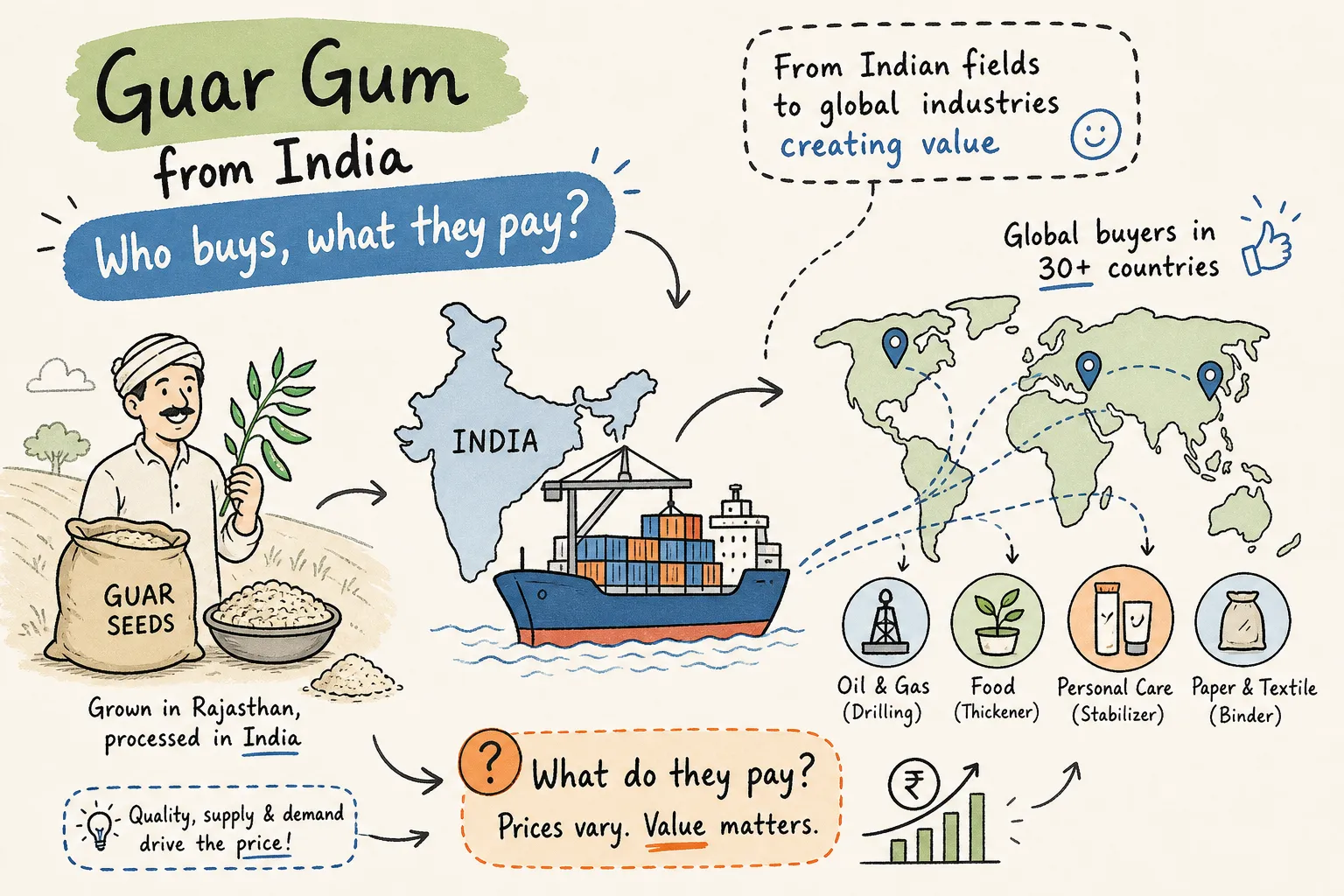
Indian gwar seed is processed into guar gum powder, which is then exported globally as an industrial and food ingredient. The single largest price driver is hydraulic fracturing, or fracking, for shale oil and gas. Guar gum is a key component of the fracturing fluid that releases oil and gas from tight rock formations.
Beyond oilfields, guar gum is used in food processing as a thickener and stabiliser, in pharmaceuticals as a binding agent, in textiles, and in water treatment. Major export destinations include Germany, the United States, Russia, Norway, and China. In FY2024, 25, India exported approximately 4,74,519 tonnes of guar gum products worth US$550 million, confirming that this is a major global commodity, not a niche agricultural product.
Price outlook for gwar seed in 2026
As of late 2026, gwar seed prices across major Indian mandis range from ₹5,350 to ₹6,265 per quintal, with an all-India average near ₹5,934 per quintal. NCDEX guar-gum futures, which provide a forward-looking price signal, had corrected from around ₹13,300 to ₹12,460 per quintal in September as new-crop arrivals approached. Prices remain firm but volatile. Export order flow, the pace of new-crop arrivals in October and November, and US shale-drilling activity are the three factors that will determine whether seed prices hold or soften through the post-harvest period. Checking these signals before deciding when to sell is as important as the agronomic decisions made at sowing time.
Benefit 7: Crop flexibility that few kharif fasals can match
Most crops lock you into a single outcome at sowing time. Gwar does not. Depending on market conditions and farm needs at the time of harvest, the same gwar crop can serve as a grain and gum crop, a high-quality legume fodder for cattle, a green manure to improve soil for the next rabi fasal, or even a vegetable crop (cluster beans, sold as sabji in local mandis). This flexibility is a genuine risk-reduction benefit, particularly for smaller farms with limited financial cushion.
Fodder, green manure, and the double-use option
If gum-seed prices at harvest time are weaker than expected, a farmer can redirect the standing crop towards fodder use or green manure incorporation without a total loss of the season's investment. Legume fodder from guar has good nutritional value for cattle, and gwar green manure, incorporated before pod formation, adds both nitrogen and organic matter that benefit the following crop. For fodder-focused use, the seed rate increases to 30, 40 kg/ha and the management priorities shift slightly, but the same field and the same monsoon produce a usable outcome regardless of grain market conditions.
Intercropping gwar with bajra or til
In arid Rajasthan, intercropping gwar with pearl millet (bajra) or sesame (til) is a well-established practice that gives farmers a second income stream from the same land without significant additional cost. The RGC 1055 variety, also known as Guar Uday, is specifically noted for its suitability in intercropping systems because of its compact, non-lodging growth habit. A farmer who intercropped gwar with bajra in a difficult monsoon year effectively holds two bets on the same piece of zameen, reducing the risk that either crop alone carries.
Benefit 8: Choosing the right variety and getting your crop established
None of the agronomic or economic benefits that define gwar ki kheti fayde materialise if the wrong variety goes into the ground or if the crop is poorly established in the first few weeks. Variety selection and early management are where potential yield is either protected or surrendered. For Rajasthan farmers, there is a clear set of recommended options backed by state agricultural university research.
Best guar varieties for Rajasthan farmers
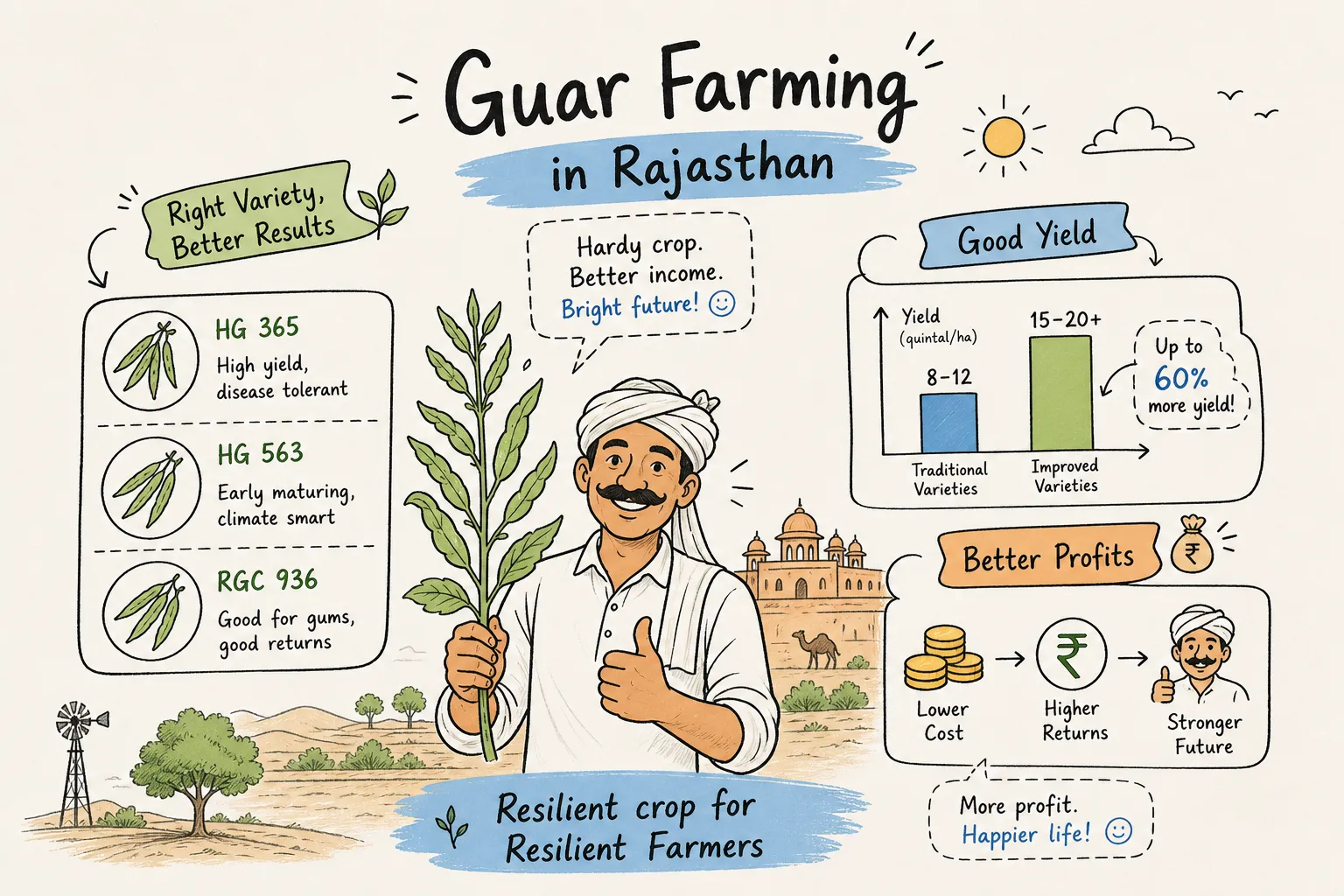
The top recommended varieties for Rajasthan are RGC 936, RGC 1003, RGC 1038, RGC 1055 (Guar Uday), and Durgapura Safed. Among these, RGC 1055 stands out for its high gum content, early maturity, and suitability for intercropping systems. RGC 1003 is widely recommended for grain and gum production across the arid belt. Durgapura Safed performs well specifically for grain and gum in the drier districts. Farmers in Haryana and Punjab have additional options including HG 365 and HG 563, the latter being valued for its gum quality. For most Rajasthan farmers growing gwar as a grain and gum crop, RGC 1055 or RGC 1003 is the practical first choice.
Sowing time, seed rate, and spacing
Sow in the first or second week of July after the first dependable monsoon shower of 30, 40 mm. Use 15, 20 kg of seed per hectare for a grain crop, placing seed 2, 3 cm deep in rows spaced 35, 50 cm apart. For fodder-focused cultivation, increase the seed rate to 30, 40 kg/ha. Certified, disease-free seed from a reputable source is worth the marginal extra cost because it dramatically reduces the risk of early-season disease problems that can set back the entire stand.
Three management priorities that protect your yield
- Rhizobium seed treatment before sowing: Treating seed with a guar-specific Rhizobium culture ensures effective root nodulation and activates the nitrogen-fixation benefit from day one. This single step costs very little and delivers a measurable agronomic return.
- Weed-free establishment in the first 30 days: Gwar is most vulnerable to weed competition in the first 25, 35 days after emergence. One intercultivation followed by hand weeding during this period is the most cost-effective management investment of the season.
- Weekly scouting rather than calendar spraying: Monitor regularly for jassids, whitefly, bacterial blight, and pod borers. Apply plant protection products only when pest pressure crosses the economic threshold, not on a fixed calendar schedule. This approach keeps input costs down and protects beneficial insects that support the crop.
Selling smart: tracking live gwar mandi bhav before you haul to market
The difference between ₹5,400 and ₹6,200 per quintal on the same crop is often just a matter of knowing when and where to sell. On a 10-quintal harvest, that difference is ₹8,000 in the farmer's pocket or out of it. A farmer who loads the trolley and heads to the nearest mandi on the first day of heavy arrivals, without checking rates across different markets, is making a decision on incomplete information. That is an avoidable mistake.
Why gwar mandi bhav varies so much by timing and location
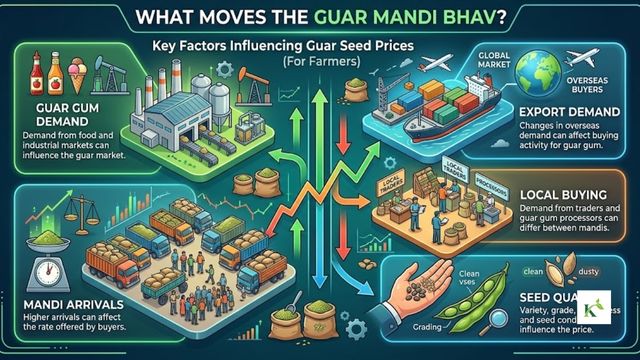
Gwar seed price at any given mandi on any given day is driven by four main factors: the volume of new-crop arrivals pressing into the market (heaviest in October and November), active export order flow from processors, the physical quality of the grain (bold versus light seed commands a material premium), and which mandi you choose to sell at. On the same day, Jodhpur, Bikaner, Sri Ganganagar, Nohar, and Hanumangarh can show price differences of ₹100, ₹300 per quintal or more. Knowing which of these five major Rajasthan arrival centres is offering the strongest rate on a given day directly affects your net return per quintal.
How KhetiKisaan helps you time your sale for maximum munafa
KhetiKisaan provides verified, ground-level gwar mandi bhav sourced from contacts physically present at APMC auction yards during live bol-chaal (bidding sessions), not delayed government feeds or estimated averages. This distinction matters because prices during a live auction can differ from officially reported averages, and a farmer acting on stale data may sell at a rate that was accurate yesterday but not today. Before loading the trolley, check today's gwar rates across Rajasthan's major mandis on KhetiKisaan, compare the figures, factor in your transport cost to each location, and then make the call. The platform also carries crop guides for agronomy questions alongside the price data, so both the growing decision and the selling decision can be informed from the same source.
Putting it all together: gwar ki kheti fayde for your zameen
The eight advantages of gwar ki kheti, drought tolerance, low input cost, nitrogen fixation, soil improvement, realistic earnings, global export demand, crop flexibility, and a strong variety portfolio, do not operate in isolation. They compound. A crop that fixes its own nitrogen also reduces your fertiliser bill for the next rabi season. A crop that tolerates dry spells also tolerates the risk of an uncertain monsoon. A crop with export-driven demand also tends to hold its mandi price more steadily than purely domestic crops when international buyers are active.
For a Rajasthan farmer with light sandy or sandy-loam land, an unpredictable monsoon, and a need to keep input costs under control, gwar is genuinely one of the few kharif crops that works for the land, the soil, and the bank account at the same time. The agronomic decision and the market timing decision carry equal weight: getting one right while ignoring the other still leaves money on the table.
Before your next gwar harvest reaches the mandi gate, visit KhetiKisaan to check today's gwar mandi bhav across Rajasthan's major APMC centres. Every quintal you grew deserves the best price available that day, and knowing the rate before you leave the farm is the simplest way to make sure it gets one.