







Pink Bollworm Management in Bt Cotton: A Practical Guide for Farmers
 Jul 11, 2026
 by Pankaj Sihag



Pink Bollworm Management in Bt Cotton: A Practical Guide for Farmers
Cotton is among India's most important cash crops. It provides income to millions of farmers and supports the country's textile industry. The introduction of Bt cotton has helped farmers reduce crop losses caused by several insect pests.
It has also helped them improve productivity. However, pink bollworm (Gulabi Sundi) continues to pose a threat to cotton cultivation.
In recent years, it has been observed that the pink bollworm has developed resistance to the Bt protein in many cotton-growing regions. As a result, Bt cotton alone is no longer enough to protect the crop.
Farmers now need to follow Integrated Pest Management (IPM) practices. They should also monitor their fields regularly and take timely action to minimise damage.
This guide explains how pink bollworm affects Bt cotton. It also outlines practical steps farmers can take to manage the pest effectively throughout the crop season.
 Table of Contents
What is Pink Bollworm?
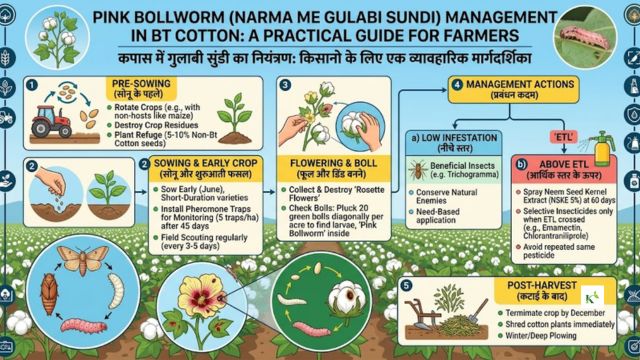
Pink bollworm (Pectinophora gossypiella), also known as Gulabi Sundi, is one of the most destructive pests of cotton. The adult insect is a small moth, but the real damage is caused by its larvae. After hatching, the larvae bore into flower buds and developing cotton bolls. They feed on the seeds and fibres while remaining hidden inside.
The larvae stay protected within the boll. This means the infestation goes unnoticed until significant damage has already occurred. Affected bolls may not develop properly, open prematurely or produce poor-quality lint. In the case of heavy infestations, yields are lower and fibre quality is reduced. It also means significant financial losses for farmers.
Bt cotton was actually introduced to control bollworms. However, continuous cultivation over many years led to the pink bollworm developing resistance in several areas. It means farmers cannot rely solely on Bt cotton. There is a need to combine good agricultural practices with timely pest management to protect crops.
Preventive Measures Before Sowing
Good pest management begins before the crop is planted. Preventive measures help reduce the chances of infestation later in the season.
Here are some important recommendations for farmers:
-
Use approximately 450 grams of Bt cotton seed per bigha.
-
Maintain a spacing of 108 cm between rows and 60 cm between plants to improve air circulation and crop growth.
-
Carry out deep summer ploughing to expose and destroy pest stages present in the soil.
-
Follow crop rotation instead of growing cotton continuously in the same field.
-
Remove weeds from the field and surrounding areas, as they may serve as alternate hosts for pests.
-
Prefer early maturing and shorter duration cotton varieties wherever suitable.
Monitor the Crop Regularly
Regular monitoring helps detect pink bollworm before it causes severe damage.
Farmers should inspect their fields at frequent intervals and look for early symptoms such as:
-
Rosette flowers that fail to open normally.
-
Damaged flower buds.
-
Green bolls with signs of larval feeding.
-
Poor boll development.
According to the advisory by the agriculture department, farmers should install two pheromone traps per acre about 40 to 50 days after sowing.
Control measures should begin if:
-
Each trap catches 5 to 8 moths continuously for three days.
-
5 to 10 out of every 100 flowers show rosette flower symptoms.
-
1 to 2 larvae are found after opening 20 green bolls that are around 10 to 15 days old.
Taking action at the right time helps prevent widespread infestation. This also reduces unnecessary pesticide applications.
Pink Bollworm Management During the Crop Season
The type and intensity of growth measures changes as per the crop’s growth stage.
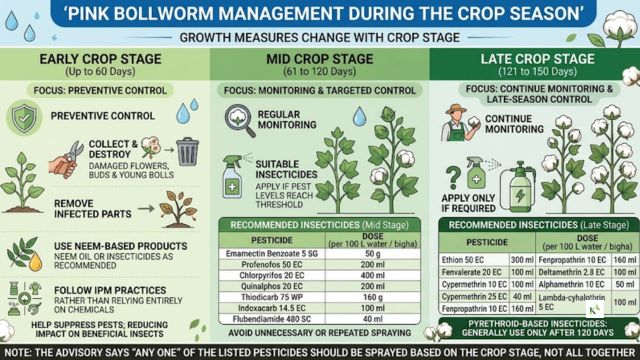
Early Crop Stage (Up to 60 Days)
During the initial growth stage, focus should be on preventive control.
Farmers should:
-
Collect and destroy damaged flowers, buds and young bolls.
-
Remove infected plant parts from the field.
-
Use neem oil or neem-based insecticides as recommended.
-
Follow Integrated Pest Management practices rather than relying entirely on chemical pesticides.
Neem-based products help suppress early pest populations while reducing the impact on beneficial insects.
Mid Crop Stage (61 to 120 Days)
As the crop develops, regular monitoring becomes even more important. If pest levels reach the recommended threshold, suitable insecticides can be applied as per agricultural recommendations.
The advisory recommends insecticides such as:
|
Pesticide |
Dose (per 100 L water / bigha) |
|
|---|---|---|
|
1 |
Emamectin Benzoate 5 SG |
50 grams |
|
2 |
Profenofos 50 EC |
200 ml |
|
3 |
Chlorpyrifos 20 EC |
400 ml |
|
4 |
Quinalphos 20 EC |
200 ml |
|
5 |
Thiodicarb 75 WP |
160 grams |
|
6 |
Indoxacarb 14.5 EC |
100 ml |
|
7 |
Flubendiamide 480 SC |
40 ml |
Avoid unnecessary or repeated spraying when pest levels remain below the threshold.
Late Crop Stage (121 to 150 Days)
Late in the season, farmers should continue monitoring the crop and apply recommended insecticides only if required.
The advisory includes products such as:
|
# |
Pesticide |
Dose (per 100 L water / bigha) |
|---|---|---|
|
1 |
Ethion 50 EC |
300 ml |
|
2 |
Fenvalerate 20 EC |
100 ml |
|
3 |
Cypermethrin 10 EC |
100 ml |
|
4 |
Cypermethrin 25 EC |
40 ml |
|
5 |
Fenpropathrin 10 EC |
160 ml |
|
6 |
Deltamethrin 2.8 EC |
100 ml |
|
7 |
Alphamethrin 10 EC |
50 ml |
|
8 |
Lambda-cyhalothrin 5 EC |
100 ml |
Pyrethroid-based insecticides should generally be used only after the crop has reached about 120 days, as advised by agricultural experts.
Note: The advisory says "any one" of the listed pesticides should be sprayed based on the crop stage, not all of them together.
Additional Precautions
Apart from spraying insecticides, good field hygiene plays an important role in reducing pink bollworm populations.
Farmers should also:
-
Destroy damaged cotton bolls and crop residues after harvest.
-
Store cotton stalks carefully, as pink bollworm can survive inside them.
-
Cover stored cotton stalks with a polythene sheet or mosquito net from April onwards to prevent moth emergence.
-
Ensure all infested plant material is removed from the field.
-
Pay extra attention if fields are located near cotton ginning units or areas where cotton stalks are stored, as these locations may have a higher risk of infestation.
-
Continue following Integrated Pest Management practices throughout the season.
These measures reduce the number of surviving insects that can infest the next cotton crop.
Conclusion
Pink bollworm remains one of the biggest threats to Bt cotton cultivation. Since the pest has developed resistance to Bt technology in many areas, farmers should not depend solely on the crop's built-in protection.
For successful management, farmers must adopt a combination of preventive measures, regular crop monitoring, pheromone traps, timely field inspections, proper sanitation and responsible insecticide use.
Early detection and action can significantly reduce crop losses. They can also help improve cotton yield and fibre quality.
Farmers should follow these recommended practices throughout the growing season. This enables them to better protect their Bt cotton crop and ensure more profitable production.
FAQs
Related Blogs

Oct 02, 2026
by Pankaj Sihag

Sep 12, 2026
by Pankaj Sihag
Sep 02, 2026
by Pankaj Sihag
Aug 27, 2026
by Pankaj Sihag
Apr 11, 2026
by Pankaj Sihag
Apr 08, 2026
by Pankaj Sihag