







Simple Ways to Increase Crop Yield Without Spending Extra Money
 Jul 01, 2026
 by Pankaj Sihag



Simple Ways to Increase Crop Yield Without Spending Extra Money
-
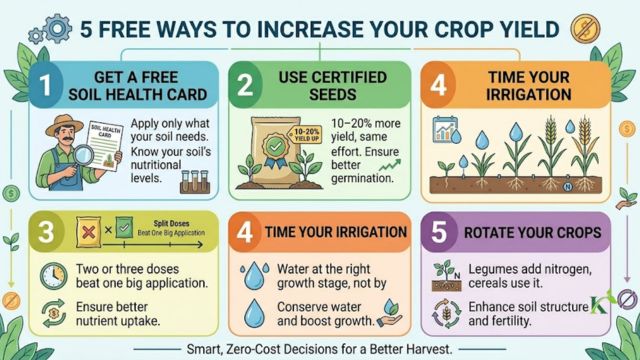
You can increase crop yield without buying more inputs; just use existing ones better.
-
Soil testing helps you apply only what your land actually needs, cutting waste.
-
Certified seeds give 10–20% more yield than home-saved seeds at little extra cost.
-
Crop rotation and organic methods improve soil naturally over time
 Table of Contents
- Better Yield Does Not Always Mean More Spending
- Start With a Soil Test - It Saves Money First
- Use Certified Seeds - Not Last Season's Harvest
- Apply Fertiliser Smarter, Not More
- Rotate Your Crops to Rebuild the Soil Naturally
- Water Wisely - Timing Matters More Than Quantity
- Control Weeds Early and Save Your Crop's Food
- Use Compost and Farm Waste - Do Not Burn It
- Final Thoughts
- FAQs
Better Yield Does Not Always Mean More Spending
You can increase crop yield without buying more fertiliser, more pesticide, or more of anything. In most cases, the bigger problem is not what you are spending; it is how you are using what you already have.
Soil that is not tested, seeds saved from last year's harvest, water applied without timing- these are the things quietly pulling your yield down. Fixing them costs little to nothing.
This guide covers farming productivity tips that work across crops like gehun, dhan, sarso, chana, and makka, and do not require a bigger budget.
Start With a Soil Test - It Saves Money First
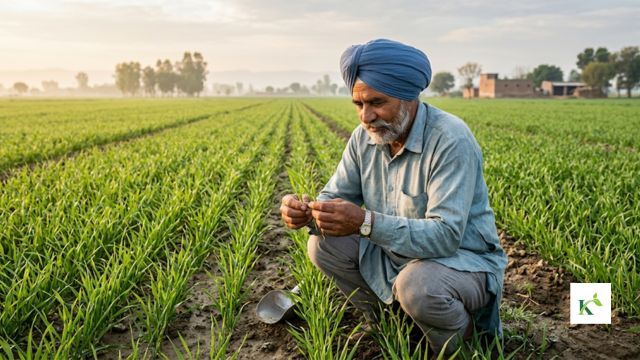
Most kisaans apply fertiliser out of habit, not based on what the soil actually needs. The result is either too much of one nutrient or too little of another. Both reduce yield.
A basic soil test from your nearest Krishi Vigyan Kendra (KVK) or state soil testing lab tells you your soil's pH, nitrogen, phosphorus, potassium, organic carbon, zinc, and sulphur levels. This is the foundation of good soil improvement methods.
What the test helps you do:
-
Stop wasting money on nutrients your soil already has
-
Fix acidity or alkalinity before it reduces absorption
-
Match fertiliser to your specific fasal and soil type
Tip: Test your soil at least once every 2–3 years, or before any change in your cropping pattern.
Use Certified Seeds - Not Last Season's Harvest
Certified seeds (HYV Seeds) of recommended varieties generally give 10–20% more yield than home-saved seed. The germination rate is higher, the crop is more uniform, and disease resistance is better.
The seed rate also matters. Overseeding wastes seed and increases disease risk. Underseeding leaves gaps in the field. Both reduce your final output.
For gehun in north India, for example, the recommended seed rate is around 40–45 kg per acre for irrigated conditions. For sarso, it is closer to 1.5–2 kg per acre depending on the variety.
Check with your state agriculture department or KVK for variety recommendations suited to your district's soil and climate.
Apply Fertiliser Smarter, Not More
Indian farmers often use too much urea and too little phosphorus, potassium, sulphur, and zinc. This imbalance reduces how much yield you actually get from each kilogram of fertiliser.
A better approach is to follow the 4R principle:
-
Right source: Use the fertiliser your crop actually responds to
-
Right dose: Based on your soil test, not guesswork
-
Right time: Basal phosphorus at sowing, nitrogen split across growth stages
-
Right place: Near the root zone, not broadcast wastefully
For cereals like gehun and makka, splitting nitrogen into two or three doses instead of one reduces losses and improves uptake. This is one of the most effective crop growth techniques with no added cost.
Rotate Your Crops to Rebuild the Soil Naturally
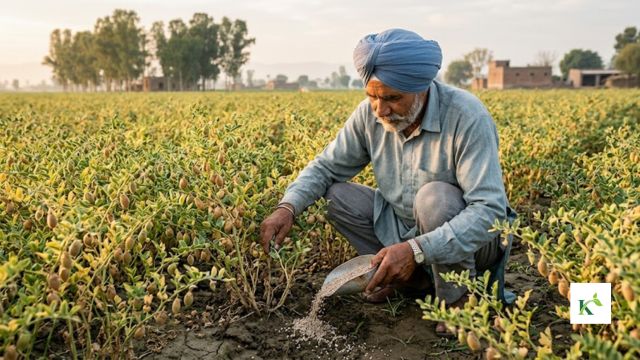
Growing the same fasal on the same zameen season after season depletes specific nutrients and encourages pests and diseases to build up in the soil. Crop rotation breaks this cycle.
Rotating cereals with legumes, like chana, moong, or arhar, is one of the most effective organic farming methods available to Indian kisaans.
Legumes fix nitrogen naturally from the air and leave the soil richer for the next crop. This directly reduces your fertiliser cost in the following season.
A simple rotation example for north India:
-
Kharif: makka or dhan
-
Rabi: chana or sarso
-
Next rabi: gehun
Crop rotation also improves soil improvement methods over time without any additional purchase.
Water Wisely - Timing Matters More Than Quantity
India uses over 70% of its freshwater for agriculture. Most of that goes to crops through flood irrigation, where a large portion evaporates or drains away before roots can absorb it.
You do not need drip irrigation to improve irrigation efficiency. Timing your irrigation correctly makes a bigger difference:
-
For gehun, the most critical stages are crown root initiation (20–25 days after sowing) and heading or flowering
-
For dhan, light standing water during tillering helps build stronger plant growth and supports better yield
-
For sarso, the first irrigation at branching and the second at pod formation are important
Control Weeds Early and Save Your Crop's Food
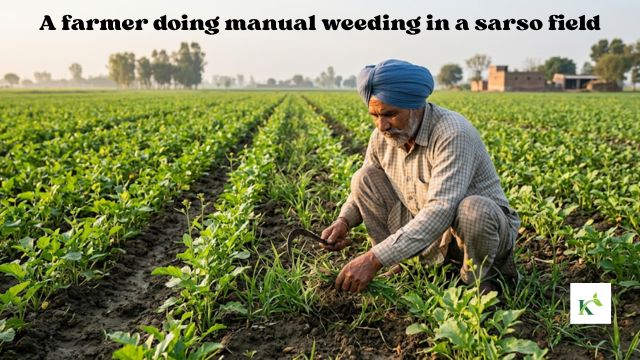
Weeds compete with your fasal for water, nutrients, and sunlight. In many fields, unchecked weeds reduce yield by 20–40% without any pest or disease involvement at all.
Early weeding, within the first 3–4 weeks after sowing, gives your crop a clean start.
For gehun, the critical weed-free period is the first 30–35 days. For dhan, it is the first 30 days after transplanting.
Use Compost and Farm Waste - Do Not Burn It
Stubble burning destroys organic matter that your soil needs. Incorporating crop residue back into the field, or composting, improves soil structure, water retention, and microbial activity over time.
Adding farmyard manure (FYM) before sowing is one of the oldest and most effective low-cost farming ideas in Indian agriculture. It reduces dependence on chemical inputs gradually.
For organic carbon levels below 0.5%, common in Punjab, Haryana, and Uttar Pradesh soils, regular addition of FYM or vermicompost over 2–3 seasons makes a visible difference to soil health and yield.
Final Thoughts
Most of what pulls crop yield down in India is not a lack of inputs; it is inputs used at the wrong time, in the wrong amount, on soil that has not been properly understood.
Sustainable agriculture does not mean doing less. It means doing the same things more carefully: testing before you apply, timing your irrigation, rotating your crops, and letting the soil recover.
These are low-cost farming ideas that work on any zameen, whether you grow gehun in Haryana, sarso in Rajasthan, or chana in Madhya Pradesh.
Before the next sowing season, check your soil, plan your crop rotation, and stay updated on mandi bhav for your fasal on KhetiKisaan, so your planning covers both the field and the market.