





Rice Mill vs Mandi vs Export Trader: Where Does Dhan Farmer Actually Get the Best Rate
 Jun 22, 2026
 by Pankaj Sihag



Rice Mill vs Mandi vs Export Trader: Where Does Dhan Farmer Actually Get the Best Rate
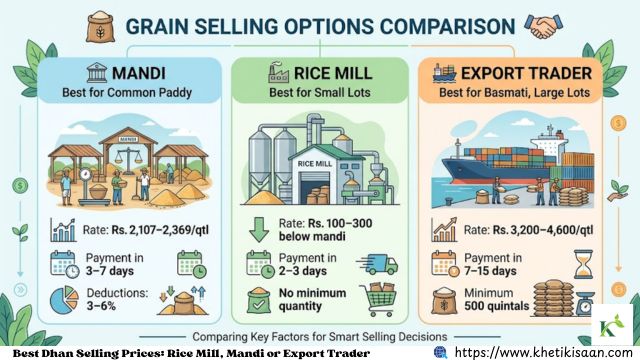
- Comparing the selling price of dhan at rice mills and mandis shows mills typically pay Rs. 100 to Rs. 300 per quintal less than mandi rates, but offer faster payment.
-
Government mandi (MSP route) gives price certainty at Rs. 2,369 per quintal for common paddy in 2025-26. However, it also involves delays and moisture rejection risk.
-
Export traders pay the highest rates for premium basmati dhan (Rs. 3,500 to Rs. 4,600 per quintal in Haryana).
-
The best channel depends on your variety, quantity, quality and urgency.
-
Platforms like KhetiKisaan help you compare live buyer rates before you are ready to sell.
 Table of Contents
- Who Actually Pays the Most for Your Dhan?
- Option #1: Selling Dhan at the Mandi: Safe Floor, Real Costs
- Option #2: Selling to a Rice Mill: Convenient But Cheaper
- Option #3: Selling to an Export Trader: Premium Rates, Strict Conditions
- Quick Comparison: Which Channel Gives the Best Dhan Rate?
- How Can Dhan Farmers Get Maximum Profit?
- FAQs
Who Actually Pays the Most for Your Dhan?
Farmers growing paddy in India face this question every harvest season: sell at the local mandi, go directly to a rice mill or try an export trader?
There can be a difference of thousands of rupees per acre between the three.
As a general rule: if you grow common paddy, start with the mandi.
If you grow basmati in large lots, you can go for an export trader.
Otherwise, a local rice mill is the most accessible option for you.
This guide offers a comparison of dhan procurement rates in India that farmers need to make a smarter decision before the next sale.
Option #1: Selling Dhan at the Mandi: Safe Floor, Real Costs
The government mandi offers the Minimum Support Price (MSP) so farmers get a guaranteed rate.
|
For Kharif 2025-26, the MSPs are:
More than 2,700 designated mandis are operational in Punjab alone during the procurement season. |
However, farmers usually do not receive the full price shown in the market. They need to pay some extra charges like:
-
fees to the middleman
-
weighing charges and
-
market fees
This reduces the money they receive by about 3% to 6%.
When a farmer needs cash urgently, the mandi may not be the best option for him. There are chances of rejection due to moisture content, and farmers may need to wait for 3 to 7 days for payment.
There can be a clear difference in the dhan mandi bhav and mill buying rate for common paddy. Open mandi rates currently lie between Rs. 1,268 and Rs. 3,284 per quintal.
The average rate is around Rs. 2,107 per quintal. In many places where the government does not buy crops, farmers receive much less than the MSP.
Option #2: Selling to a Rice Mill: Convenient But Cheaper
Commonly, paddy farmers across the country sell directly to rice mills. The key advantages of selling to a rice mill are:
-
The rice mills buy throughout the year.
-
They do not follow Agricultural Produce Market Committee (APMC) registration requirements and pay within 2 to 3 days.
-
Rice mills are found in more convenient locations than mandis.
This is why rice mills are often the default buyer for small farmers.
However, if you compare the selling price of dhan at rice mills and mandis, mills generally buy raw paddy at lower rates. They apply processing costs and pay Rs. 100 to Rs. 300 per quintal less than the mandi rate.
The rice mills also have their own moisture and quality parameters.
Mills are still a good option because of certainty and easy reach. Suppose you are a farmer and live around 40km away from the nearest mandi. You do not have a transportation arrangement.
If you want to reach the mandi, you will have to pay the freight and commission. So, selling to a nearby rice mill at a slightly lower rate would be a better option for you.
Option #3: Selling to an Export Trader: Premium Rates, Strict Conditions
The export traders are the best option for farmers who grow basmati dhan. However, the export trader’s price for basmati dhan in India depends on multiple factors like:
-
Variety
-
Elongation ratio and
-
Region
|
Currently, for premium basmati, you can get the following rates:
Tip: You can check live rates for other states from KhetiKisaan: Aaj Ka Bhav |
If you qualify, you can receive the highest gross rate from the export traders. However, this comes with some strict quality rules.
Export traders consider important factors like variety purity, broken percentage and moisture levels less than 14%. The minimum lot size is generally 500 quintals.
You may also need to transport your produce to a centralised collection point. There is also no APMC regulatory protection.
Quick Comparison: Which Channel Gives the Best Dhan Rate?
Here is a quick comparison table to help you analyse which channel offers the best Dhan rate:
|
Factor |
Mandi (MSP Route) |
Rice Mill |
Export Trader |
|---|---|---|---|
|
Typical Rate |
Rs. 2,107 to 2,369/qtl (common) |
Rs. 100 to 300 below mandi |
Rs. 3,200 to 4,600/qtl (basmati) |
|
Payment Speed |
3 to 7 days |
2 to 3 days |
7 to 15 days |
|
Quality Scrutiny |
Moderate (moisture check) |
High (mill parameters) |
Very high (variety + grade) |
|
Min. Lot Size |
No minimum |
No minimum |
500+ quintals |
|
Best For |
Common paddy, procurement states |
Small lots, remote areas |
Premium basmati, large lots |
How Can Dhan Farmers Get Maximum Profit?
There is no single best sales channel for dhan farmers.
You need to consider factors like your variety (basmati vs common), your lot size and your nearest live rate to determine the best option for you.
Need some help to decide?
KhetiKisaan offers all the information you need. It is a digital platform that gives dhan farmers access to live buyer rates, verified purchaser contacts and a transparent view of the rates mills, mandis and traders are offering in their district.
Check www.khetikisaan.com before your next sale.
FAQs
Related Blogs
Jun 22, 2026
by Pankaj Sihag