





1509 Dhan Rate in India: Latest Mandi Prices, Trends & Selling Tips for Farmers
 Aug 22, 2026
 by Pankaj Sihag



1509 Dhan Rate in India: Latest Mandi Prices, Trends & Selling Tips for Farmers
- The 1509 dhan rate in India varies between mandis and can change with arrivals, crop quality, buyer demand, and local trading conditions.
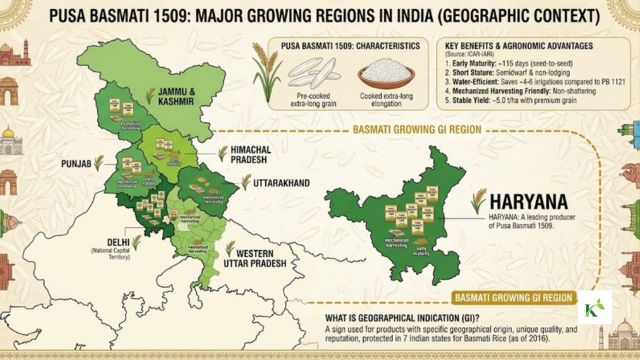
- Pusa Basmati 1509 is an early-maturing Basmati variety developed by the Indian Agricultural Research Institute. ICAR states that it matures in about 115 days and has an average seed yield of 41.4 quintals per hectare.
- India exported 6.52 million metric tonnes of Basmati rice in 2025-26, according to APEDA, showing the scale of the market beyond domestic mandis.
- Mandi prices should be checked by variety, mandi, grade, date, and price type rather than treated as a single India-wide rate.
- Comparing the latest mandi rate with crop quality, arrivals, and transport costs gives farmers a better basis for deciding where to sell.
 Table of Contents
- What Is the Latest 1509 Dhan Rate in India?
- Why Does The 1509 Paddy Price Change Between Mandis?
- What Makes 1509 Basmati Paddy Different?
- What Should Farmers Check Before Selling 1509 Dhan?
- How Can Farmers Track The 1509 Dhan Price Today?
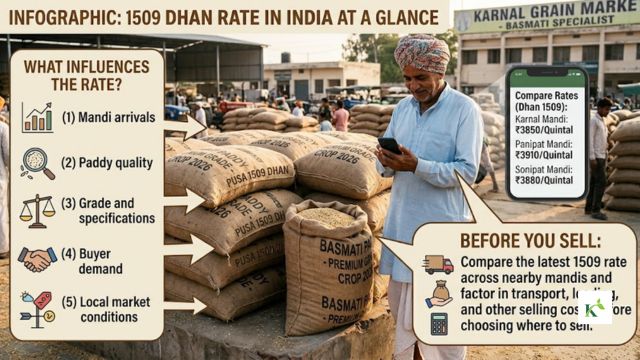
- What Can Influence The 1509 Paddy Market Price?
- Conclusion
- FAQs
What Is the Latest 1509 Dhan Rate in India?
The 1509 dhan rate in India can differ from one mandi to another, even within the same state. For example, Basmati 1509 at Kunjpura APMC in Karnal, Haryana, was reported at ₹3,530 per quintal, while another available mandi record from Nilokheri APMC reported ₹3,980 per quintal.
These are reported prices from specific mandis, not a fixed India-wide rate. Farmers checking the 1509 paddy price today should therefore look at the latest available figure for their specific mandi.
Remember that mandi prices can change with fresh arrivals, crop quality, buyer demand, and local trading activity.
Why Does The 1509 Paddy Price Change Between Mandis?
The 1509 paddy price today depends on what is happening in the market where the crop is being sold. The quantity arriving at the mandi, quality of the paddy, buyer participation, and demand from rice millers and traders can all affect the rate.
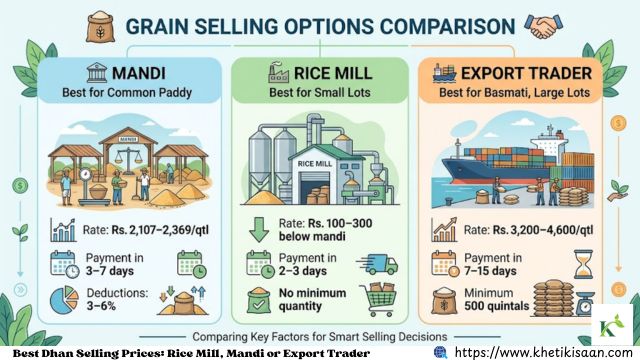
Basmati also has a sizeable export market. The Agricultural and Processed Food Products Export Development Authority (APEDA) reports India exported 6.52 million metric tonnes of Basmati rice during 2025-26, valued at ₹50,138.28 crore. Saudi Arabia, Iran, Iraq, the UAE, Yemen, and the US were among the major destinations.
Export demand is therefore relevant to the wider Basmati market, although it does not translate into a fixed 1509 paddy price at a particular mandi. Local arrivals and buying conditions still matter when a farmer takes a crop to market.
What Makes 1509 Basmati Paddy Different?
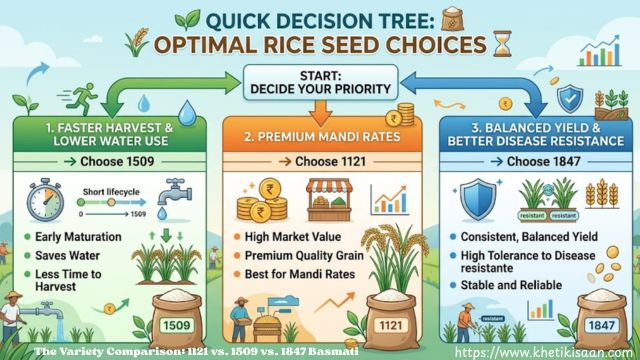
The 1509 basmati paddy rate is influenced by the characteristics of the crop as well as market conditions.
Pusa Basmati 1509 is an early-maturing variety developed by the Indian Agricultural Research Institute (IARI). ICAR describes Pusa Basmati 1509 as an early-maturing, reduced-height, non-lodging, and non-shattering variety. It matures in about 115 days and has an average seed yield of 41.4 quintals per hectare.
ICAR-IARI has also described Pusa Basmati 1509 as a short-duration variety of about 115–120 days, with superior grain quality and high market value.
Its shorter crop duration is one reason 1509 occupies a distinct position among Basmati varieties. It does not, however, guarantee a particular mandi rate. The price received by a farmer still depends on the crop and the market at the time of sale.
What Should Farmers Check Before Selling 1509 Dhan?
The 1509 paddy mandi rate is only one part of the selling decision. Before taking the crop to market, it is worth checking the following:
- Latest mandi rate: Use a recent quotation for 1509 rather than relying on an older rate shared by a buyer or another farmer.
- Modal price: Check the modal price alongside the minimum and maximum prices. It can provide a useful reference for the day's reported trading conditions, but it should not be treated as a guaranteed price for every lot.
- Crop quality: Moisture, grain quality, purity, and other specifications can affect the price offered by buyers. A particular moisture level should not be treated as a guaranteed price threshold without checking the buyer's requirements.
- Nearby markets: Compare the rate in more than one mandi where possible. Include transport and other selling costs before deciding that a higher quoted rate will result in a better return.
- Arrivals: Check recent mandi arrivals along with the price. This helps put the current rate into context by showing how much produce is reaching the market.
- Variety and grade: Make sure the quoted price is for Basmati 1509. Comparing different varieties or grades can give a misleading impression of price differences.
How Can Farmers Track The 1509 Dhan Price Today?
The 1509 mandi bhav today is most useful when it is linked to a specific mandi and date. A rate without either detail can become misleading.
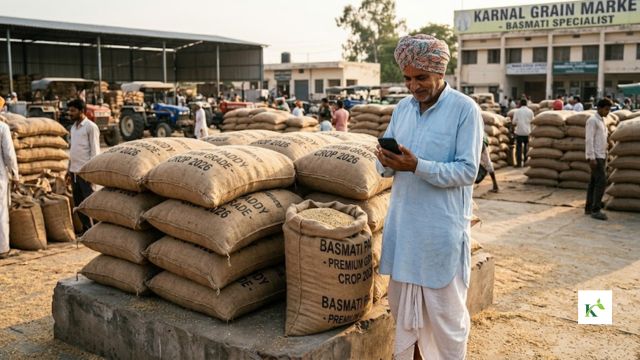
Government agricultural market platforms and mandi data can provide information such as minimum, modal, and maximum prices, arrivals, and the date of the reported market activity. Farmers can use these figures alongside local mandi updates when comparing markets.
KhetiKisaan can also be used to check available mandi bhav updates before taking 1509 paddy to market.
What Can Influence The 1509 Paddy Market Price?
The 1509 paddy market price does not move because of one factor. Several things can affect the rate being quoted at a mandi:
- Arrivals: The volume of paddy reaching a market can influence local trading conditions.
- Crop quality: Grain characteristics, purity, moisture, and other quality parameters can affect buyer assessments.
- Buyer demand: Millers and traders may have different requirements depending on their current procurement needs.
- Basmati demand: The wider domestic and export market can influence buying conditions for Basmati rice.
- Variety and grade: Different Basmati varieties and grades can attract different prices, even within the same market.
- Location: The number of active buyers, nearby rice-processing activity, and transport connections can differ between mandis.
Conclusion
The 1509 dhan rate in India can differ considerably between mandis, even when the same variety is being traded. The latest rate needs to be read alongside the market, date, crop quality, arrivals, grade, and local trading conditions.
Before selling, farmers should compare recent prices for Basmati 1509, check whether the quoted rates relate to comparable grades, and consider transport and other selling costs. Checking the latest available mandi information close to the day of sale can provide a more relevant basis for the decision.
KhetiKisaan can help farmers keep track of mandi bhav and market updates when making that decision.
FAQs
Related Blogs
Jun 22, 2026
by Pankaj Sihag