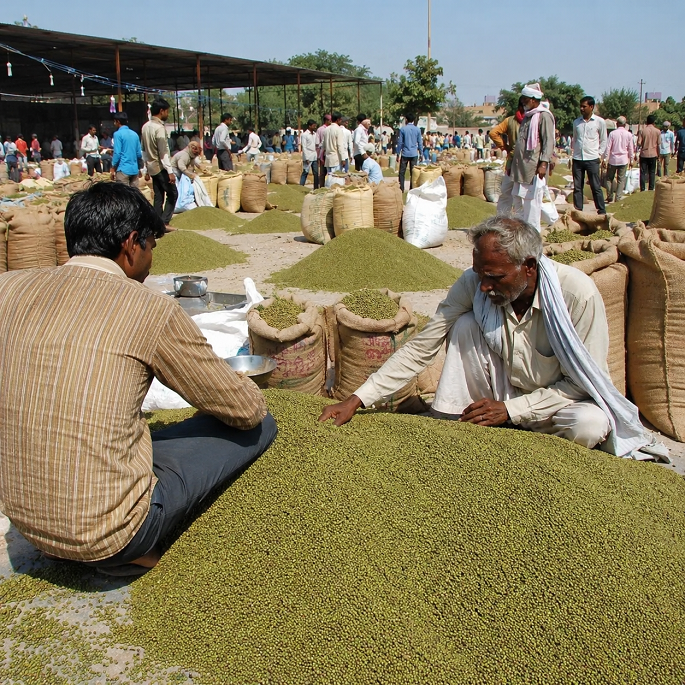






Gwar Crop Profit per Acre: Real Costs and Returns
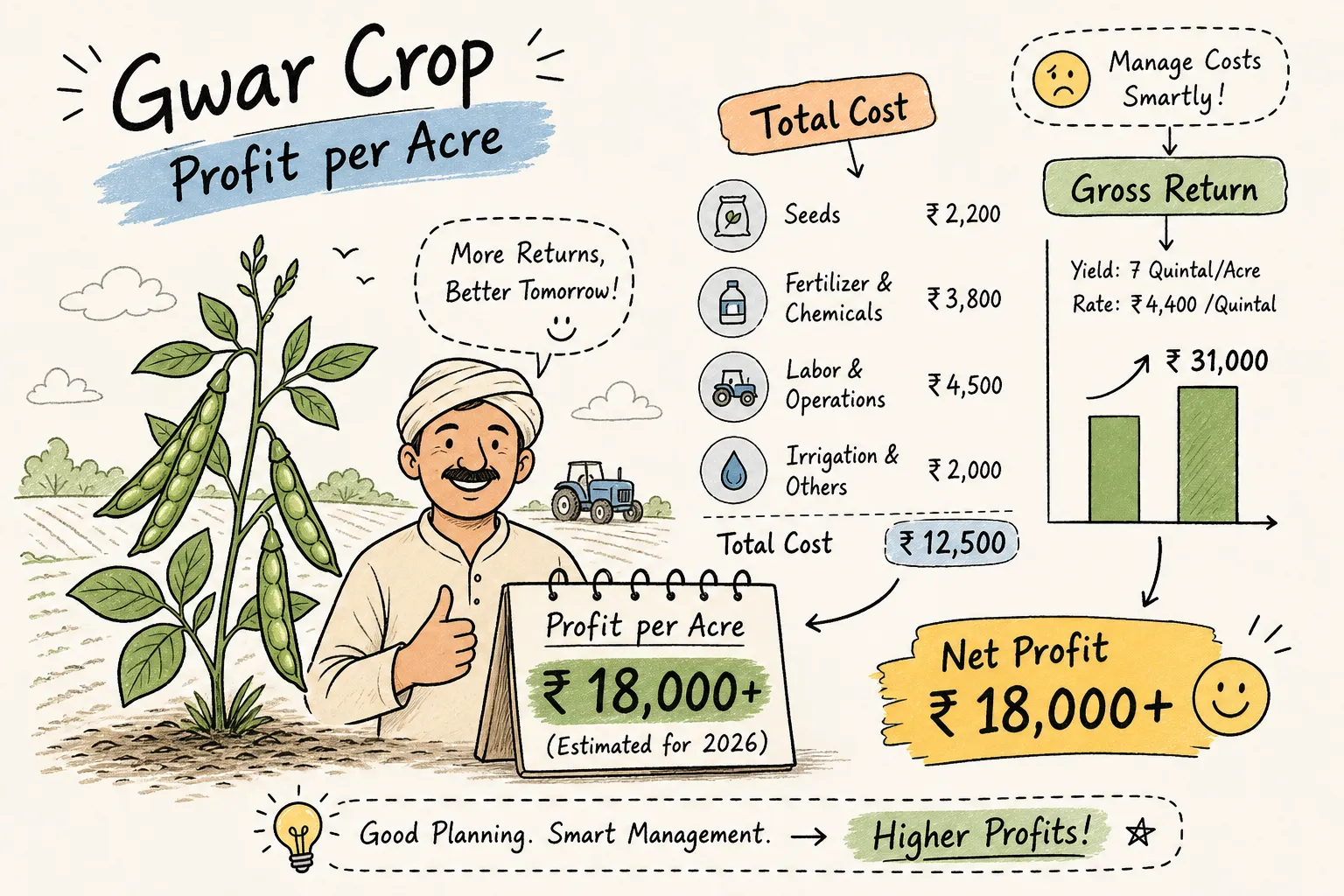
 Oct 12, 2026
 by Pankaj Sihag



Gwar Crop Profit per Acre: Real Costs and Returns
If you are planning to grow gwar (cluster bean) this Kharif season, estimating your gwar crop profit per acre before you sow, not after harvest, is the single most useful calculation you can do. The actual munafa per acre depends almost entirely on three numbers: what you spent growing the crop, how many quintals came off the field, and what the mandi bhav was on the day you sold. Get these three numbers right in advance, and gwar can be one of the most rewarding crops in North India's Kharif calendar. A decent monsoon season can still end in disappointment if the numbers are wrong.
This article gives you a clear, number-driven picture of gwar cultivation profit per acre: full input cost breakdowns, realistic yield ranges for rainfed and irrigated conditions, current mandi bhav data from Rajasthan, Gujarat, and Haryana, and three worked-out profit scenarios so you can see exactly where your farm sits. Farmers who compare multiple mandi rates before deciding where to sell typically recover better prices than those who rely on word-of-mouth from neighbours or the first bid from their arhatiya (commission agent). By the end of this piece, you will have everything needed to calculate expected returns and decide whether gwar makes sense for your farm this season.
 Table of Contents
- Quick facts: gwar cultivation snapshot
- Gwar crop profit per acre, cost breakdown
- Realistic gwar yield per acre: rainfed vs irrigated
- Gwar mandi bhav: what prices are farmers seeing
- Calculating gwar crop profit per acre: three scenarios
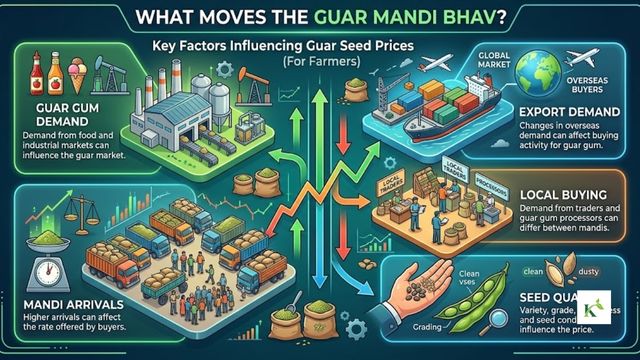
- What makes gwar prices swing so sharply
- How to improve your net returns from gwar this season
- The bottom line on gwar crop profit per acre
- FAQs
Quick facts: gwar cultivation snapshot
Key numbers at a glance
| Parameter | Rainfed | Irrigated |
|---|---|---|
| Typical input cost per acre | ₹9,000, ₹12,000 | ₹20,000, ₹30,000 |
| Realistic yield range (kg/acre) | 300, 900 kg | 700, 1,200 kg |
| Mandi bhav range (Rajasthan) | ₹6,400, ₹7,140/quintal | |
| Mandi bhav range (Gujarat) | ₹5,500, ₹6,600/quintal | |
| Mandi bhav range (Haryana) | ₹5,500, ₹7,122/quintal | |
| Indicative net profit per acre | ₹10,000, ₹25,000 | ₹25,000, ₹45,000 |
| Break-even yield (cash costs only) | ~156, 200 kg/acre at ₹6,400/quintal | |
| Sowing window | June, July with first monsoon shower | |
| Seed rate | 8, 10 kg/acre | |
| Government MSP | Not applicable, no MSP declared for gwar seed |
What makes gwar different from other Kharif crops
Gwar holds a unique position in the Kharif lineup for two reasons that most other crops cannot match. First, it is a nitrogen-fixing legume, its roots restore soil fertility naturally, reducing your fertiliser cost for the following Rabi crop by a meaningful margin. Second, gwar's price is not driven by Indian household consumption alone. Its primary industrial use is guar gum, a derivative that serves as a critical input in hydraulic fracturing (fracking) used by the oil and gas industry globally.
This dual demand structure, food thickener plus oilfield chemical, gives gwar far more price upside than crops like bajra or moong. It also brings considerably more volatility. A price swing of ₹500, ₹1,000/quintal within a single season is not unusual, and a kisaan who sells on the wrong day versus the right day can lose or gain thousands of rupees per acre on identical yields. Understanding gwar's price dynamics is just as important as agronomic management.
Gwar crop profit per acre, cost breakdown
Seed, fertiliser and land preparation costs
Quality certified seed costs ₹400, ₹1,500/acre depending on whether you purchase from an authorised dealer or use retained seed from the previous season. Improved varieties like RGC-936 (best suited for arid western Rajasthan) and HG-365 (recommended for Haryana and northern Rajasthan) deliver materially higher yields, so paying for certified seed is usually worth it. DAP, phosphorus, and sulphur-based fertiliser add another ₹800, ₹2,000/acre. Gwar fixes its own nitrogen through root nodules, so you do not need heavy nitrogen applications, this keeps fertiliser costs manageable compared to crops like maize or cotton.
Land preparation, sowing, and machinery hire, including tractor charges and seed drill use, adds ₹700, ₹1,500/acre. Sow at 45 cm row spacing with 15 cm plant spacing, using 8, 10 kg of seed per acre, immediately after dependable monsoon moisture arrives in June or early July. Late sowing reduces yield potential significantly, so timing this correctly is a no-cost way to protect your returns.
Labour, plant protection and harvesting expenses
Weeding, spraying, and general crop management labour typically costs ₹1,500, ₹3,500/acre combined. Plant protection, herbicide plus pesticide applications, adds ₹300, ₹1,200/acre depending on weed and pest pressure in your area. Harvesting and threshing is one of the biggest variable cost items: expect ₹2,000, ₹3,500/acre, varying considerably depending on whether machine harvesting is available locally or you rely entirely on hired manual labour.
Transport to the mandi adds ₹200, ₹800/acre based on distance. This cost is easy to underestimate when planning, particularly if your nearest APMC is more than 30, 40 km away. Budget the upper end if you intend to take produce to a mandi other than your closest one in order to capture a better bhav. The transport premium is frequently more than recovered by the price difference.
Total cost estimate: what to budget realistically
A typical rainfed gwar crop under standard management costs approximately ₹10,000/acre in cash outlays. Fully irrigated, commercially managed cultivation with purchased inputs and hired labour across all operations can reach ₹25,000, ₹30,000/acre. The table below shows the component-wise split so you can identify where your own farm is likely to sit.
| Cost component | Rainfed budget (₹/acre) | Irrigated budget (₹/acre) |
|---|---|---|
| Seed | 700 | 1,200 |
| Fertiliser (DAP, phosphorus, sulphur) | 1,200 | 2,500 |
| Land preparation and machinery | 1,000 | 1,500 |
| Irrigation (diesel/electricity) | 0, 300 | 3,000, 5,000 |
| Labour (weeding, sowing, spraying) | 1,500 | 3,000 |
| Plant protection | 700 | 1,200 |
| Harvesting and threshing | 2,800 | 3,500 |
| Transport to mandi | 400 | 700 |
| Miscellaneous and interest | 700 | 800 |
| Total | ~₹10,000 | ~₹18,400, ₹20,400 (standard irrigated); up to ₹25,000, ₹30,000 for fully commercial operations |
Controlling harvesting and labour costs is where most farmers have the greatest leverage. These two components together can account for 40, 50% of total cash expenditure, and sourcing machine harvesting through a farmer group or cooperative can reduce this substantially.
Realistic gwar yield per acre: rainfed vs irrigated
Rainfed gwar yield: what a normal monsoon gives you
In rainfed conditions, plan for a realistic range of 300, 900 kg/acre. National average estimates vary by source and season, figures of around 260, 313 kg/acre reflect drought-affected years and sub-optimal management pulling the average down. In a decent monsoon with timely sowing and proper weed control, Rajasthan farmers commonly achieve 400, 600 kg/acre, and well-managed fields in better rainfall zones push toward the top of this range. Poor or erratic rainfall during the critical flowering-to-pod-fill stage can push yield below 300 kg/acre, leaving the crop barely covering cash costs.
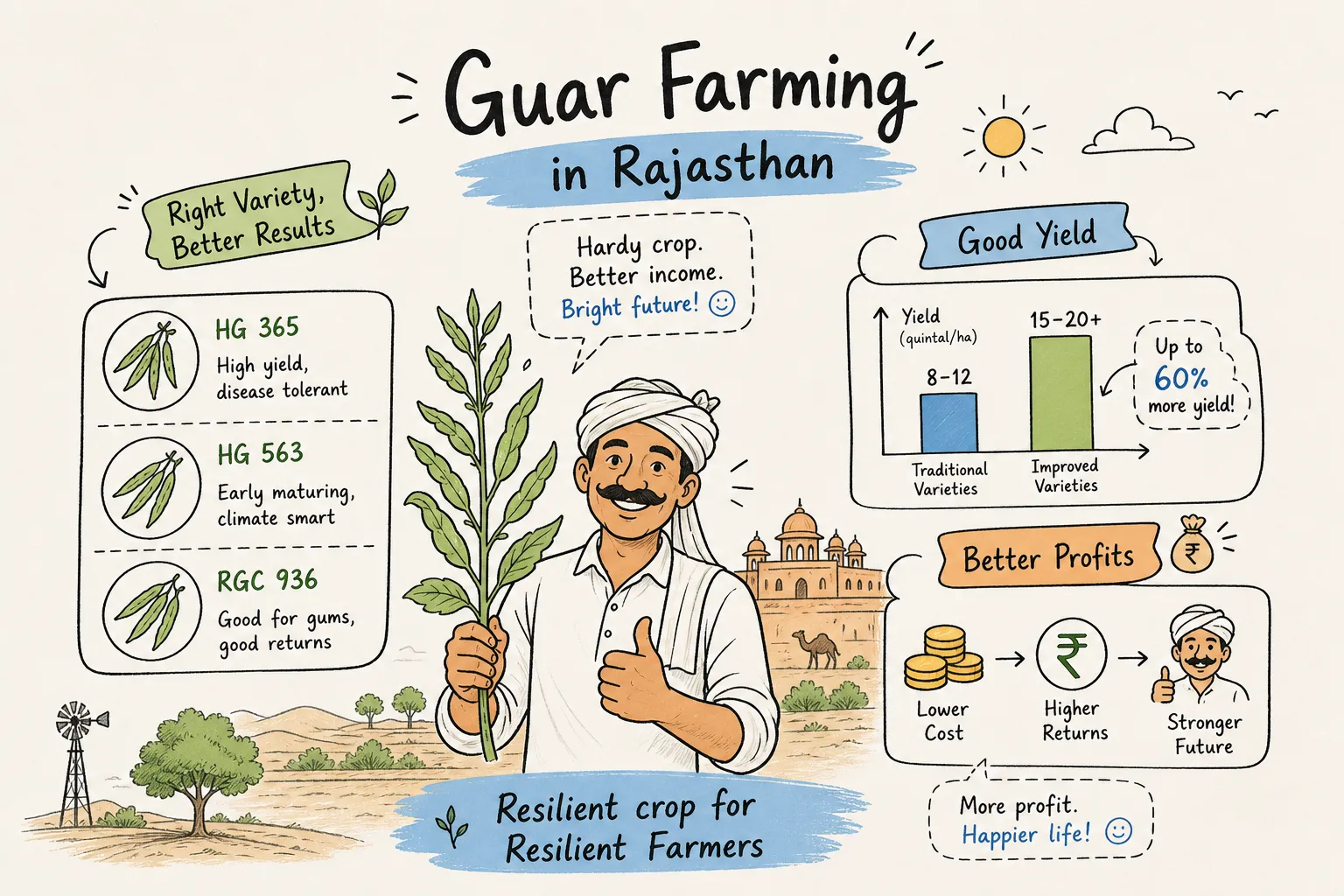
Variety selection matters enormously under rainfed conditions. RGC-936 is the strongest all-rounder for arid and semi-arid Rajasthan, recording around 3.7 quintals/acre in comparative trials, with good drought tolerance and early maturity. HG-365 is the preferred choice for Haryana and northern Rajasthan, performing reliably at 2.8, 3.2 quintals/acre under rainfed practice, with a short growing duration that is useful when the monsoon is late or truncated.
Irrigated gwar yield: the numbers from Haryana and Rajasthan trials
With even one or two supplemental irrigations applied during the critical pod-filling period, yield climbs significantly. Improved variety trials in Haryana and Rajasthan report 700, 1,200 kg/acre under irrigated management. District-level figures from Haryana indicate averages of 762, 812 kg/acre, and well-managed irrigated fields with varieties like HG-365 or RGC-936 can reach the upper end of this range. Irrigation fundamentally changes the risk profile of gwar: from a weather-dependent gamble to a more predictable, calculable enterprise.
The profitability implication is significant. A yield of 750 kg/acre versus 400 kg/acre at the same ₹6,500/quintal mandi bhav translates to ₹22,750 additional gross revenue per acre, dwarfing the cost of one or two irrigation cycles. If water is available, a single well-timed irrigation is almost certainly the highest-return investment a gwar farmer can make.
Gwar mandi bhav: what prices are farmers seeing
Current gwar seed rates across major mandis
Gwar seed is trading at ₹6,400, ₹8,140/quintal across Rajasthan's 17-plus mandis, with a median near ₹7,400/quintal. Gujarat mandis report approximately ₹7,215/quintal as a typical price, with individual markets ranging from ₹5,500 to ₹7,600/quintal. Haryana presents the widest spread: Hansi reports around ₹5,500/quintal at the lower end, while Siwani has traded near ₹8,122/quintal, a difference of over ₹2,600/quintal between two mandis within the same state.
No government MSP exists for gwar seed, which means prices are entirely market-driven and directly exposed to both domestic supply and global export demand. There is no price floor to fall back on in a bad year. Unlike wheat or paddy, where MSP provides a guaranteed minimum, gwar farmers must actively monitor market behaviour and make informed selling decisions. This reinforces the importance of understanding price dynamics before committing to the crop.
Why gwar bhav varies so much between mandis on the same day
A ₹500, ₹700/quintal difference between two mandis 100 km apart is not unusual. The reasons are practical: moisture content and pod-fill quality, the volume of arrivals that particular day (high arrivals push prices down), local processor or exporter presence, and how many active buyers are present at that specific bol-chaal (auction). A large guar processing unit near one mandi will consistently bid more aggressively than a market where buyers are only occasional visitors.
Farmers who compare multiple mandi rates before loading their trolley consistently recover more per quintal than those who take the first local bid. This is not a minor difference in convenience. At ₹600/quintal across 5 quintals per acre, it is ₹3,000/acre, which exceeds the cost of seed and fertiliser combined.
Tracking live gwar mandi bhav before you sell
During the peak October, November post-harvest window, price differences between mandis are most pronounced and arrivals are heaviest. Checking live gwar mandi bhav listings across Rajasthan, Gujarat, and Haryana mandis before deciding where to sell can directly recover thousands of rupees per acre. KhetiKisaan publishes daily gwar mandi bhav listings sourced from APMC markets, giving farmers a practical starting point for comparing rates across regions. It takes minutes and costs nothing.
Calculating gwar crop profit per acre: three scenarios
The three scenarios below use current price and cost data. All figures are per acre, and input costs exclude imputed land rent and family labour value unless specifically noted.
Scenario 1: poor monsoon, weak prices (the loss risk)
- Rainfed yield: 350 kg/acre
- Mandi bhav: ₹5,800/quintal
- Input cost: ₹10,000/acre
- Gross revenue: ₹20,300/acre
- Net profit (cash costs only): approximately ₹10,300/acre
This looks positive on paper, but the calculation excludes family labour value and land rent. A realistic full-cost accounting, including 60 days of family labour at even ₹300/day and a modest land rent of ₹3,000, ₹5,000/acre, reduces net returns to near zero or into loss territory. This is the baseline risk scenario every farmer should work through before sowing. If your monsoon forecast is poor, the break-even pressure is real.
Scenario 2: average monsoon, median prices (typical outcome)
- Rainfed yield: 550 kg/acre
- Mandi bhav: ₹6,400/quintal
- Input cost: ₹10,500/acre
- Gross revenue: ₹35,200/acre
- Net profit after cash inputs: approximately ₹24,700/acre
This represents a realistic middle-case outcome for a well-managed rainfed crop in Rajasthan or Haryana in a decent monsoon year, using a good variety and timely sowing. After accounting for family labour and land rent, a net munafa of ₹15,000, ₹18,000/acre is achievable, comparing favourably with bajra or moong under similar conditions. This is the scenario most farmers in a normal season should plan for.
Scenario 3: good yield, good timing on price (the upside)
- Irrigated yield: 900 kg/acre
- Mandi bhav: ₹7,000/quintal (timed to a post-harvest market recovery)
- Input cost: ₹18,000/acre (accounting for irrigation and higher management)
- Gross revenue: ₹63,000/acre
- Net profit: approximately ₹45,000/acre
This scenario shows what becomes possible when variety selection, water management, and market timing align. The ₹600/quintal difference between selling at ₹6,400 and ₹7,000/quintal at 900 kg/acre yield translates to ₹5,400/acre in additional net return, purely from price timing, with no additional investment. Monitoring gwar bhav during the post-harvest holding period is as important as any agronomic practice.
What makes gwar prices swing so sharply
The oilfield connection: how fracking demand moves your mandi rate
Guar gum is a critical thickening agent in hydraulic fracturing, the technique used to extract shale oil and gas in the United States, particularly in the Permian Basin. When crude oil prices rise and drilling activity picks up, processors start buying gwar seed aggressively, and Rajasthan mandi bhav can jump ₹500, ₹1,000/quintal within weeks. When U.S. rig counts fall, buyer interest softens and prices follow. The 2012 global guar price spike, where prices hit record highs, was driven precisely by a U.S. shale boom coinciding with a poor Indian crop. While such extremes remain possible but are not the norm, a price driver 12,000 km away genuinely does determine what a Rajasthan kisaan earns at the mandi.
The practical implication: watch crude oil price trends and U.S. rig count data during your holding period. Both are publicly available. When oil is above $70/barrel and rig counts are climbing, processor demand for gwar seed in India tends to firm up within several weeks to a few months as export orders flow through the supply chain.
Monsoon variability and inventory behaviour by processors
India is the dominant global gwar producer, along with Pakistan, the two countries account for roughly 85% of world supply, with Rajasthan contributing the largest share within India. A weak or erratic monsoon has an immediate effect on global availability, and processors know this. When crop estimates are lower early in the season, exporters and processors start building inventory before harvest, pushing prices up even before the first arrivals reach the mandi. When a bumper crop arrives, the reverse happens quickly.
The post-harvest season is often the worst time to sell if arrivals are heavy. October and November see the maximum supply pressure as thousands of farmers bring fresh Kharif gwar to market simultaneously. Farmers who can store their gwar in dry, ventilated conditions for 60, 90 days frequently benefit from a January, March off-season price recovery as supply tightens and export demand is sustained. This is an observed seasonal tendency supported by multi-year price patterns, and worth factoring into your selling plan.
How to improve your net returns from gwar this season
Variety selection and input discipline
Choose your variety based on your zone: RGC-936 for western and central Rajasthan's sandy, arid belt; HG-365 for Haryana, Punjab, and northern Rajasthan districts like Sri Ganganagar and Hanumangarh. A variety delivering 700 kg/acre versus 450 kg/acre at the same ₹6,500/quintal mandi bhav adds approximately ₹16,250/acre in gross revenue, far exceeding any other single management intervention. Rajasthan State Seeds Corporation has been distributing hybrid gwar seed at a subsidised rate of approximately ₹90/kg through designated centres; check availability with your local agriculture supervisor before purchasing at commercial prices, as distribution is typically district-specific and limited in quantity.
Pair variety selection with targeted fertiliser use: phosphorus and sulphur at recommended rates, minimal nitrogen since gwar fixes its own. Sow promptly with the onset of monsoon in June, July at 45 cm × 15 cm spacing, using 8, 10 kg of seed per acre. Late sowing consistently reduces yield potential and is one of the most common, entirely avoidable causes of below-average returns.
Timing your mandi sale to capture better bhav
Gwar bhav typically dips in October, November when fresh Kharif arrivals flood mandis across Rajasthan, Gujarat, and Haryana simultaneously. Prices often recover from January onward as supply tightens and processor procurement picks up ahead of the export season. Farmers with basic storage, a dry, clean room or kutcha godown, can hold gwar for 60, 90 days and sell when prices improve.
Enrol in PM Fasal Bima Yojana (PMFBY) before the notified deadline for your tehsil: gwar is a notified Kharif crop in Rajasthan, with farmer premium at approximately 2% of the insured sum, which limits downside risk if you choose to hold rather than sell immediately. During the holding period, use a live mandi price platform like KhetiKisaan to track daily gwar bhav listings for Rajasthan, Gujarat, and Haryana mandis. When rates in a mandi you can reach at reasonable transport cost move ₹300, ₹400/quintal above your local market, that is the signal to act. This habit of daily price-tracking, completely free and requiring only a smartphone, routinely adds more to a farmer's per-acre munafa than any expensive input could.
The bottom line on gwar crop profit per acre
Gwar crop profit per acre is not one fixed number. It ranges from a slim margin, or even a loss after full-cost accounting, in poor-yield, low-price scenarios, to ₹40,000, ₹45,000/acre in well-managed irrigated conditions with smart price timing. Understanding where your farm is likely to sit within that range is the entire point of doing this calculation before sowing rather than after harvest.
The variables within your control are input discipline, variety selection, sowing timeliness, and when and where you sell. The variable outside your control, mandi bhav, can be actively managed through daily monitoring rather than left to chance or the arhatiya's word. Tracking live gwar mandi bhav on a platform like KhetiKisaan is one of the simplest, zero-cost habits a kisaan can build. Done consistently during the post-harvest holding period, it regularly adds thousands of rupees to per-acre munafa through the straightforward act of knowing what the market is doing before you act.
If you grow gwar this Kharif season, start with the right variety for your zone, control your costs at every stage, enrol in PMFBY for a safety net, and track mandi bhav daily before selling. That combination of agronomic discipline and market awareness is what separates a consistently profitable gwar farmer from one who leaves returns on the table year after year.
FAQs
Related Blogs
Oct 02, 2026
by Pankaj Sihag
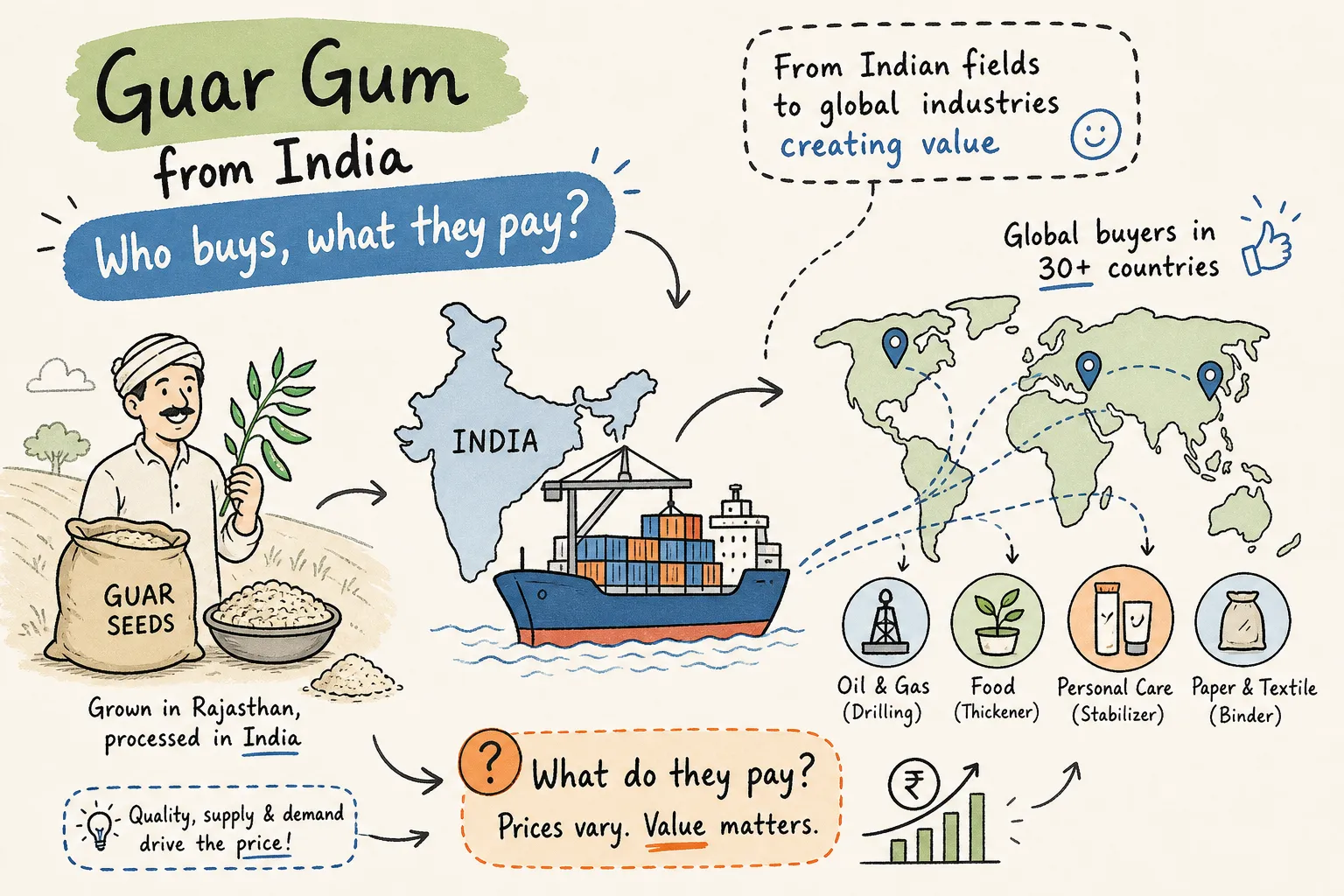
Sep 14, 2026
by Pankaj Sihag
Sep 01, 2026
by Pankaj Sihag
Aug 24, 2026
by Pankaj Sihag