





Isabgol Mandi Bhav Today: Prices, Trends and Best Mandis
 Sep 23, 2026
 by Pankaj Sihag



Isabgol Mandi Bhav Today: Prices, Trends and Best Mandis
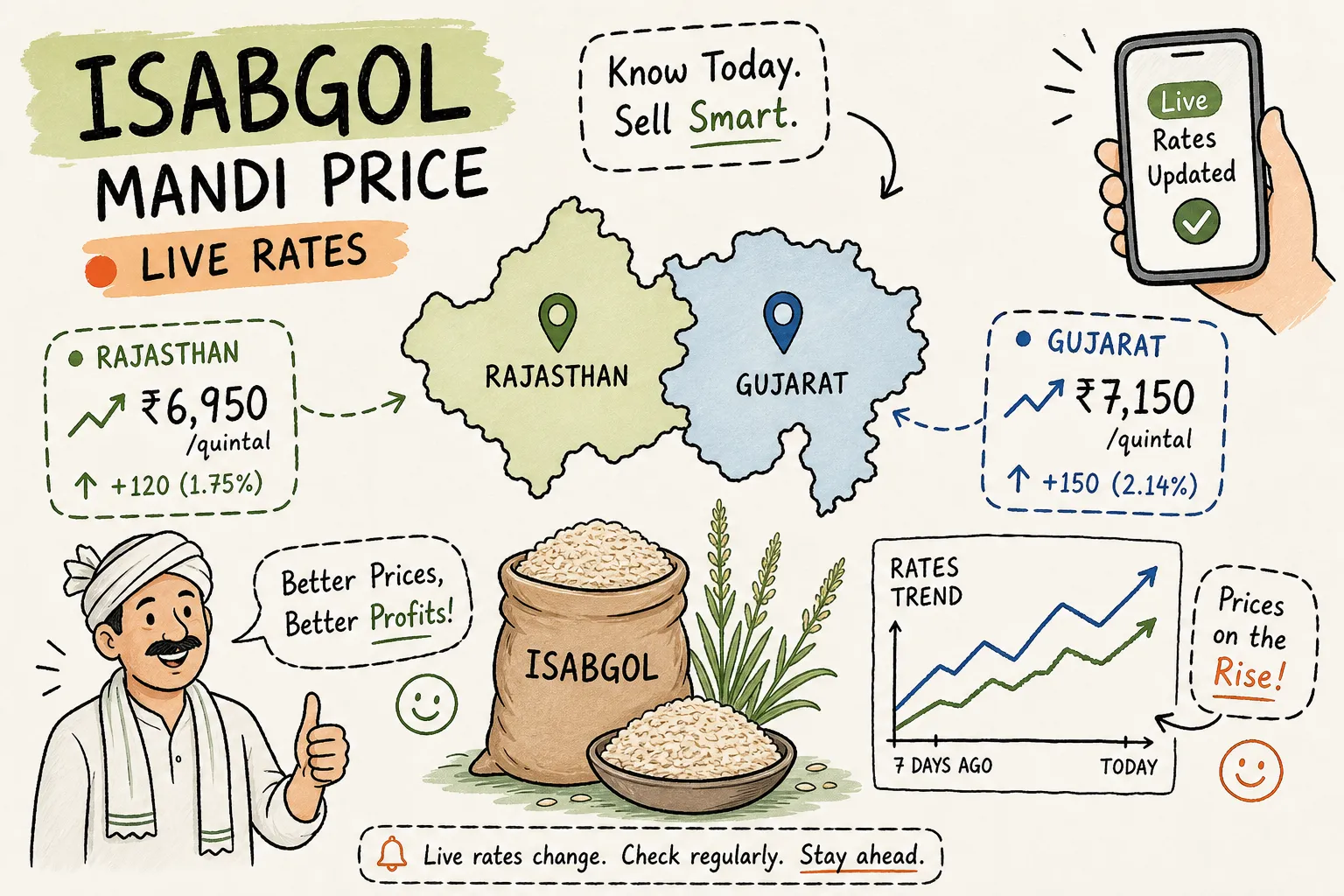
Isabgol mandi bhav in Rajasthan is currently ranging between ₹11,000 and ₹13,500 per quintal (psyllium husk / ispaghula), with meaningful variation depending on the mandi and the grade you bring to auction. Unjha in Gujarat recorded rates as high as ₹14,675 per quintal on 22 September 2026, confirming that the top end of this market is very much alive for quality lots. This is not a uniform price across the board: the same auction yard can see a ₹4,000-plus spread between a poorly graded lot and a clean, high-purity one on the same morning.
The stakes here are real. Isabgol is a high-value export commodity for India, with the country supplying roughly 80, 90% of the world's psyllium husk demand. A difference of ₹500, ₹1,000 per quintal matters enormously when you are selling 20 or 50 quintals. Choosing the wrong mandi, or acting on day-old price information, can quietly cost you more than a bad season would.
This article covers today's isabgol rate per quintal across major mandis, what has been moving prices over the past several months, how your crop's grade directly affects your final payment, which mandis are paying the best net rates right now, and a clear framework for deciding whether to sell or hold your stock. For today's ground-verified isabgol mandi bhav sourced directly from live APMC auction yards, KhetiKisaan tracks bol-chaal (live bidding) isabgol prices so you are not working off delayed government feeds.
 Table of Contents
- Quick Facts: Isabgol Mandi Bhav
- Today's isabgol mandi bhav across major APMC centres
- What is driving isabgol price fluctuations right now
- How quality grade affects what you actually get paid
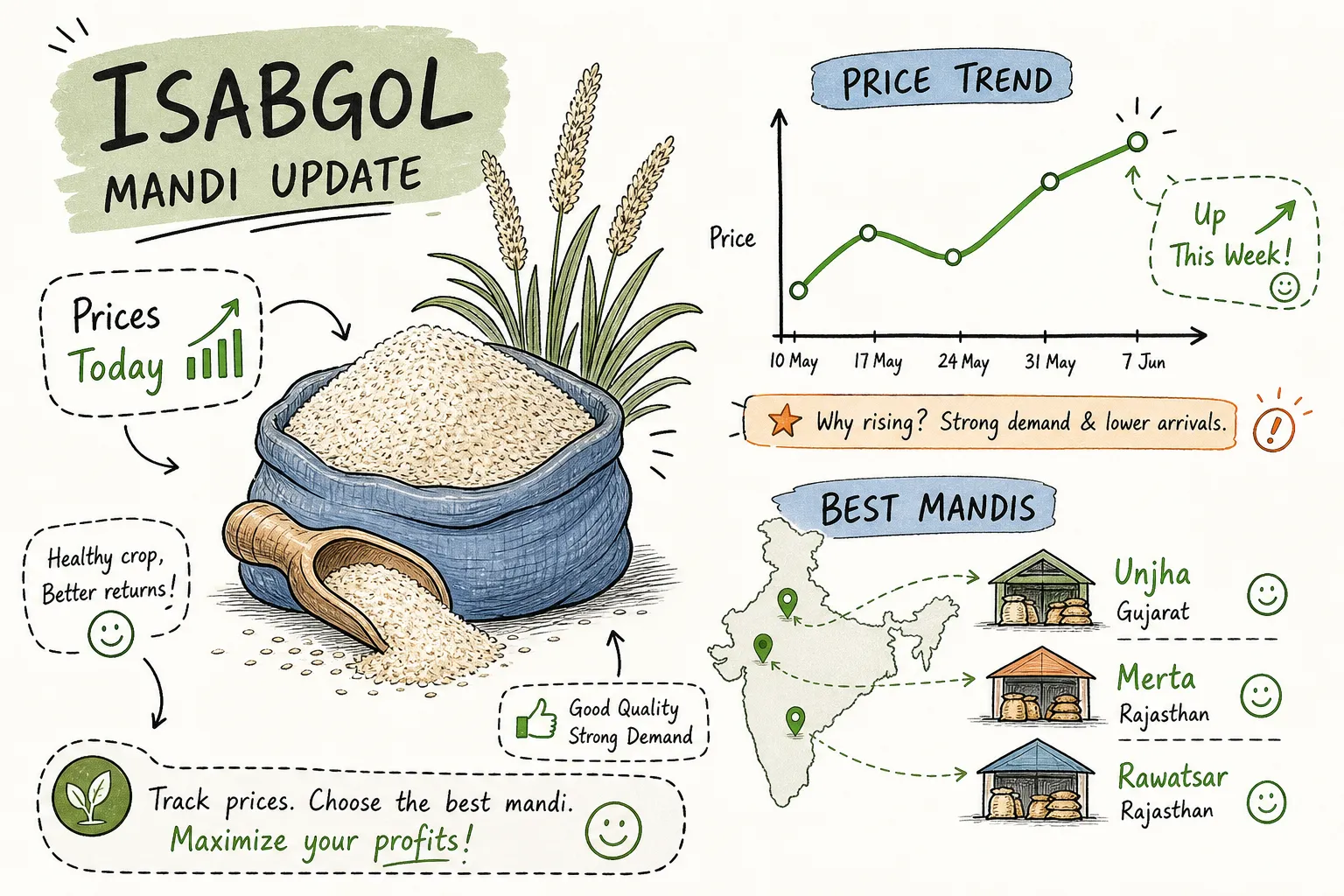
- Which mandis offer the best isabgol mandi bhav and net rates
- How to track live isabgol bhav before every sale
- Should you sell your isabgol now or wait?
- Selling smarter starts with verified data
- FAQs
Quick Facts: Isabgol Mandi Bhav
- Current Rajasthan price range: ₹11,000, ₹13,500 per quintal (grade and mandi dependent)
- Highest gross quote in Rajasthan: Jodhpur grain market at ₹13,930 per quintal (recent record)
- Unjha (Gujarat) benchmark: ₹13,250 per quintal average on 22 Sep 2026; range ₹11,250, ₹14,675
- Short-term trend: stable to mildly upward; not a sharp rally
- MSP status: No government MSP has been announced for isabgol; prices are fully market-determined through open APMC auction
- India's export share: approximately 80, 90% of production is exported; the US, Germany, and the UK are among the top buyers
Today's isabgol mandi bhav across major APMC centres
The numbers below come from live auction data and verified mandi reports. Use these as your baseline before making any selling decision today.
Rajasthan mandi rates: Jodhpur, Nagaur, Nimbahera and beyond
| Mandi / Area | Min (₹/qtl) | Modal (₹/qtl) | Max (₹/qtl) |
|---|---|---|---|
| Nagaur | 9,000 | 12,460, 12,500 | 13,741 |
| Jodhpur (Osiyan Mathania) | 10,000 | 11,000, 11,500 | 12,000 |
| Jalore | 2,100 | 10,917 | 14,100 |
| Bhagat Ki Kothi | N/A | N/A | 13,090 |
| Nimbahera | N/A | 13,001 | 13,800 |
| Jodhpur grain market (recent record) | N/A | N/A | 13,930 |
The wide within-mandi range at Jalore (₹2,100 to ₹14,100 on the same day) is not a data error. It directly reflects the massive price gap between low-grade, moisture-damaged, or adulterated lots and clean, high-purity isabgol from irrigated, well-managed fields. The spread tells you exactly how much grade quality is worth in rupee terms.
Gujarat and Madhya Pradesh: Unjha, Siddhpur and Neemuch
| Mandi / Area | Modal / Average (₹/qtl) | Max (₹/qtl) |
|---|---|---|
| Unjha (Gujarat), 22 Sep 2026 | 13,250 | 14,675 |
| Siddhpur (Gujarat), 16 Sep 2026 | 13,047 | N/A |
| Banaskantha (Gujarat) | 10,323 | N/A |
| Neemuch (Madhya Pradesh) | 12,500 | 13,501 |
| Piplia (Madhya Pradesh) | 9,875 | N/A |
Unjha is not just another mandi on this list. It is the national benchmark for ispaghula price: processors, exporters, and large traders across Rajasthan, Gujarat, and Madhya Pradesh watch Unjha's daily rates before setting their own buying bids. When Unjha firms up, Rajasthan mandis tend to follow within a few days. The current Unjha average of ₹13,250 per quintal is sending a constructive signal to the broader market.
What is driving isabgol price fluctuations right now
Price moves do not happen without a cause. Knowing the drivers helps you anticipate the next move rather than simply react to it.
Supply side: crop area, harvest status and arrivals
Smaller crop area or slower harvest progress tightens near-term supply and supports prices. Slow arrivals at auction yards can temporarily lift the cash mandi bhav even when the overall crop size is adequate, because processors and exporters need a consistent daily flow of material. The market is currently watching whether any production shortfall is real or just a delayed arrival pattern: that distinction determines whether current price firmness has staying power or will ease as arrivals pick up.
Demand side: export orders and processor offtake
Isabgol is fundamentally an export-driven commodity. India supplies approximately 80, 90% of the world's psyllium husk demand, with the United States, Germany, the United Kingdom, France, and Italy as the dominant buyers. Reduced export flows or restocking orders from these markets can tighten available domestic supply quickly, lifting isabgol market prices across India within days. Processor demand amplifies this: when bulk buyers in the Unjha, Siddhpur belt need to replenish factory stocks, they bid aggressively at auction, and that pricing signal travels to Rajasthan mandis like Nagaur and Jodhpur within a few trading sessions.
Weather, post-harvest quality and seasonal risk
Heat waves, uneven monsoon distribution, and El Niño-related weather patterns affect both crop yield and post-harvest quality. Weather-damaged lots attract meaningful discounts at auction; clean, properly dried isabgol from irrigated fields commands a premium. Farmers should treat post-harvest moisture management as a direct income lever, not just a storage precaution. Bringing a well-dried, clean lot to the mandi is one of the highest-return investments you can make in the days between harvest and sale.
How quality grade affects what you actually get paid
Grade is where the real money is made or lost at auction. The price table at the top of this article shows large within-mandi ranges; grade is the primary explanation for those gaps.
AGMARK grades and purity categories explained
Official AGMARK grades for isabgol husk recognise three categories: Special, Grade I, and Grade II, defined by parameters including moisture content (maximum 11.5% across all grades), organic impurities or extraneous matter, total ash, and acid-insoluble ash. Special grade allows no more than 2.5% organic impurities; Grade I allows up to 7.5%; Grade II permits up to 12.5%. In day-to-day trade at Unjha and major Rajasthan mandis, traders and processors describe isabgol quality by purity percentage, 85%, 95%, 98%, and 99% pure lots, which roughly correspond in market parlance to lower, medium, and higher AGMARK grade categories respectively. These mappings are informal and can vary by buyer and region.
The real price gap between grades at mandi level
Export-market data makes the grade premium concrete: indicative export prices suggest 99% pure isabgol can command approximately USD 3,200, 3,700 per tonne compared to USD 2,400, 2,600 per tonne for 95% pure material, a premium of USD 600, 1,100 per tonne simply for the purity difference, before any processing or packaging is involved. Note that FOB and export quotes vary across reports and trading terminals, so treat these figures as indicative rather than fixed. At the mandi level, the Jalore range of ₹2,100 to ₹14,100 per quintal on a single day illustrates the same principle in rupee terms. Practical implication: every step you take to clean, dry, and grade your fasal (crop) before it reaches the auction yard is not a post-harvest chore, it is a direct, measurable income improvement.
Which mandis offer the best isabgol mandi bhav and net rates
Gross mandi price is not the same as what lands in your pocket. Net realisation after commission, freight, and loading charges is the number that matters.
Top gross-price mandis in and around Rajasthan
Based on current and recent verified data, here are the mandis recording the highest gross quotes for isabgol:
- Jodhpur grain market: ₹13,930 per quintal maximum (recent record)
- Nimbahera: ₹13,800 per quintal maximum; modal ₹13,001 per quintal
- Unjha (Gujarat): ₹14,675 per quintal maximum; average ₹13,250 per quintal
- Siddhpur (Gujarat): ₹13,047 per quintal modal
- Nagaur: ₹13,741 per quintal maximum; average ₹12,460, ₹12,500 per quintal
- Bhagat Ki Kothi: ₹13,090 per quintal maximum
- Neemuch (MP): ₹13,501 per quintal maximum; modal ₹12,500 per quintal
Understanding net realisation after commissions and freight
As an illustrative example from Rajasthan value-chain data, storage costs of around 4% of gross value plus mandi commission of around 6%, plus transport, can reduce gross realisation to approximately ₹12,441 per quintal at the processor end, though actual percentages vary by mandi and season. APMC commission in Rajasthan typically runs in the range of 2, 4% of the sale value; add loading and unloading charges, and the deductions add up quickly. A mandi quoting ₹500 more per quintal but located 80 km further away may net you less than a closer mandi after fuel, labour, and vehicle depreciation.
The practical approach is straightforward: before loading your trolley, calculate your net-at-farm price for at least two mandis. Take the quoted mandi rate, subtract your freight cost (distance multiplied by your fuel cost per kilometre), mandi commission (2, 4%), and loading charges. The mandi with the highest net figure, not the highest headline quote, is where your isabgol should go.
How to track live isabgol bhav before every sale
Accurate isabgol price today data is the foundation of a good selling decision. Working from stale data is one of the most common and most costly mistakes farmers make at the mandi.
Why delayed price data costs farmers real money
Government APMC data feeds are often 24, 48 hours behind actual auction outcomes. By the time a rate appears on a general government portal, the lot that achieved that price may already be sold, the grade mix that morning may have shifted, or a large buyer may have stepped back from the market. Acting on yesterday's isabgol rate per quintal means you might drive 60 km to a mandi expecting ₹12,500 and discover that yesterday's quote was a one-lot spike that did not repeat today. On a volatile trading day, the gap between a perceived price and the actual bol-chaal (live bidding) price can run ₹500, ₹1,500 per quintal.
How KhetiKisaan captures bol-chaal rates from live auction yards
KhetiKisaan maintains a network of on-ground contacts physically present at APMC auction yards during live bidding sessions, covering major isabgol mandis across Rajasthan and nearby states. These contacts report actual transaction prices from the auction floor as bidding happens, not estimated averages or delayed government uploads. The isabgol mandi bhav you see on KhetiKisaan reflects what farmers are actually receiving that morning at the auction yard, in the same local mandi terminology, crop name, grade description, mandi name, that the kisaan community already uses.
Before loading your fasal onto a tractor-trolley and heading to the mandi, check KhetiKisaan's mandi-wise isabgol listings for today's verified rates. It takes two minutes and can save you thousands of rupees per lot, either by confirming your chosen mandi is the right call or by pointing you to a better-paying yard nearby. You can also reach out to the KhetiKisaan team directly for mandi-specific guidance on any given morning.
Should you sell your isabgol now or wait?
The sell-or-hold question has a clear answer when you apply a structured framework. Here is how to think through it.
Signals that suggest selling now makes sense
Current isabgol mandi bhav in the ₹11,000, ₹13,500 per quintal range is at or near the upper end of the 2025, 26 trading band. This is not a distress-sale environment; you are not leaving money on the table by selling at current rates. If your stock is from the current season and properly dried, you are not losing quality by selling now. If godown rent, insurance, and fumigation costs are accumulating, holding longer reduces your effective net realisation even if the headline price inches upward. Storage costs, typically around 4% of gross value per storage period, add up meaningfully over two or three months, so factor them into your holding calculation.
When holding isabgol stock could pay off
Holding makes sense under specific conditions, not as a general strategy. If export demand from the US or European markets picks up sharply in Q4 2026, or if a major psyllium-buying country faces a supply disruption, prices could test ₹14,000 or higher again. But holding only makes financial sense when three conditions are met together: you have low-cost, proper storage with adequate moisture control; your lot is well-graded and clean; and you have reliable daily isabgol mandi Rajasthan rates to act on quickly when prices spike. Do not hold your stock based on arhtiya (commission agent) rumour or neighbour speculation. Hold based on verified data, and only if your storage situation genuinely allows it.
Selling smarter starts with verified data
Isabgol mandi bhav today sits in a ₹11,000, ₹13,500 per quintal range across Rajasthan, with selective firmness at quality-conscious mandis like Jodhpur, Nimbahera, and Nagaur, and a strong benchmark signal from Unjha at ₹13,250 per quintal average. The market is not in a broad rally, but it is not soft either. Conditions are constructive for farmers who bring well-graded, clean lots to the right mandi at the right moment.
The three variables that determine your actual return are grade quality, mandi choice, and net realisation after deductions. None of these require luck; all three respond directly to preparation. Clean your fasal properly after harvest, calculate your net-at-farm price for two or three mandis before you load your trolley, and use verified live rates rather than yesterday's word-of-mouth quote from the dhaba near the mandi.
Check KhetiKisaan for ground-verified isabgol mandi bhav before every sale. The kisaan who walks into the mandi with verified price data, a calculated net realisation figure, and a clear grade assessment will always do better than the one who arrives without verified data and relies on spot luck. That is not luck; that is preparation, and it is the only reliable route to maximum munafa (profit) from your isabgol crop.