





Lahsun Ka Bhav Today: Latest Garlic Mandi Rates
 Sep 28, 2026
 by Pankaj Sihag



Lahsun Ka Bhav Today: Latest Garlic Mandi Rates
- National garlic median price: ₹12,500/quintal
- Madhya Pradesh modal rate: ₹7,397/quintal (₹73.97/kg)
- 7-day price trend: up 4.8% to 18.3% depending on mandi zone
- Primary producing states: Madhya Pradesh, Rajasthan, Gujarat
Lahsun ka bhav today tells a clear story: the national garlic median stands at ₹12,500/quintal, with Madhya Pradesh's state modal at ₹7,397/quintal (₹73.97/kg). If your commission agent (arhatiya) is coming this morning and you are sitting on stored stock, do not load that trolley before reading the mandi-wise breakdown below. Individual market rates on the same date range from ₹5,000 to over ₹29,000 per quintal depending on quality, state, and local arrivals, and the difference between knowing and not knowing can cost you ₹1,000 per quintal or more.
Lahsun prices have been unusually volatile this season, and there are real reasons behind it. A weaker-than-normal monsoon, an approximate 14% June-to-August rainfall deficit, and smaller rabi crop sizes from MP and Rajasthan have tightened supply considerably. Rabi stocks are being drawn down faster than expected, and fresh arrivals remain subdued through the monsoon lull period. This combination is creating genuine tezi (price firming) at most mandis, but not uniformly. Knowing your specific mandi's lahsun ka bhav before you sell is the difference between a fair deal and leaving money on the table.
Below is a full state-wise breakdown, a trend analysis, a carry-cost framework for the sell-or-store decision, and storage tips to protect whatever stock you are holding.
 Table of Contents
- Lahsun Ka Bhav Today: State-wise Mandi Rates at a Glance
- Which Mandis Are Paying the Most and Least for Garlic Right Now?
- Is the Garlic Price Rising or Falling? The 7-Day Trend Explained
- Why Lahsun Prices Are Moving the Way They Are This Season
- Where to Check Live Garlic Mandi Rates Every Day
- Sell Your Lahsun Now or Store It: A Practical Framework
- Storage Tips to Protect Your Lahsun Crop Value
- Final Takeaway on Lahsun Ka Bhav: What to Do With Your Stock Today
- FAQs
Lahsun Ka Bhav Today: State-wise Mandi Rates at a Glance
The most important thing to understand before reading any price table is what "modal rate" actually means. The modal rate is the most frequently transacted price in a live APMC auction (bol-chaal) on a given day, not an average. Individual mandis within the same state can deviate from the state modal by ₹1,500, ₹3,000 per quintal in either direction, depending on local arrival volumes and buyer competition that day.
Lahsun Ka Bhav, Madhya Pradesh Mandi Rates Today
MP is one of India's largest garlic-producing states, which is why its modal rate of ₹7,397/quintal is widely referenced as a key indicator for wholesale farm-gate pricing. The lahsun price per kg works out to ₹73.97 at this modal, but what is striking today is the intra-state spread: Indore is reporting ₹5,000/quintal while Ujjain sits at ₹8,100/quintal on the same date. That ₹3,100 gap within the same state on a single day tells you just how much local supply conditions and buyer activity matter.
| Mandi (MP) | Modal Rate (₹/quintal) | Min Price (₹/quintal) | Max Price (₹/quintal) |
|---|---|---|---|
| Indore | 5,000 | 4,500 | 6,728 |
| Ujjain | 8,100 | 6,000 | 9,000 |
| Neemuch | 6,460 | 5,800 | 10,500 |
| Mandsaur | 6,311 | 5,500 | 7,200 |
Data sourced from APMC feeds and on-ground contacts. Rates update daily; verify before transacting.
Rajasthan Garlic Mandi Rate Today
Rajasthan is the second major producing belt, with Kota, Jhalawar, and Chittorgarh forming the core garlic zone. State-wide modal data from a single official feed is harder to pin here because Rajasthan reports through multiple independent APMC samitis. The most recent available data puts Kota at ₹11,223/quintal, while the broader Rajasthan state average across 22 mandis came in around ₹12,148/quintal.
Small and medium mandis in Rajasthan tend to lag the price discovery seen in larger terminal markets. If your nearest mandi is a smaller one, it is worth checking whether a nearby larger APMC has significantly better bids before you make the drive. The difference can easily justify the extra transport cost on a larger lot.
Gujarat Garlic Wholesale Price Today
Gujarat's primary garlic trading hubs, particularly Rajkot, act as redistribution points for garlic moving into wholesale and export channels. Rajkot APMC is reporting ₹8,200, ₹8,250/quintal for recent sessions. Across six reporting APMCs in Gujarat, the state average sits around ₹10,922/quintal, though a different aggregation shows ₹7,842/quintal, reflecting how much the choice of included mandis affects the reported figure.
Gujarat prices often reflect grade-sorted and cleaned garlic rather than raw farm-gate stock. Buyers here are frequently supplying dehydration units and processors, so they are particular about size uniformity and moisture content. If your stock is unsorted mixed grade, you will fetch less than the reported modal rate at Gujarat mandis.
Which Mandis Are Paying the Most and Least for Garlic Right Now?
Understanding the national price range gives you context for whether your local rate is reasonable or whether your arhatiya is quoting you too low.
Where are buyers paying the most?
The current national high is ₹29,000/quintal at Palayamkottai (Uzhavar Sandhai) in Tamil Nadu. To clarify the two figures you may have seen reported for this mandi: ₹29,000/quintal represents the top transaction quote for premium-grade stock, while ₹20,833/quintal is the modal, the most frequently transacted price at that same auction. Nearby mandis like Vaniyampadi and Jameenrayapettai are also touching ₹28,000/quintal. Southern markets pay more for premium-quality garlic bulbs because local production is limited and consumption demand is strong.
These prices are not directly accessible to a farmer in Rajasthan or MP who would need to transport stock across 1,500 km and navigate interstate logistics. However, they signal strong national demand, which eventually exerts upward pressure on prices at producing-belt mandis too. When southern buyers are competing hard, it pulls buying interest northward into the wholesale chain.
Where are prices being suppressed?
The apparent low is ₹13/quintal at Patti in Punjab, which looks alarming but is almost certainly a reporting error or a very small lot of damaged or sub-grade stock rather than a functioning market price. Do not let this outlier figure cause panic.
What this outlier does illustrate is real: quality grading drives enormous price divergence within the same commodity. Wet, small-bulb, sprouted, or mechanically damaged garlic fetches a fraction of what clean, dry, large-bulb stock commands. A farmer in MP or Rajasthan who sorts and cleans their stock before arriving at the mandi can realistically capture an extra ₹500, ₹1,500 per quintal over an unsorted lot. The effort is modest; the return is not.
Is the Garlic Price Rising or Falling? The 7-Day Trend Explained
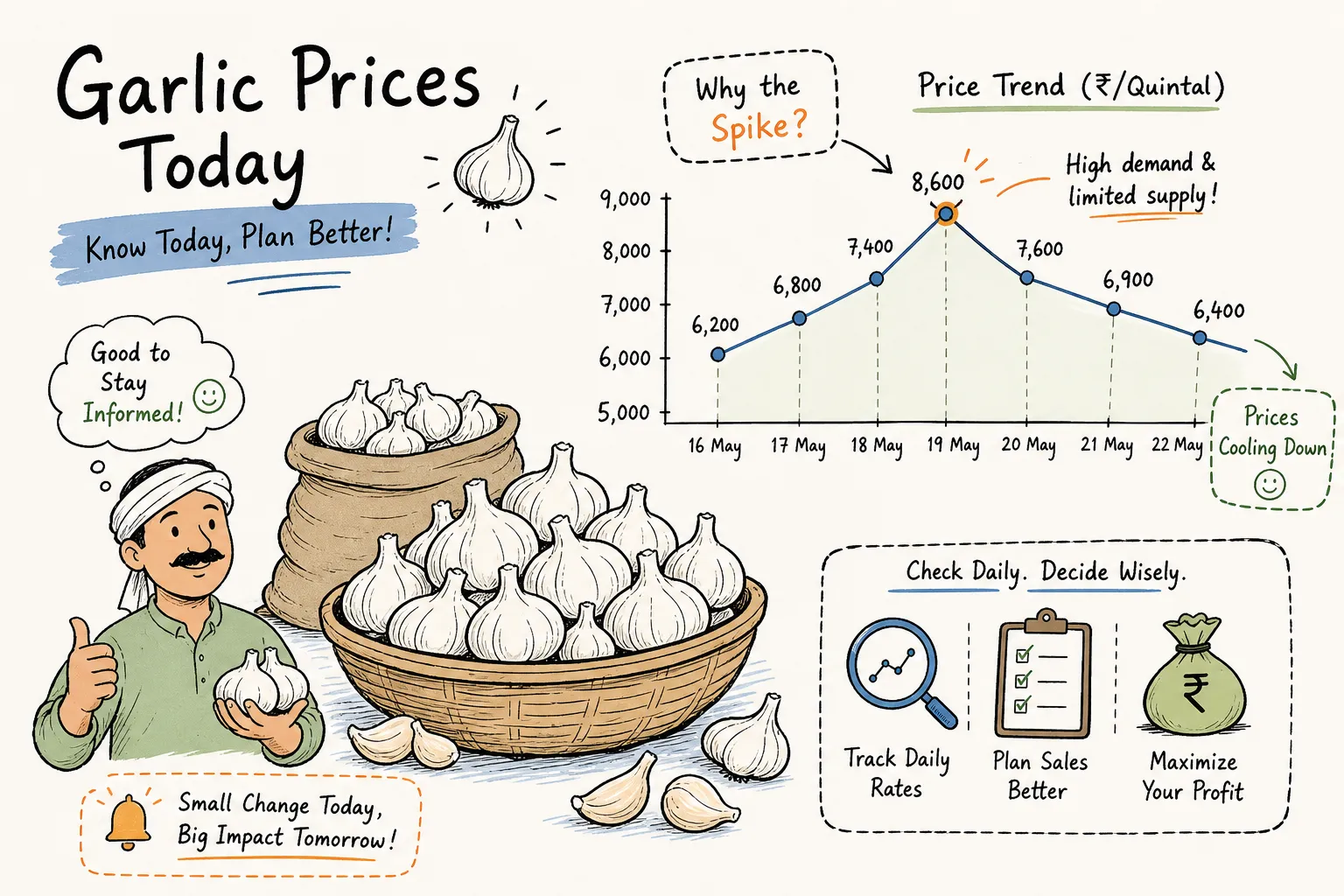
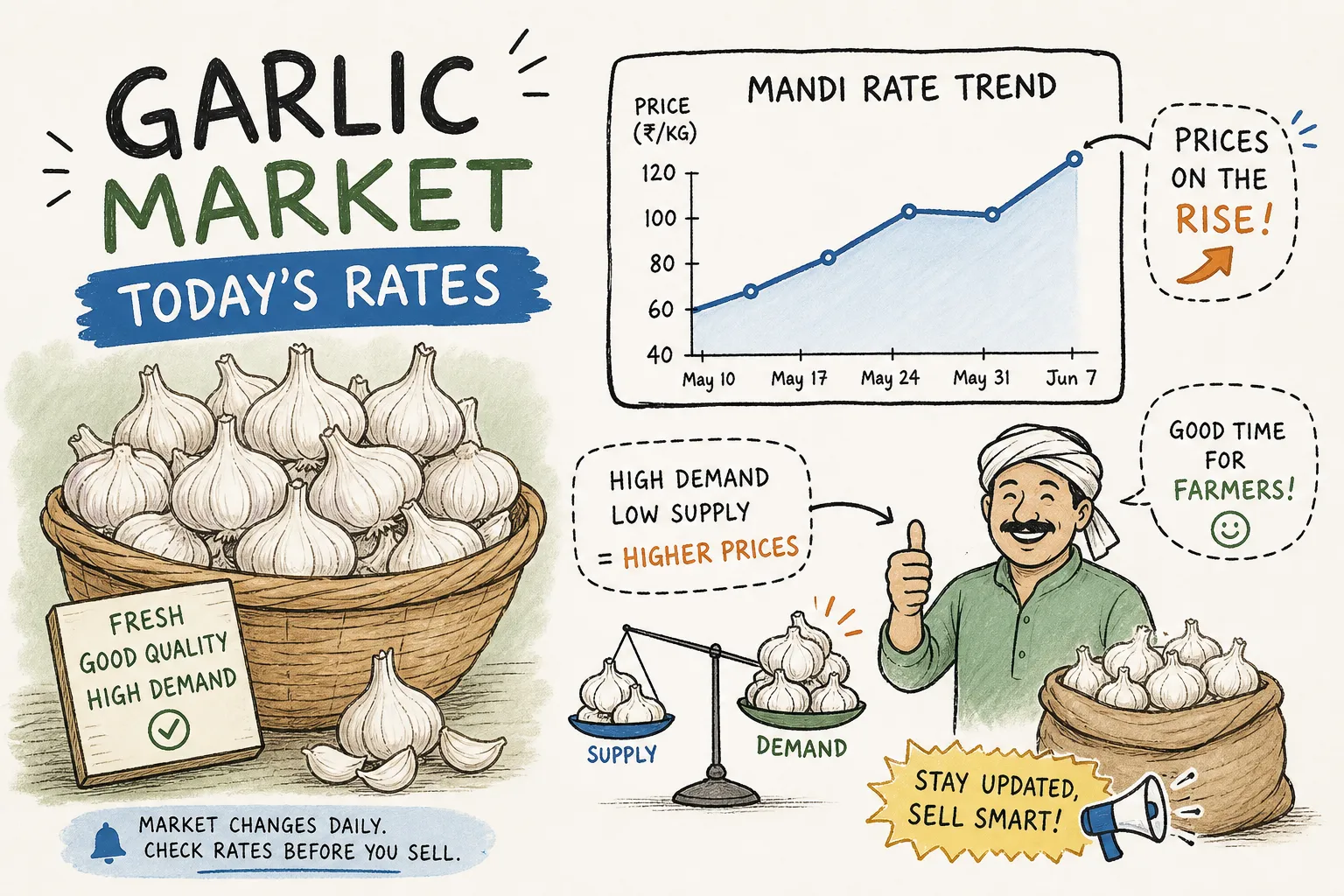
This is the question that determines whether you should sell this week or hold for another fortnight. Prices are rising, and the trend has structural factors behind it, not just a single day's spike.
Reading the 7-day momentum
Current data shows a 4.8% to 18.3% price rise over the past seven days, depending on which mandi series and data source you use. The tighter Agmarknet-based series shows the conservative 4.8% gain for specific mandis, while broader aggregated indices capturing multiple market movements show the higher end. For a farmer holding 100 quintals, even a 4.8% weekly gain translates to roughly ₹600/quintal in additional value, meaningful money by any measure.
The reason for this range is not data error; it is because garlic mandis in Tamil Nadu and Karnataka, which are seeing the most dramatic price action, are pulling the national average up sharply, while producing-belt mandis in MP and Rajasthan are firming more gradually.
What the 30-day pattern signals
The 30-day trend mirrors the 7-day gain closely, which is the important signal here. When a weekly price rise is matched by the monthly trend, it means the gain is not a one-session spike triggered by a single large buyer or a short supply day. It indicates a sustained upward correction rooted in structural supply tightening. Sustained trends like this typically continue until a significant new arrival event changes the supply picture, in garlic's case, that usually means the next rabi harvest season or a large cold-storage release.
A note on data freshness and why it matters
Official government portals aggregate mandi data through reporting cycles that can lag the actual auction by 24, 72 hours. The bol-chaal happens at 8, 10 AM in most APMC yards, but the officially published rate sometimes reflects the previous day's transaction or a delayed entry. By the time you read it, the on-ground price may have shifted ₹500, ₹1,500/quintal. This is why sourcing lahsun ka bhav from platforms with on-ground contacts physically present at live auctions makes a material difference to your negotiating position.
Why Lahsun Prices Are Moving the Way They Are This Season
Price signals are more useful when you understand the forces driving them. Here is what is actually happening in the garlic market right now.
Supply squeeze from the producing belt
Rajasthan and MP together account for the large majority of India's rabi garlic output. This season, both states reported smaller crop sizes. Irregular moisture during the bulb-development stage produced smaller bulbs and lower marketable yields per bigha. Early depletion of stored rabi stocks means fewer bags are arriving at auction each morning, which means buyers are competing harder for what little arrives. That is classic tezi: same or more demand, less supply.
Monsoon disruptions and the seasonal lull
India recorded an approximate 14% rainfall deficit through June, August 2026, with August alone ending with a 16% shortfall. El Niño conditions exacerbated heat stress and soil moisture deficits in key producing regions. Kharif garlic, a minor crop compared to rabi, has not meaningfully bridged the supply gap. Unseasonal rain in Maharashtra and Karnataka damaged standing crops and increased post-harvest spoilage. The monsoon lull period from roughly July through September is historically when garlic prices firm up, because rabi stocks are being drawn down and fresh arrivals are limited, and 2026's monsoon dynamics are amplifying that seasonal pattern.
Export demand for processed garlic
Fresh garlic exports from India are limited, but demand for dehydrated garlic flakes, garlic powder, and garlic paste from Middle Eastern, EU, and Southeast Asian buyers remains active. Processors in Gujarat and Rajasthan continue to offtake from mandis to supply these export orders. This steady processing demand creates a structural floor under farm-gate prices and prevents the sharp seasonal correction that some traders expect each year after the monsoon. As long as processor procurement remains active, the downside is cushioned.
Where to Check Live Garlic Mandi Rates Every Day
Having today's accurate lahsun mandi bhav before you negotiate is not a convenience, it is leverage. A farmer who walks into a mandi knowing the current garlic mandi rate has a fundamentally stronger position than one relying on yesterday's figure or a neighbour's estimate.
The problem with delayed government feeds
The official Agmarknet portal is a genuinely useful resource, but it has a structural lag. Data is reported by APMC samitis in batches, and the published rate often reflects the previous day's auction or an early-morning snapshot that does not capture late-session price movements. In a volatile crop like garlic, where prices can shift ₹500, ₹2,000/quintal between Monday and Tuesday, a 24-hour lag is a real information disadvantage when your arhatiya quotes you a number.
How KhetiKisaan sources its lahsun bhav
KhetiKisaan maintains a network of on-ground contacts physically present at major APMC yards during live auctions, covering markets across Rajasthan and Madhya Pradesh. According to KhetiKisaan's methodology, the lahsun mandi bhav it publishes reflects actual transaction rates from that morning's bol-chaal rather than estimated averages or delayed government feeds. That means you get the garlic mandi rate from the auction floor, not from a data pipeline that is already a day old. Visit KhetiKisaan's garlic mandi rates page daily for fresh updates sourced directly from ground-level auction contacts.
Sell Your Lahsun Now or Store It: A Practical Framework
The sell-or-store decision for lahsun is ultimately a numbers exercise, not a gut feeling. Here is how to work through it honestly.
The carrying cost calculation every farmer must do
Storing garlic costs money even when it sits in your own godown. Your per-quintal carrying cost over a 60-day storage period includes:
- Interest on stock value (opportunity cost at current lending rate on the equivalent cash value)
- Storage rental or infrastructure cost
- Shrinkage and spoilage loss, typically 5, 15% over 60, 90 days for garlic in ambient conditions
- Handling and transport to the eventual buyer
- Risk premium for the uncertainty that prices could fall instead of rise
Add these up per quintal. If the expected price 60, 90 days from now does not exceed today's price by at least that total spread, selling now is the rational choice. As a working example, assuming a 12% annual lending rate, modest storage costs, and 8, 10% average shrinkage, most farmers with ambient storage find this break-even spread works out to roughly ₹400, ₹700 per quintal over 60 days. Your actual figure will vary; run the numbers for your own situation. Given the current 4.8%, 18.3% weekly gain trend, the maths may favour holding if your storage quality is good.
When holding stock makes sense right now
Farmers with reliable cold storage (0, 4°C) or a dry, well-ventilated godown have a reasonable case for holding through October 2026. The monsoon lull typically eases by late October when fresh arrivals begin moving, which could dampen prices. If your carrying cost is comfortably below ₹500/quintal over 60 days, the current upward trend supports holding. The supply squeeze described earlier is not resolving quickly, which means the price floor has structural support.
If you are relying on open or semi-covered storage, the calculation changes. Spoilage risk in poor storage can easily reach 10, 15% over 60 days, which effectively erases any price gain and reduces your saleable volume. Do not let optimism about price trends override an honest assessment of your storage quality.
Red flags that mean you should sell immediately
Sell without waiting if any of these apply: your stored stock is showing sprouting or soft rot; you have a loan repayment due and the interest cost of delay exceeds the potential price gain; or your local mandi has seen a sharp jump in arrivals over the past week, which typically signals a price correction is forming.
Arrival volumes are as important a signal as the price itself. When bags pile up at the mandi gate, buyers gain the negotiating power and lahsun ka bhav softens quickly.
Storage Tips to Protect Your Lahsun Crop Value
If you have decided to hold your stock, getting storage conditions right is not optional; it directly determines how much of your stock reaches the buyer in sellable condition.
Ideal conditions for lahsun storage
Garlic stores best at 0, 2°C with 65, 70% relative humidity in a proper cold store, conditions supported by post-harvest research on allium storage. Under these conditions, well-cured bulbs can hold quality for six to nine months. In the absence of cold storage, a well-ventilated dry godown at 20, 30°C works reasonably for 30, 45 days, provided relative humidity stays below 70, 75%. Always elevate bags on wooden pallets to allow airflow underneath; garlic sitting directly on a damp floor is the fastest way to trigger rot that spreads through the entire lot.
Moisture is garlic's primary enemy in storage. Even a slightly damp gunny sack in contact with a damp concrete floor creates enough humidity to start decay within a week. If your godown has any moisture seepage, address it before storing any additional stock.
Grading before storage pays back at sale time
Farmers who clean and grade their stock before storage consistently achieve a ₹500, ₹1,500/quintal premium over unsorted stock when they eventually sell. Remove damaged, cracked, wet, or visibly diseased bulbs immediately and sell those separately to local processors or traders at lower rates rather than mixing them into your stored lot. Small-grade bulbs that are unlikely to fetch wholesale rates should be separated early; storing them alongside premium stock only increases spoilage risk without adding value.
Warning signs your stored stock needs to move fast
Many post-harvest extension services recommend inspecting your storage every 7, 10 days. Act immediately if you find soft spots on individual bulbs, visible mould, a sharp ammonia-like odour in the godown, or more than 3, 5% sprouting across the lot. Any of these signs mean the stock is declining faster than any price gain can compensate. Sell within the next week regardless of the prevailing garlic mandi rate, partial recovery of value is better than watching the lot deteriorate completely.
Final Takeaway on Lahsun Ka Bhav: What to Do With Your Stock Today
The core picture is clear. Lahsun ka bhav is in a firm upward cycle supported by constrained supply, a below-normal monsoon, and active processor demand. The MP state modal stands at ₹7,397/quintal, Rajasthan's Kota belt is around ₹11,223, ₹12,148/quintal, and national premium markets are well above ₹20,000/quintal for top-grade stock. Farmers who have clean, well-stored stock have a reasonable window to hold through October, but the carry-cost calculation must be done honestly and without wishful thinking.
If your storage is reliable, your carrying cost is below ₹500/quintal over 60 days, and your stock is in good condition, the current trend supports waiting. If any of those conditions are not met, selling now at a firm market is the smarter call than risking spoilage chasing a price gain that may or may not materialise. Either way, the decision should be made with today's actual garlic mandi rate in hand, not yesterday's number or a neighbour's estimate.
Check KhetiKisaan's daily lahsun mandi bhav update before you load the trolley or call the arhatiya. Knowing the live auction rate before that conversation starts is the simplest, most effective step you can take to protect your crop's value.
FAQs
Related Blogs
Sep 28, 2026
by Pankaj Sihag
Sep 23, 2026
by Pankaj Sihag