





Moong Mandi Bhav Today: State-wise Rates and Selling Tips
 Sep 22, 2026
 by Pankaj Sihag



Moong Mandi Bhav Today: State-wise Rates and Selling Tips
Knowing the moong mandi bhav today at nearby APMCs is the first step to a better decision. Many APMC mandi rates for green gram (moong) are currently trading below the government's Minimum Support Price (MSP), though a 16.6% rally in Rajasthan over the past 30 days has brought some relief to kisaans. Whether you are sitting on a fresh Kharif harvest or weighing storage against selling, understanding where your fasal stands in today's market is essential before you load your tractor.
This update brings you verified state-wise moong mandi rates, a close look at North India APMCs, and practical steps to squeeze every extra rupee from your sale. Read through the numbers, understand what is driving the current tezi, and use the selling checklist before you make a move.
 Table of Contents
- Quick facts: moong mandi bhav today at a glance
- Moong mandi bhav today: North India focus on Sri Ganganagar, Nohar and nearby APMCs
- What the modal price means and why you should track it
- Which mandis are paying the most for moong right now
- Moong price trend over the past 30 days: is tezi likely to hold?
- Hidden APMC deductions that reduce your actual take-home
- Practical steps to get the best moong rate before you load the truck
- Track moong mandi bhav today on KhetiKisaan, and sell smarter
- FAQs
Quick facts: moong mandi bhav today at a glance
| Metric | Figure |
|---|---|
| All-India median rate | ₹7,728 per quintal |
| All-India average rate | ₹7,848 per quintal |
| All-India modal rate (355 mandis, 11 states) | ₹7,195 per quintal |
| Government MSP (Kharif 2026, 27) | ₹8,780 per quintal |
| Highest single-mandi rate today | ₹15,000 per quintal (APMC Tuljapur, MH) |
| Lowest single-mandi rate today | ₹800 per quintal (Udaipura, MP) |
The most important number here is the gap between the all-India average (₹7,848/quintal) and the government MSP (₹8,780/quintal). Moong is currently trading roughly ₹932 below MSP in the open market on average. If your state government has activated MSP procurement for moong this season, it is worth checking whether you qualify before selling in the open mandi, that difference adds up to significant money on any decent quantity of fasal.
State-wise moong price today per quintal
| State | Rate per quintal (₹) | Rate per kg (₹) |
|---|---|---|
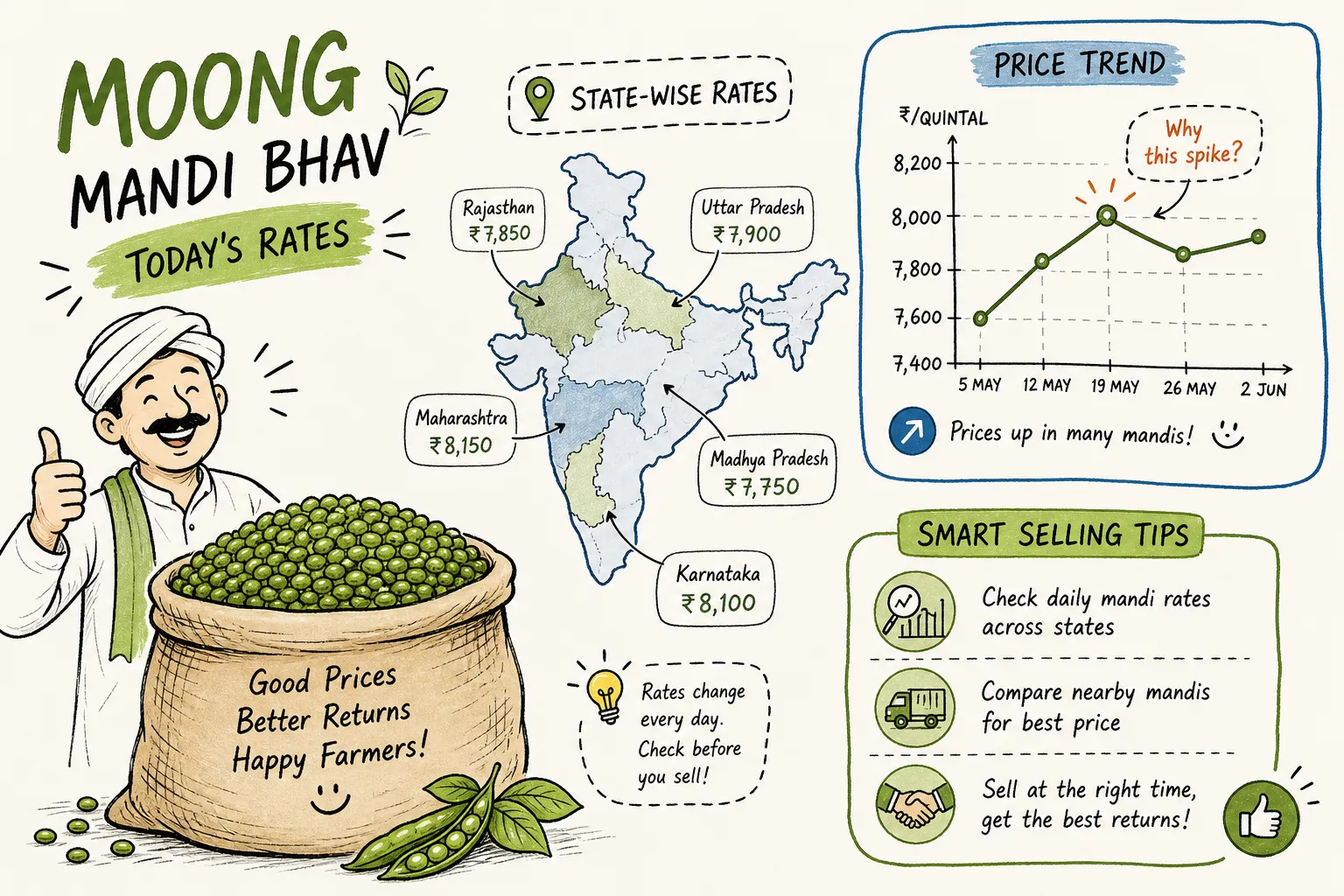
| Maharashtra | ₹8,769 | ₹87.7 |
| Haryana | ₹7,669 | ₹76.7 |
| Gujarat | ₹7,350 | ₹73.5 |
| Rajasthan | ₹7,100 | ₹71.0 |
These are median or average APMC auction rates at the state level, not MSP figures. Within each state, individual mandi rates vary further depending on arrival volumes, buyer presence on that day, and the grade of produce being auctioned. Always verify at the specific APMC before you travel.
How KhetiKisaan collects these verified prices
KhetiKisaan's approach, as stated by the platform, is to keep on-ground contacts physically present at live APMC auction yards during the bol-chaal (bidding session), recording actual transaction rates lot by lot. This means you are getting the real price that moong changed hands at that morning, rather than a government average published a day or two later. For crops like moong where rates shift daily, that timeliness matters.
Moong mandi bhav today: North India focus on Sri Ganganagar, Nohar and nearby APMCs
Rajasthan's state average is currently ₹7,100/quintal, sitting below the all-India median of ₹7,728/quintal. Choosing the right mandi is especially critical for kisaans in this belt. Selling at the wrong mandi in Rajasthan today could cost you several hundred rupees per quintal compared to a better-performing market a short distance away, a difference that adds up quickly across a full truck load.
Sri Ganganagar and Nohar APMC rates today
| APMC Mandi | Min rate (₹/qtl) | Modal rate (₹/qtl) | Max rate (₹/qtl) |
|---|---|---|---|
| Sri Ganganagar (Grain) | ₹7,400 | ₹7,650 | ₹7,900 |
| Nohar | ₹7,900 | ₹8,100 | ₹8,240 |
Sri Ganganagar APMC is reporting a modal rate of ₹7,650/quintal, which is above the Rajasthan state average and worth tracking daily. Nohar's last reported rate of ₹8,240/quintal (as of 12 September) is notably stronger, though that data is several days old and should be confirmed fresh before making travel plans. KhetiKisaan reports daily updates for both these mandis, so check the platform each morning before you decide.
Nearby mandis worth checking before you decide
Farmers within 40, 60 km of Sri Ganganagar should also keep an eye on Suratgarh, Padampur, and Rawatsar APMCs on the Rajasthan side, as well as Sirsa and Fatehabad on the Haryana border. Haryana's state average is ₹7,669/quintal, and border-belt mandis sometimes reflect that stronger moong price today. If a mandi 35 km away is paying ₹300 more per quintal and transport costs you ₹80/quintal, you are still ahead by ₹220/quintal. On 20 quintals, that is ₹4,400 extra in your pocket for a single trip.
What the modal price means and why you should track it
The price on the mandi notice board often shows the day's maximum, the rate a premium lot fetched from an aggressive buyer. Most farmers' produce does not fall in that top bracket. The modal price, by contrast, is the rate at which the largest number of lots actually sold during that day's session, making it a far more realistic benchmark for planning your sale.
How modal price is set during live bol-chaal at the mandi
During a bol-chaal session, traders bid for individual lots brought to the auction floor. The price varies lot by lot based on quality, moisture content, and buyer competition at that moment. The modal price is the most frequently occurring transaction rate across all lots auctioned that day. It is not set by the mandi committee; it emerges from actual bidding.
A practical example: if 60 out of 100 moong lots sold in the ₹7,150, ₹7,200 band, that range becomes the modal rate for the session. The maximum may have been ₹7,900 on one exceptional lot, but the modal tells you what a typical bag actually fetched.
Today's all-India moong modal rate
The current all-India modal rate for moong is ₹7,195/quintal, captured across 355 mandis in 11 states. Compare this to the all-India average of ₹7,848/quintal and you see a ₹653 gap. This happens because a handful of high-value mandis, particularly in Maharashtra, pull the average upward without representing what most farmers in North India actually receive. Use the modal rate as your planning benchmark, not the average. It keeps your profit calculations grounded in reality.
Which mandis are paying the most for moong right now
Today's mandi-to-mandi variation for green gram runs from ₹800/quintal at the low end to ₹15,000/quintal at the top. That is not a typo. A range this wide makes comparing mandis before you travel essential. The difference between choosing the right mandi and the wrong one can be several hundred to a few thousand rupees per quintal, even within a single state.
Top-paying mandis and their current rates
- APMC Tuljapur, Maharashtra: ₹15,000/quintal. This premium is driven by a specific specialty variety grade, not the standard green gram you are likely trading. Treat this as an outlier, not a benchmark for bulk commodity sales.
- Nohar, Rajasthan: ₹8,240/quintal. The strongest recent rate in North India and notably above the Rajasthan state average. Worth verifying today's figure before travelling.
- Sri Ganganagar, Rajasthan: ₹7,650/quintal. Solid for the region and above the state median, with reasonable arrival volumes making it a reliable trading point.
- Haryana belt mandis: ₹7,669/quintal (state average). Individual mandis in Sirsa and Fatehabad districts often track above this average, especially when North Indian dal millers are actively buying.
Markets where rates are depressed and why
Udaipura in Madhya Pradesh reported ₹800/quintal, well below any reasonable market rate. This kind of figure typically reflects one or more of the following: extremely poor-quality produce, a thin market with almost no buyers present that day, or very high local arrival pressure relative to mill capacity. The reasons in any specific case are difficult to confirm without a detailed mandi report. The lesson is not that MP is a bad state to sell in, but that any mandi can have a bad day. Checking bhav before loading your vehicle is money you do not have to leave on the table.
Moong price trend over the past 30 days: is tezi likely to hold?
Rajasthan's moong average has climbed ₹1,014/quintal since 22 August 2026, a gain of 16.6% over 30 days. Prices moved from roughly ₹7,000/quintal early in the period to around ₹7,960/quintal by 17 September in key markets, before the state average settled at ₹7,100/quintal on 21 September. This is a genuine and meaningful rally, not noise. The question every kisaan is now asking is whether it continues or reverses.
What drove this 30-day price rally in Rajasthan
Three forces combined to push green gram rates higher. Heavy monsoon rains delayed harvesting across Rajasthan, Madhya Pradesh, and parts of North India, slowing the flow of new crop into mandis and tightening nearby supply. At the same time, Kharif acreage for moong came in below last year's figures, meaning the total crop is expected to be smaller even before weather adjustments. Dal millers and traders are buying in a steady, need-based manner, with mandis in Jaipur, Nagaur, and Sri Ganganagar seeing active procurement from both local processors and traders with pulse export connections. There is no dramatic export-driven boom pushing prices; the tezi is a supply story, not a demand explosion.
Should you sell now or wait for higher rates?
Here is a direct answer. If you need liquidity for input costs, repayments, or household expenses, current rates of ₹7,100, ₹7,669/quintal in North India are workable, particularly at better-performing mandis like Nohar or the Haryana border belt. Do not hold for hope money if the carrying cost of storage is eating into your margin.
If your storage is dry, pest-free, and low-cost, a short hold is reasonable given the current supply tightness. Prices can reverse quickly once peak Kharif arrivals hit the mandis in October, and the upside is limited by comfortable government buffer stocks. Track the moong mandi bhav every morning on KhetiKisaan and make the sell call on data, not on rumour.
Hidden APMC deductions that reduce your actual take-home
The price announced at auction is not the amount deposited in your account. Every APMC sale involves a set of deductions that together can reduce your payout by 8, 15% of gross value. Most articles on mandi bhav skip this part entirely. We will not.
Use this formula to calculate your net payout:
Net payout = Gross sale value − commission − hamali − kata/tare deductions − transport and other authorised market charges
What gets cut and how much
- Commission (arhatiya):In Rajasthan, the commission for food grains including pulses is typically 2% of gross value, deducted from the farmer's proceeds by the commission agent who facilitates the auction.
- Market fee / APMC cess: Rajasthan levies approximately 1.6% of sale value as the market fee under the KUMS framework. This is separate from the arhatiya's commission.
- Hamali (loading/unloading/cleaning): Charged per quintal or per bag depending on the mandi. Rates vary by market and are not standardised statewide, so ask for the specific mandi's rate card on arrival.
- Kata/tare (weighing tolerance): Some mandis apply a tare deduction that reduces the effective payable weight below the gross weighed quantity. Confirm this explicitly before the lot is weighed.
- Transport and sundry market charges: Where routed through the mandi system, these add to the total deduction load.
A worked example for one quintal of moong
Suppose your moong sells at ₹7,500/quintal at auction. The arhatiya's commission at 2% is ₹150. The APMC market fee at 1.6% is ₹120. Hamali at ₹40/quintal adds another ₹40. Total deductions: ₹310 per quintal. Your actual take-home is ₹7,190, not ₹7,500. On 50 quintals, that is ₹15,500 that never reached your pocket. Run this calculation against your specific mandi's charge sheet before you assume the quoted rate is the final payment.
Practical steps to get the best moong rate before you load the truck
Good mandi decisions are made before you start the engine, not after you arrive at the gate. These steps are concrete and sequential. Follow them every time you plan a moong sale.
Compare at least two or three mandis before you decide
Check that morning's moong mandi bhav on KhetiKisaan for Sri Ganganagar, Nohar, and the nearest Haryana border mandi. Write down the modal rate for each. Then calculate your transport cost per quintal for each option. If Sri Ganganagar modal is ₹7,650 and Nohar modal is ₹8,100, that is ₹450 more per quintal at Nohar. If the additional distance adds ₹120/quintal in transport, you are still ahead by ₹330/quintal at Nohar. On 30 quintals, that comparison earns you ₹9,900 extra for a five-minute price check.
How to use moong mandi bhav today for timing and grading decisions
Arrive before the main bol-chaal session begins, usually by 7, 8 a.m. depending on the mandi. Buyer competition is highest when fresh traders are entering; by late morning, many buyers have already completed their procurement targets and bids turn sluggish.
On the produce side, clean your moong thoroughly before bringing it to market. Traders and graders discount heavily for moisture, stones, and mixed-grade lots. A well-cleaned, dry, bold-seed lot can command ₹200, ₹400 more per quintal than a mixed or partially cleaned batch. If you have both premium bold-seed-grade moong and ordinary grain in your stock, keep them separate and auction them as distinct lots, they attract different buyer segments and different price levels.
Track moong mandi bhav today on KhetiKisaan, and sell smarter
Moong dal price per quintal can shift by hundreds of rupees between one morning and the next, and between one mandi and the mandi 40 km down the road. The kisaans who consistently get better rates are simply the ones checking the moong mandi bhav today before they make a move, not after they have already arrived at the gate. Use KhetiKisaan each morning to compare verified APMC rates across Rajasthan, Haryana, Maharashtra, and Gujarat, run your transport cost calculation, and then decide. The data is there; using it takes two minutes and costs nothing.