





Why Is Lahsun Price Rising in Indian Mandis?
 Oct 02, 2026
 by Pankaj Sihag



Why Is Lahsun Price Rising in Indian Mandis?
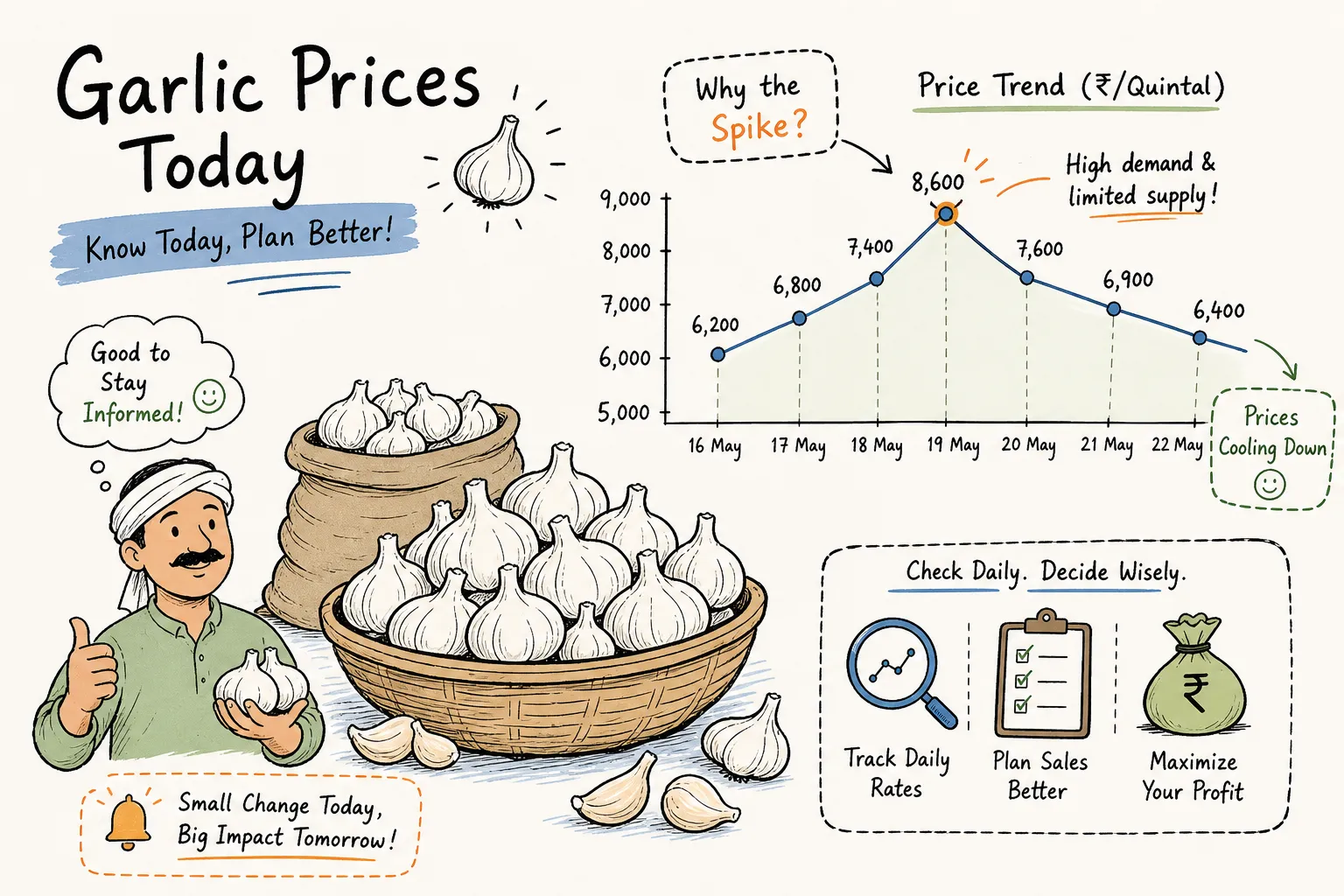
- National median lahsun price: approximately ₹13,000/quintal (₹130/kg) as in October.
- Delhi APMC rate: ₹9,500/quintal (₹95/kg) as in October.
- Nagpur APMC range: ₹6,000, ₹20,000/quintal depending on grade and lot.
- Retail garlic price online: ₹99/kg to ₹260/kg depending on platform and offer.
- Current market phase: seasonal lean period with tight stocks and strong export demand pushing wholesale lahsun bhav higher.
- Before your next mandi trip: verify today's lahsun mandi rate city-wise, mandi-to-mandi variation is ₹5,000/quintal or more right now.
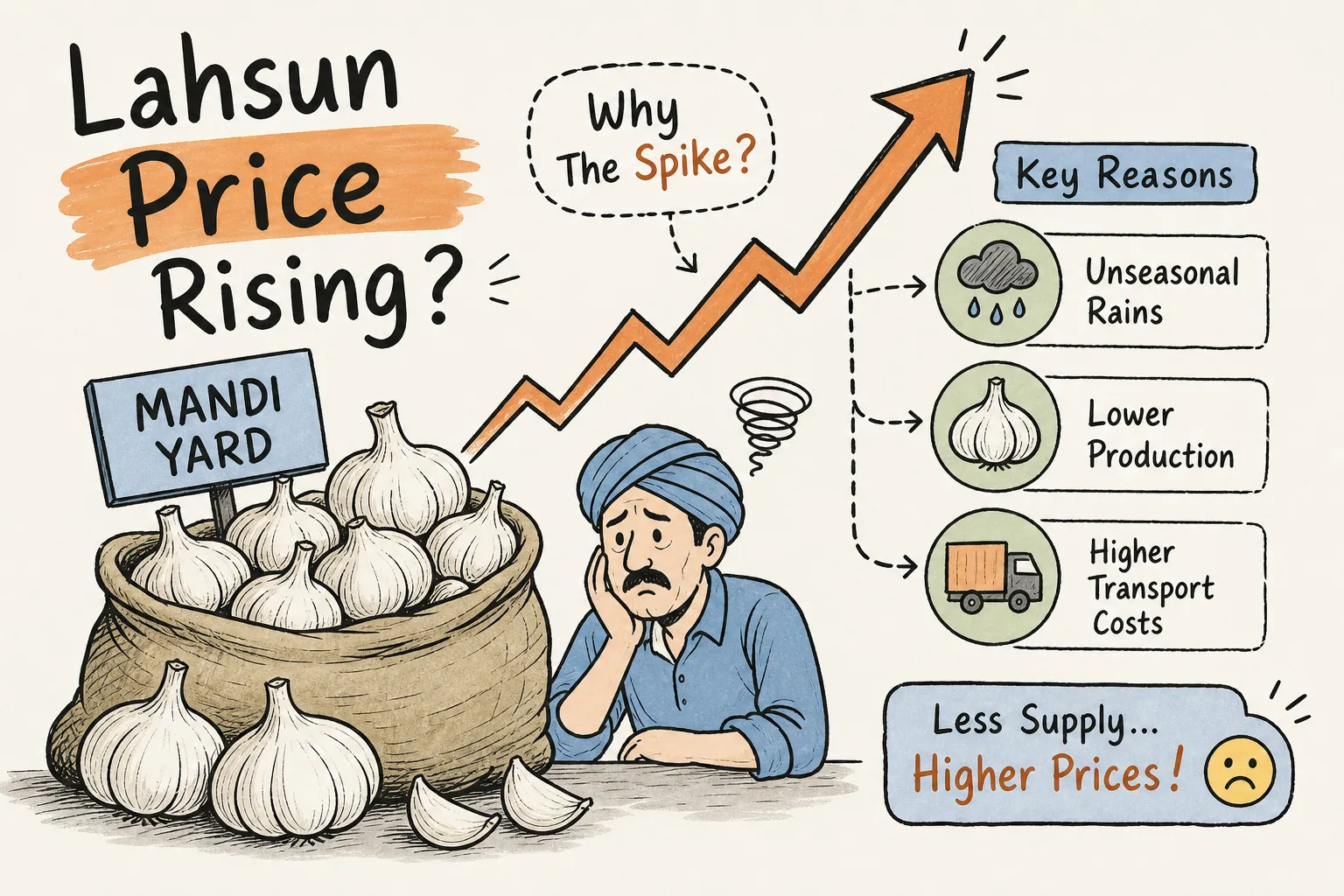
If you have visited any major APMC yard in the last few weeks, you already know something is different. Garlic buyers are paying more per quintal than they were three months ago, and sellers who stored their crop after the April harvest are quietly smiling. This is not a random spike. The lahsun price surge playing out across Indian mandis right now is the predictable result of three overlapping forces: stored stock running thin in godowns, aggressive export demand pulling premium-grade supply out of domestic yards, and trader anxiety about whether the next rabi crop will arrive on time given an uneven monsoon in key producing states.
Understanding these forces is not merely academic. For a farmer deciding whether to release stored stock now or hold for another month, the difference in realisation can be several hundred to a few thousand rupees per quintal, depending on the mandi and grade. For a trader or processor, knowing which mandi is under-supplied versus which still has reasonable arrivals can mean the difference between a profitable procurement and an expensive mistake. Wide variation in lahsun bhav across APMC yards is clearly visible right now, and knowing the difference between mandis could save you hundreds of rupees per quintal.
This article breaks down today's mandi bhav city-wise, explains the seasonal and structural forces driving prices up, maps the grade-wise price ladder from standard white garlic to GG4 and peeled, and shows you where to get ground-verified rates before you commit to a transaction. Garlic price today varies sharply by location, check the mandi-wise lahsun mandi rate and per-kg figures below.
 Table of Contents
- Today's lahsun mandi bhav across major APMC centres
- Why lahsun price is climbing right now
- Seasonal supply cycle: when garlic gets cheap and when it spikes
- How producing states set the national lahsun rate
- Grade-wise lahsun price: standard white, GG4, and peeled garlic
- Wholesale vs. retail lahsun price: what the gap actually looks like
- Where to check live lahsun bhav before you go to the mandi
- The bottom line for farmers and traders
- FAQs
Today's lahsun mandi bhav across major APMC centres
The table below shows the latest available wholesale garlic prices at key APMC mandis. These are modal or reported rates reflecting actual auction transactions, not estimated averages. Figures are sourced from APMC daily returns; always cross-check with your local mandi office for the most current session data.
| APMC mandi | Price per quintal (₹) | Price per kg (₹) |
|---|---|---|
| Mandsaur (MP) | ₹9,265 | ₹93 |
| Ratlam (MP) | ₹10,000 | ₹100 |
| Neemuch (MP) | ₹7,000 | ₹70 |
| Delhi APMC | ₹9,500 | ₹95 |
| Rajkot (Gujarat) | ₹6,600 | ₹66 |
| Nagpur APMC | ₹6,000, ₹20,000 | ₹60, ₹200 |
| National median | ₹13,000 | ₹130 |
*Rajkot figure is the most recently available published APMC return. Verify current session rate before transacting.
What stands out immediately is that Neemuch and Rajkot are trading at nearly half the national median, while Nagpur's upper range touches ₹20,000/quintal. This is not a data error. It reflects real differences in grade composition, local demand pressure, and how much stored stock remains in each catchment area. A buyer heading to Nagpur without knowing this could pay ₹200/kg for garlic that trades at ₹70/kg just three mandis away.
What do minimum, modal, and maximum mandi rates mean for you?
Every APMC auction produces three numbers: the minimum (lowest accepted bid), the modal (the most frequently transacted rate, also called the "most common price"), and the maximum (highest bid for premium lots). The modal price is the most practically useful figure for a farmer or trader. It tells you what the majority of the day's garlic lots actually sold for, not the exception at either end.
For lahsun specifically, the gap between minimum and maximum in a single mandi session can be several thousand rupees per quintal, far wider than commodities like wheat or chana, because garlic grade variation is extreme. In some sessions, this spread has exceeded ₹10,000/quintal when a mix of damp, small-clove lots and large, dry, white-skinned export-quality bulbs arrive at the same yard on the same day. A lot of poor-grade garlic and a premium GG4 consignment sit in the same APMC yard but fetch completely different prices at bol-chaal (the live auction bidding).
Why the national median garlic rate can mislead you
A national average lahsun price blends Neemuch's ₹7,000/quintal with Nagpur's ₹20,000/quintal and presents you with a figure that accurately describes neither market. A Rajasthan farmer realising ₹7,500/quintal and a Delhi trader paying ₹9,500/quintal are both contributing to the same "national average" of ₹13,000. This is why mandi-specific, verified data matters far more than any national headline figure. The only number that affects your profitability is the rate at the specific yard where your fasal (crop) will arrive, and that rate can shift by hundreds of rupees from one session to the next.
Why lahsun price is climbing right now
The current rise in garlic mandi bhav is not a single-cause story. Three distinct forces are operating simultaneously, and each reinforces the other. Understanding them separately helps you judge how long the current firmness is likely to last.
Stored stock running thin across major godowns
After the February, April rabi harvest, significant volumes of garlic entered cold storage facilities in Madhya Pradesh and Rajasthan. Farmers and aggregators who could afford storage held back from selling at post-harvest lows, waiting for prices to firm. That decision is now paying off. By October, the stored supply that entered godowns in May and June has been steadily drawn down through July, August, and September. The godowns are not empty, but arrivals at APMC yards from stored stock have dropped noticeably. When fresh stock is scarce and the new-season rabi crop is still months away from harvest, wholesale lahsun bhav firms up naturally. This is the thin-stock phase, and it runs from October through January, precisely the period we are in now.
Export demand pulling supply away from domestic mandis
India exported approximately 11,125 metric tonnes of fresh garlic during the 2025, 2026 reporting period, with Bangladesh, Malaysia, and the UAE together accounting for roughly 67% of export value (source: DGFT export data). During the current season, exporters are competing directly with domestic traders at APMC auction yards to secure large, white, low-defect bulbs that meet international specifications. When an exporter bids for the same lot as a domestic wholesaler at a Mandsaur or Ratlam auction, the bol-chaal rate rises. Export-quality garlic gets pulled from the mandi supply, leaving lower-grade and smaller-clove stock for domestic buyers. This reduces the overall quality of available supply while simultaneously raising the price baseline across all grades, including the ordinary white garlic that a vegetable retailer or restaurant would typically buy.
Erratic monsoon affecting the next crop outlook
The monsoon created uneven conditions across the three major garlic-producing states. Rajasthan faced the most persistent moisture-related pressure, with delayed and uneven rains causing farmers to postpone sowing in rain-fed areas. Madhya Pradesh was relatively more resilient, though early disruptions likely delayed sowing in some belts. Gujarat saw an initial setback followed by recovery after improved July, August rains.
What this means for current prices is that traders cannot be confident about the scale and timing of the next fresh garlic supply wave. When future supply looks uncertain, traders buy now rather than wait. This forward buying adds demand pressure to an already thin current supply, pushing lahsun mandi rates above what pure current-stock fundamentals would justify. Price movements during lean periods like this frequently overshoot the actual supply shortfall.
Seasonal supply cycle: when garlic gets cheap and when it spikes
Lahsun price follows a highly predictable seasonal arc. Understanding this arc lets you plan your selling or buying decisions months in advance, rather than simply reacting to the current rate.
The harvest window and why prices bottom out in March, April
India's garlic crop is a rabi fasal (winter-season crop), planted between October and December and harvested between February and April. During the harvest window, fresh arrivals flood APMC yards, particularly in the Mandsaur, Neemuch belt of Madhya Pradesh, India's largest garlic-producing cluster. When abundant supply hits the market simultaneously, wholesale prices drop to their seasonal floor. This is the best time for traders and food processors to procure large quantities and fill cold storage. For farmers without storage access, selling during harvest is often unavoidable, but those who can store even for four to six months typically see a meaningful price improvement.
The lean season firmness: October to January
From October through January, stored stocks tighten and fresh arrivals are minimal. APMC yard receipts thin out, competition among buyers increases, and the modal lahsun bhav rises to its seasonal peak. The current price surge fits this pattern precisely. Farmers who stored their rabi crop in March, April and are bringing it to market now have reported substantially higher returns in many mandis compared to what post-harvest prices offered. The lean season firmness is not a surprise, it is the expected reward for storage risk and cost. The only variable is the magnitude: in years where export demand coincides with thin storage, the peak can be sharper and more sustained than in a purely domestic supply-demand cycle.
How producing states set the national lahsun rate
Madhya Pradesh, Gujarat, and Rajasthan between them account for the overwhelming majority of India's garlic output. What happens in their mandis drives prices nationally, regardless of what retail apps or national averages suggest.
Madhya Pradesh: the benchmark belt
The Mandsaur, Neemuch, Ratlam belt is India's single most important garlic-producing cluster. Mandsaur APMC is widely treated as the reference price point for wholesale garlic across the country. When large arrivals hit Mandsaur in the post-harvest season, prices soften nationally; when MP arrivals slow, as they do from October onwards, prices firm across the board. The current Indore APMC rate of ₹3,131/quintal, down from a 30-day average of ₹3,652, is an outlier that reflects local grade mix and arrival patterns rather than a contradictory national signal. The Mandsaur (₹9,265/quintal) and Ratlam (₹10,000/quintal) rates are far more representative of the current benchmark belt sentiment.
Gujarat and Rajasthan: regional supply that moderates the peak
Rajkot in Gujarat recently saw lahsun bhav ease from ₹8,500 to ₹6,600/quintal over 30 days, with a 30-day average of ₹7,410/quintal. This suggests Gujarat's storage release is still ongoing and providing some supply buffer to the national market. Rajasthan adds another layer of supply, and when both Gujarat and Rajasthan storage releases overlap, national price spikes can be partially contained.
However, if Rajasthan's monsoon-delayed sowing translates into a smaller-than-expected rabi crop arriving at mandis in early 2027, the price correction that normally happens in March, April may be shallower than usual. That forward risk is precisely what is keeping trader sentiment bullish in the current lean period.
Grade-wise lahsun price: standard white, GG4, and peeled garlic
Not all garlic fetches the same price at the mandi. Grade, size, dryness, and intended use create a price ladder with significant distance between the rungs.
| Grade / form | Typical price range (₹/kg) | Premium over standard white |
|---|---|---|
| Standard white garlic | ₹80, ₹120/kg | Base |
| GG4 / large export-quality bulbs | ₹130, ₹180/kg | Typically +15% to +40%; can exceed 50% in tight supply |
| Peeled garlic (farm/foodservice grade) | ₹172, ₹200/kg | +50% to +120% |
| Premium peeled / ready-to-use | ₹200, ₹300/kg | +100% to +200% |
Why GG4 garlic commands a significant premium over ordinary white
GG4 refers to large, uniform, export-specification garlic bulbs with consistent size, white skin, low defects, and dry cloves. Exporters specifically demand this grade for South-East Asian and European markets, and domestic premium buyers, hotel chains, organised retail, and food manufacturers, prefer it for consistency. At ₹130, ₹180/kg versus ₹80, ₹120/kg for standard white garlic, the premium is not trivial. For a farmer producing GG4, the additional cost involves better seed selection, careful sorting and grading post-harvest, and proper drying. Those costs are real, but the returns per quintal make the investment worthwhile, especially in the current lean season when the spread between grades widens because exporters are competing hard for quality supply.
Peeled garlic pricing: why the markup can reach 100%
Peeled lahsun trades at ₹172, ₹300/kg in wholesale and retail markets, a steep premium over whole garlic at equivalent grade. The markup is justified by genuine cost factors: peeling is a manual, labour-intensive process; roughly 20, 25% of the bulb weight is lost as skin and core; shelf life drops sharply once the protective skin is removed; and cold-chain logistics become non-negotiable. For a restaurant or food processor, peeled garlic is a convenience product that saves kitchen labour. For a price-conscious buyer, understanding this premium prevents an unnecessary overpay. If you are buying more than a few kilograms, whole garlic purchased at mandi rates and peeled in-house is far cheaper per usable kilogram than the processed product on a grocery platform.
Wholesale vs. retail lahsun price: what the gap actually looks like
The gap between what a farmer or trader pays at an APMC yard and what a consumer pays on a grocery app is significant. Knowing this gap helps buyers make rational sourcing decisions based on their volume and convenience requirements.
What grocery apps charge vs. what APMC mandis quote
Flipkart currently lists garlic at ₹99/kg, with a bank offer bringing it to ₹79/kg. BigBasket's Fresho Garlic is priced at ₹260/kg, down 45% from a listed MRP of ₹477/kg; the same platform also shows an organic variety at ₹224.50/kg. The Delhi APMC wholesale rate for the same period was ₹95/kg. A retail consumer buying from BigBasket is paying roughly 2.7 times the wholesale APMC rate for garlic of comparable grade. That gap is not profit alone: branding, packaging, sorting and grading to retail standards, cold-chain logistics from APMC to warehouse to dark store to doorstep, and platform margin all add genuine cost. The convenience premium is real and justified for small quantities, but it is a poor choice for anyone buying in volume.
When buying from the mandi makes financial sense
For anyone purchasing more than 5, 10 kg at a time, a restaurant, a food processing unit, a large joint family, or a small trader, the APMC route delivers meaningful savings. The practical barrier is knowing which mandi to visit and what rate to expect before you load your vehicle and drive. A trader who makes a 60-km trip based on yesterday's price data only to find the mandi has shifted ₹800/quintal downward has lost money on transport, time, and negotiating position. Getting same-day, verified lahsun bhav before you go is not optional in this market, it is the difference between a good purchase and an avoidable loss.
Where to check live lahsun bhav before you go to the mandi
Accurate, timely price data is the practical tool that ties everything in this article together. Without it, even a well-informed understanding of seasonal cycles and grade differences cannot protect you from a bad transaction.
Why government price feeds lag behind real auction rates
Most government portals and price aggregator apps pull APMC data from official returns filed after the day's auction closes. In many cases, this means the price that appears on your screen relates to the previous day's session rather than this morning's auction. In a commodity like lahsun, where the modal rate can shift by ₹500, ₹1,000/quintal in a single session, a day-old figure is not just stale, it can actively mislead your decision. A trader who arrives at a mandi expecting yesterday's published rate and finds the market has moved significantly has already lost negotiating leverage before the conversation even starts. The transport cost, the time, and the psychological pressure of being on-site with a loaded vehicle all work against a composed buying or selling decision.
How KhetiKisaan helps you track lahsun mandi rates
KhetiKisaan is designed to bridge this information gap. The platform aggregates lahsun bhav data covering multiple APMC centres and lists rates per quintal, using the same Hindi-English crop terminology that farmers and traders use on the ground, making it practical for the kisaan (farmer) and the arhatiya (commission agent) alike. For lahsun specifically, where price swings of ₹500, ₹1,000/quintal in a single session are not unusual, checking a reliable private data source before you load your vehicle is a sensible precaution. Before your next mandi trip, look up the current lahsun bhav on KhetiKisaan, it takes a couple of minutes and could spare you a costly surprise at the yard.
The bottom line for farmers and traders
Three things stand out from everything discussed above. First, lahsun price is high right now for concrete, overlapping reasons: stored supply is depleting, exporters are competing at APMC auctions, and the market is pricing in uncertainty about the next crop. This is not a temporary anomaly, it is the predictable lean-season peak arriving on schedule, amplified by export pressure. Second, the wide variation between mandis means where you sell or buy matters as much as when. A difference of ₹5,000, ₹7,000/quintal between Neemuch and a premium-demand yard in Delhi or Nagpur is the difference between a fair return and an excellent one. Third, acting on stale price data in this kind of market is an avoidable and expensive mistake.
Platforms and tools that close the information gap between the APMC auction yard and your decision-making have real, measurable value in a volatile commodity like garlic. KhetiKisaan's lahsun mandi rate data covers multiple APMC centres and gives you a useful price reference before you head to the yard, the kind of information that a well-connected arhatiya (commission agent) takes for granted. Before your next mandi trip, check lahsun bhav on KhetiKisaan. It takes a couple of minutes and could spare you a costly surprise per quintal.
FAQs
Related Blogs

Oct 02, 2026
by Pankaj Sihag
Sep 28, 2026
by Pankaj Sihag