





Best Moong Varieties for High Market Price
 Oct 09, 2026
 by Pankaj Sihag



Best Moong Varieties for High Market Price
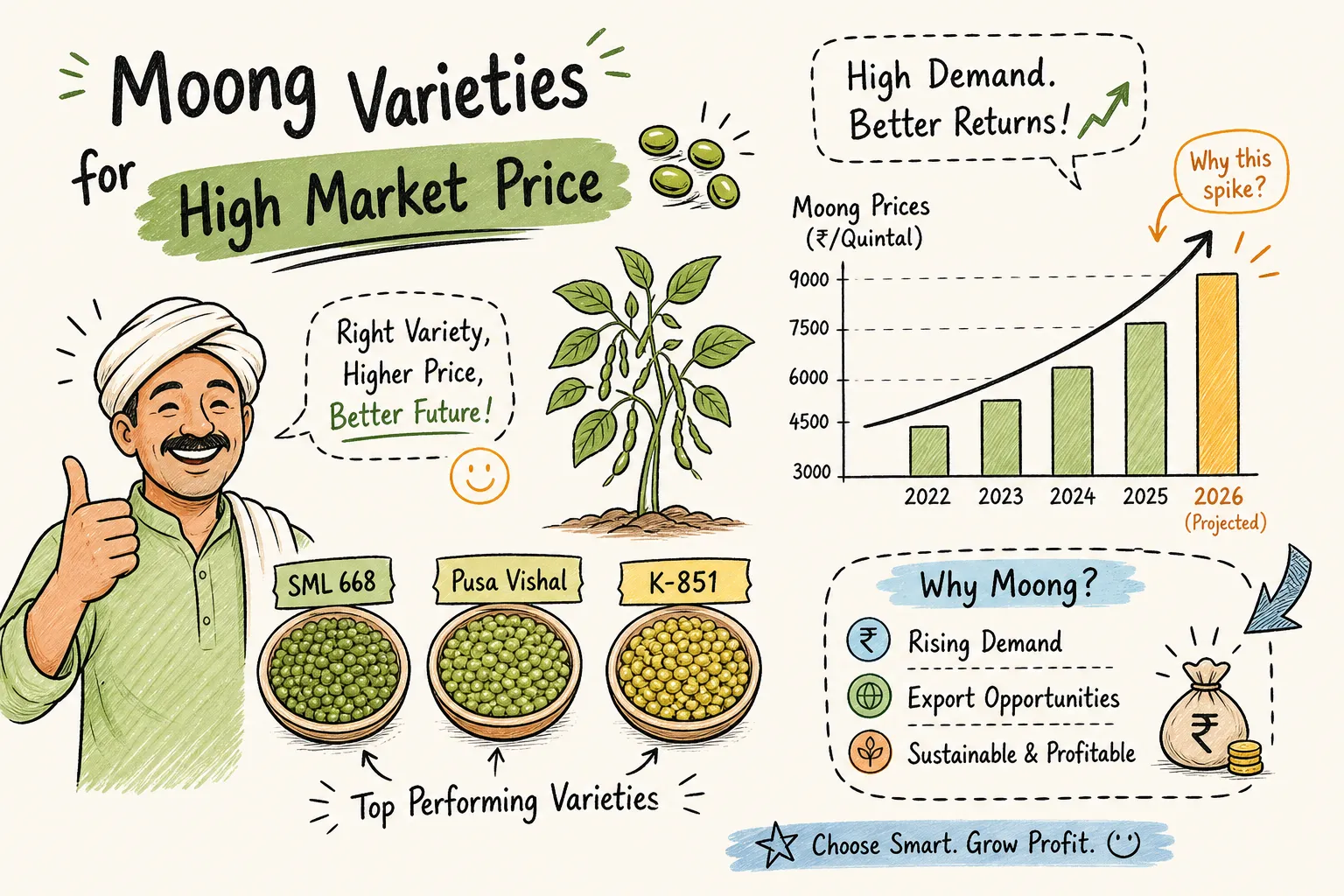
What is the best variety of moong to grow for high market price in India? It is a question that comes down to one decision made weeks before sowing, and the financial gap it creates is larger than most farmers realise. The 2026-27 MSP for moong is ₹8,780 per quintal, yet many Rajasthan farmers are walking away from the mandi with just ₹7,452 per quintal. That gap is not simply about timing or bargaining skill. A large part of it traces back to which variety you planted.
A wrong variety produces grain that lands in a lower mandi grade, attracts weaker bids, and fails export procurement checks. The right variety, harvested clean and timed well, can cross ₹9,000 per quintal. The difference between "local" grade moong and "bold chamki" grade moong at a North Indian APMC yard is often ₹1,000 to ₹2,000 per quintal on the same day, in the same shed. That is not a small number when you are bringing in 50 or 100 quintals.
This guide draws on varietal research from ICAR-IIPR and state agricultural universities, combined with live auction price patterns tracked daily at major APMC yards across Rajasthan and Haryana through KhetiKisaan's ground-level network. By the end, you will know which varieties to grow, why they fetch more, and what to do after harvest to actually realise that premium.
| MSP for moong | ₹8,780/quintal |
|---|---|
| Average Rajasthan farmgate realisation | ~₹8,452/quintal |
| Premium for bold, bright-green grain | ₹1,000, 2,000/quintal over standard lots |
| Virat Chamki documented premium | ~₹460/quintal over ordinary moong (Nagaur) |
| Top varieties for North India | NM-94, NM-2002, IPM-02-3 (Meha), SML 668, SML 832 |
 Table of Contents
- Why the variety you choose decides your mandi return
- Which is the best variety of moong to grow? NM-94, NM-2002, and IPM-02-3 compared
- Other high-value moong varieties worth knowing about
- What grain quality traits command a premium at the mandi
- Real-time mandi bhav for moong: what major APMC yards are showing
- Season and zone matching for North India
- Post-harvest steps that protect your price premium
- Where to source certified seed for these varieties
- The bottom line: three questions before you sow
- FAQs
Why the variety you choose decides your mandi return
The MSP vs actual realisation gap explained
Most kisaans assume the MSP is the minimum they will receive at the mandi. At North Indian APMC yards, the reality is different. If your moong arrives as a mixed-colour, small-seed lot with high moisture, the arhatiya (commission agent) categorises it as "local" or "medium" grade, not "bold" or "chamki" grade. Bidding starts lower and closes lower. The MSP becomes irrelevant unless government procurement is active in your mandi on that specific day.
Traders informally use three broad grades: local/ordinary, medium, and bold/chamki. The price spread between these grades runs roughly ₹800 to ₹2,000 per quintal. That entire range reflects grain quality, not market volatility.
How variety genetics drive mandi grade
Your variety's genetics directly control the traits that determine mandi grade: seed size, seed colour uniformity, seed-coat thickness (which affects dal recovery), and days to maturity (which affects whether grain is harvested at the right moisture). A variety with bold, bright-green, uniform seeds that dries below 10% moisture quickly will almost always land in a higher bid bracket. A variety prone to uneven maturity or poor seed fill under heat stress will produce grain that traders immediately sort into the lower pile. This is the core logic behind variety selection for profit, you are not just choosing a yield number on a brochure. You are choosing where your grain lands in the grading hierarchy on auction day.
Which is the best variety of moong to grow? NM-94, NM-2002, and IPM-02-3 compared
NM-94: the benchmark variety for North India
NM-94 is the standard reference variety for Rajasthan and Haryana moong cultivation and remains a preferred procurement variety for dal mills and government agencies. Its appeal to buyers rests on three clear attributes: grain uniformity, wide adaptability, and a dal recovery of 72%, the highest among the three main ICAR-IIPR varieties compared here. Its protein content of 24.5% is also the highest of the three.
NM-94 is suitable for both Kharif and Zaid seasons across North India's primary moong belt. Its main limitation is susceptibility to Mungbean Yellow Mosaic Virus (MYMV) in high-pressure areas, where it can suffer significant yield losses in a bad season. If your area has a history of MYMV, consider NM-2002 or IPM-02-3 instead, or confirm disease pressure with your local Krishi Vigyan Kendra before committing.
NM-2002: bold grain and better splitting efficiency
NM-2002 is valued by dal mills primarily for its bolder grain size, which improves splitting efficiency and produces more whole dal per quintal processed. Its published dal recovery is 70%, slightly below NM-94, but its bolder seed size reduces dehulling cost and produces a visually attractive, uniform dal that commands retail premiums. Its protein content stands at 24%.
Dal mills pay more for raw grain that delivers greater whole-dal yield with lower processing loss. NM-2002's bold seed and efficient splitting profile means mills can recover more saleable output per quintal of raw grain, and that extra willingness to pay comes directly back to you at the mandi. NM-2002 is recommended across Rajasthan and Haryana for both Kharif and Zaid, with a generally good adaptability profile. Its MYMV resistance is better than NM-94's, though not as strong as IPM-02-3's.
IPM-02-3 (Meha): MYMV resistance meets market demand
IPM-02-3, released by ICAR-IIPR and popularly known as Meha, is specifically valued for its resistance to MYMV. In areas where MYMV pressure is high, unprotected varieties can lose 30 to 70% of yield in a severe season. IPM-02-3 eliminates that risk and delivers consistent supply to the mandi, exactly what export procurement channels value: reliable volume of clean grain, season after season.
Its dal recovery is 68% and protein content 23.5%, both slightly lower than NM-94 and NM-2002. The consistency advantage, however, is significant. A farmer growing IPM-02-3 in a MYMV-prone area will bring a full crop to the mandi. A farmer growing NM-94 in the same area may arrive with 40% of expected volume in a bad year. Consistent supply builds a reputation with local traders and dal mill procurement agents. IPM-02-3 matures in approximately 60 days, which suits both Kharif and Zaid windows in North India.
Other high-value moong varieties worth knowing about
SML 668 and SML 832: the summer-season performers
These two Punjab Agricultural University (PAU) varieties dominate Zaid (spring-summer) cultivation in North India. SML 668 has a potential yield of 11.25 q/ha (roughly 4.56 q/acre), with field demonstrations recording up to 14.05 q/ha. SML 832 reaches 11.50 q/ha potential. Both mature in around 60 to 61 days, which fits the tight Zaid window between wheat harvest and monsoon arrival. They are tolerant to MYMV, and SML 832 also shows tolerance to thrips.
Must Read: Best Moong Varieties for High Yield in North India
The reason these varieties command strong mandi prices is not yield alone. Their short maturity allows clean harvesting at low moisture when Zaid supply is thin in the market. Moong harvested in May, June from a Zaid crop typically enters the mandi three to four months before the Kharif flood of arrivals. That seasonal timing alone supports better prices, often 10 to 15% above Kharif-season rates in an average year.
Virat Chamki: the documented premium variety
Among named varieties with a clear price record at mandis, Virat Chamki stands out. At Nagaur, it reached ₹8,960 per quintal versus ₹8,500 per quintal for ordinary moong in the same market: a premium of approximately ₹460 per quintal. The driver of this premium is visual, bold seeds with a characteristic sheen that traders and retail dal buyers immediately recognise as superior grade. That instant visual recognition bypasses the need for lab testing and moves the grain into the higher bid bracket from the moment the bag is opened.
Virat Chamki is well suited to Rajasthan and adjacent areas. It is worth noting that the premium it commands is partly varietal and partly about the cleanliness and uniformity of the lot presented. A Virat Chamki lot with mixed moisture or foreign matter will still lose that premium at auction.
What grain quality traits command a premium at the mandi
The five quality traits traders use to set the bid
Understanding how dal mills and traders evaluate grain is essential if you want to protect the premium your variety is capable of delivering. These five attributes determine which price bracket a lot enters at auction, listed from highest to lowest price impact:
- Dal recovery and breakage rate: The single largest price driver. A 10-percentage-point difference in recovery changes usable output by roughly 100 kg per tonne of raw grain.
- Moisture and cleanliness: Wet grain invites immediate discounts for drying cost, shrinkage, and storage risk. Foreign matter raises cleaning cost and reduces saleable output.
- Seed size and coat thickness: Bolder seeds with thinner coats reduce dehulling cost and produce more whole dal, less powder and husk.
- Colour and visual uniformity: Bright, uniform seed colour is the trader's first signal of variety, freshness, and storage condition. Dull, mixed-colour lots are immediately downgraded.
- Protein content: Relevant mainly in institutional and export procurement where buyers test for it. Ordinary spot markets generally price by physical quality rather than protein percentage.
Translating quality into rupees per quintal
If a dal mill sells processed moong dal at ₹100 per kg, a 10-percentage-point difference in dal recovery changes potential dal output by roughly 100 kg per tonne of raw grain. That alone justifies paying ₹8,000 to ₹10,000 more per tonne for a high-recovery lot, even after factoring in margins, by-product value, and processing costs. This is why NM-94, with 72% dal recovery, and NM-2002, with bolder grain that improves splitting efficiency, attract active sourcing interest from dal mill procurement agents. Grow either variety, present clean, well-dried, graded grain, and the economics work in your favour at every step of the price chain.
Real-time mandi bhav for moong: what major APMC yards are showing
Current price bands at North Indian mandis
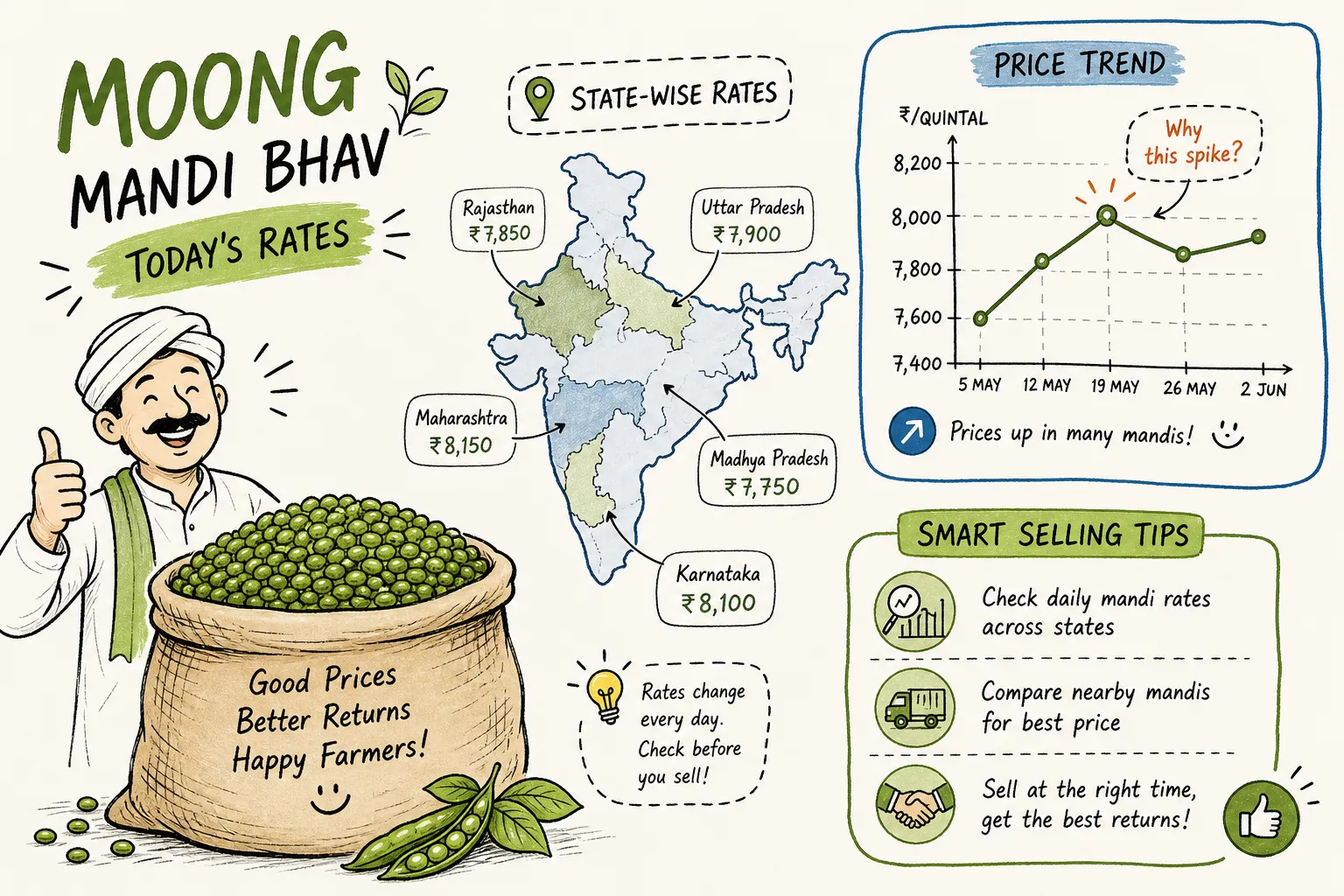
At Sri Ganganagar, moong auction rates ranged from ₹6,500 to ₹8,380 per quintal, with a modal rate around ₹8,082 per quintal for the day's arrivals of 382.5 tonnes. Nagaur has recorded bold and named-variety lots above ₹8,900 per quintal. The spread between an ordinary local-grade lot (₹7,800 to ₹8,200 per quintal) and a bold chamki-grade lot (₹8,500 to ₹9,000 per quintal) is visible at every major mandi on any given day.
Export procurement channels, particularly for dal-grade moong going to Bangladesh, the UAE, and the United States, tend to pay above MSP when grain meets quality specifications. India exported approximately 161,995 tonnes of green gram between April 2025 and January 2026, a near 870% increase year-on-year, at average FOB prices of US$1,050 to US$1,670 per tonne for standard grades, with premium protein grades reaching up to US$1,800 per tonne. That export demand flows through wholesale channels and supports stronger bidding at mandis supplying procurement agents. These figures move daily with arrivals, rupee-dollar rates, and international demand cycles.
How KhetiKisaan helps you check variety-wise prices before you sell
Unlike delayed government price feeds or averaged mandi data published days after the auction, KhetiKisaan maintains a network of on-ground contacts physically present during live bol-chaal (bidding) at APMC auction yards including Sri Ganganagar and Nohar. The rates you see on KhetiKisaan reflect actual transaction prices from that morning's auction, not estimates or government-feed averages from the previous week.
Before you load the trolley, check today's moong mandi bhav on KhetiKisaan. You can see the rate for bold moong, ordinary moong, and named-variety lots at multiple yards in Rajasthan and Haryana. That one check can tell you whether Sri Ganganagar or Nohar is paying better today, and whether prices are rising or softening. Closing the farmgate-to-MSP gap starts with knowing the live rate before you commit to a mandi, not after you arrive. Visit KhetiKisaan and check the latest moong bhav before your next haul.
Season and zone matching for North India
Zaid vs Kharif: which season produces better-priced moong?
Kharif moong arrives at mandis in September and October when market arrivals are at their peak and prices are typically softest. Supply floods the yards simultaneously from across the region, giving traders negotiating power. Zaid moong, harvested in May, June, enters the mandi when supply is lean and pre-Kharif demand from dal mills is building. That lean-supply window often supports 10 to 15% better mandi returns in an average year.
Zaid carries higher input risk: it requires reliable irrigation and short-duration heat-tolerant varieties such as SML 668, SML 832, or IPM-02-3. The trade-off is real but manageable. Farmers with access to canal or tube-well irrigation in Rajasthan, Haryana, and Punjab who grow SML 668 or SML 832 for Zaid are consistently reporting better net returns per acre than Kharif-only growers in many comparative studies. If irrigation is available, Zaid deserves serious consideration.
Zone-wise sowing window for Rajasthan, Haryana, and Punjab
| State/Zone | Kharif sowing | Zaid sowing | Recommended varieties |
|---|---|---|---|
| Rajasthan | June, July | Feb, March (complete by 15 April) | NM-94, NM-2002, IPM-02-3, RMG 268 |
| Haryana | June, July | Feb, March | NM-94, NM-2002, SML 668, SML 832 |
| Punjab | June, July | March, April | SML 668, SML 832, ML 1808, ML 2056 |
For NM-2002 specifically in Rajasthan, Kharif sowing should be completed between 15 June and 15 July with a seed rate of 12 to 15 kg/ha. Zaid sowing requires a higher seed rate of 25 to 30 kg/ha with rows at 30 cm spacing. Basal fertiliser dose of approximately 20 to 25 kg N plus 40 to 50 kg P₂O₅ per hectare applies for both seasons. Kharif moong under normal monsoon rainfall needs no irrigation unless there is a prolonged dry spell at flowering or pod fill. Zaid crop needs 3 to 4 irrigations every 10 to 12 days, stopping about 15 days before harvest.
Post-harvest steps that protect your price premium
Cleaning, drying, and grading before reaching the APMC yard
The premium your variety can command is erased quickly by poor post-harvest handling. Moisture above 10 to 11% at the time of sale invites immediate discounts and storage-damage claims by traders. Mixed-lot harvesting, combining batches of different maturity stages, produces uneven grain colour and size that pushes premium-variety grain into a medium-grade bracket at auction.
Three post-harvest steps are non-negotiable before transport to the mandi. First, field-dry the harvested crop until grain moisture is below 10%. Second, clean the lot thoroughly to remove husk, weed seeds, dust, and foreign matter using a winnowing fan or mechanical cleaner. Third, grade by size before bagging. A well-cleaned, uniformly graded lot of NM-2002 or Virat Chamki presented at auction looks visibly different from an average farm lot. Traders notice it before the bag is fully opened, and the opening bid reflects that.
Timing the sale using live mandi data
Holding clean, well-graded moong for 2 to 3 weeks when prices are rising can recover ₹300 to ₹500 per quintal. Holding too long risks moisture re-absorption, insect damage, and lost storage cost. The decision should not be a guess. Tracking daily arrivals and price movement at nearby mandis through KhetiKisaan gives you the data to choose the right sell window rather than rushing to the mandi immediately after harvest, exactly when arrivals from other farms are also peaking and prices are at their softest point of the season.
Where to source certified seed for these varieties
Government and private seed channels for North India
Certified seed for NM-94, NM-2002, and IPM-02-3 is available through state seed corporations, Krishi Vigyan Kendras, and district agriculture department depots across Rajasthan and Haryana. National Seeds Corporation (NSC) also stocks several publicly released ICAR-IIPR varieties. For SML 668 and SML 832, Punjab Agricultural University-authorised dealers are the primary and most reliable source. Nationally, Kharif certified seed availability was healthy at 193.24 lakh quintals available versus 173.26 lakh quintals required, but district-level shortages for specific preferred varieties remain a recurring problem.
If NM-94 or NM-2002 is not showing up in state corporation online listings for your district, contact your local agriculture department office directly. Stock listings at the state level do not always reflect what is physically present at district depots. Alternatively, ICAR-IIPR's own seed distribution wing and authorised multiplier farmers can be a direct source for IPM-02-3 in Rajasthan.
Cost estimates and avoiding counterfeit seed
Indicative cost for certified pulse seed runs approximately ₹1,200 to ₹3,500 per acre before subsidy, depending on variety and source. Subsidy under various state and central schemes commonly covers around 50 to 60% of seed cost for pulse crops, but this requires purchase from an approved, listed dealer.
Before purchase, verify the blue certification tag, lot number, germination percentage printed on the tag, validity date, packing seal, and invoice. Do not buy unlabelled or loose seed promoted as a premium variety through informal channels, particularly for IPM-02-3, which is frequently sold in counterfeit form in parts of Rajasthan. Book seed 4 to 6 weeks before your target sowing window. For ICAR-IIPR materials like IPM-02-3 and SML 668, early booking is essential because stock-outs at the district level are common once the sowing window opens and demand spikes.
The bottom line: three questions before you sow
Every farmer making a moong variety decision should answer three questions first. Which zone am I in and what varieties are recommended for it? Which season am I targeting, Kharif or Zaid? And what is the mandi currently paying for bold versus ordinary moong in my area?
The answers point directly to the right choice. NM-2002 for dal recovery premium where MYMV pressure is low. IPM-02-3 for disease-safe, consistent yield and reliable supply to the mandi in MYMV-prone areas. SML 668 or SML 832 for a Zaid crop that reaches the mandi during a lean-supply window. Virat Chamki where bold visual appeal drives the bid in your specific market.
If you are still asking what is the best variety of moong to grow for high market price in India, the honest answer is: it depends on your zone, your season, and your mandi. Variety selection is only half the decision. Knowing the live mandi bhav at Sri Ganganagar or Nohar before you load the trolley is what converts a good variety choice into actual profit per quintal. Check KhetiKisaan for today's moong mandi bhav, compare yards, and sell when the data tells you to, not when the harvest pressure forces you to.